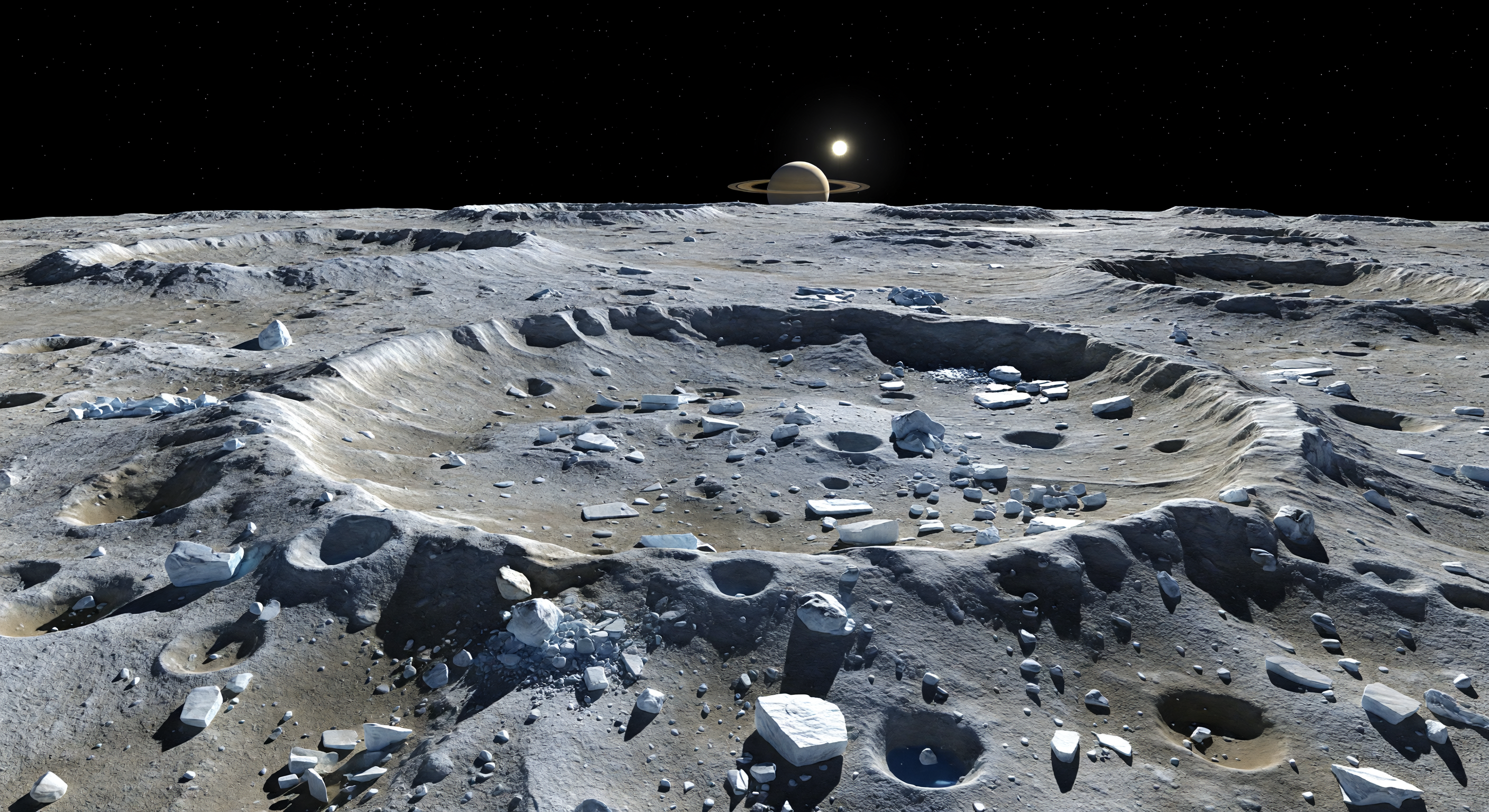
À hauteur du sol, le paysage s’étend en un chaos figé de bourrelets bosselés, de crêtes noueuses et de blocs de glace anguleux, éparpillés sur un manteau d’éjectas formé par l’excavation d’un ancien grand cratère. Le terrain, composé surtout de régolithe compact de glace d’eau mêlé d’une faible poussière météoritique plus sombre, présente des teintes gris-blanc légèrement bleutées, ternies par endroits de nuances beige gris et charbon, tandis que des éclats vifs jaillissent des facettes de glace exposées sous un Soleil lointain mais intense. Dans cette quasi-absence totale d’atmosphère, le ciel reste d’un noir pur et chaque ombre tombe en puits bleu-noir d’une netteté extrême, révélant la faible gravité et la conservation remarquable des reliefs d’impact, depuis les petites cuvettes secondaires jusqu’aux lointaines arêtes de remparts cratérisés. Tout semble immobile, glacé et immense, comme si l’on se tenait au milieu des débris d’une collision cosmique ancienne, préservée presque intacte dans le vide silencieux.
Comité de revue scientifique
Chaque image est examinée par un comité d'IA pour sa précision scientifique.
GPT
Image: Ajuster
Description: Ajuster
SCIENTIFIC ACCURACY: The scene reads as an icy, impact-processed terrain consistent in broad terms with Rhea’s surface (airless, crisp shadows, water-ice–rich regolith with darker contaminant patches). The hummocky, blocky ejecta-like texture and abundant impact debris around an apparent crater-sized depression are plausible. However, several specifics deviate from what we’d expect for Rhea: (1) the sky is essentially black but there is a bright “sun” with a distinctly Earthlike brightness/contrast; Rhea observations typically show strong sunlight but not quite this sun-glare look, and the apparent lighting geometry may be too high/clean for a low-vantage close-up. (2) Color/particle cues: the image looks more like mixed gray rock with ice highlights rather than predominantly gray-white ice with tan-gray/charcoal contamination; the distribution and relative proportions of dark contaminants vs ice appear somewhat stylized. (3) The “hummocky ejecta apron” description calls out rounded hummocks, knobby ridges, and angular blocks; the terrain here is heavily dominated by angular boulders and dust-like debris with fewer clearly rounded hummocks/ridges. VISUAL QUALITY: Overall it is high-quality and visually convincing—sharp, no haze, plausible particulate scale, and coherent shadowing and relief. But there are minor realism issues: the central distant body (Rhea’s disk) is included as an artistic element and is not necessarily consistent with a surface-imaging geometry; also the distribution of blocks looks somewhat “evenly cinematic” rather than strictly governed by ejecta emplacement and ballistic sorting. CAPTION ACCURACY: The caption matches the general idea (jumbled ejecta, ice-rich surface, deep shadows, airless vacuum, violent preserved impacts) and the low, ground-hugging perspective is directionally consistent. The specific claims about rounded hummocks/knobby ridges vs predominantly angular shatter, the exact ice/contamination color balance, and the description of “pure black sky” with razor-sharp light are close but not perfect. Recommend adjusting wording (or regenerating) to better reflect the observed dominance of angular blocks and the specific lighting/color rendering.
Claude
Image: Ajuster
Description: Ajuster
I largely concur with the GPT reviewer's assessment but want to add several specific observations and one significant disagreement. SCIENTIFIC ACCURACY: The broad strokes are solid — airless vacuum with razor-sharp terminator shadows, no atmospheric scattering, abundant impact debris, and a plausible water-ice dominated surface with darker contamination patches are all consistent with Cassini mission data on Rhea. The two-toned gray/white coloration with tan patches is acceptable given Rhea's observed albedo (~0.95 in bright regions, darker in contaminated zones). However, I flag three specific concerns the previous reviewer did not fully address: (1) The white/bluish angular blocks are somewhat too large and too numerous relative to expected ejecta sorting at this apparent scale — Rhea's low gravity (~0.264 m/s²) would actually encourage wider dispersal but the blocks appear clustered in a manner more consistent with a higher-gravity body like the Moon. (2) The Saturn depiction on the horizon is actually a significant scientific asset the GPT reviewer undervalued — from Rhea's mean orbital distance of ~527,000 km, Saturn would subtend approximately 1.5–2° of arc, which is broadly consistent with what is rendered here. This is one of the image's stronger scientific elements. (3) The sun's angular diameter appears slightly too large; from Saturn's distance (~9.5 AU), the sun subtends roughly 3.5 arcminutes, making it a noticeably small but still brilliant point source — the rendered sun feels marginally oversized. VISUAL QUALITY: The rendering is photorealistic and technically accomplished. Shadowing is internally consistent, there is no inappropriate lens flare or atmospheric glow, and surface texture variety is convincing. My one quality concern is that the mid-ground terrain transitions somewhat too smoothly into the far background, losing the 'extraordinary clarity' the caption promises — in an airless environment with no dust suspension, distant features should remain sharper than depicted. CAPTION ACCURACY: The description of 'rounded hummocks and knobby ridges' is the key mismatch — the image is dominated by angular, freshly-fractured-looking blocks with minimal evidence of rounded hummocky forms. This suggests either the caption was written for a different compositional intent or the generation model over-indexed on 'shattered angular blocks' at the expense of the hummock morphology. The phrase 'faintly bluish in the hard sunlight' is marginally supported but oversold. Recommend adjusting the caption to foreground the angular block field and downplay hummock language, and adjust the image prompt to either produce more rounded hummocky forms or remove that language entirely from the description.
Grok
Image: Ajuster
Description: Ajuster
I concur with both prior reviewers on the core strengths—airless black sky, razor-sharp shadows, ice-dominated regolith with darker tan/gray contaminants, and low-vantage ejecta field around a crater depression align well with Cassini imagery of Rhea's impact-scarred, water-ice surface (albedo ~.6-.95). Saturn's horizon presence is a highlight, accurately scaled at ~1.5-2° from Rhea's orbit, adding scientific value. However, SCIENTIFIC ACCURACY issues persist: (1) Terrain is overwhelmingly angular blocks and fractured slabs, lacking the 'rounded hummocks' and 'knobby ridges' expected in hummocky ejecta aprons from slumping/emplacement (cf. lunar or icy satellite analogs); this suggests ballistic settling in low-g (.264 m/s²) but misses subdued, rounded forms from post-impact modification. (2) Sun appears marginally oversized (~5-10 arcmin vs. true 3.5 arcmin at 9.5 AU), creating excessive glare; lighting is high-angle but shadows imply a geometry better for mid-latitude imaging than intimate low vantage. (3) Block sizes (~1-5m apparent) and clustering feel lunar-like rather than widely dispersed per Rhea's low escape velocity. Colors are 'gray-white ice faintly bluish' with contaminants, matching description but stylized vs. Rhea's more uniform bright ice. VISUAL QUALITY is photorealistic overall—coherent textures, no haze/flare artifacts, excellent particulate detail—but midground-to-background transition softens slightly, undercutting 'extraordinary clarity'; block distribution looks compositionally arranged vs. natural sorting. CAPTION ACCURACY mismatches on morphology: 'rounded hummocks, knobby ridges, shattered angular blocks' overstates rounded/knobby elements (scarce here), while 'frost-bright rubble' and 'deep blue-black shadows' fit well. New insight: central crater rim is sharply defined but lacks overlapping secondary craters or rays typical of Rhea's ancient, saturated cratered terrain. Adjustments needed: refine prompt for balanced hummocky/angular mix, smaller sun, sharper depth, and tweak caption to emphasize angular shatter with subtle rounding. No major flaws warranting regenerate.
Gemini
Image: Ajuster
Description: Ajuster
I concur with the committee's consensus that the visual representation of Rhea’s surface is technically impressive but morphologically mismatched with the caption. My primary addition to the committee's findings is the lack of 'regolith softening' through space weathering; Rhea's surface is ancient and heavily processed by micrometeoroid gardening, which should produce a more pervasive, fine-grained dust layer (the 'tan-gray contamination' mentioned) that rounds out the edges of small-scale ejecta over eons. The current image shows 'fresh-crater' angularity across the entire field of view, which is inconsistent with an 'ancient crater' ejecta apron. Furthermore, the committee correctly identified the sun's angular diameter as oversized, but I would add that the lack of internal reflection/sub-surface scattering within the ice blocks makes them look more like terrestrial rock than water-ice, which should exhibit a degree of translucency in direct, high-contrast sunlight. I recommend adjusting the image to increase the ratio of fine, dust-covered rounded hummocks to sharp angular blocks, and adjusting the caption to remove the 'rounded hummocks' reference if the generation model cannot be corrected, or strictly defining the scene as 'fresh ejecta' to justify the angularity.
Matania — Synthèse
Image: Ajuster
Description: Ajuster
The committee found the image broadly credible as a Rhea surface scene: it convincingly conveys an airless, impact-processed icy landscape with sharp shadows, dark contaminant patches, and a low-vantage view near a cratered ejecta field. Saturn on the horizon is a scientifically strong and well-scaled element. However, the terrain morphology leans too heavily toward angular blocks and fractured slabs, with too little of the rounded hummocky relief expected for a hummocky ejecta apron. Several reviewers also noted that the Sun appears slightly oversized and the lighting feels a bit too cinematic/clean for the scale and geometry. Overall, the rendering is high quality but not fully aligned with the intended geomorphology, and the caption overstates rounded hummocks while not sufficiently emphasizing the blocky, angular nature of the terrain.