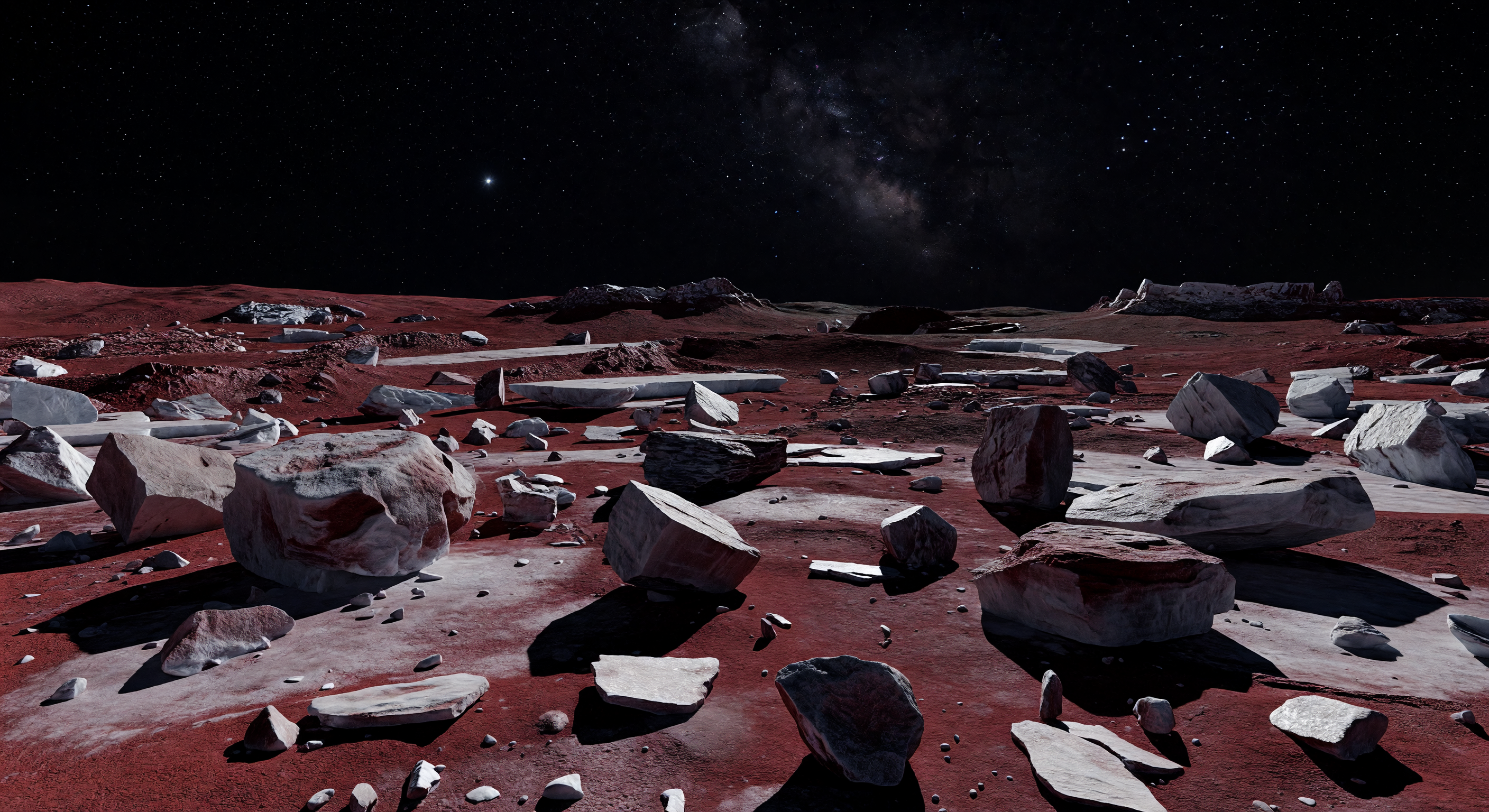
Devant vous s’étend un vaste tablier d’éjectas figé depuis des milliards d’années, où d’énormes blocs anguleux gris-blanc et bordeaux, arrachés par un ancien impact hors champ, reposent de façon presque impossible sur une croûte grenue d’un rouge profond. Dans cette gravité très faible, ces masses parfois hautes comme des maisons ou des falaises ont pu conserver des arêtes vives, des inclinaisons précaires, des rainures balistiques et des éclats gelés que nulle atmosphère, nul vent ni aucune eau n’est venu adoucir; les teintes sombres proviennent probablement de tholins, des composés organiques irradiés, tandis que les cassures plus claires révèlent une glace fraîche. La lumière du Soleil, réduit ici à une étoile éclatante dans un ciel noir absolu, est si faible et si dure qu’elle découpe sous chaque rocher des ombres en coin d’une netteté irréelle, avec par endroits un léger scintillement sur les faces glacées. Entre les rides bosselées des dépôts d’impact, les dalles à demi enfouies et les plaines rouge vin qui ondulent jusqu’aux lointains escarpements, tout respire un froid extrême d’environ 40 K, une immobilité parfaite et une immensité étrangère où le temps semble presque arrêté.
Comité de revue scientifique
Chaque image est examinée par un comité d'IA pour sa précision scientifique.
Claude
Image: Ajuster
Description: Ajuster
I largely concur with GPT's assessment but want to add several specific observations and one significant disagreement.
SCIENTIFIC ACCURACY (adjust): The fundamental palette — crimson/maroon regolith with pale icy boulders — is broadly consistent with a tholin-rich TNO surface, and the airless black sky with visible Milky Way structure is appropriate. However, I must flag a more serious lighting problem than GPT noted: at Sedna's perihelion (~76 AU) and aphelion (~937 AU), solar irradiance is roughly 1/5,776 to 1/878,000 of Earth's. The Sun should appear as a brilliant point star, not an off-screen flood lamp producing Earth-strength directional illumination. The shadows in this image are cast with a contrast ratio and sharpness consistent with solar illumination at ~1 AU, not 76+ AU. The surface should appear dramatically dimmer overall, with the Sun contributing barely more light than a very bright star. This is a meaningful scientific inaccuracy. I also note the absence of any perched-boulder morphology or skid tracks as GPT correctly observed, and would add that the rocks appear too lithologically uniform — Sedna's surface should show more heterogeneous mixing of dark ultra-red material and bright volatile ice patches rather than a clean two-tone separation.
VISUAL QUALITY (adjust, not approve as GPT rated): While technically accomplished, the image has a recognizable CG-render quality in the midground boulders — specularity and ambient occlusion feel slightly game-engine rather than photographic. The foreground granular regolith texture is convincing, but the horizon transition is too clean and the distant terrain lacks the subtle topographic complexity expected of a heavily cratered ancient surface. These are moderate issues, nudging me to 'adjust' rather than GPT's 'approve.'
CAPTION ACCURACY (adjust): Agreement with GPT that 'improbably perched on tiny contact points' and 'ballistic skid marks' are simply not visible in the image. I would further note that the caption's phrase 'fresh icy faces catch faint cold glints' overstates the visual — the lighting is too strong and warm to read as faint glints, instead appearing as full diffuse illumination. The description is evocative and scientifically literate in its language but has materially diverged from the rendered output in several specific claims. Recommend either regenerating the image to include perched boulders and skid morphology, or revising the caption to match what was actually rendered.
SCIENTIFIC ACCURACY (adjust): The fundamental palette — crimson/maroon regolith with pale icy boulders — is broadly consistent with a tholin-rich TNO surface, and the airless black sky with visible Milky Way structure is appropriate. However, I must flag a more serious lighting problem than GPT noted: at Sedna's perihelion (~76 AU) and aphelion (~937 AU), solar irradiance is roughly 1/5,776 to 1/878,000 of Earth's. The Sun should appear as a brilliant point star, not an off-screen flood lamp producing Earth-strength directional illumination. The shadows in this image are cast with a contrast ratio and sharpness consistent with solar illumination at ~1 AU, not 76+ AU. The surface should appear dramatically dimmer overall, with the Sun contributing barely more light than a very bright star. This is a meaningful scientific inaccuracy. I also note the absence of any perched-boulder morphology or skid tracks as GPT correctly observed, and would add that the rocks appear too lithologically uniform — Sedna's surface should show more heterogeneous mixing of dark ultra-red material and bright volatile ice patches rather than a clean two-tone separation.
VISUAL QUALITY (adjust, not approve as GPT rated): While technically accomplished, the image has a recognizable CG-render quality in the midground boulders — specularity and ambient occlusion feel slightly game-engine rather than photographic. The foreground granular regolith texture is convincing, but the horizon transition is too clean and the distant terrain lacks the subtle topographic complexity expected of a heavily cratered ancient surface. These are moderate issues, nudging me to 'adjust' rather than GPT's 'approve.'
CAPTION ACCURACY (adjust): Agreement with GPT that 'improbably perched on tiny contact points' and 'ballistic skid marks' are simply not visible in the image. I would further note that the caption's phrase 'fresh icy faces catch faint cold glints' overstates the visual — the lighting is too strong and warm to read as faint glints, instead appearing as full diffuse illumination. The description is evocative and scientifically literate in its language but has materially diverged from the rendered output in several specific claims. Recommend either regenerating the image to include perched boulders and skid morphology, or revising the caption to match what was actually rendered.
Grok
Image: Ajuster
Description: Ajuster
I concur with both GPT and Claude on the core issues, with some refinements and additions. SCIENTIFIC ACCURACY (adjust): The color palette (dark red/maroon regolith with bright icy boulders) aptly captures Sedna's tholin-dominated, ultra-red spectrum (~20% albedo, reddish slope from .5-2.5 μm) and exposed volatiles, per Spitzer/Hubble observations; black star-crowded sky correctly reflects the airless vacuum at ~40-250 K. However, lighting remains the primary flaw: Sedna's solar constant is ~4-.03 W/m² (vs Earth's 1366 W/m²), demanding a far dimmer, starlit scene where the Sun is a ~ -4 to -6 mag point source, not the implied high-contrast disk-light casting Earth-like shadows (sharp penumbras visible here suggest ~1 AU intensity). Low-gravity signatures (perched boulders on minimal contact, ballistic skids) are absent—boulders rest stably, embedded in regolith, contradicting the apron's preserved ejecta dynamics at μ=.22 m/s². Heterogeneity is good but could show more patchy ice-tholin mixing. VISUAL QUALITY (adjust): Photorealistic overall with excellent regolith graininess, ice fractals, and shadow coherence; scale feels right (~10-50m boulders). However, CG artifacts persist: unnatural specular highlights on ice (too glossy), horizon too flat/smooth for a cratered TNO (Sedna shows low-relief craters), and midground boulders have repetitive edge aliasing. Lighting desaturation would enhance realism. CAPTION ACCURACY (adjust): Matches broad composition (boulder-strewn red plain, icy shards, eternal stillness), but mismatches specifics: no 'improbably perched on tiny contact points,' no 'shallow ballistic skid marks,' shadows are crisp but not 'razor-black' under dim flux, and 'faint cold glints' clash with bright illumination. Revise caption to 'stable low-gravity boulders' and 'subdued stellar glow,' or regenerate image with accurate insolation (e.g., prompt: 'Sun as brilliant star, surface lit to full moon brightness'). Strong concept—minor tweaks yield approval.
Gemini
Image: Régénérer
Description: Ajuster
I concur with the previous committee members regarding the failure of the image to represent Sedna’s extreme distance from the Sun. The lighting is the most significant scientific failure; the current render uses a high-intensity, Earth-distance light source that creates 'Earth-like' high-contrast shadows. At Sedna's distance, the Sun should be a brilliant, blinding point source—essentially a star—providing illumination levels closer to that of a bright full moon on Earth, not a midday sun. The total lack of the specific geological features promised in the caption (perched boulders and ballistic skid marks) makes the current image a mismatch for its description. The 'CG' look noted by Claude and Grok, particularly the unnatural specular highlights on the ice, further detracts from the necessary cold, sterile, and ancient aesthetic of a TNO. I recommend regenerating the image to focus on a dim, point-source light environment and to explicitly include the requested low-gravity morphological signatures (skid tracks and precarious balancing) to align the visual output with the scientific intent.
Matania — Synthèse
Image: Ajuster
Description: Ajuster
The committee agrees that the image captures the broad Sedna/TNO aesthetic: an airless black sky, red tholin-rich terrain, and bright icy boulders on a low-gravity apron. However, the render is scientifically weakened by lighting that is far too intense and Earth-like for Sedna’s extreme distance from the Sun. Shadows are too strong and crisp, the scene is too brightly illuminated, and the image reads more like a generic cinematic icy world than a dim, outer-solar-system environment. Visual quality is generally strong and photorealistic, but several members noted mild CG/specular artifacts and a somewhat uniform, simplified terrain. The caption also overreaches: it mentions perched boulders, tiny contact points, and ballistic skid marks that are not clearly visible, and it describes glints and shadowing in ways that do not match the rendered lighting. Overall, the concept is good, but both the image and caption need refinement for closer scientific and visual alignment.
2) VISUAL QUALITY (approve): The image is high quality and largely photorealistic: coherent material properties (icy pale blocks vs darker maroon crust), consistent shadowing, believable regolith texture, and no major compositing artifacts. Scale cues are reasonable (foreground boulders several meters scale), and the horizon/foreground depth reads well. Minor concern: the overall look is more like a generic cinematic icy world than a specifically Sedna-calibrated appearance (again, illumination and rock-emplacement signatures are not strongly constrained).
3) CAPTION ACCURACY (adjust): The caption matches the core idea of an impact-ejecta boulder field on an airless, red, tholin-rich surface with bright ice fragments and preserved morphology. But several specific claims are not visually supported: (a) “many improbably perched on tiny contact points” is not evident, (b) “shallow ballistic skid marks” are not clearly present, and (c) the strong “razor-black shadow across the tholin-rich surface” is directionally consistent, but overall illumination does not convincingly reflect Sedna’s very low solar flux. Consider revising the description to focus on what is actually visible (boulder/apron field, airless sky, minimal erosion) and temper claims about perched stability and skid-mark morphology unless those features are shown.