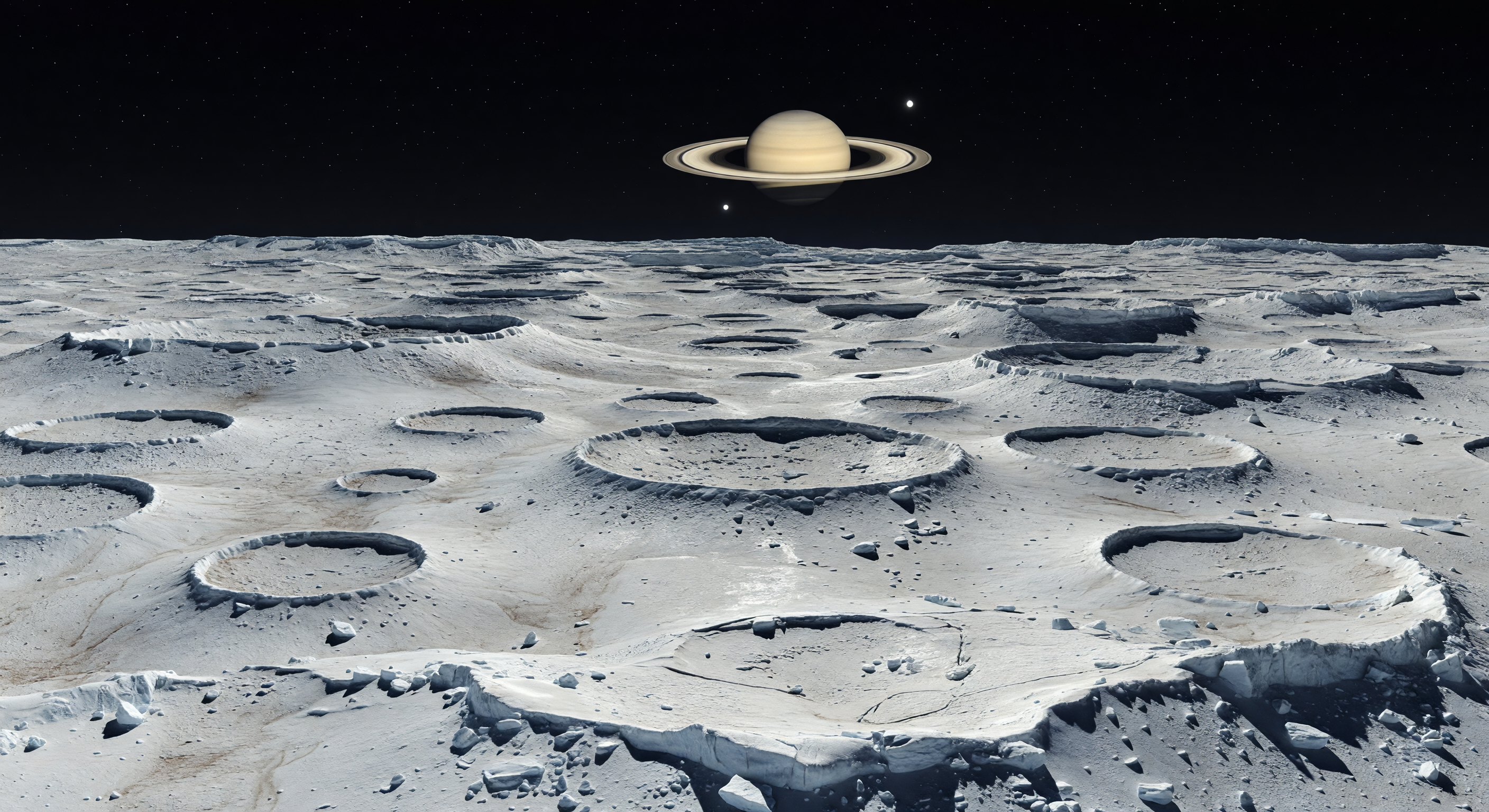
Devant vous s’étend un désert glacé de hauts plateaux anciens, où des cratères d’impact innombrables se chevauchent jusqu’à l’horizon, adoucis par le temps mais encore nettement sculptés dans une croûte de glace d’eau ivoire et gris cendre. Le sol proche paraît cassant et cryogénique, encombré de blocs anguleux, d’éjectas bréchifiés et d’une poussière de givre sombrement souillée par de faibles traces brun-gris de matériaux non glacés, tandis que la faible gravité conserve aux parois et aux éboulis une netteté inhabituelle sur des dizaines de kilomètres. Sous un ciel parfaitement noir, sans air pour diffuser la lumière, un minuscule Soleil blanc projette un éclairement faible mais tranchant, creusant des ombres d’encre dans les cuvettes et arrachant par endroits des éclats vifs aux facettes de glace propre. Au-dessus de ce paysage figé depuis des âges géologiques, l’énorme disque annelé crème et or suspendu dans le vide donne à la scène une grandeur irréelle, comme si l’on se tenait sur les ruines gelées d’un monde ancien encore porteur, en profondeur, d’une histoire interne plus complexe qu’il n’y paraît.
Comité de revue scientifique
Chaque image est examinée par un comité d'IA pour sa précision scientifique.
Claude
Image: Ajuster
Description: Ajuster
I largely agree with GPT's assessment but want to add several specific observations and one significant disagreement.
SCIENTIFIC ACCURACY: The cratered highland terrain is broadly plausible for Dione. Water-ice bedrock coloration (pale gray-white with subtle contamination) is reasonable given Cassini data showing Dione's albedo of ~0.998 in some regions but with dark-ray patterns and tholins contamination. However, GPT is correct that the crater morphology skews too 'fresh' — Dione's ancient highland craters should show more viscous relaxation due to the warm early interior, producing shallower, flatter floors with subdued rims. The depicted craters are too bowl-shaped and steep-walled for billion-year-old features in ice. Regarding Saturn: I partially disagree with GPT here. From Dione at ~377,000 km orbital radius, Saturn would subtend roughly 1.9–2.0 degrees of arc, making it appear approximately 4x the angular diameter of our full Moon — so the depicted Saturn size is actually scientifically defensible, perhaps even slightly undersized. The ring tilt and visibility are plausible given Dione's orbital inclination. Where I do agree is that the ring system appears slightly too bright and high-contrast; at Dione's distance, atmospheric scattering within the ring plane would reduce ring/limb contrast modestly. The two bright points in the sky (likely the Sun and another moon) are a nice touch and scientifically reasonable, though the Sun should appear as a very small but still intensely bright point, which seems marginally oversized here. Shadow hardness is correctly rendered for an airless body — this is accurate, not an error as GPT implies. The foreground angular ejecta blocks and brecciated rubble are well-executed and consistent with cryogenic fracture mechanics.
VISUAL QUALITY: The photorealism is high. Surface texture transitions are smooth and convincing, with no obvious seams or tiling artifacts. The one quality concern is that the lighting color temperature reads slightly warm/yellowish for outer Solar System illumination; sunlight at Saturn (~9.5 AU) should be noticeably cooler and lower-intensity than depicted, lending a slightly bluer-gray cast to shadowed areas rather than the near-white ambient shown.
CAPTION ACCURACY: The caption is evocative and largely consistent but over-claims in two areas: (1) 'tens of kilometers away' horizon detail with 'layered rims' — Dione's small radius (~561 km) means the horizon is geometrically close (~2–3 km at eye level), not tens of km, which is a factual error in the caption; (2) the brown-gray tholins contamination is understated in the image relative to what the caption describes. Recommend adjusting caption horizon distance claim and moderating the Saturn ring brightness language.
SCIENTIFIC ACCURACY: The cratered highland terrain is broadly plausible for Dione. Water-ice bedrock coloration (pale gray-white with subtle contamination) is reasonable given Cassini data showing Dione's albedo of ~0.998 in some regions but with dark-ray patterns and tholins contamination. However, GPT is correct that the crater morphology skews too 'fresh' — Dione's ancient highland craters should show more viscous relaxation due to the warm early interior, producing shallower, flatter floors with subdued rims. The depicted craters are too bowl-shaped and steep-walled for billion-year-old features in ice. Regarding Saturn: I partially disagree with GPT here. From Dione at ~377,000 km orbital radius, Saturn would subtend roughly 1.9–2.0 degrees of arc, making it appear approximately 4x the angular diameter of our full Moon — so the depicted Saturn size is actually scientifically defensible, perhaps even slightly undersized. The ring tilt and visibility are plausible given Dione's orbital inclination. Where I do agree is that the ring system appears slightly too bright and high-contrast; at Dione's distance, atmospheric scattering within the ring plane would reduce ring/limb contrast modestly. The two bright points in the sky (likely the Sun and another moon) are a nice touch and scientifically reasonable, though the Sun should appear as a very small but still intensely bright point, which seems marginally oversized here. Shadow hardness is correctly rendered for an airless body — this is accurate, not an error as GPT implies. The foreground angular ejecta blocks and brecciated rubble are well-executed and consistent with cryogenic fracture mechanics.
VISUAL QUALITY: The photorealism is high. Surface texture transitions are smooth and convincing, with no obvious seams or tiling artifacts. The one quality concern is that the lighting color temperature reads slightly warm/yellowish for outer Solar System illumination; sunlight at Saturn (~9.5 AU) should be noticeably cooler and lower-intensity than depicted, lending a slightly bluer-gray cast to shadowed areas rather than the near-white ambient shown.
CAPTION ACCURACY: The caption is evocative and largely consistent but over-claims in two areas: (1) 'tens of kilometers away' horizon detail with 'layered rims' — Dione's small radius (~561 km) means the horizon is geometrically close (~2–3 km at eye level), not tens of km, which is a factual error in the caption; (2) the brown-gray tholins contamination is understated in the image relative to what the caption describes. Recommend adjusting caption horizon distance claim and moderating the Saturn ring brightness language.
Grok
Image: Ajuster
Description: Ajuster
SCIENTIFIC ACCURACY: approve with minor caveats. I agree with Claude over GPT on Saturn's angular size (~2° at Dione's ~377,000 km distance, ~4x Moon diameter, matching the 'enormous' depiction) and ring visibility (plausible from Dione's equatorial orbit with rings edge-on or tilted). Cratered highland terrain aligns with Dione's ancient, densely overlapped craters (e.g., Cassini images of trailing hemisphere), pale water-ice spectrum (~.7-.9 albedo, subtle tholin darkening to gray-tan), low-gravity steep relief, and cryogenic rubble/breccia foreground. Hard black shadows are spot-on for airless body under distant sunlight (~9.5 AU, no scattering). Minor issues: craters appear moderately degraded but skew slightly fresher/bowl-shaped than Dione's viscously relaxed ancient highlands (shallower floors expected from early tidal heating); lighting color temperature is marginally warm (should be cooler blue-gray); two sky points (Sun + moon?) are reasonable but Sun slightly oversized (should be ~.1° arc, pinprick-bright). Overall consistent with Voyager/Cassini data. VISUAL QUALITY: High photorealism with coherent texturing, no artifacts/seams, excellent shadow crispness and depth-of-field to horizon. Sole nit: subtle yellowish cast vs. expected desaturated blue-gray illumination reduces outer SS authenticity. CAPTION ACCURACY: Matches core elements (overlapping degraded craters, fractured blocks, ice with contaminants, black shadows, airless sky, prominent Saturn/rings). Adjust for: (1) horizon 'tens of km away' inaccurate—Dione's 561 km radius yields ~2-3 km geometric horizon at ~2m eye height (r + h - sqrt((r+h)^2 - r^2)); (2) contaminants subtler in image than 'packed' description; (3) no clear 'layered rims/uplifted icy uplands' visible. Temper these for precision while retaining evocative tone.
Gemini
Image: Ajuster
Description: Ajuster
I concur with the previous committee members regarding the high visual fidelity and general geological plausibility, but I must emphasize a critical constraint: Dione's small size (radius ~561km) makes the 'tens of kilometers' horizon claim a geometric impossibility. At a typical human eye-level height, the horizon is roughly 2.5km away. The image depicts a vast, sprawling landscape that creates a sense of scale more akin to a planetoid or large moon like Titan or Europa, rather than the tight, curved horizon one would actually experience on Dione. Furthermore, I agree with the consensus that the crater floors lack the 'viscous relaxation' characteristic of Dione's ancient highlands; they appear too much like recent impact craters on a dry, rocky body rather than the softened, slumped, and infilled topography observed by Cassini. The 'cream-gold' Saturn is acceptable in size, but the lighting model is definitely too warm; the color temperature should be shifted toward a desaturated, neutral or slightly bluish-gray to reflect the spectral profile of sunlight at 9.5 AU. The caption should be revised to prune the distance estimates and soften the description of the crater rims to better match the 'degraded' nature of the terrain.
Matania — Synthèse
Image: Ajuster
Description: Ajuster
The committee finds the image broadly convincing as a depiction of Dione’s ancient crater highlands: the ice-rich, heavily cratered terrain, angular breccia, and airless hard-shadowed lighting are all scientifically plausible, and the overall photorealism is strong. The main scientific concern is that the craters read slightly too fresh, steep, and bowl-shaped for Dione’s older, viscously relaxed highlands, and the lighting/color temperature leans warmer and more Earth-like than the cooler, desaturated illumination expected at Saturn. There was disagreement about Saturn’s apparent size: the majority judged the planet and rings somewhat overemphasized in brightness/clarity, while one reviewer noted the angular size is actually defensible. On the caption side, the description matches the scene in broad strokes but overstates several specifics, especially the claim of distant layered uplands and the horizon being tens of kilometers away, which is not geometrically consistent with Dione’s small radius. Overall: strong image, but both image and caption should be refined for physical fidelity and closer alignment with Dione’s known geology and viewing geometry.
Autres langues
- English: Ancient Crater Highlands
- Español: Tierras altas de cráteres antiguos
- Português: Terras altas de crateras antigas
- Deutsch: Uralte Kraterhöhen
- العربية: مرتفعات الفوهات العتيقة
- हिन्दी: प्राचीन क्रेटर उच्चभूमि
- 日本語: 古代クレーター高地
- 한국어: 고대 분화구 고원
- Italiano: Altopiani di antichi crateri
- Nederlands: Oude kraterhooglanden
VISUAL QUALITY: The image is photorealistic in style with good resolution and coherent surface shading. Crater rims and ejecta blocks are rendered consistently, and there are no obvious geometric artifacts, warped geometry, or texturing seams. The main quality issue is not technical realism but physical plausibility of the Saturn/ring presentation and overall lighting/color temperature.
CAPTION ACCURACY: The caption broadly matches the visible content (cratered highlands, fractured blocks, degraded overlapping craters, airless sky). But it over-claims specific details that are not clearly supported: the described “layered rims and uplifted icy uplands tens of kilometers away” are not clearly evidenced; contaminant color (faint brown-gray/tan dust) is minimal compared to what’s described; and the “enormous cream-gold Saturn with its rings etched in stunning clarity” appears, but likely at an unrealistic angular scale/clarity for a Dione vantage. Adjust the caption to reflect what is actually visible and temper/qualify the Saturn/rings scale and the degree of spectral contamination.