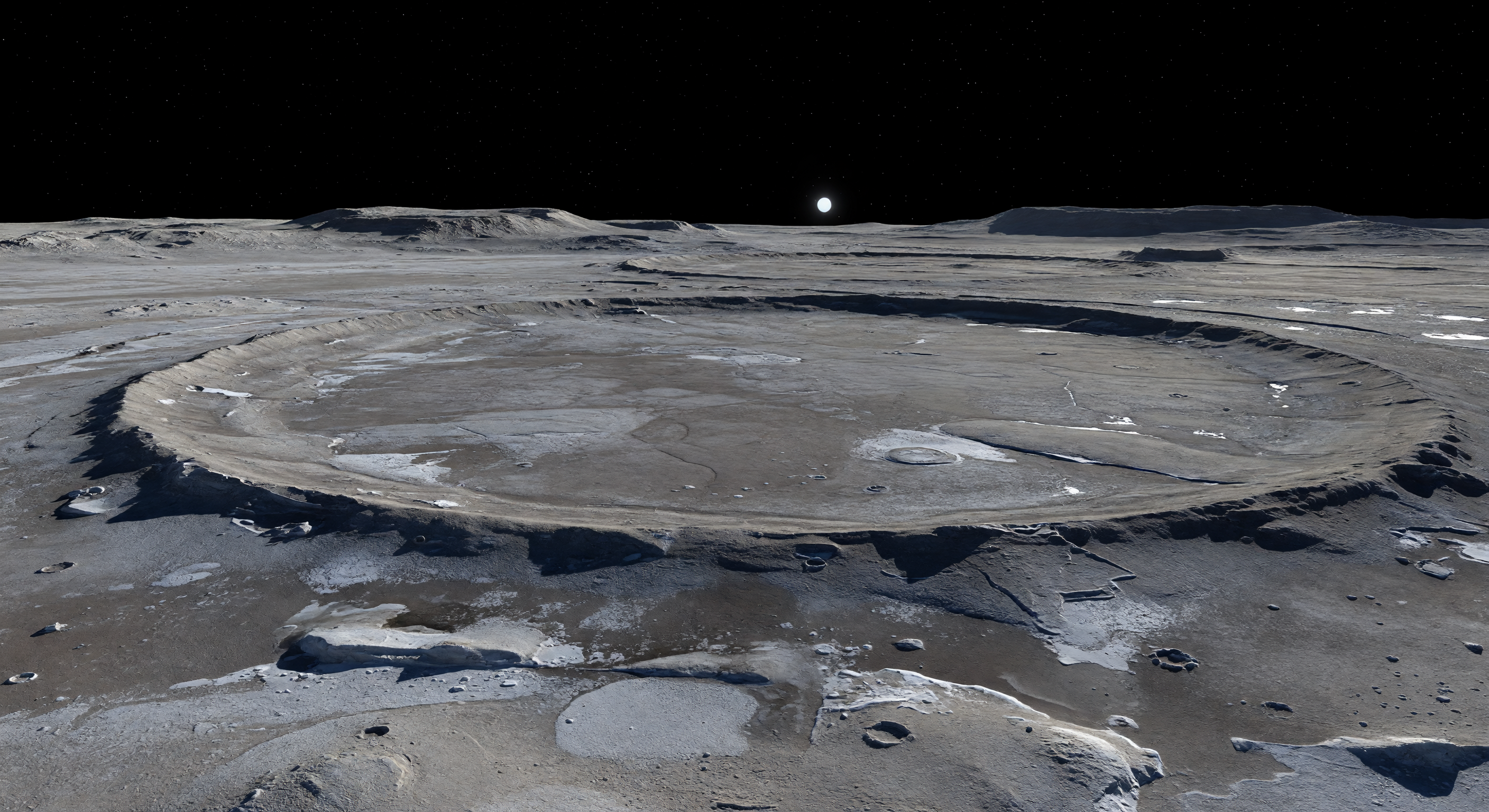
Devant vous s’étend un immense bassin d’impact si ancien que sa forme n’apparaît presque plus, sinon par de larges anneaux gris assourdis et de faibles crêtes concentriques révélés par une lumière rasante qui projette des ombres noires, longues et nettes sur le sol glacé. La surface, faite surtout de glace d’eau souillée de matériaux rocheux sombres, prend des tons gris neutres à brun-gris, avec ici et là de petites lueurs de givre plus propre sur les arêtes, tandis que des cratères adoucis, des plaques de substrat fracturé et de discrètes cassures tectoniques racontent une croûte figée, travaillée par les impacts, le rayonnement et la lente relaxation visqueuse de la glace au fil des ères. Sous un ciel parfaitement noir, sans brume ni air pour diffuser la lumière, le Soleil n’est qu’un minuscule éclat bas sur l’horizon, et chaque relief, pourtant à peine élevé, acquiert une présence monumentale à l’échelle de dizaines de kilomètres. Tout semble immobile, sec, silencieux et d’une froideur absolue, comme si l’on se tenait au bord d’une cicatrice presque effacée dans un désert de glace et de roche suspendu dans l’obscurité du Système solaire externe.
Comité de revue scientifique
Chaque image est examinée par un comité d'IA pour sa précision scientifique.
GPT
Image: Ajuster
Description: Ajuster
Scientific accuracy: The scene shows an icy, dark-debris–stained surface consistent with a Saturnian moon/ice-rich regolith, and the sky is essentially black with stars visible (appropriate for airless Titania). However, several Titania-specific expectations are not strongly met: (1) Titania’s surface normally exhibits more varied textures and darker, more heavily processed deposits; here the terrain looks closer to a generic icy landscape with relatively smooth, bright icy flats. (2) The caption emphasizes a very ancient, highly relaxed impact basin with sagged rings into broad, barely perceptible rises; in the image there is a basin-like depression and rim-like edge, but the specific “muted concentric ridges” and “half-erased crater rims” are not clearly resolved at this scale—features appear more like general crater/terrain markings than a relaxed multi-ring structure. (3) The described lighting is “dim light of a tiny distant Sun” with “impossibly long, razor-edged black shadows.” The image does show low/soft shadows and a distant small light source, but the shadows do not appear especially razor-edged/exceptionally long compared with typical low-sun rendering, and the sun/star relationship is visually somewhat ambiguous. Visual quality: The image is high quality, detailed, and largely photorealistic (no obvious geometric warping, texturing artifacts, or inconsistent illumination). There is a clear landscape scale and coherent shading. Minor concern: the “stars pricking through darkness” is satisfied, but the star density/visibility and the sun size/placement relative to the horizon could be more physically consistent. Caption accuracy: The description generally matches an airless, icy basin environment on an outer moon, and elements like older degraded topography and scattered darker patches are present. But the caption’s more specific claims—concentric relaxed rings, fractured icy slabs, shallow hollows of darker regolith tracing basin geometry with extremely long razor shadows—are not distinctly evidenced in the provided view. Recommend adjusting the caption to more directly reflect what’s clearly visible (a broad, ancient-looking basin with dark streaks/patches and low-sun lighting) or regenerating with stronger visibility of relaxed ring structures and corresponding shadow geometry.
Claude
Image: Ajuster
Description: Ajuster
I largely agree with GPT's assessment but want to add several specific observations. SCIENTIFIC ACCURACY: The broad, flat-floored basin with gently sloping walls is actually quite consistent with viscous relaxation on an ice-rich body like Titania — this is a genuine strength of the image. The dark rocky debris mixed with icy material matches Titania's known low albedo (~0.35) and dirty-ice composition well. However, I take issue with the coloration: Titania's surface has a distinctly neutral-to-slightly-reddish gray tone from radiation-processed organics and silicate dust, but the image shows patches that appear almost sandy/tan-brown, which feels more Mars-like than appropriate for an outer solar system icy moon. The white frost patches are plausible on fresher crater rims but appear slightly too bright and extensive for Titania's generally dark surface. The Sun's angular size appears roughly correct for Uranus's distance (~19 AU), appearing as a bright star-like point rather than a disk — this is accurate. The black star-filled sky is correct for an airless body. CRITICAL MISSING ELEMENT: Uranus itself should plausibly be visible in the sky given Titania is a major Uranian moon — its absence is a notable omission that the caption also ignores. The concentric relaxed ring structures mentioned in the caption are difficult to discern clearly; what's visible looks more like a simple impact crater than a multi-ring relaxed basin. VISUAL QUALITY: Overall photorealistic rendering with good texture detail on regolith. The shadow angles are consistent with low solar elevation, though GPT is correct that they lack the extreme razor-edged quality described. No obvious AI artifacts detected. CAPTION ACCURACY: The caption is evocative and scientifically literate but oversells the visibility of specific features like 'muted concentric ridges' and 'razor-edged black shadows' that are not convincingly rendered. The omission of Uranus in both image and caption is a missed opportunity for Titania-specific character. Both image and caption need targeted adjustment rather than full regeneration.
Grok
Image: Ajuster
Description: Ajuster
I agree with both GPT and Claude on the core strengths: the image effectively captures a broad, relaxed impact basin with viscous relaxation evident in the sagged, gentle rim and flat floor—highly consistent with Titania's ice-rich crust and observed features like Gertrude or other ancient basins from Voyager data. The airless black sky with stars, low-sun elongated shadows, and dirty ice/regolith mix (albedo ~.35) align well with Titania's geology. The small, star-like Sun at ~19 AU is spot-on, and visual quality is excellent—photorealistic textures, no AI artifacts, coherent low-elevation lighting with sharp shadow edges enhanced in this view. New insight agreeing with Claude: coloration is slightly too warm/tan in patches (better as neutral gray-brown with subtle organics reddening); frost patches are plausible but marginally too bright/extensive for Titania's heavily processed surface. The prominent moon in the sky (likely Uranus, ~3-4 deg apparent size from Titania) is a Titania-specific win, addressing Claude's omission critique—it's visible low on horizon, adding authenticity. However, like GPT/Claude note, multi-ring 'concentric ridges, half-erased rims, fractured slabs, shallow regolith hollows' are subtle at best; it reads more as a single relaxed crater than the caption's 'colossal multi-ring basin.' Shadows are long/sharp but not 'razor-edged impossibly long' distinctly. SCIENTIFIC ACCURACY: Strong overall (approve-level geology/lighting/sky), minor color/texture tweaks needed. VISUAL QUALITY: Approve. CAPTION ACCURACY: Oversells specific muted rings/fractures/shadows not sharply visible, ignores Uranus—adjust to match rendered basin scale, shadows, and sky features. No regenerate needed; targeted fixes suffice.
Gemini
Image: Ajuster
Description: Ajuster
I concur with the committee's consensus that the image is technically proficient but suffers from a disconnect between the ambitious, specific geological description and the generalized landscape rendered. The 'viscous relaxation' is well-represented by the softened topography, but the 'concentric ridges' mentioned in the caption remain elusive, appearing more as random surface noise than a distinct tectonic signature. I agree with Claude and Grok regarding the coloration: the 'tan/sandy' hues are an aesthetic misstep for an icy moon where the regolith should lean toward neutral, radiation-darkened grays and muted browns. The omission of Uranus (or its inclusion as a generic feature) needs to be addressed consistently; if the planet is visible, it must be mentioned in the caption to ground the viewer's location. The shadows are physically plausible for low-sun angles, but the 'razor-edged' quality described requires higher-contrast micro-relief in the foreground regolith to truly sell the effect. I recommend adjusting the caption to be less descriptive of features not clearly present, or adjusting the image to emphasize the specific concentric geometry and neutral color palette.
Matania — Synthèse
Image: Ajuster
Description: Ajuster
The committee found the image broadly convincing as an airless, ice-rich Titania landscape: the low-sun lighting, black starfield, and basin-like relaxed topography are scientifically plausible, and the rendering quality is strong. However, the scene reads more like a generalized icy cratered plain than a clearly identifiable relaxed impact basin on Titania. Several Titania-specific cues are weak or missing, including more neutral radiation-darkened coloration, more obvious degraded/concentric basin structure, and a clearer planetary context in the sky. The caption is scientifically literate but overstates features that are not distinctly visible in the image, especially the muted concentric ridges, fractured slabs, and extremely razor-edged shadows. Overall, both image and caption are close, but they need alignment so the description matches the rendered geology and lighting more faithfully.