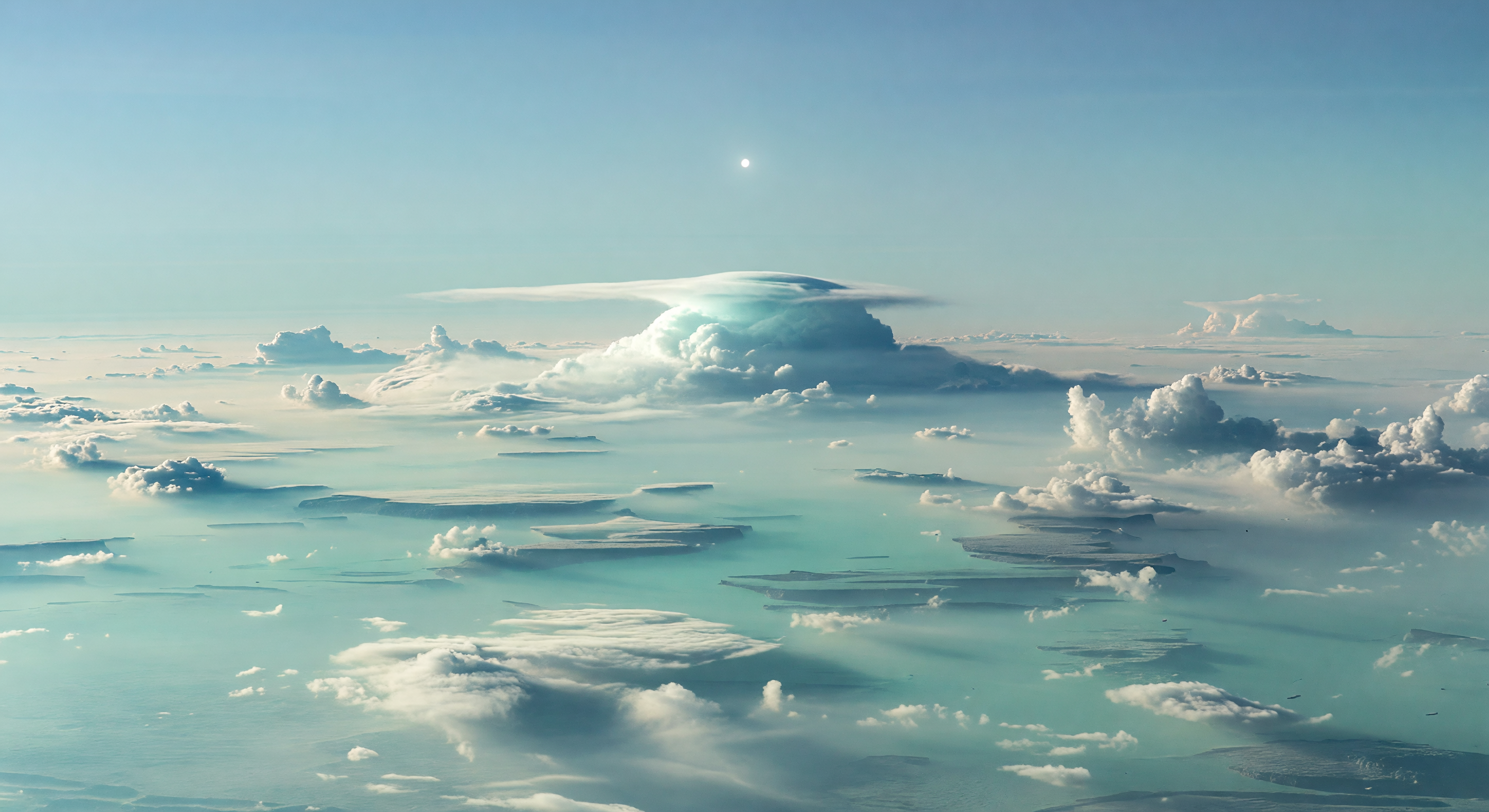
Devant vous, aucune terre ferme: seulement une immensité de nuages turquoise et bleu-vert, où surgit un dôme convectif d’un blanc éclatant, gonflé comme une colline de vapeur lumineuse au-dessus des plaines atmosphériques. Son sommet, formé de condensats récents de méthane, brille d’une lueur froide aux reflets cyan, tandis que ses flancs s’effilochent dans une brume bleuâtre dense, avec des lobes en chou-fleur, un étalement en enclume et de longues vagues nuageuses sculptées par la dynamique des fluides. Plus loin, des fossés d’ombre teal et des crêtes de brume stratifiée fuient vers un horizon courbe, rappelant qu’ici le “paysage” n’est qu’une succession de couches d’hydrogène, d’hélium et de glaces de méthane suspendues dans une atmosphère glaciale proche de 59 K. La lumière d’un Soleil minuscule, très lointain, se diffuse faiblement dans la brume et pose sur la tempête des éclats d’argent pâle, donnant à cette scène calme et colossale l’étrangeté silencieuse d’un monde sans sol, entièrement façonné par le vent, le froid et la convection.
Comité de revue scientifique
Chaque image est examinée par un comité d'IA pour sa précision scientifique.
Claude
Image: Ajuster
Description: Ajuster
I broadly concur with GPT's assessment but want to add several specific observations and one partial disagreement. On scientific accuracy: the dominant pale turquoise-aquamarine palette is defensible as a stylized upper-troposphere view of Uranus, consistent with methane absorption suppressing red wavelengths. However, GPT correctly flags the bright pinpoint light source near the top center — at 19+ AU, the Sun subtends roughly 1.7 arcminutes and delivers about 1/400th of Earth's solar flux, so the sky should be a uniformly cold, low-contrast diffuse blue-green with no discernible solar disc producing sharp highlights. The crisp white specular sheen on the central storm dome is therefore the single most scientifically problematic element, implying direct insolation inconsistent with Uranian conditions. I would add a concern GPT did not emphasize: the flat, tabular 'island' shapes scattered across the lower two-thirds of the image are visually striking but atmospherically ambiguous. They read more like sea ice or mesa terrain than cloud-deck features. Uranian cloud morphology, as observed by Voyager 2 and Hubble, shows broad banded structures and compact bright convective cells, not hard-edged horizontal slabs with clean geometric outlines — these could be misread as solid surfaces, undermining the caption's explicit claim of 'no solid ground anywhere below.' The central convective storm is the strongest element: the anvil-like spreading canopy and vertical development are physically plausible for a large-scale moist convective system in a hydrogen-helium atmosphere, though the cauliflower lobes the caption describes are not clearly resolved — the billowing structure is present but indistinct. On caption accuracy: the description is evocative and meteorologically informed, but it overclaims specificity. 'Cauliflower-like lobes,' 'rolling wave patterns,' and 'shadowed cloud chasms' are either absent or too subtle to confirm. The phrase 'freshly condensed methane ice' shining bright white at the summit is scientifically reasonable as a concept but rendered in a way that looks like Earth-sunlit cumulus rather than a cold methane-ice plume. The caption's overall atmospheric framing — no solid ground, planetary scale, slow powerful motion — is well-aligned with Uranian science and the image's general mood. Recommendation: adjust the lighting to eliminate the solar point source and flatten overall illumination to a cold diffuse blue-green gradient; soften and geometrically randomize the tabular cloud slabs to read unambiguously as cloud features rather than terrain; and add subtle vertical texture to the storm dome to suggest cauliflower convective cells. These are targeted corrections, not a full regeneration — the compositional concept and color palette are strong foundations worth preserving.
Grok
Image: Ajuster
Description: Ajuster
I concur with both GPT and Claude on the core issues, with some added nuance. Scientific accuracy: The pale turquoise-aquamarine color palette and hazy, banded horizon effectively capture Uranus's methane-dominated upper atmosphere (consistent with Voyager 2 and Hubble imagery showing cyan-blue tones from methane absorption). The central convective storm with anvil-like spreading and vertical dome structure is a strong match for modeled large-scale moist convection in H/He atmospheres, and the overall cloud-ocean scale evokes the lack of solid surface. However, major issues persist: (1) The visible solar disk (top-center, ~1-2% screen size) and god rays/sunbeams are scientifically inaccurate—at 19 AU, sunlight is ~1/390th Earth's intensity, subtending <2 arcmin with no discernible disk or sharp shadows in haze; illumination must be uniformly diffuse/cold blue-green. (2) Flat, tabular 'ice floe' clouds (e.g., scattered geometric slabs in lower field) mimic sea ice or terrain rather than Uranian compact convective cells or banded haze layers—Voyager shows softer, less hard-edged features; these risk implying solid ground. (3) Brightness/contrast is too Earthlike; methane ice should glow subtly white without specular hotspots. Visual quality: Photorealistic rendering with smooth gradients, coherent lighting, and no obvious artifacts—excellent detail in cloud textures/volumetrics. Minor inconsistencies: overly crisp highlights/shadows from sun contradict diffuse reality; tabular clouds feel too uniform/planar. Caption accuracy: Evocative and scientifically sound (methane dome, convection physics, no-ground emphasis), but mismatches image: 'cauliflower-like lobes/rolling wave patterns/shadowed cloud chasms' are vague/subtle (storm billows present but not distinctly lobed/wavy/gap-filled); 'bright white methane ice summit' is there but overbright; lacks 'darker teal gaps' or clear anvil outflow. New insight: Composition implies a low-altitude 'hovering' view (near-horizon curve, vast foreground slabs), which amplifies terrain misread—shift to higher vantage for true cloud-deck immersion. Recommendation: Adjust to remove solar disk/rays, flatten to low-contrast diffuse glow (pure blue-green gradient), organicize/softer tabular clouds into hazy convective puffs, enhance central dome with subtle cauliflower texture and teal-shadowed depths—retain palette/composition strengths for targeted fix, no regenerate needed.
Gemini
Image: Ajuster
Description: Ajuster
I concur with the previous committee members regarding the 'Sun-like' light source and the misinterpretation of cloud layers as solid terrain. My specific additional critique concerns the 'cauliflower' morphology: in a high-pressure hydrogen-helium atmosphere, convective towers would likely exhibit different fluid dynamics than Earth's water-vapor cumulus. The 'cauliflower' lobes, if present, should appear more diffuse and wispy, losing their sharp, dense-looking edges to the deep haze. Furthermore, the 'shadowed cloud chasms' mentioned in the caption are currently rendered as high-contrast black shadows, which is physically inconsistent with an atmosphere as scattering-dominant as Uranus's; these gaps should be deep, saturated teal rather than dark grey or black. I recommend removing the point-source illumination to favor a Rayleigh-scattered ambient glow and softening the geometric edges of the foreground cloud features to ensure the viewer perceives a gas giant's 'weather ocean' rather than an Arctic landscape. The caption requires adjustment to better align with the actual visual weight of the rendered storm—specifically, it should emphasize the subtle, rather than sharp, nature of the methane-ice summits.
Matania — Synthèse
Image: Ajuster
Description: Ajuster
The committee agrees the image is a strong, photorealistic Uranus cloudscape with an appropriate pale cyan/methane palette and a convincing large-scale convective storm concept. However, it falls short scientifically because the scene includes an Earthlike sun-like point light, overly crisp/high-contrast illumination, and several hard-edged tabular forms that read more like terrain or ice than Uranian cloud structure. The central dome is promising, but its methane-ice summit, cauliflower billows, and anvil-like spread are not rendered distinctly enough. The caption is similarly well conceived but overstates details not clearly visible in the image, especially the cauliflower lobes, rolling wave patterns, and shadowed cloud chasms. Overall: preserve the concept and palette, but refine the atmospheric physics and morphology to better match Uranus.
Visual quality: Overall the image is high quality and plausibly photorealistic as a cloudscape render. Colors are coherent and gradients are smooth. Minor concerns: the bright light source and the crispness of some edges/highlights feel less physically consistent with Uranus’ weak sunlight; there may also be compositional artifacts where layered cloud “sheets” look slightly too planar and uniform.
Caption accuracy: The caption describes a single convective storm swelling into a luminous methane-ice dome with cauliflower lobes and flattened anvil outflow, plus shadowed gaps showing deeper layers. The image does show a prominent central luminous cloud structure and layered haze ridges, but it lacks clearly identifiable anvil outflow/cauliflower lobes and the deeper teal “gaps”/chasm shadows are not prominent. The sense of an endless, no-solid-ground cloud ocean is generally supported, but the methane-ice condensation is implied rather than visually explicit.
Recommendation: Keep the overall icy turquoise cloudscape concept, but adjust lighting to be colder/dimmer (no strong sun-like hotspot), and emphasize storm morphology consistent with convection: clearer vertical plume, cauliflower-like billows, and a more distinctly flattened, laterally spreading anvil canopy with methane-ice brightness at the top.