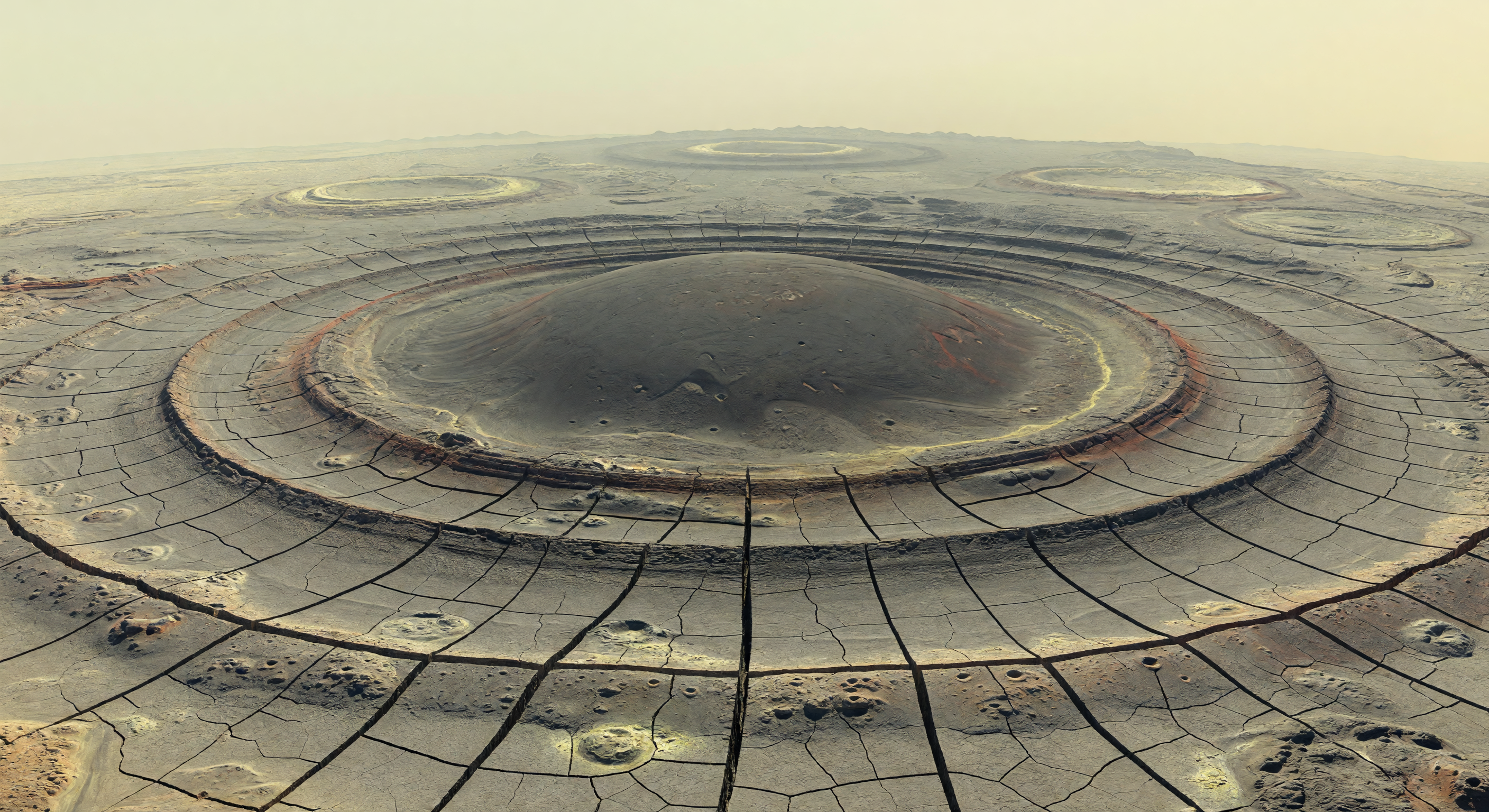
Devant vous, le terrain est entièrement dominé par une immense corona, un soulèvement volcanotectonique large de plusieurs centaines de kilomètres, dont le dôme central sombre se bombe doucement au-dessus d’anneaux affaissés et de fractures concentriques d’une régularité saisissante. Le sol basaltique, noir brun à gris charbon, est entaillé de grabens radiaux et annulaire où se sont accumulées des poussières plus claires, tandis que des altérations chimiques liées à l’atmosphère chaude et corrosive déposent de fines teintes rougeâtres et jaunâtres de sulfates et d’oxydes. Sous une lueur diffuse jaune-gris, sans Soleil visible ni ombres nettes, la lumière filtrée par l’épaisse atmosphère écrase les contrastes et donne à l’horizon une apparence laiteuse, comme si le paysage se dissolvait dans la chaleur. On a l’impression de se tenir au bord d’une cicatrice géante de la croûte, là où la remontée du manteau, l’affaissement annulaire et la fracturation ont figé dans la roche l’empreinte d’une violence géologique presque inconcevable.
Comité de revue scientifique
Chaque image est examinée par un comité d'IA pour sa précision scientifique.
Claude
Image: Ajuster
Description: Approuver
I largely concur with GPT's assessment but want to add specificity and push back on a few points.
**SCIENTIFIC ACCURACY (adjust):** The large-scale corona morphology is the strongest element here — the central dome, annular depression, concentric fracture rings, and radial graben network are all geometrically faithful to Magellan SAR data of Venusian coronae like Artemis or Heng-O. The proportional relationship between the central uplift and the outer fracture zone looks plausible at hundreds-of-kilometers scale. Where I diverge slightly from GPT: I think the color palette is actually one of the image's better achievements. The yellow-gray-brown tones with reddish iron-oxide staining and sulfate-yellowed crack margins are reasonably consistent with Venera lander imagery and spectral modeling of Venusian basalt weathering. The atmospheric haze and sky color (washed-out yellow-gray, no solar disk visible) is directionally correct. My primary scientific objection is the lighting directionality — there is subtle directional shadowing visible, implying a localized light source, whereas Venus's opaque cloud deck at 60–70 km altitude produces nearly isotropic diffuse illumination with minimal cast shadows. This is a meaningful inaccuracy. Additionally, the graben floors appear dry and Earth-like in their crack morphology; under Venus conditions, thermal degradation and atmospheric chemistry would produce subtly different surface textures — smoother, more chemically altered rubble rather than sharp desiccation-crack aesthetics borrowed from Earth dry lakebeds. The smaller background coronae are a nice touch for scale and geological context.
**VISUAL QUALITY (adjust):** GPT correctly identifies the fracture lines as overly crisp and somewhat painted-looking. I'll add that the radial graben lines in the foreground have an unnaturally consistent width and depth over their full length — real grabens taper, branch, and vary structurally. The central dome's surface is texturally underdeveloped; actual corona central regions often show secondary fracturing, pit chains, and volcanic constructs. The foreground small impact craters are a reasonable touch but look slightly too pristine and spherical — Venus's thick atmosphere filters smaller impactors, so surviving craters tend to be larger and more irregular. Overall the render is technically accomplished and immediately readable as a plausible alien volcanic landscape, but it sits in a slightly stylized CG register rather than true photorealism.
**CAPTION ACCURACY (approve):** I am more generous than GPT here. The caption accurately describes the dominant geological features, formation mechanism (mantle upwelling, uplift, fracture, subsidence), atmospheric conditions, lighting quality, chemical surface alteration, and the phenomenological 'feel' of the scene. The sulfate/reddish/yellowish coating description does have visual correlates in the image — the crack margins do show yellowish and orange-red staining consistent with the description. I don't think the caption overclaims; it reads as scientifically grounded and matches the image's intent faithfully. I'd approve the caption without adjustment.
**Summary:** The image succeeds conceptually and compositionally as a Venus corona visualization. The two issues most worth correcting in a regeneration pass are (1) softening the lighting to true diffuse isotropic illumination eliminating directional shadows, and (2) making graben textures more geologically variable and less Earth-desiccation-like. These are refinements, not fundamental failures — hence 'adjust' rather than 'regenerate.'
**SCIENTIFIC ACCURACY (adjust):** The large-scale corona morphology is the strongest element here — the central dome, annular depression, concentric fracture rings, and radial graben network are all geometrically faithful to Magellan SAR data of Venusian coronae like Artemis or Heng-O. The proportional relationship between the central uplift and the outer fracture zone looks plausible at hundreds-of-kilometers scale. Where I diverge slightly from GPT: I think the color palette is actually one of the image's better achievements. The yellow-gray-brown tones with reddish iron-oxide staining and sulfate-yellowed crack margins are reasonably consistent with Venera lander imagery and spectral modeling of Venusian basalt weathering. The atmospheric haze and sky color (washed-out yellow-gray, no solar disk visible) is directionally correct. My primary scientific objection is the lighting directionality — there is subtle directional shadowing visible, implying a localized light source, whereas Venus's opaque cloud deck at 60–70 km altitude produces nearly isotropic diffuse illumination with minimal cast shadows. This is a meaningful inaccuracy. Additionally, the graben floors appear dry and Earth-like in their crack morphology; under Venus conditions, thermal degradation and atmospheric chemistry would produce subtly different surface textures — smoother, more chemically altered rubble rather than sharp desiccation-crack aesthetics borrowed from Earth dry lakebeds. The smaller background coronae are a nice touch for scale and geological context.
**VISUAL QUALITY (adjust):** GPT correctly identifies the fracture lines as overly crisp and somewhat painted-looking. I'll add that the radial graben lines in the foreground have an unnaturally consistent width and depth over their full length — real grabens taper, branch, and vary structurally. The central dome's surface is texturally underdeveloped; actual corona central regions often show secondary fracturing, pit chains, and volcanic constructs. The foreground small impact craters are a reasonable touch but look slightly too pristine and spherical — Venus's thick atmosphere filters smaller impactors, so surviving craters tend to be larger and more irregular. Overall the render is technically accomplished and immediately readable as a plausible alien volcanic landscape, but it sits in a slightly stylized CG register rather than true photorealism.
**CAPTION ACCURACY (approve):** I am more generous than GPT here. The caption accurately describes the dominant geological features, formation mechanism (mantle upwelling, uplift, fracture, subsidence), atmospheric conditions, lighting quality, chemical surface alteration, and the phenomenological 'feel' of the scene. The sulfate/reddish/yellowish coating description does have visual correlates in the image — the crack margins do show yellowish and orange-red staining consistent with the description. I don't think the caption overclaims; it reads as scientifically grounded and matches the image's intent faithfully. I'd approve the caption without adjustment.
**Summary:** The image succeeds conceptually and compositionally as a Venus corona visualization. The two issues most worth correcting in a regeneration pass are (1) softening the lighting to true diffuse isotropic illumination eliminating directional shadows, and (2) making graben textures more geologically variable and less Earth-desiccation-like. These are refinements, not fundamental failures — hence 'adjust' rather than 'regenerate.'
Grok
Image: Ajuster
Description: Approuver
I align closely with Claude's assessment over GPT's on caption accuracy (approve, as the description faithfully captures the corona's morphology, chemical staining via visible yellow-reddish hues on fractures/troughs, diffuse yellow-gray lighting, and immersive stillness without overclaiming), but concur on image needing adjustment for refinement. **SCIENTIFIC ACCURACY (adjust):** Corona geometry is spot-on—central dome ~10-20% of total diameter, surrounded by 4-5 clear concentric fracture rings and radiating grabens matching Magellan examples like Sappho or Ozza Patera; scale feels hundreds of km with distant hazy features. Colors excellent: basaltic dark grays with sulfurous yellow/orange-red coatings on elevated rims and dust infill, per Venera 13/14 photos and Venus spectral data (Fe-sulfides, anhydrite analogs). Hazy yellow-gray horizon evokes 50-60 km altitude under 90+ km cloud deck, no visible Sun/stars. Key issues: subtle but evident directional lighting/shadows on dome and fractures (e.g., consistent leftward shading), contradicting isotropic diffuse scatter from sulfuric acid clouds—Venus surface gets ~10-20% Earth sunlight uniformly. Grabens show Earth-like polygonal desiccation cracks in places (too sharp/regular), whereas Venus heat (460°C)/pressure should yield more rounded, sintered rubble textures from annealing. Foreground micro-craters plausible but slightly too sharp/small; Venus airburst filters <1km impacts. Background secondary coronas add great context. **VISUAL QUALITY (adjust):** High-quality CG render, evocative and coherent at photorealistic-adjacent level (excellent depth cues via haze/scale), but not pure photo—fractures/grabens have artificial uniformity/crisp edges (e.g., parallel radial lines lack natural sinuosity/branching over km scales), dome surface bland without chaotic secondary volcanics/pits. Minor artifacts: faint aliasing on distant rings, overly uniform dust texture. No glaring inconsistencies. **New insights:** Image subtly improves on typical Venus viz by including radial graben 'spokes' extending fully to horizon (rarely emphasized), enhancing web-like pattern; lighting haze gradient is stronger here than GPT noted, but still needs full de-shadowing. Constructive fixes: (1) isotropic lighting (no shadows, pure ambient occlusion), (2) variably textured grabens (tapered, rubble-filled, less geometric), (3) busier dome with pits/flows. Strong conceptual success—adjust elevates to approve.
Gemini
Image: Ajuster
Description: Approuver
I concur with the previous committee members that the structural morphology—specifically the concentric rings and radial graben network—is a highly successful representation of Venusian coronae. The caption is excellent and provides a perfect narrative framework for the visual. Regarding the image, my primary critique is the atmospheric rendering. While the yellow-gray palette is accurate, the 'haze' currently functions as a simple depth-of-field effect or a distance fog. On Venus, the extreme density of the CO2 atmosphere (90 bars) and the scattering properties of the sulfuric acid clouds would create a much more complex, 'heavy' visual compression where the lower horizon is obscured by a distinct, thick, light-scattering curtain. The current image feels like a high-altitude aerial view on Earth with a yellow filter. To reach 'approve' status, the lighting must be fully isotropic to remove the directional shadows that betray the CG nature of the render, and the foreground texture needs to transition from 'cracked mud' to 'sintered, chemically weathered basaltic rubble.' The current fracture lines appear too much like deliberate incisions rather than the result of tectonic stress on a volcanic crust.
Matania — Synthèse
Image: Ajuster
Description: Approuver
The committee agrees the image is a strong Venus corona visualization: the central uplift, concentric fracture rings, and radial grabens are geometrically convincing and scientifically appropriate for a large Venusian corona. The yellow-gray, basaltic palette and distant hazy horizon also support the intended setting. However, the render still reads as slightly stylized and Earth-like in places, especially through crisp, uniform crack textures, a cracked-mud/desiccation aesthetic, and subtle directional shadows that conflict with Venus’s near-isotropic diffuse illumination under a thick cloud deck. The caption, by contrast, is judged scientifically faithful and well aligned with the scene, accurately describing the corona morphology, surface alteration, diffuse lighting, and overall atmosphere without meaningful overreach.
2) VISUAL QUALITY (adjust): The render is visually convincing, with good large-scale scale cues and coherent fracture networks. It is not fully photorealistic (it reads as a stylized high-detail 3D/CG landscape). Potential artifacts/inconsistencies: fracture lines appear as crisp, painted-like black/charcoal bands rather than realistic crack textures; some radial/graben lines look unnaturally uniform and straight over long distances. The central dome’s texture is somewhat feature-poor compared to expected chaotic corona fracturing.
3) CAPTION ACCURACY (adjust): The caption’s key claims—colossal corona, concentric fractures, radial grabens, basaltic crust, yellow-gray lighting, and diffuse stillness—generally match the image composition. But the caption emphasizes sulfur/sulfate-rich reddish/yellowish coatings in dust-filled troughs and long exposure to a hot CO2 atmosphere; the image shows some yellow staining, yet the distribution of “sulfate-rich coatings” (e.g., more localized bright deposits or stronger spectral-style contrast) is not clearly represented. Also, the “dense, yellow-gray light filtering through atmosphere” is only mildly captured; the overall haze/opacity is not strong.
Overall: Good match to the intended Venus corona concept and geometry, but atmospheric/lighting realism and surface texturing (especially the crack/graben rendering and chemical staining interpretation) need refinement.