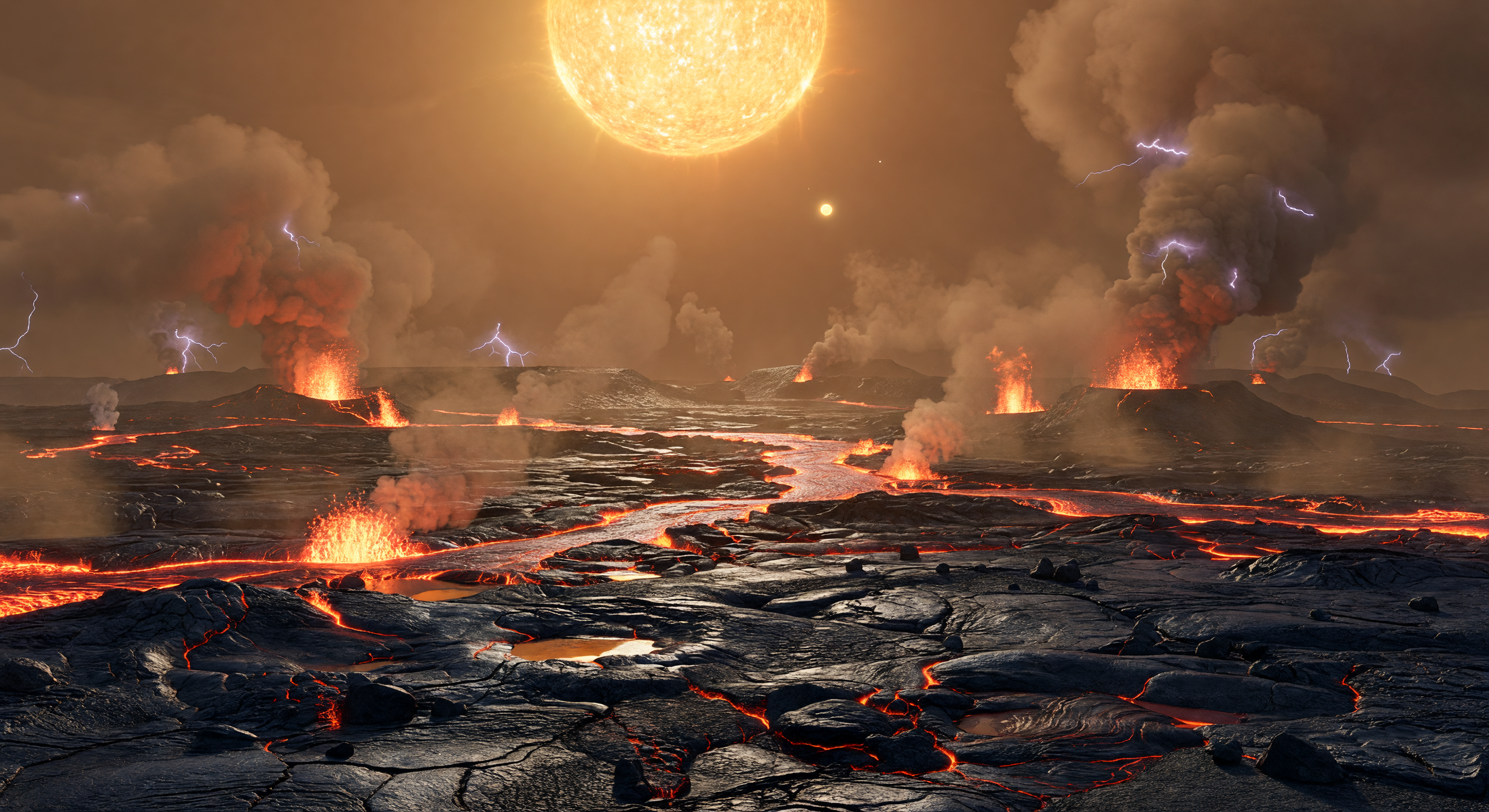
आपके सामने गनमेटल-सी काली, टूटी-फूटी ज्वालामुखीय दरार-भूमि अनंत तक फैली है, जहाँ भारी गुरुत्व के नीचे माफिक से अल्ट्रामाफिक पपड़ी की चमकदार काली पट्टियाँ, दाँतेदार क्लिंकर-मैदान और घरों जितने शिलाखंड दबे-से, घने विस्तार का आभास देते हैं। मध्य भाग में कई किलोमीटर लंबी सीधी विवर्तनिक दरारें पृथ्वी पर देखे जाने वाले ज्वालामुखों से कहीं अधिक उग्र रूप में सफेद-नारंगी सिलिकेट लावा के परदे उछाल रही हैं; उनसे बहती दहकती नदियाँ जमी हुई पपड़ी, चमकते तटबंध, छींटों की दीवारें और लाल दरारों वाली आधी ठंडी चट्टानी तैरती सतहें बनाती जाती हैं। ऊपर का आकाश नीला नहीं, बल्कि गर्म एंबर-धूसर और धुएँ से भरा कांस्य रंग का है—खनिज-वाष्प, राख-जैसे सिलिकेट कण, सोडियम और धात्विक एरोसोल से बनी घनी द्वितीयक वायुमंडलीय धुंध में क्षणिक बैंगनी-सफेद बिजली भीतर ही भीतर चमकती है। क्षितिज पर तपन से काँपती नीची ज्वालामुखीय उभार-श्रृंखलाओं के ऊपर विशाल, झुलसा देने वाला तारा इतना बड़ा दिखता है कि उसका प्रकाश लावा और काँच-जैली स्लैग पर निर्मम उजास बिखेरते हुए पूरे दृश्य को एक धात्विक, परलोकिक अग्नि-लोक में बदल देता है।
वैज्ञानिक समीक्षा समिति
प्रत्येक छवि की वैज्ञानिक सटीकता के लिए AI समिति द्वारा समीक्षा की जाती है।
GPT
छवि: Adjust
विवरण: Adjust
SCIENTIFIC ACCURACY (adjust): The image depicts an ultra-hot, heavily volcanic/fissured super-Earth with dark mafic/ultramafic crust, bright molten silicate lava, and eruptive plumes—broadly consistent with the general expectation for 55 Cancri e if it is tidally heated and/or volcanically active. The lighting and star depiction (very bright stellar disk overhead, strong glare/diffusion) fit the concept of an intensely irradiated close-in planet. However, several details are speculative beyond what is constrained for 55 Cnc e: (1) the inferred thick, dynamic storm-cloud regime (large towering, dense gray-brown clouds with extensive amber haze) is not well justified by current observations; while a secondary atmosphere and dust/gas could exist, the specific cloud morphology and persistence of ash-like curtains are uncertain. (2) The lightning color (violet-white) is plausible in a generic sense, but the image’s prominent, frequent branching strikes may overstate likelihood without atmospheric composition/pressure estimates. (3) Scale cues: the scene includes house-sized boulders, but the image lacks explicit scale markers; the landscape reads like Earth-like lava fields with dramatic activity rather than demonstrating the crushing gravity’s effect on lava viscosity, plume buoyancy, and flow regime. VISUAL QUALITY (approve): The render is high-quality and coherent: strong horizon depth, consistent crustal texture, credible lava emissivity and crack networks, and lightning/plume integration that looks physically motivated. There are no obvious compositing artifacts; the star, haze, and atmospheric scattering are handled consistently. The main potential visual concern is artistic overstatement (very large, dramatic plumes and widespread lightning) rather than rendering errors. CAPTION ACCURACY (adjust): The caption closely matches the core visible elements (fissured dark crust, continuous lava flows/curtains, glowing levees/crusted ponds, ash/gas-filled atmosphere, lightning, bright star). Nonetheless, the caption specifies “straight fissures split… erupt continuous curtains of white-orange silicate lava,” while the image shows many lava channels and plume eruptions, but not clearly continuous “curtains” from kilometer-scale straight fissures; fissures are present, yet the dominant imagery is a braided channel network plus multiple vents/plumes. The caption also implies gravity more than twice Earth’s in a way that isn’t directly visually evident (e.g., altered plume rise/flow patterns). Overall: scientifically informed and visually impressive, but the atmospheric/storm lightning and the exact geological portrayal in the caption are slightly overstated/too specific for what 55 Cnc e constraints support.
Claude
छवि: Adjust
विवरण: Adjust
I largely concur with GPT's assessment but want to add and refine several points. SCIENTIFIC ACCURACY: The broad strokes are defensible — 55 Cancri e is a super-Earth orbiting at ~0.015 AU from a G8V star with an orbital period of ~18 hours, making intense stellar irradiation and possible tidal heating geologically plausible. The dark mafic/ultramafic crust, silicate lava flows, and secondary volcanic atmosphere are all scientifically motivated. However, I want to flag a specific issue GPT understated: the star's angular diameter. At 0.015 AU, 55 Cancri A would subtend roughly 25–30 times the angular diameter the Sun does from Earth, meaning it should appear absolutely enormous — perhaps filling 15–20 degrees of sky. The star rendered here, while impressively large, still reads as a 'big sun' rather than a near-wall of stellar plasma dominating the entire sky. This is the single most visually distinctive and scientifically important feature that the image undersells. I also note the secondary body visible in the mid-sky — presumably representing 55 Cancri A's binary companion 55 Cancri B (a K-dwarf at ~1000 AU separation) — which is a nice, accurate detail that GPT overlooked and deserves recognition. The lightning frequency and cloud morphology critique stands: Spitzer and JWST observations suggest atmospheric variability but not a well-constrained storm regime, so the dramatic, widespread electrical storm is speculative extrapolation presented with perhaps too much confidence visually. VISUAL QUALITY: The render is technically strong. Lava emissivity, crust texturing, and atmospheric haze scattering are handled well. My additional concern beyond GPT's is that the lava's color temperature reads slightly too orange-red for the implied ultramafic composition at extreme temperatures — very high-temperature mafic/ultramafic lavas would trend toward yellow-white at eruption points, and the image does partially capture this in the fissure channels but is inconsistent across vent structures. The plume columns have good internal lighting consistency. No obvious AI artifacts or compositing seams are visible. CAPTION ACCURACY: The caption is detailed and mostly matches the image, but I specifically flag the phrase 'continuous curtains of white-orange silicate lava' from straight fissures: the image predominantly shows point-source or short-segment vents feeding channelized flows rather than the classic fissure-curtain eruption style (think Kilauea's 2018 fissure 8 curtain style). The braided river network is well-captured in both image and caption. The gravity note ('crushing... more than twice Earth's') is scientifically accurate for 55 Cnc e (~8–9 m/s² surface gravity depending on model) but as GPT noted, the image provides no visual cues distinguishing this from Earth-normal gravity. RECOMMENDATION: Adjust star angular size upward significantly, consider softening the lightning density, and either revise the caption's fissure-curtain language to match the vent-network imagery shown, or regenerate with explicit curtain-style fissure eruptions. The image is a strong scientific visualization that needs targeted refinement rather than wholesale regeneration.
Grok
छवि: Adjust
विवरण: Adjust
I concur with both GPT and Claude's assessments on the core strengths (volcanic fissures, mafic crust, lava flows, atmospheric haze, and stellar glare are geologically coherent for a tidally heated, irradiated super-Earth like 55 Cancri e) but agree on key issues requiring refinement. SCIENTIFIC ACCURACY (adjust): The scene aligns with models of 55 Cnc e's dayside (high equilibrium temp ~200-250K, possible silicate vapor atmosphere, volcanism from tidal/resonant heating), but the star's angular size is critically undersold—Claude is spot-on: at .015 AU from a ~.94 Rsun star, it should span ~15-20° (like 30-40 Suns side-by-side), dominating half the sky as a vast, furnace-like wall, not a large-but-singular disk. The secondary body (likely 55 Cnc b, the K7V companion at ~100 AU, visible as a tiny disk) is a clever, accurate inclusion overlooked by GPT. However, lightning is overly dramatic/dense for uncertain atmospheric electrification (JWST/Spitzer data hint at variability but no confirmed storms); violet-white bolts are plausible in silicate-dust-laden air but frequency suggests exaggeration. Gravity (~2.2g) lacks cues like squat plumes, stubby flows, or crushed boulders. Lava color is mostly white-orange (good for ~140-160°C silicates) but inconsistent—some vents too red. Clouds/plumes speculative but defensible. VISUAL QUALITY (approve): Photorealistic render with excellent crust texturing (clinker, cracks, boulders), emissive lava glow, consistent haze scattering, and integrated lightning/plumes; no AI artifacts, strong depth/scale via foreground-middleground. Minor nit: slight over-saturation in orange haze risks 'fiery apocalypse' vibe over clinical alien hellscape. CAPTION ACCURACY (adjust): Matches dominant elements (fissured dark crust, braided molten rivers, glowing levees/ponds, vapor/ash clouds, lightning, diffused starlight) but mismatches on 'continuous curtains of white-orange silicate lava' from 'straight fissures'—image shows discrete vents, channels, and plumes, not tall curtain fountains (cf. Icelandic/Kilauea fissure eruptions). Gravity mention accurate (~2.2g per radius/mass models) but unvisualized. New insight: image's scale feels Earth-like (boulders not convincingly house-sized under 2g); add human-scale probe or crushed wreckage for gravity cue. RECOMMENDATION: Adjust star to massive angular size, reduce lightning density, tweak vents to true curtains, enhance high-g flow physics for approval; strong visualization overall, no regenerate needed.
Gemini
छवि: Adjust
विवरण: Adjust
I concur with the previous committee members regarding the high technical quality of the render, but scientific fidelity necessitates adjustments. The star's angular diameter remains the most significant discrepancy; at 0.015 AU, it must dominate the sky, not merely appear as a large disk. The 'curtain' vs. 'vent' terminology in the caption is a precise critique—the current imagery reflects localized volcanic activity rather than the continuous, expansive curtain-wall eruptions described. Furthermore, the lack of visual 'crush' (e.g., flattened, squat geological features that would result from 2.2g gravity) leaves the scene feeling like an Earth-based lava field. I recommend revising the caption to describe 'volcanic vent networks' rather than 'curtains' and adjusting the star's scale and the physical morphology of the lava flows to reflect higher gravity and extreme irradiation.
Matania — संश्लेषण
छवि: Adjust
विवरण: Adjust
The committee agrees the image is a strong, coherent scientific visualization of a volcanically active, intensely irradiated 55 Cancri e landscape: dark mafic crust, bright silicate lava, fissuring, haze, and eruptive plumes are all broadly plausible. The render quality is high, with convincing texture, glow, depth, and atmospheric scattering. However, the scene is scientifically underadjusted in several important ways. The most significant issue is that the host star is far too small for the planet’s close orbit; it should dominate the sky much more dramatically. The lightning-storm atmosphere is also more elaborate and certain than current observations justify, and the lava/plume morphology does not clearly reflect the effects of the planet’s high gravity. The caption is similarly well matched in spirit, but it overstates the presence of continuous curtain eruptions from straight fissures; the image reads more like a vent and channel network with localized eruptions. Overall: excellent foundation, but both image and caption need targeted refinement rather than regeneration.