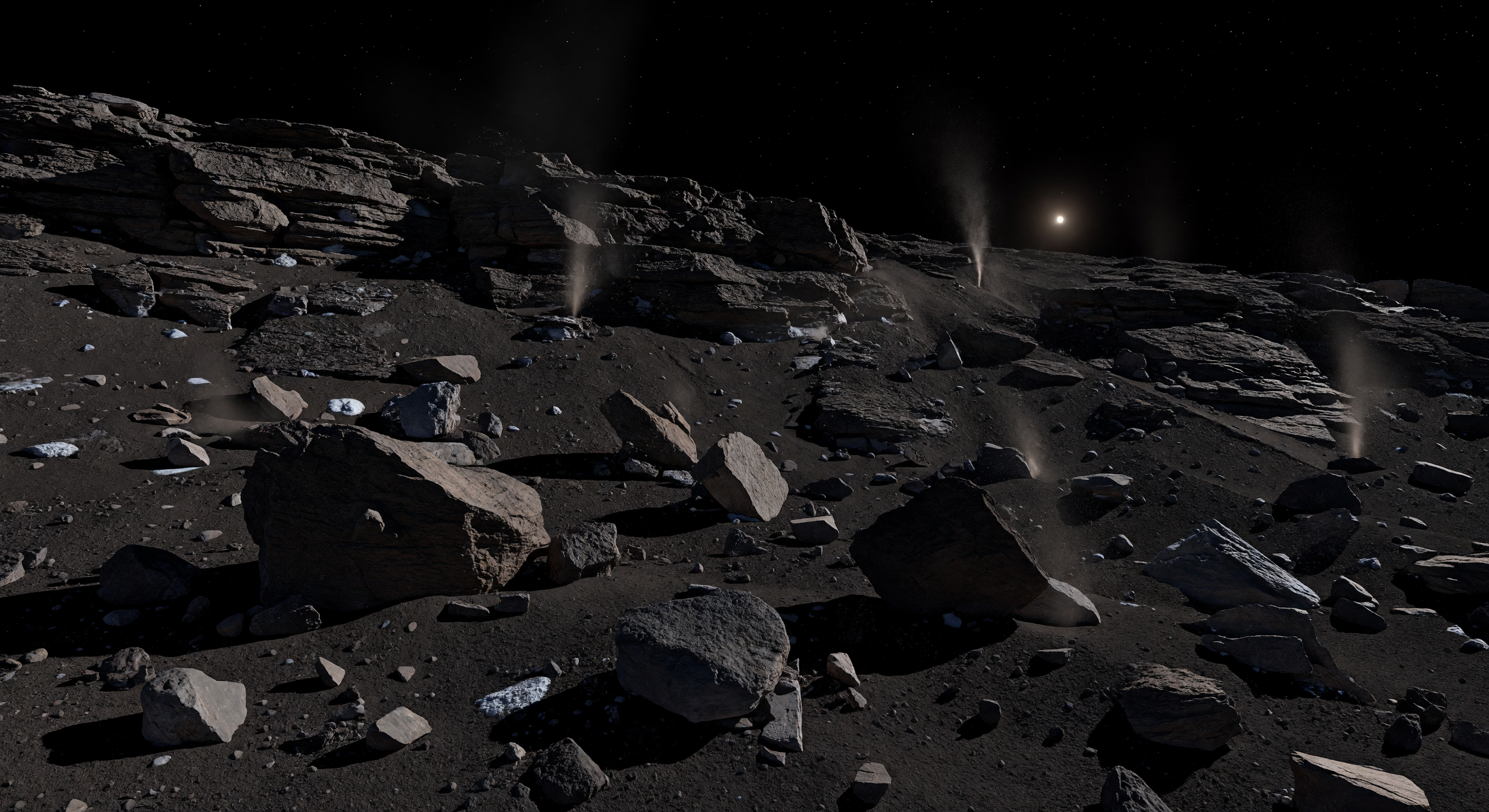
आपके सामने एक तीखी ढाल फैली है, जिसके ऊपर टूटी‑फूटी परतों वाली पीछे हटती कगार खड़ी है और नीचे मुट्ठीभर कंकड़ों से लेकर घर जितने विशाल, नुकीले शिलाखंड बिखरे पड़े हैं—कई इतने हल्के गुरुत्व में मानो बस छूते भर हों, और उनके नीचे निर्वात की कठोर धूप से कटे स्याह, उस्तरे जैसे तीखे साये जमा हैं। यह सतह अत्यंत अँधेरे, कार्बनिक‑समृद्ध धूल‑और‑बर्फ मिश्रित पदार्थ की बनी है; कगार में दिखती भंगुर परतें, बहुभुजी दरारें, धँसे हुए कोटर और मलबे की धाराएँ बताती हैं कि यहाँ चट्टानें पृथ्वी जैसी ठोस नहीं, बल्कि उर्ध्वपातन और ढहाव से लगातार बदलती कमजोर, छिद्रयुक्त परतें हैं। गहरी कालिमा के बीच कहीं‑कहीं दरारों में जमी गंदी, दानेदार जल‑बर्फ हल्की नीली‑सफेद चमक देती है, जबकि छायादार चीरे से उठती पतली गैस‑और‑धूल की फुहारें सीधे काले आकाश में विलीन हो जाती हैं, क्योंकि यहाँ न हवा है, न बादल, न प्रकाश को नरम करने वाला कोई वायुमंडल। पास ही मुड़ता हुआ क्षितिज इस छोटे से नाभिक का पैमाना उजागर करता है, और उस दृश्य में खड़े होकर लगता है जैसे आप किसी जमे हुए, नाजुक, फिर भी सक्रिय अवशेष पर हों, जहाँ सौर ऊष्मा धीरे‑धीरे पूरे भू-दृश्य को तराश रही है।
वैज्ञानिक समीक्षा समिति
प्रत्येक छवि की वैज्ञानिक सटीकता के लिए AI समिति द्वारा समीक्षा की जाती है।
Claude
छवि: Adjust
विवरण: Adjust
I largely concur with GPT's assessment but want to add and refine several specific observations.
SCIENTIFIC ACCURACY: The overall albedo of the surface is problematic — this is the most significant scientific issue. 67P has one of the lowest albedos of any known solar system object (~4-6%), making it extraordinarily dark, comparable to coal or black velvet. The image renders the surface as a medium-dark brownish-grey, which is substantially too reflective and too warm in color tone. OSIRIS camera data from Rosetta shows a surface that is nearly featureless in color at visible wavelengths — essentially neutral very dark grey, not the brownish tan hues depicted here. The layered cliff structure is actually one of the strongest elements scientifically, consistent with the consolidated 'cliffs' regions like Hathor on 67P. The jets are directionally plausible but too broad and diffuse — real 67P jets observed by Rosetta were far more collimated and narrow. The white/bright patches scattered across the foreground are too numerous and too prominent; exposed water ice on 67P is rare, small, and found primarily in shadowed alcoves, not strewn openly across boulder fields. The distant sun size appears roughly correct for a ~3 AU heliocentric distance.
VISUAL QUALITY: Render quality is high with coherent lighting and good shadow geometry. The shadows are appropriately hard-edged given the airless environment, which is correct. The boulder scale variety is good. However, the jets share an almost identical morphology and spacing that feels procedurally generated rather than physically motivated — they should vary significantly in intensity, width, and orientation based on local topography and insolation angle. The bright ice patches have a slightly artificial 'placed asset' quality rather than being organically integrated into the terrain.
CAPTION ACCURACY: The caption's claim of 'coal-dark' surface that 'seems to swallow sunlight' is the most glaring mismatch — the image shows a noticeably brighter surface than this implies. The 'bluish-white patches of exposed water ice' are present but are far more prominent in the image than the caption's 'here and there' language suggests. The 'polygonal cracks' described in the cliff face are not distinctly visible. The description of 'barely touching the ground' perched boulders and knife-edged shadows is partially supported by the imagery. Overall the caption describes a scientifically more accurate 67P than the image actually depicts, creating a gap between text and visual that requires reconciliation — either darken and de-saturate the surface significantly or revise the caption's albedo language.
SCIENTIFIC ACCURACY: The overall albedo of the surface is problematic — this is the most significant scientific issue. 67P has one of the lowest albedos of any known solar system object (~4-6%), making it extraordinarily dark, comparable to coal or black velvet. The image renders the surface as a medium-dark brownish-grey, which is substantially too reflective and too warm in color tone. OSIRIS camera data from Rosetta shows a surface that is nearly featureless in color at visible wavelengths — essentially neutral very dark grey, not the brownish tan hues depicted here. The layered cliff structure is actually one of the strongest elements scientifically, consistent with the consolidated 'cliffs' regions like Hathor on 67P. The jets are directionally plausible but too broad and diffuse — real 67P jets observed by Rosetta were far more collimated and narrow. The white/bright patches scattered across the foreground are too numerous and too prominent; exposed water ice on 67P is rare, small, and found primarily in shadowed alcoves, not strewn openly across boulder fields. The distant sun size appears roughly correct for a ~3 AU heliocentric distance.
VISUAL QUALITY: Render quality is high with coherent lighting and good shadow geometry. The shadows are appropriately hard-edged given the airless environment, which is correct. The boulder scale variety is good. However, the jets share an almost identical morphology and spacing that feels procedurally generated rather than physically motivated — they should vary significantly in intensity, width, and orientation based on local topography and insolation angle. The bright ice patches have a slightly artificial 'placed asset' quality rather than being organically integrated into the terrain.
CAPTION ACCURACY: The caption's claim of 'coal-dark' surface that 'seems to swallow sunlight' is the most glaring mismatch — the image shows a noticeably brighter surface than this implies. The 'bluish-white patches of exposed water ice' are present but are far more prominent in the image than the caption's 'here and there' language suggests. The 'polygonal cracks' described in the cliff face are not distinctly visible. The description of 'barely touching the ground' perched boulders and knife-edged shadows is partially supported by the imagery. Overall the caption describes a scientifically more accurate 67P than the image actually depicts, creating a gap between text and visual that requires reconciliation — either darken and de-saturate the surface significantly or revise the caption's albedo language.
Grok
छवि: Adjust
विवरण: Adjust
I concur with both GPT and Claude on the core issues, particularly the surface albedo mismatch, which is the most critical scientific flaw: the image's medium-dark brownish-grey tones (~20-30% reflectance visually) are far too bright and saturated compared to 67P's actual ~4-6% albedo, appearing more like C-type asteroids (e.g., Ryugu) than Rosetta's near-black, neutral-grey, organic-rich crust that indeed 'swallows sunlight.' This alone warrants adjustment for scientific fidelity. The cliff's layered, fractured structure with overhangs and collapse scars strongly evokes 67P's Hathor/Big Island regions, a highlight. Jets are present and active, but as Claude notes, they are overly uniform/broad (like identical fountains) rather than the narrow, collimated, variable plumes seen in OSIRIS images; real 67P activity shows discrete, topography-guided streams. Bluish-white ice patches are visible in crevices/boulders (better integrated than Claude suggests, partially supporting 'sheltered crevices'), but too abundant/prominent vs. 67P's rarity. Shadows are convincingly hard-edged/airless, boulder perching evokes low-gravity fragility (house-sized blocks look precariously balanced), black sky and subtle curved horizon fit a ~4km body at ~3AU (sunlit patches plausible for perihelion activity). No new major disagreements, but add: scale feels right (close horizon implies small world), though no clear 'polygonal cracks' on scarp. Visual quality is excellent—photorealistic, no artifacts, coherent low-key lighting—but jets and albedo need procedural refinement. Caption accurately describes an idealized 67P but overstates image details (e.g., 'knife-edged shadows in the airless light' are present but not 'perfectly black'; 'polygonal cracks' vague; ice 'here and there' vs. image's several patches). Minor tweaks to darken surface/ vary jets or tone down caption's extremes would approve both.
Gemini
छवि: Adjust
विवरण: Adjust
I agree with the previous committee members regarding the critical discrepancy in surface albedo. 67P is notoriously dark—one of the least reflective objects in the solar system—and the current image renders it with too much mid-tone brightness and warm color saturation. The 'brownish' tint is an aesthetic artifact that contradicts the nearly neutral, charcoal-grey reality revealed by the Rosetta mission. Furthermore, the 'procedural' look of the jets is a significant visual weakness; they lack the chaotic, high-velocity collimation characteristic of comet activity, which is driven by specific fracture geometry rather than uniform surface venting. While the boulder placement and shadow harshness successfully capture the 'airless' feel, the abundance of exposed ice patches creates an impression of a much more active or 'wet' world than 67P actually is. The caption is well-written but creates a disconnect by promising a level of geological detail (polygonal cracks, specific shadow sharpness) that the image does not resolve clearly. I recommend darkening the overall exposure significantly, desaturating the color palette toward a neutral grey, and refining the jet morphology to be more irregular and narrow.
Matania — संश्लेषण
छवि: Adjust
विवरण: Adjust
The committee found the scene broadly faithful to 67P/Churyumov-Gerasimenko’s rugged cometary terrain: fractured layered cliffs, steep rubble slopes, hard-edged shadows, a black sky, and active outgassing all support the setting. However, the image is too bright and warm in tone for 67P’s extremely low-albedo, near-neutral charcoal surface, making it read as more reflective than Rosetta observations indicate. The jets are plausible in concept but appear overly uniform, broad, and stylized rather than narrow, irregular, and topography-driven. Exposed ice patches are visible but somewhat too prominent and numerous for a typical 67P scene. The caption captures the intended atmosphere and general geology, but several details are overstated or not clearly supported by the image, especially the intensity of the darkness, the precision of the shadows, the prevalence of polygonal cracking, and the specificity of the ice exposures.
Visual quality: The image is high-quality and largely photorealistic in style (consistent lighting, coherent terrain texturing, plausible particulate/surface roughness). The main visual concern is that the jets appear somewhat uniform and stylized (resembling multiple similar fountains) rather than varied, narrow, collimated gas plumes typical of comet activity. The horizon/sky curvature effect is subtle and does not clearly validate the “strangely close, curved horizon” wording. No obvious rendering artifacts, but the activity looks a bit more cinematic than physically constrained.
Caption accuracy: The caption matches the general idea (perched rubble/boulders on a steep debris apron near a fractured scarp, with active sublimation jets and some bright icy material). But several detailed claims are overstated relative to what’s visibly supported (perfect knife-edged shadows/airless shadow geometry, widespread polygonal cracks and collapse scars, and specific sheltered crevice ice glints). Therefore, minor-to-moderate adjustments are needed to align the description with what the image actually shows.