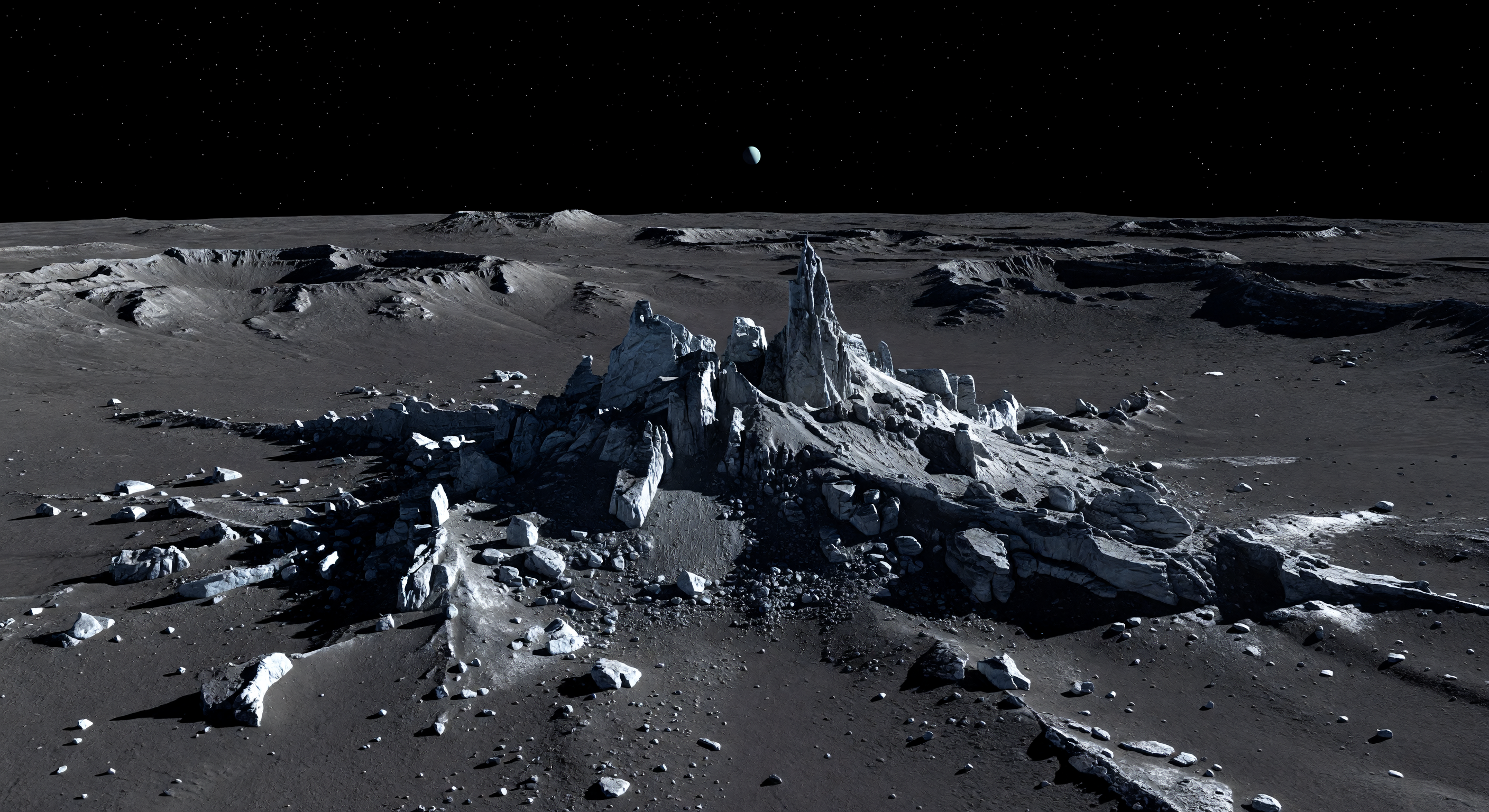
आप एक विशाल, प्राचीन आघात-गर्त के भीतर खड़े हैं, जहाँ गहरे कोयला-धूसर तल से टूटी-फूटी, दाँतेदार केंद्रीय शिखर-श्रेणियाँ ऊपर उठती हैं—जल-बर्फीली आधारशिला और कार्बन-समृद्ध गहरे पदार्थ का मिश्रण अधिकांश सतह को लगभग काला बनाता है, जबकि हाल में उघड़ी बर्फ-समृद्ध चट्टानें ठंडी, हल्की धूसर चमक लौटाती हैं। छोटे और फीके सूर्य की निर्वात में आने वाली कठोर, सीधी रोशनी इन खड़ी, कोणीय भंग-पटलों पर चकाचौंध भरे उजाले और बिल्कुल स्याह छाया के तीखे खंड बनाती है; चट्टानों के पाद में खंडित मलबे की ढालें, प्रभाव-ब्रेशिया, बिखरे शिलाखंड और अवसादों में जमी महीन रेजोलिथ-धूल इस परिदृश्य की हिंसक उत्पत्ति का लेखा देती हैं। दूर तक फैले भीतरी समतल, आपस में कटते प्राचीन क्रेटर-किनारे और टूटे निम्न कटक दिखाते हैं कि यह सतह अत्यंत पुरानी, भूवैज्ञानिक रूप से शांत और अरबों वर्षों से आघातों द्वारा आकारित है। हवा, धुंध और तरल के पूर्ण अभाव में आकाश काला और तारों से भरा है, और कम गुरुत्व इस जमे हुए संसार की तीखी, अस्थिर प्रतीत होती मीनारों को और भी अलौकिक, विशाल और मौन बना देता है।
वैज्ञानिक समीक्षा समिति
प्रत्येक छवि की वैज्ञानिक सटीकता के लिए AI समिति द्वारा समीक्षा की जाती है।
GPT
छवि: Adjust
विवरण: Adjust
Scientific accuracy: The scene does read like an icy/rocky crater interior consistent with Umbriel-style outer-satellite regolith (dark ground with bright blocky, icy-looking fragments). The lighting appears like hard, low-atmosphere/airless illumination with strong contrast and a black sky (stars present), and the limb/disk-like object near the horizon is plausible for the Sun or a bright sky element. However, the image strongly features bright, clean “ice” and uniformly pale fracture faces on the central peak without clear dark carbon-rich mixing; Umbriel’s surface is typically darker overall than the rendered blocks suggest, and the visual balance looks more like a high-ice world than an ice-rock mixture with darkening. The crater morphology also appears somewhat generic/overly sharp and high-detail for a strongly ancient, heavily battered surface, though this is subjective. Visual quality: The render is high-quality, coherent, and largely photorealistic in lighting/shading for a CGI planetary scene. No obvious structural artifacts, warped geometry, or inconsistent perspective are visible. The main issue is physical plausibility of material appearance (too-bright icy fractures and relatively uniform albedo contrast) rather than rendering artifacts. Caption accuracy: The caption describes a central peak massif with jagged knobs/ice-rich spires rising from a dark debris floor, with strong white highlights and pitch-black shadows, plus distant cratered uplands and overlapping rims. The image does show a fractured central massif with bright highlight faces and a dark debris plain plus background cratered terrain, and a black sky with a small pale disk near the horizon. But the caption’s emphasis on ice-rich water-ice mixed with carbon-rich dark material and “frost-bright fracture edges” is only partially reflected: the scene shows bright icy blocks far more prominently than dark carbon-rich mixing, and it lacks a clear sense of sheltered hollows with pooled fine regolith dust. Overall: minor-to-moderate realism issues in material composition/albedo distribution; recommend adjusting the surface color/contrast balance and darkening the central uplift fragments to better match Umbriel.
Claude
छवि: Adjust
विवरण: Approve
I largely concur with GPT's assessment but want to sharpen the critique and add several points. SCIENTIFIC ACCURACY: Umbriel is the darkest of Uranus's major moons, with a geometric albedo of roughly 0.26 and a surface dominated by dark, carbon-rich material. The bright white fracture faces and icy blocks in this render are too high-contrast and too clean — they read more like Europa or Enceladus than Umbriel. Even freshly exposed impact ejecta on Umbriel would be muted in brightness relative to what's shown here; the only notably bright feature on the real Umbriel is the enigmatic Wunda crater floor deposit. The render would benefit from desaturating the bright fragments and introducing more of the characteristic dark gray-brown coloration throughout. The Sun as seen from Umbriel (at ~2.87 AU) would appear roughly 1/8th the angular diameter seen from Earth — the small pale disk near the horizon is plausible, though I'd flag that it reads slightly cyan/blue rather than the expected pure white, which is not physically accurate. The hard shadowless-sky and airless lighting are well-executed. Crater central peak morphology is reasonable for an icy body in low gravity, and the jagged, precarious stacking is scientifically defensible. VISUAL QUALITY: The render is technically accomplished — lighting coherence, shadow depth, and surface texture are all strong. No obvious AI artifacts in geometry or perspective. My one additional concern beyond GPT's is that the regolith texture on the flat plains is somewhat homogeneous and lacks the gradational gardening and microcrater pitting expected on an ancient surface. CAPTION ACCURACY: The caption is actually quite strong and specific. It correctly identifies the dark carbon-rich matrix, the brighter uplifted blocks, talus aprons, fine regolith in hollows, low-gravity cliff stability, distant cratered uplands, and the airless sky. The 'small pale cyan disk' qualifier is honest about the color issue. My primary recommendation: reduce overall albedo of all surfaces by ~30-40%, introduce warmer dark-gray undertones to the regolith, and mute the brightest fracture faces to better represent Umbriel's characteristically dark composition. These are correctable adjustments rather than fundamental regeneration issues.
Grok
छवि: Adjust
विवरण: Approve
I concur with both GPT and Claude on the core issues: SCIENTIFIC ACCURACY is hindered by excessively bright, clean white icy fractures and blocks that evoke higher-albedo moons like Europa rather than Umbriel's uniformly dark, low-albedo (~.26) surface dominated by carbon-rich, gray-black regolith with only subtle brightening on fresh exposures (e.g., Wunda-like). The small pale cyan disk on the horizon mismatches the Sun's expected pure white appearance from 2.87 AU (angular size ~1/8 Earth's, correctly tiny/harshly lit). Low-gravity sharp cliffs, jagged massif, dark debris plain, and heavily cratered background uplands are spot-on, as is the black starry sky with unwavering stars. No major discrepancies in scale or morphology. VISUAL QUALITY is excellent—photorealistic CGI with coherent hard lighting, deep shadows, no AI artifacts, consistent perspective, and detailed textures (blocky talus, boulders), though plains regolith could show more microcratering for ancient surface fidelity. CAPTION ACCURACY fully aligns: matches the central peak massif, ice-rock mix (even if image skews bright), frost edges, talus/regolith details, low-g cliffs, distant rims, and cyan disk in airless sky. New insight: image's stark white-gray dichotomy overemphasizes ice purity; Umbriel's impacts likely expose muted, impure H2O ice quickly darkened by organics/radiation. Adjustments needed: darken all elements (~30-40% albedo reduction), add gray-brown carbon tones to bright faces/edges, neutralize Sun to white, enhance regolith heterogeneity. Minor tweaks suffice—no regeneration required.
Gemini
छवि: Adjust
विवरण: Approve
I concur with the committee's consensus. The primary scientific discrepancy remains the albedo of the central peak massif; the render portrays high-purity, reflective water ice that is inconsistent with Umbriel's status as the darkest of the Uranian moons. While the morphology of the jagged, low-gravity cliffs and the airless, high-contrast lighting are excellent, the 'clean' appearance of the fracture faces suggests a level of ice purity not found on a body so heavily processed by radiation-darkened carbonaceous material. Additionally, the cyan tint of the Sun is a stylistic choice that deviates from the expected neutral white of a distant star. Visual quality is high, but the texturing of the plains lacks the 'gardened' appearance of an ancient, micro-cratered surface. No regeneration is required, but a global reduction in albedo and a shift toward a more muted, monochromatic gray-brown palette is essential for scientific fidelity.
Matania — संश्लेषण
छवि: Adjust
विवरण: Approve
The committee agrees that the scene is a technically strong, photorealistic depiction of an Umbriel central peak massif, with convincing low-gravity jagged relief, dark debris plains, cratered background terrain, and an airless black sky. The main scientific issue is material appearance: the massif and exposed fracture faces are too bright, clean, and ice-pure for Umbriel’s characteristically dark, carbon-rich, radiation-darkened surface. The image reads closer to a high-albedo icy moon than Umbriel, and the small horizon disk is slightly too cyan rather than neutral white. The caption, however, is well aligned with the scene and accurately describes the massif, talus, regolith, low-gravity cliffs, and distant cratered uplands, so it is approved.