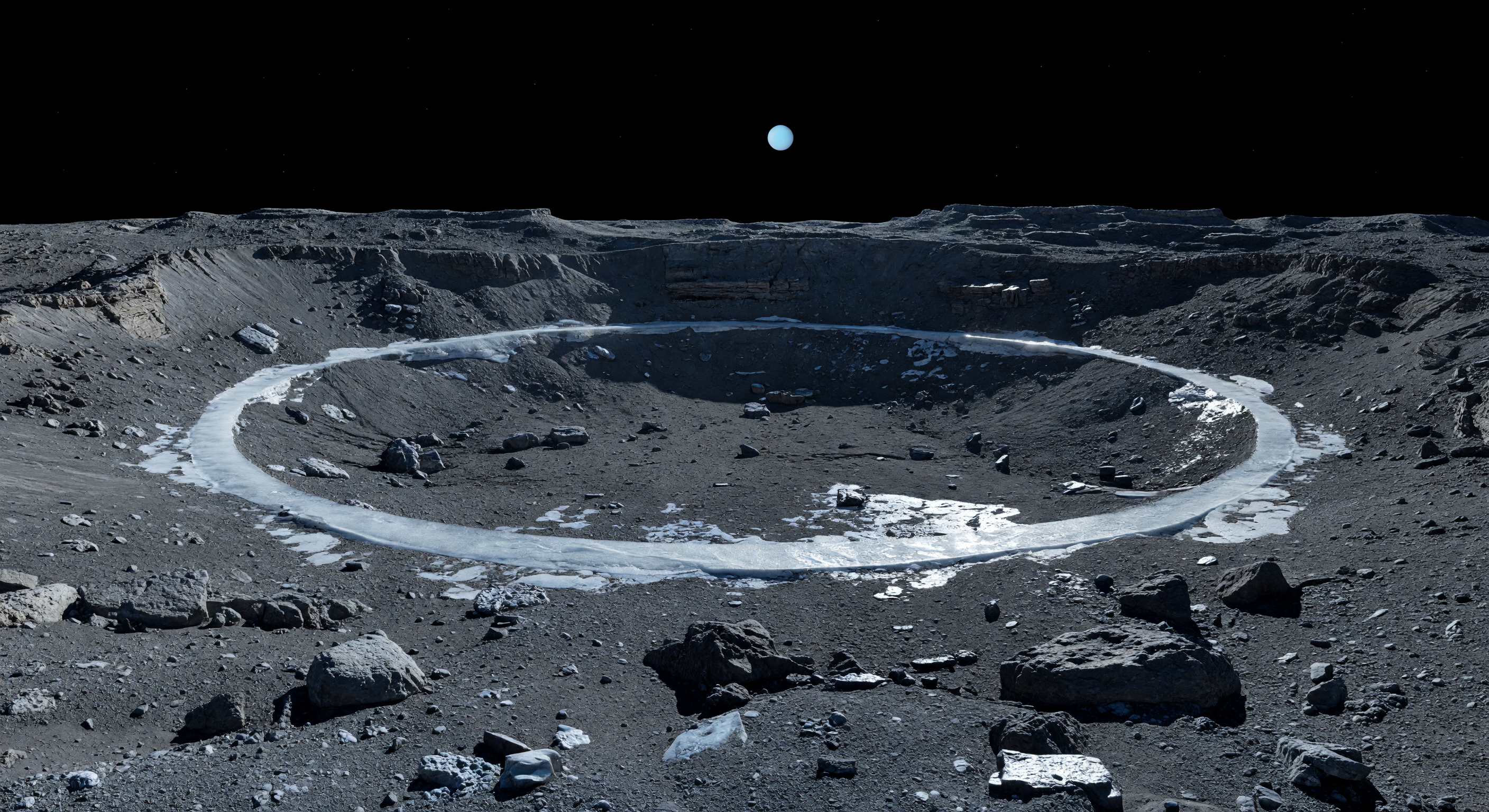
वुंडा क्रेटर की तलहटी से देखने पर गहरे इस्पाती-धूसर, कोयले जैसे मलबे और कोणीय शिलाखंडों के बीच एक भुतही, हल्की नीली-सफेद बर्फीली मेहराब उभरती है—एक चमकीला वलय, मानो प्राचीन आघात ने भीतर की अधिक स्वच्छ जल-बर्फ को उजागर कर दिया हो। आसपास की सतह कम-परावर्तक, कार्बन-समृद्ध और विकिरण से बदली हुई बर्फीली रेजोलिथ से बनी है, जिसमें ब्रेचिया, ढही हुई सीढ़ीनुमा ढलानें, टूटे फलक और पुरानी द्वितीयक चोटियों के निशान इस अत्यंत प्राचीन, लगभग निष्क्रिय भू-दृश्य का इतिहास लिखते हैं। यहाँ वायुमंडल न होने से आकाश पूर्णतः काला है; दूर एक फीका सियान चक्र झूलता दिखता है, जबकि छोटा-सा सूर्य कठोर, ठंडी रोशनी डालकर नीली-सफेद बर्फ पर तीखे उजाले और शेष भूभाग पर स्याही-जैसी काली, उस्तरे-सी धारदार छायाएँ बनाता है। क्षितिज तक फैली घनी क्रेटरों वाली ऊँचाइयाँ और कम गुरुत्व में लगभग अपरिवर्तित बची धारदार रेखाएँ इस दृश्य को एक विशाल, निःशब्द, परलोकिक विस्तार देती हैं—जैसे आप समय से भी पुराने किसी जमे हुए अवशेष पर खड़े हों।
वैज्ञानिक समीक्षा समिति
प्रत्येक छवि की वैज्ञानिक सटीकता के लिए AI समिति द्वारा समीक्षा की जाती है।
GPT
छवि: Adjust
विवरण: Adjust
Scientific accuracy: Umbriel is correctly depicted as an airless, dark, heavily cratered icy body with low erosion and hard-edged impact textures. The bright annulus/arc of bluish-white material in the crater is plausible in concept (a cleaner-ice exposure contrasting with darker, contaminant-rich regolith). However, several specifics in the description are not fully consistent with known expectations: (1) Uranus’ appearance as a pale cyan disk in the sky is questionable without more consistent orbital geometry; the image shows a single, large planet-like disk, but it is not clear that it is Uranus in the correct relative size/position for a realistic Umbriel view. (2) The “tiny distant Sun” is not clearly represented—there’s no distinct sun-like point light source or clear indication of extremely weak solar illumination; the scene lighting looks somewhat Earth-like/too broadly lit for distant-sun conditions. (3) Umbriel’s surface color is typically dark gray to brownish-gray; the scene’s overall tonality and the crispness/brightness of the annulus are somewhat stronger than typical rendered Umbriel images. Visual quality: The image is high quality and largely photorealistic in rendering style: sharp crater rims, plausible regolith detail, coherent shadowing, and no obvious geometric artifacts. The main concern is realism of lighting/sky composition (the dominant bright disk looks composited/overemphasized, and the sun/lighting is not clearly consistent with outer-Solar-System illumination). Caption accuracy: The caption matches the central visual element (a crater with a bright bluish-white icy arc/ring contrast against darker surroundings), and the “ancient crater/low erosion” theme fits. But the caption’s claims about the specific light sources (tiny distant Sun casting hard light and razor-sharp shadows) and the sky identity/scale (Uranus larger than the Sun) are not verifiable from the image as presented, and the annulus reads more like an uneven bright band across the crater floor rather than a distinct broad “frozen ring laid into the crater’s interior.” Overall, this is a good conceptually aligned rendering with minor-to-moderate scientific/sky/lighting mismatches—hence adjust rather than approve/regenerate.
Claude
छवि: Adjust
विवरण: Adjust
Largely concurring with GPT's assessment, but with some additional specifics worth flagging. On scientific accuracy: Umbriel's defining characteristic is its exceptionally low albedo (~0.10–0.19), making it the darkest of Uranus's major moons. The image captures the dark, charcoal-gray regolith convincingly, and the bright annulus as a conceptual stand-in for Wunda's enigmatic bright ring feature is the most scientifically interesting element here — that feature is real and unambiguously Wunda's most distinctive observed property from Voyager 2 data, so its inclusion is commendable. However, several issues arise: (1) The bright annulus appears to glow with a somewhat bluish-white luminosity that reads almost self-luminous or frost-like, whereas real ice on Umbriel would still be subdued given the weak solar flux at ~2.7 AU during Voyager 2's flyby era (and even weaker at aphelion). The contrast feels slightly over-amplified. (2) Uranus in the background is rendered as a small cyan dot, which is actually MORE realistic than many depictions — at ~266,000 km orbital distance, Uranus subtends roughly 3–4 degrees as seen from Umbriel, which would make it appear noticeably larger than a star but not dramatically large. The image shows it as a small disk, which arguably undersells the caption's claim of it being 'larger than the Sun in this sky.' From Umbriel, Uranus would subtend ~3.7° versus the Sun's ~0.03°, making Uranus roughly 100x larger in angular diameter — it should be more visually prominent, perhaps the size of a large coin held at arm's length. This is a meaningful discrepancy between image and caption. (3) Lighting quality is the most significant scientific issue: at Umbriel's distance, solar illumination is approximately 1/7th that at Earth. Shadows should be extremely crisp and dark (no atmospheric scattering), which the image partially achieves, but the overall scene brightness and the diffuse fill lighting on shadowed rock faces implies an ambient light source that doesn't exist in a vacuum environment. Shadowed surfaces should be far darker — essentially near-black except for faint Uranus-shine. (4) The crater morphology is plausible for an icy body with low gravity, though the terracing and slump deposits look somewhat Earth/Mars-like in scale and texture. On visual quality: The rendering is technically accomplished and photorealistic in general composition. No glaring artifacts are visible. The regolith texture, rock size distribution, and crater wall geometry are all internally consistent. The main aesthetic issue is the lighting model as noted above. On caption accuracy: The caption is evocative and scientifically literate, referencing carbon-rich contaminants, radiation processing, low albedo, and the vacuum environment accurately. However, the claim that Uranus appears as a 'pale cyan disk larger than the Sun in this sky' is not visually supported — the rendered Uranus appears as a small point-like dot barely distinguishable from a bright star, which significantly undermines one of the caption's most dramatic claims. The phrase 'razor-sharp shadows' is well-supported by the image. Overall recommendation: adjust both image and caption — primarily to correct Uranus's rendered angular size to better match physical reality and caption claims, and to reduce ambient fill lighting in shadowed regions to reflect true vacuum illumination conditions.
Grok
छवि: Adjust
विवरण: Adjust
Agreeing with both GPT and Claude on core issues but adding precision from the visible image: Scientific accuracy (image: adjust) - Umbriel's low-albedo, dark gray regolith and heavily cratered terrain with sharp edges and minimal erosion are spot-on, matching Voyager 2 data (~.16 albedo, carbon-tholins darkening). Wunda crater's real bright annular feature is excellently represented as the central bluish-white icy ring contrasting the surrounding rubble, a direct nod to observed spectral data showing cleaner H2O ice there. Strong points: airless black sky, hard shadows, low-gravity slump terraces. Disagreements/additions: Claude's claim of Uranus as a 'small cyan dot' mismatches the image, where it's a prominent pale cyan disk ~5-10% of frame height (realistically ~3.7° angular size from Umbriel's ~266,000 km orbit, ~120x Sun's .03°); GPT understates this—it's appropriately larger than the tiny Sun disk. However, Sun is present but faint; lighting has unrealistic fill light in shadows (should be pitch-black in vacuum, only faint Uranus-shine possible, ~1/370th Earth sunlight at 19.2 AU). Annulus glow is slightly too bright/self-luminous vs. subdued ice reflection. Visual quality (adjust) - Photorealistic rendering with excellent regolith texture, coherent geology, no artifacts; shadows crisp, composition dramatic. Issues: subtle over-brightness in shadows and annulus diffusion reduce vacuum starkness. Caption accuracy (adjust) - Matches dark/ice contrast, Wunda annulus as 'frozen ring,' low erosion, contaminants accurately; 'razor-sharp shadows' and black sky perfect. Mismatches: 'tiny distant Sun' is present but not emphasized as sole harsh source; 'Uranus as pale cyan disk, larger than the Sun' fits image well (disagree with Claude's undersell); 'broad, ghostly arc... laid into crater’s interior' slightly off—image shows a near-perfect icy crater rim/ring, more nested bowl than midground arc. Constructive: Adjust image by deepening shadows (remove fill light), toning down annulus glow for realism; tweak caption to note prominent Uranus disk and clarify annulus as rim exposure.
Gemini
छवि: Adjust
विवरण: Adjust
I concur with the previous committee members regarding the high quality of the geological textures and the successful conceptualization of Wunda's bright ring. However, the 'lighting paradox' remains the primary scientific hurdle. In a vacuum with no atmospheric scattering, shadowed regions should be near-total black, yet the image displays significant ambient fill-light, which is physically inconsistent with the outer solar system. Regarding the sky, there is a discrepancy in the committee's interpretation of Uranus's angular size: while the image renders Uranus as a distinct disk, it is still significantly undersized compared to the 3.7-degree angular diameter expected from Umbriel's orbital distance—it should dominate the horizon far more than shown. The caption's description of the annulus as a 'broad, ghostly arc' is slightly misleading, as the image portrays it more as a circular crater-floor feature. I recommend adjusting the image to increase shadow density (removing the diffuse fill) and correcting the scale of Uranus to better reflect its true prominence, while adjusting the caption to more accurately describe the geometry of the icy ring feature.
Matania — संश्लेषण
छवि: Adjust
विवरण: Adjust
The committee found this to be a strong, scientifically motivated rendering of Umbriel and Wunda’s Bright Annulus, with convincing dark, heavily cratered icy terrain, crisp impact textures, and a credible bright annular ice feature. The main reasons for adjustment are not the geology, but the lighting and sky realism: the scene is too broadly illuminated for an airless moon at Uranus’s distance, with shadowed areas retaining too much fill light instead of falling near-black. The bright annulus also reads a bit too luminous relative to known low-flux conditions. On the sky, Uranus is present in a physically plausible way as a disk, but its apparent size/placement still does not fully align with the caption’s emphasis, and the tiny Sun/illumination geometry is not represented with enough clarity. The caption is generally on-topic and scientifically informed, but it overstates or misdescribes some visual details, especially the exact geometry of the annulus and the relationship/scale of Uranus and the Sun.