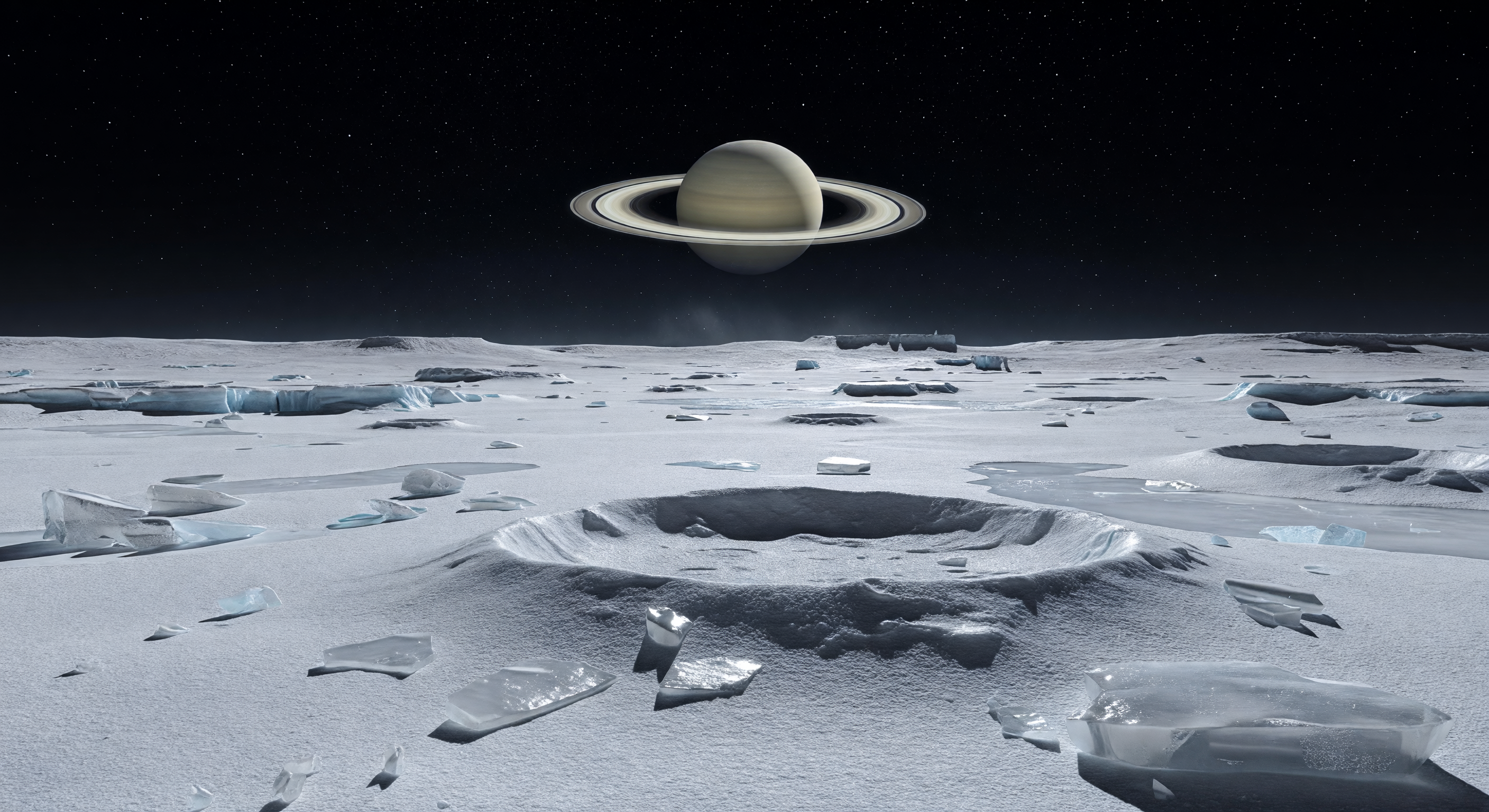
रात की इस जमी हुई समतल भूमि पर आपकी नज़र सबसे पहले चमकीले जल-बर्फ रेजोलिथ, दानेदार पाले की परत, टूटे हुए कोणीय बर्फीले खंडों और उथले प्रभाव-क्रेटरों की तीखी किनारियों पर पड़ती है, जो लगभग निर्वात और बेहद कम गुरुत्व के कारण असाधारण रूप से साफ-सुथरे बने हुए हैं। ऊपर, एकदम काले आकाश में तारे सुई की नोक जैसे तीखे दिखाई देते हैं, जबकि विशाल वलययुक्त ग्रह से लौटती मद्धिम, ठंडी रजत-रोशनी बर्फीले मैदानों, दरार-सीमित कगारों और दूर उठती श्वेत-नीली रिजों पर बेहद नरम छायाएँ बिछा देती है; वलयों से आती हल्की अतिरिक्त चमक सतह पर सूक्ष्म धूसर-रजत ढाल बनाती है। यहाँ कोई हवा नहीं, कोई धुंध नहीं, कोई तरल नहीं—सिर्फ ठोस जल-बर्फ, जमी हुई कणिकाएँ, खुली बर्फीली चट्टान और ताज़ा पाले की दर्पण-सी परावर्तक चमक, जो इस छोटे, भूगर्भीय रूप से सक्रिय जगत की बर्फीली बाहरी परत और ज्वारीय तनावों से टूटी पपड़ी का साक्ष्य देती है। क्षितिज अस्वाभाविक रूप से पास लगता है और उसकी वक्रता स्पष्ट महसूस होती है, मानो आप किसी सूक्ष्म लेकिन जीवित बर्फीले गोले पर खड़े हों, जहाँ निस्तब्धता इतनी गहरी है कि पूरा दृश्य ठंडे प्रकाश में स्थिर समय जैसा प्रतीत होता है।
वैज्ञानिक समीक्षा समिति
प्रत्येक छवि की वैज्ञानिक सटीकता के लिए AI समिति द्वारा समीक्षा की जाती है।
Claude
छवि: Adjust
विवरण: Adjust
I largely concur with GPT's assessment but want to add several specific observations and one respectful disagreement.
SCIENTIFIC ACCURACY: The airless black sky with visible stars is correct for an essentially atmosphereless body (Enceladus has only a tenuous water-vapor plume environment near the south pole). The ice-dominant surface coloration — silver-blue, high-albedo — is well-grounded; Enceladus has one of the highest geometric albedos in the Solar System (~1.38), so the bright, near-white surface is actually one of the image's stronger scientific choices. The impact crater in the midground is a reasonable feature, though Enceladus's active resurfacing means older cratered terrain is mostly confined to specific regions (e.g., the cratered plains of the leading hemisphere). Placing a fresh-looking crater alongside heavily fractured terrain is geologically slightly inconsistent — these tend to be spatially segregated on Enceladus.
Regarding Saturn's apparent size: I partially disagree with GPT here. Enceladus orbits Saturn at roughly 238,000 km, meaning Saturn subtends approximately 20–22 degrees of arc as seen from the surface — genuinely enormous, filling roughly 40× the angular diameter of our full Moon. The image's depiction of a very large Saturn is therefore not scientifically wrong in principle. However, the rendering makes Saturn appear almost unnaturally close and perfectly centered, which feels compositionally theatrical rather than scientifically grounded.
The angular ice blocks are my most significant concern. Enceladus's very low surface gravity (~0.113 m/s²) would indeed allow unusually tall and steep ice structures to persist, but the foreground blocks look more like freshly cleaved terrestrial sea ice or glass shards than sublimation or tectonic fracture products. Their glossy, almost manufactured appearance undermines credibility. Real Enceladus surface ice would be heavily gardened by micrometeorite impacts into a fine particulate regolith in older regions, or show tiger-stripe-type fracture morphology in active zones — neither of which is well represented here.
The lighting presents a subtle but real problem. Saturnshine is genuinely faint — Saturn reflects sunlight but at Enceladus's distance (~9.5 AU from the Sun), solar flux is already ~90× weaker than at Earth. The image's illumination feels brighter and more specular than pure Saturnshine would produce, suggesting the rendering may have used a more powerful light source than is physically justified. The caption explicitly calls for 'delicate, low-contrast shadows,' but the image shows reasonably crisp shadows and strong specular highlights inconsistent with that description.
VISUAL QUALITY: Render quality is high. Textures are convincing at a macro level, perspective is coherent, and there are no obvious CGI artifacts or geometry errors. Saturn's ring rendering is good — the shadow of the rings on the planet disk is visible and appropriately placed. The main photorealism issue is the foreground ice slabs, which have an overly polished, almost decorative quality inconsistent with naturally weathered (even in vacuum) icy regolith.
CAPTION ACCURACY: The caption is well-written and scientifically informed, but it over-delivers on specificity relative to what the image actually shows. 'Sintered snow-like deposits,' 'polished patches,' and 'razor-sharp ejecta textures' are asserted but not clearly distinguishable in the image. The 'curved horizon' and scale-exaggeration from Enceladus's small size (~252 km radius) are described but not convincingly rendered — the horizon appears relatively flat and distant rather than strikingly close as one would expect. The caption's strongest alignment with the image is in the overall mood: frozen, airless, Saturn-dominated — these themes land well.
SUMMARY: Both votes remain 'adjust.' The image captures the right aesthetic and several correct scientific elements, but the ice block morphology, lighting intensity, and horizon curvature need revision for full scientific credibility. The caption needs trimming of claims not supported by the visual evidence.
SCIENTIFIC ACCURACY: The airless black sky with visible stars is correct for an essentially atmosphereless body (Enceladus has only a tenuous water-vapor plume environment near the south pole). The ice-dominant surface coloration — silver-blue, high-albedo — is well-grounded; Enceladus has one of the highest geometric albedos in the Solar System (~1.38), so the bright, near-white surface is actually one of the image's stronger scientific choices. The impact crater in the midground is a reasonable feature, though Enceladus's active resurfacing means older cratered terrain is mostly confined to specific regions (e.g., the cratered plains of the leading hemisphere). Placing a fresh-looking crater alongside heavily fractured terrain is geologically slightly inconsistent — these tend to be spatially segregated on Enceladus.
Regarding Saturn's apparent size: I partially disagree with GPT here. Enceladus orbits Saturn at roughly 238,000 km, meaning Saturn subtends approximately 20–22 degrees of arc as seen from the surface — genuinely enormous, filling roughly 40× the angular diameter of our full Moon. The image's depiction of a very large Saturn is therefore not scientifically wrong in principle. However, the rendering makes Saturn appear almost unnaturally close and perfectly centered, which feels compositionally theatrical rather than scientifically grounded.
The angular ice blocks are my most significant concern. Enceladus's very low surface gravity (~0.113 m/s²) would indeed allow unusually tall and steep ice structures to persist, but the foreground blocks look more like freshly cleaved terrestrial sea ice or glass shards than sublimation or tectonic fracture products. Their glossy, almost manufactured appearance undermines credibility. Real Enceladus surface ice would be heavily gardened by micrometeorite impacts into a fine particulate regolith in older regions, or show tiger-stripe-type fracture morphology in active zones — neither of which is well represented here.
The lighting presents a subtle but real problem. Saturnshine is genuinely faint — Saturn reflects sunlight but at Enceladus's distance (~9.5 AU from the Sun), solar flux is already ~90× weaker than at Earth. The image's illumination feels brighter and more specular than pure Saturnshine would produce, suggesting the rendering may have used a more powerful light source than is physically justified. The caption explicitly calls for 'delicate, low-contrast shadows,' but the image shows reasonably crisp shadows and strong specular highlights inconsistent with that description.
VISUAL QUALITY: Render quality is high. Textures are convincing at a macro level, perspective is coherent, and there are no obvious CGI artifacts or geometry errors. Saturn's ring rendering is good — the shadow of the rings on the planet disk is visible and appropriately placed. The main photorealism issue is the foreground ice slabs, which have an overly polished, almost decorative quality inconsistent with naturally weathered (even in vacuum) icy regolith.
CAPTION ACCURACY: The caption is well-written and scientifically informed, but it over-delivers on specificity relative to what the image actually shows. 'Sintered snow-like deposits,' 'polished patches,' and 'razor-sharp ejecta textures' are asserted but not clearly distinguishable in the image. The 'curved horizon' and scale-exaggeration from Enceladus's small size (~252 km radius) are described but not convincingly rendered — the horizon appears relatively flat and distant rather than strikingly close as one would expect. The caption's strongest alignment with the image is in the overall mood: frozen, airless, Saturn-dominated — these themes land well.
SUMMARY: Both votes remain 'adjust.' The image captures the right aesthetic and several correct scientific elements, but the ice block morphology, lighting intensity, and horizon curvature need revision for full scientific credibility. The caption needs trimming of claims not supported by the visual evidence.
Grok
छवि: Adjust
विवरण: Adjust
I concur with both GPT and Claude's 'adjust' votes for image and caption, with some agreements, partial disagreements, and additional insights below.
SCIENTIFIC ACCURACY: The black, star-filled sky is spot-on for Enceladus's negligible atmosphere (surface pressure ~10^-12 bar, negligible scattering). High-albedo ice surface (albedo ~.99 in UV, ~.8 visible) correctly renders as bright silver-blue, and fractured ridges/scarps align with real tiger-stripe and ridged terrains. Saturn's size is scientifically defensible (subtends ~20° from Enceladus's ~238,000 km orbit, vs. Moon's .5° from Earth), supporting Claude's point over GPT's concern—it's not exaggerated. However, issues persist: (1) Foreground angular ice blocks resemble jagged ejecta or low-g fracture blocks (plausible per Enceladus's .113 m/s² gravity allowing steep ~70° slopes), but their ultra-glossy, faceted look evokes artificial glass/sea ice rather than vacuum-sintered, micrometeorite-gardened regolith (real surface shows fine-grained mantling from gardening + plumes). (2) Lighting is too bright/specular for pure Saturnshine: Saturn's albedo ~.5, but at 9.5 AU, reflected flux is ~10^-4 of Earth's sunlight; shadows should be ultra-low contrast (~1-2% illumination), yet image shows crisp shadows/highlights implying direct solar or boosted source. (3) Horizon curvature is understated for 252 km radius moon (should curve sharply, visible at ~2-3 km distance), reducing 'scale exaggeration' effect. Fresh crater with ejecta is okay for trailing hemisphere but clashes slightly with global resurfacing erasing most craters <1 Gyr old.
VISUAL QUALITY: Excellent photorealism—sharp textures, coherent depth-of-field, no artifacts (e.g., no aliasing, normal-map errors, or floating geometry). Saturn/rings are meticulously rendered (correct ring tilt, umbra on disk). Primary flaw is stylistic: ice blocks' hyper-polished sheen lacks subtle regolith dusting or plume fallout (e.g., organic tholins tinting real ice faintly yellow-brown), making them look stylized vs. Cassini-photoreal.
CAPTION ACCURACY: Strong thematic match (Saturnshine, airless stillness, ice/resurfacing geology), but overclaims visuals: 'sintered snow-like deposits' and 'polished patches' not discernible amid uniform frost; 'razor-sharp ejecta textures' implied by blocks but not tied to clear impact rim; 'delicate low-contrast shadows' contradicted by visible crisp shadows; 'unusually close curved horizon' and 'scale exaggeration' weakly rendered (horizon too flat/distant). Caption scientifically astute but needs alignment tweaks.
SUMMARY: Minor refinements to regolith texture, dimmer/low-contrast lighting, sharper horizon curve, and less glossy blocks would approve the image. Caption should generalize unsupported specifics. High potential—adjust, don't regenerate.
SCIENTIFIC ACCURACY: The black, star-filled sky is spot-on for Enceladus's negligible atmosphere (surface pressure ~10^-12 bar, negligible scattering). High-albedo ice surface (albedo ~.99 in UV, ~.8 visible) correctly renders as bright silver-blue, and fractured ridges/scarps align with real tiger-stripe and ridged terrains. Saturn's size is scientifically defensible (subtends ~20° from Enceladus's ~238,000 km orbit, vs. Moon's .5° from Earth), supporting Claude's point over GPT's concern—it's not exaggerated. However, issues persist: (1) Foreground angular ice blocks resemble jagged ejecta or low-g fracture blocks (plausible per Enceladus's .113 m/s² gravity allowing steep ~70° slopes), but their ultra-glossy, faceted look evokes artificial glass/sea ice rather than vacuum-sintered, micrometeorite-gardened regolith (real surface shows fine-grained mantling from gardening + plumes). (2) Lighting is too bright/specular for pure Saturnshine: Saturn's albedo ~.5, but at 9.5 AU, reflected flux is ~10^-4 of Earth's sunlight; shadows should be ultra-low contrast (~1-2% illumination), yet image shows crisp shadows/highlights implying direct solar or boosted source. (3) Horizon curvature is understated for 252 km radius moon (should curve sharply, visible at ~2-3 km distance), reducing 'scale exaggeration' effect. Fresh crater with ejecta is okay for trailing hemisphere but clashes slightly with global resurfacing erasing most craters <1 Gyr old.
VISUAL QUALITY: Excellent photorealism—sharp textures, coherent depth-of-field, no artifacts (e.g., no aliasing, normal-map errors, or floating geometry). Saturn/rings are meticulously rendered (correct ring tilt, umbra on disk). Primary flaw is stylistic: ice blocks' hyper-polished sheen lacks subtle regolith dusting or plume fallout (e.g., organic tholins tinting real ice faintly yellow-brown), making them look stylized vs. Cassini-photoreal.
CAPTION ACCURACY: Strong thematic match (Saturnshine, airless stillness, ice/resurfacing geology), but overclaims visuals: 'sintered snow-like deposits' and 'polished patches' not discernible amid uniform frost; 'razor-sharp ejecta textures' implied by blocks but not tied to clear impact rim; 'delicate low-contrast shadows' contradicted by visible crisp shadows; 'unusually close curved horizon' and 'scale exaggeration' weakly rendered (horizon too flat/distant). Caption scientifically astute but needs alignment tweaks.
SUMMARY: Minor refinements to regolith texture, dimmer/low-contrast lighting, sharper horizon curve, and less glossy blocks would approve the image. Caption should generalize unsupported specifics. High potential—adjust, don't regenerate.
Gemini
छवि: Adjust
विवरण: Adjust
I concur with the previous committee members. The image is an impressive technical achievement in rendering, but it misses the mark on 'exoplanetary' physical fidelity. Scientific Accuracy: The primary issue remains the lighting. While Saturn’s angular size is correctly massive, the illumination is far too 'local' and intense; the high specular highlights on the ice blocks suggest an artificial key light rather than the soft, diffuse, and extremely faint glow of Saturnshine. The ice morphology is also too 'terrestrial'—the blocks look like weathered limestone or sea ice, failing to capture the unique, fine-grained, sintered regolith that forms under constant plume fallout and micrometeoroid gardening. Visual Quality: The image is visually stunning but suffers from a 'manufactured' aesthetic. The foreground ice blocks lack the subtle, porous, and potentially tholin-stained texture that Cassini data suggests exists on Enceladus. The horizon is indeed too flat; on a body with a radius of only 252km, the horizon should drop away aggressively, which would create a much more dramatic sense of scale. Caption Accuracy: The caption is evocative but suffers from 'writer's bias'—it describes features (like the razor-sharp ejecta and specific sintered textures) that are simply not present in the visual output. The text promises a scientific study of a landscape that the image provides only in a generic, albeit beautiful, form. I recommend adjusting the lighting to be much dimmer and more diffuse, and softening the foreground ice geometry to better reflect vacuum-sintered regolith.
Matania — संश्लेषण
छवि: Adjust
विवरण: Adjust
The committee found the image to be a strong, visually convincing Saturnshine nightscape of Enceladus, with correctly airless black sky, bright icy terrain, and a scientifically defensible large Saturn in the sky. However, several details reduce physical fidelity: the foreground ice blocks look overly glossy and artificial, the lighting is too bright and specular for true Saturnshine, and the horizon/scale cues are less dramatic than Enceladus’s small radius would suggest. The caption captures the overall mood and main scientific themes well, but it overstates or specifies details not clearly visible in the image, especially the exact surface texture, ejecta sharpness, and low-contrast lighting description.
Visual quality: The image is high-resolution and convincingly rendered with strong photorealistic material cues (frost/ice sheen) and coherent perspective. The main visual concern is physical plausibility: the large angular “ice slabs” look like detached chunks with unclear resting states (partly appearing to hover or float very near the camera) and the crater/rim detail is less clearly tied to a single, preserved impact ejecta structure. Aside from these plausibility issues, there are no obvious rendering artifacts (e.g., banding, geometry glitches).
Caption accuracy: The caption’s general themes (airless night, Saturn as primary light source, bright silver-blue reflective ice, crater/fracture terrain, impacts shaping geology) largely align with what is depicted. But it over-specifies details that are not clearly evidenced: it mentions sintered snow-like deposits, polished patches, and razor-sharp ejecta preservation—these are only partially supported visually—and the emphasized scale effects (particularly Saturn’s apparent position/relative size) are not clearly consistent with the caption’s reasoning. Because of these mismatches, both votes are "adjust" rather than "approve".