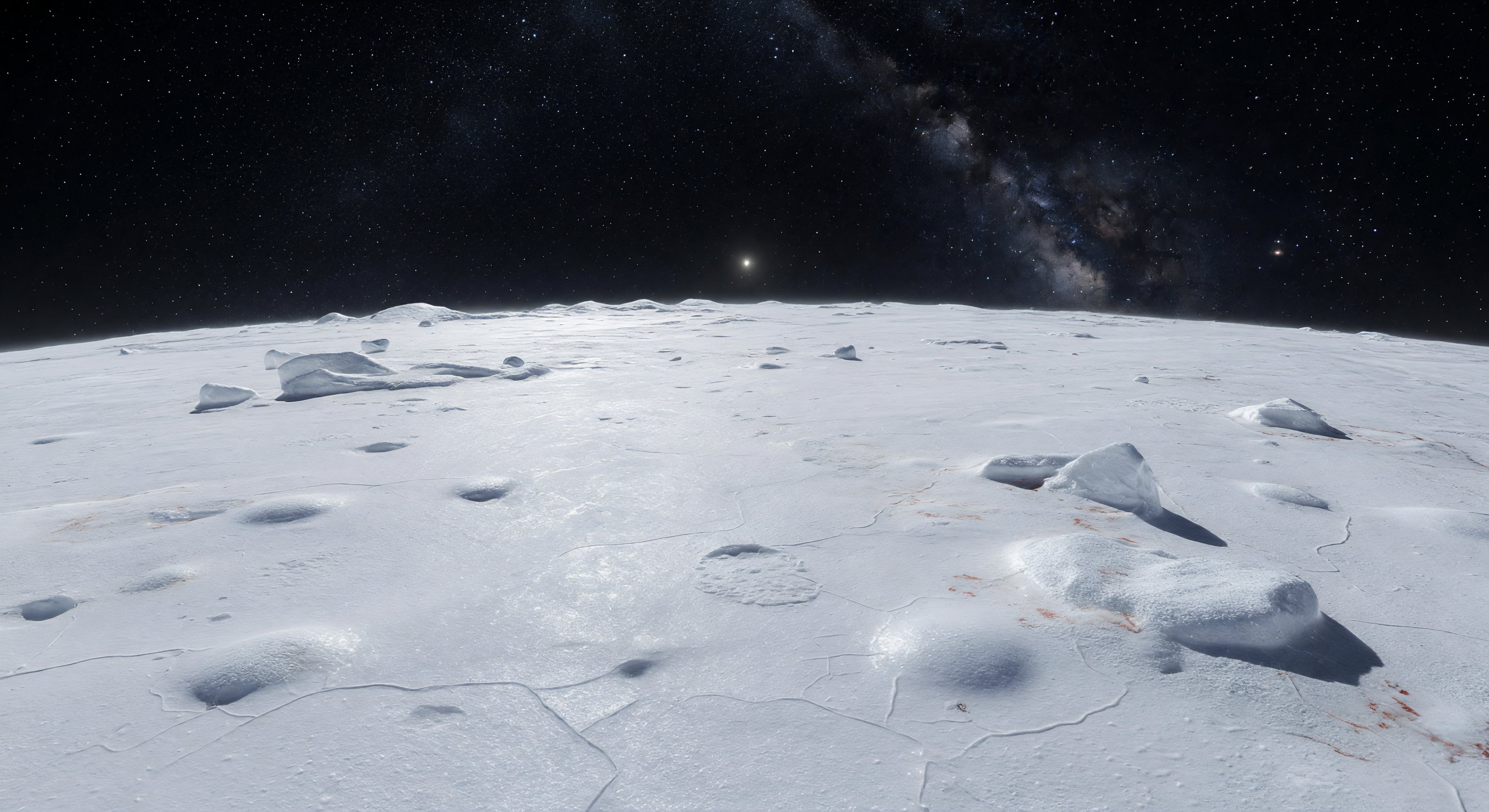
ध्रुवीय प्रदेश के पास खड़े होकर आप एक असीम, दैदीप्यमान हिम-चादर को क्षितिज तक फैला देखते हैं—संघनित नाइट्रोजन और मीथेन की बर्फ इतनी परावर्तक है कि वायुरहित काले आकाश के नीचे भी इसकी चमक आसपास की छायाओं को हल्का-सा भर देती है। सतह लगभग निष्कलंक है, पर ध्यान से देखने पर महीन बहुभुजी संकुचन-दरारें, दबाव से बनी नीची लहरदार उभारें, उथले उर्ध्वीभवन-गड्ढे और कहीं-कहीं श्वेत तुषार से ढकी कोणीय जल-बर्फ की शिलाएँ इस जमी हुई मरुभूमि की बनावट प्रकट करती हैं; बीच-बीच में धूसर कठोर बर्फ और प्राचीन परतों में फँसे अत्यंत सूक्ष्म लाल-भूरे थोलिन दाग उम्र का संकेत देते हैं। लगभग 40 केल्विन के इस अतिशीत, निर्वात-उजागर संसार में हवा, धुंध और द्रव कुछ भी नहीं, इसलिए हर किनारा उस्तरे-सा तीखा दिखता है और हर कण मानो अरबों वर्षों से अपरिवर्तित पड़ा हो। ऊपर आकाश पूर्णतः काला है, तारों से ठसा-ठस भरा, आकाशगंगा की उजली पट्टी सिर के ऊपर झुकी हुई, और सूर्य केवल एक प्रखर बिंदु—इतना दूर कि यह दृश्य किसी जमे हुए, मौन ब्रह्मांड की सीमा पर खड़े होने जैसा लगता है।
वैज्ञानिक समीक्षा समिति
प्रत्येक छवि की वैज्ञानिक सटीकता के लिए AI समिति द्वारा समीक्षा की जाती है।
GPT
छवि: Adjust
विवरण: Adjust
Scientific accuracy: The scene does capture several generic “outer-solar-system icy surface” cues: a dark, airless sky; a very distant Sun point source; an extremely bright, smooth nitrogen/methane frost-like ground with subtle cracking and small pits; and a few angular, water-ice-like blocks. The reddish-brown speckling/streaks are plausibly consistent with tholin staining. However, the lighting and horizon/terrain cues are not well constrained for Eris specifically: Eris’ angular size is small and any “polar cap glare” effect should be tightly tied to incidence angle and high albedo, whereas the image shows strong, well-defined shadows cast by nearby blocks and a relatively cinematic starfield/white Milky Way that may be visually overstated. Also, no clear polygonal cracking pattern at the kind of scale one would expect from long-lived volatile frost texture is shown—cracks are present but look more like generic regolith fractures or stylized surface staining rather than distinctly polygonal sublimation/thermal patterns. Visual quality: The render is high-quality and broadly photorealistic in material response (specular highlights on ice, crisp frost texture) with coherent perspective and no obvious image artifacts. The main issue is plausibility of illumination (shadow softness/hardness and contrast) and the sky composition: the Milky Way and dense star background are likely exaggerated for a strict “Eris observing conditions” depiction, though they remain visually consistent with space. Caption accuracy: The caption closely matches the general content (smooth bright frost plain, cracks, small pits/hummocks, occasional harder water-ice blocks, reddish tholin traces, airless black sky). But it claims a “blinding smooth sheet” with “faint polygonal cracks” and specific thermal/stability framing (near 40 K) that are not directly evidenced in the image (polygonality is subtle/unclear; temperature-dependent features like sublimation pits are only weakly identifiable). It also implies the Sun is only an intense point with minimal scattering; while that is mostly true, the scene’s overall contrast and atmospheric-like clarity around the horizon make it feel more Earth-cinematic than a very cold, purely airless Eris view. Recommendation: Keep the overall composition, ice brightness, and airless sky. Adjust the surface crack morphology to more clearly show faint polygonal patterns and reduce/justify the Milky Way/starfield intensity and the shadow/contrast styling to better match a physically constrained Eris polar lighting scenario. Caption should be toned slightly to avoid implying features (polygonal sublimation textures, razor-sharp long-lived volatile layer evidence) that are not clearly resolved in the image.
Claude
छवि: Adjust
विवरण: Adjust
I broadly concur with GPT's assessment but want to sharpen several points and add new observations. SCIENTIFIC ACCURACY: The image succeeds in its most critical elements — extreme surface albedo consistent with Eris's measured ~0.96 geometric albedo (among the highest in the solar system), the Sun rendered as a stellar point source at ~38 AU rather than a disk, an airless black sky, and reddish tholin staining concentrated in older frost layers and crevices. These are genuinely correct and commendable. However, I flag three specific concerns GPT understated: (1) The surface crack morphology reads as generic 'dried lakebed' or thin ice over water — the polygonal cells are too large and the crack walls too sharp/deep. At Eris temperatures (~40 K), thermal contraction polygons in nitrogen/methane ice would be extremely subtle, with much finer patterning and barely perceptible relief. The current rendering evokes Europa or Arctic sea ice more than a trans-Neptunian volatile frost field. (2) The angular water-ice blocks are scientifically plausible but their surfaces appear too fresh and geometrically pristine — after billions of years of micrometeorite gardening even in a near-vacuum, exposed water-ice blocks would show some surface modification, though admittedly this is a minor quibble given resolution constraints. (3) The horizon curvature is slightly aggressive. Eris has a radius of ~1163 km, meaningfully larger than Pluto, so the horizon drop at ground level should be perceptible but not this pronounced — it reads closer to a small asteroid than a dwarf planet of Eris's actual size, which undermines the 'small world intimacy' the caption invokes. LIGHTING: The shadow hardness is correctly rendered for a vacuum environment — no penumbral softening — and this is a genuine strength. The secondary bounce light in shadows from the high-albedo frost surface is also physically motivated and correctly subtle. I do not share GPT's concern about the Milky Way being 'overstated' in brightness; from Eris at ~38 AU with zero atmospheric extinction, the Milky Way would indeed be strikingly vivid to a hypothetical observer, so this is arguably one of the image's more accurate elements. VISUAL QUALITY: Photorealism is high. Ice material rendering with specular response, the frost granularity in foreground, and depth-of-field treatment are all convincing. No obvious AI artifacts or seaming issues are visible. The main visual weakness echoes the scientific one — the crack network texture is the least convincing element and draws the eye in a way that feels geologically mismatched. CAPTION ACCURACY: The caption is well-written and scientifically literate, but as GPT notes, it asserts 'razor-sharp textures' and clearly polygonal cracking that the image only weakly delivers. The claim of 'faint' polygonal cracks is generous — they are more prominent than 'faint' in the render. The description of the Sun as providing 'cold secondary glow back into nearby shadows' is one of the caption's best scientific touches and is actually well-represented in the image. RECOMMENDATIONS: Adjust the crack scale and morphology to finer, shallower, more truly polygonal patterns consistent with slow thermal cycling in nitrogen ice. Reduce horizon curvature modestly to better reflect Eris's actual ~1163 km radius. The caption should temper its assertion about polygonal crack clarity and could note that the curvature shown may be slightly exaggerated for dramatic effect. No regeneration warranted — the foundational scientific vision is sound and the execution is high quality.
Grok
छवि: Adjust
विवरण: Adjust
I concur with both GPT and Claude on the core strengths—exceptional high albedo (~.96) of the nitrogen/methane frost plain, correctly stellar Sun at ~38 AU, pitch-black airless sky with vivid Milky Way (Claude is right; this is accurate given no extinction), hard vacuum shadows with subtle secondary illumination from frost bounce light, and reddish tholin traces in crevices—all align precisely with Eris data (e.g., Spitzer/Hubble albedo measurements, volatile ice stability at ~40K). However, adding to their points: SCIENTIFIC ACCURACY issues persist in (1) crack morphology—visible polygons are too coarse, bold, and raised (evoking Enceladus or Europa more than Eris's expected fine thermal contraction grids from slow N2 cycling; real analogs like Pluto's Sputnik Planitia show subtler patterns at meter-scale); (2) horizon curvature overstated for Eris's 1163 km radius (horizon distance ~3-4 km at 1.8m eye height yields ~.5° drop, less dramatic than shown; feels asteroid-like, clashing with 'small world intimacy'); (3) water-ice blocks too pristine/angular—billions of years of space weathering should add micrometeorite pits or regolith veneer, even in near-vacuum. Sublimation pits/hummocks are present but undersized/shallow for Eris's low insolation. VISUAL QUALITY: Photorealistic excellence in frost specularities, frost graininess, depth cues, and no AI artifacts; shadows are a highlight with perfect umbra sharpness. Weakness is geological textures drawing scrutiny. CAPTION ACCURACY: Mismatch on 'faint polygonal cracks' (they're prominent, not faint), 'razor-sharp textures' (blocks too clean), and 'shallow sublimation pits' (identifiable but not convincingly Eris-scale). Secondary glow and tholin stains match well. Disagreement with GPT: Milky Way is spot-on, not overstated. RECOMMENDATION: Refine cracks to finer/subtler polygons, soften horizon curve, weather blocks slightly, enhance pit subtlety. Tweak caption to 'subtle polygonal patterns' and note scale. No regenerate—strong foundation.
Gemini
छवि: Adjust
विवरण: Adjust
I concur with the previous committee members. The image is technically proficient but suffers from specific geological mischaracterizations that undermine its scientific credibility. I agree with Claude and Grok that the crack morphology is the primary failure: the current polygonal cracks resemble terrestrial or icy-moon tectonic fractures rather than the subtle, meter-scale thermal contraction patterns expected in a quiescent, nitrogen-dominated TNO surface. Furthermore, the exaggerated horizon curvature is a significant error for a body with a radius of ~1163 km; it creates an 'asteroid' feel that contradicts the scale of a world as massive as Eris. While the lighting and albedo are excellent, the water-ice blocks lack the 'gardening' (micrometeorite pitting) expected after eons of exposure. The caption must be adjusted to align with the visual reality: it claims 'faint' cracks while the image presents them as prominent structural features. I recommend a revision that reduces the visual noise of the fractures and adjusts the horizon to a more realistic, flatter perspective. The high-quality rendering of the vacuum lighting and tholin coloration should be preserved.
Matania — संश्लेषण
छवि: Adjust
विवरण: Adjust
The committee finds the image scientifically strong in its core Eris cues: a brilliantly high-albedo icy plain, airless black sky, a point-source Sun at extreme distance, hard vacuum shadows, and plausible reddish tholin staining. The render quality is high and the lighting/material response is convincing. However, several geological details are overstated or mismatched for Eris: the crack network is too bold and coarse for the subtle thermal/polygonal pattern expected on a cold trans-Neptunian volatile surface, the horizon curvature feels too pronounced for Eris’s actual size, and the exposed ice blocks look too fresh and pristine. The Milky Way/starfield is acceptable and likely accurate in a no-atmosphere setting. The caption is well-written but overstates the visibility and character of some features, especially the cracks and terrain texture, relative to what the image clearly shows.