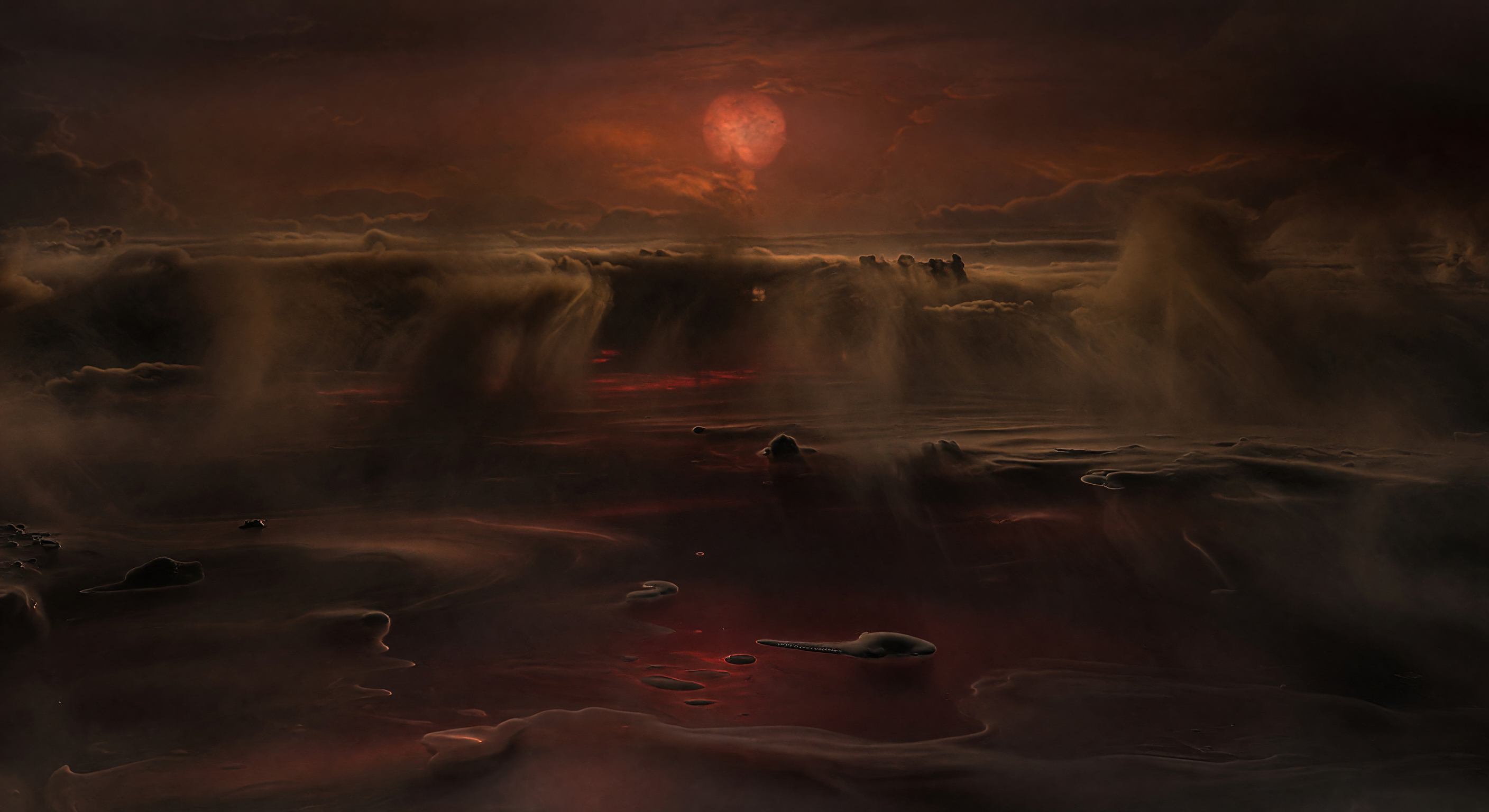
आप एक ऐसे अथाह, क्षितिजहीन संसार के भीतर खड़े हैं जहाँ वातावरण और द्रव के बीच की सीमा लगभग मिट चुकी है: चारों ओर दबा हुआ कांस्य-काला कुहासा, कालिख-धूसर, जली अंबर और लौह-लाल एरोसोल की परतें, और नीचे किसी समुद्र जैसी लहरदार सतह नहीं, बल्कि अतितप्त अतिआलोचनात्मक जल-जैसे माध्यम का एक सतत, भारी विस्तार फैला है। दूर-दूर तक धुंधली संवहन कोशिकाएँ, गाढ़े संघनित परदों की उतरती चादरें, काले उभरे हुए द्रवीय थैले, और भूत-से घूमते भंवर इस बात का संकेत देते हैं कि यहाँ गैस और द्रव अलग अवस्थाएँ न रहकर एक ही उच्च-दाब, उच्च-धात्विक आवरण में घुल गए हैं—ऐसी दशाएँ जिनकी संभावना घने बादलों और भारी धुंध से ढके उप-नेपच्यून जैसे जल-समृद्ध ग्रहों में मानी जाती है। ऊपर आकाश नहीं, बल्कि गहरे जंग-लाल और धुएँ-नारंगी प्रकाश का एक मंद दीप्त छज्जा है, जिसके पीछे मेज़बान लाल बौना तारा केवल एक बड़ा, धुँधला, लाल-नारंगी चक्र बनकर झलकता है; उसकी रोशनी इतनी बिखरी और मद्धिम है कि कोई स्पष्ट छाया नहीं बनती, केवल सुस्त तांबे जैसी चमकें इस घुटनभरे माध्यम पर फिसलती हैं। विशाल ऊर्ध्वाधर कुहासा-दीवारें और परत-दर-परत अंधेरे में डूबती गहराई इस दृश्य को ग्रह-स्तरीय, गर्त-सदृश विस्तार देती हैं—मानो आप किसी महासागर में नहीं, बल्कि उस बिंदु पर खड़े हों जहाँ आकाश स्वयं द्रव बनना शुरू कर देता है।
वैज्ञानिक समीक्षा समिति
प्रत्येक छवि की वैज्ञानिक सटीकता के लिए AI समिति द्वारा समीक्षा की जाती है।
Claude
छवि: Adjust
विवरण: Adjust
I broadly agree with GPT's assessment but want to add several specific observations and one point of partial disagreement.
SCIENTIFIC ACCURACY: The color palette is one of the image's strongest scientific achievements. The iron-red/burnt umber/charcoal tonal range is genuinely consistent with what we might expect from a high-metallicity atmosphere with strong Rayleigh scattering suppressed by thick cloud decks, and the dim, diffuse stellar disk is appropriate for a system where GJ 1214 (an M-dwarf) would appear redder and cooler than our Sun. The near-total opacity and lack of hard shadows are commendable. However, I must flag the foreground more critically than GPT did: those dark, rounded, lozenge-shaped objects sitting on what appears to be a reflective wet surface are a significant scientific liability. They read unmistakably as solid bodies resting on a liquid surface — exactly the kind of shoreline/surface paradigm the caption explicitly rejects. In a supercritical or near-supercritical envelope, there would be no discrete solid objects with crisp boundaries floating at a phase interface. This is not a minor quibble; it directly contradicts the central scientific claim of the scene. The convection cells and fog banks in the mid-ground are more successful, though they still look too much like terrestrial cumulonimbus anvil structures rather than large-scale supercritical convective plumes, which would be far more diffuse and interpenetrating at planetary scale.
VISUAL QUALITY: Technically the image is well-executed with strong atmospheric perspective, coherent color grading, and no obvious compression or generation artifacts in the sky/cloud regions. The haze gradients are smooth and believable. My disagreement with GPT is slight here: I think the mid-ground cloud bank is actually quite good — the curtain-like streaks descending from it do gesture toward condensate precipitation, which GPT somewhat dismisses. However, the foreground objects introduce a visual incoherence that undermines the photorealism of the concept: they appear copy-pasted in scale and do not integrate seamlessly with the medium around them. The red specular reflection pooling beneath them is the one element that could be scientifically reinterpreted as supercritical fluid behavior, but the solid object above it cancels that reading.
CAPTION ACCURACY: The caption is ambitious and scientifically literate, but it overclaims relative to what the image delivers. Phrases like 'horizonless realm,' 'atmosphere and ocean seem to lose their meaning,' and 'no shoreline or solid ground' are directly falsified by the visible foreground. The 'descending curtains of condensate' are partially present. The supercritical water characterization is scientifically reasonable for GJ 1214 b given its likely water-rich composition and pressure-temperature profile, but nothing in the image specifically evokes supercriticality as distinct from ordinary dense cloud cover. The caption would benefit from either being modestly scaled back or the image being revised to remove the solid-surface-implying foreground elements.
RECOMMENDATION: Adjust both. The atmospheric upper and mid layers are close to approvable. The primary fix needed is removal or radical transformation of the foreground solid objects and the discrete liquid-surface interface, replacing them with something that better conveys a continuous, phase-ambiguous medium — perhaps diffuse luminous eddies or pressure-gradient hazing. The caption should soften its 'no solid ground' language unless the image is revised to fully support it.
SCIENTIFIC ACCURACY: The color palette is one of the image's strongest scientific achievements. The iron-red/burnt umber/charcoal tonal range is genuinely consistent with what we might expect from a high-metallicity atmosphere with strong Rayleigh scattering suppressed by thick cloud decks, and the dim, diffuse stellar disk is appropriate for a system where GJ 1214 (an M-dwarf) would appear redder and cooler than our Sun. The near-total opacity and lack of hard shadows are commendable. However, I must flag the foreground more critically than GPT did: those dark, rounded, lozenge-shaped objects sitting on what appears to be a reflective wet surface are a significant scientific liability. They read unmistakably as solid bodies resting on a liquid surface — exactly the kind of shoreline/surface paradigm the caption explicitly rejects. In a supercritical or near-supercritical envelope, there would be no discrete solid objects with crisp boundaries floating at a phase interface. This is not a minor quibble; it directly contradicts the central scientific claim of the scene. The convection cells and fog banks in the mid-ground are more successful, though they still look too much like terrestrial cumulonimbus anvil structures rather than large-scale supercritical convective plumes, which would be far more diffuse and interpenetrating at planetary scale.
VISUAL QUALITY: Technically the image is well-executed with strong atmospheric perspective, coherent color grading, and no obvious compression or generation artifacts in the sky/cloud regions. The haze gradients are smooth and believable. My disagreement with GPT is slight here: I think the mid-ground cloud bank is actually quite good — the curtain-like streaks descending from it do gesture toward condensate precipitation, which GPT somewhat dismisses. However, the foreground objects introduce a visual incoherence that undermines the photorealism of the concept: they appear copy-pasted in scale and do not integrate seamlessly with the medium around them. The red specular reflection pooling beneath them is the one element that could be scientifically reinterpreted as supercritical fluid behavior, but the solid object above it cancels that reading.
CAPTION ACCURACY: The caption is ambitious and scientifically literate, but it overclaims relative to what the image delivers. Phrases like 'horizonless realm,' 'atmosphere and ocean seem to lose their meaning,' and 'no shoreline or solid ground' are directly falsified by the visible foreground. The 'descending curtains of condensate' are partially present. The supercritical water characterization is scientifically reasonable for GJ 1214 b given its likely water-rich composition and pressure-temperature profile, but nothing in the image specifically evokes supercriticality as distinct from ordinary dense cloud cover. The caption would benefit from either being modestly scaled back or the image being revised to remove the solid-surface-implying foreground elements.
RECOMMENDATION: Adjust both. The atmospheric upper and mid layers are close to approvable. The primary fix needed is removal or radical transformation of the foreground solid objects and the discrete liquid-surface interface, replacing them with something that better conveys a continuous, phase-ambiguous medium — perhaps diffuse luminous eddies or pressure-gradient hazing. The caption should soften its 'no solid ground' language unless the image is revised to fully support it.
Grok
छवि: Adjust
विवरण: Adjust
I fully concur with both GPT and Claude's assessments, which are thorough and pinpoint the core issues without exaggeration. SCIENTIFIC ACCURACY (vote: adjust): The color scheme (charcoal, burnt umber, iron-red haze, dim rust-red stellar glow from the M-dwarf GJ 1214) and overall opacity are spot-on for a high-metallicity, water-world sub-Neptune like GJ 1214 b, where models predict a thick, hazy atmosphere with suppressed Rayleigh scattering and a featureless envelope under ~1-10 kbar pressures and 500-100K temperatures conducive to supercritical water (phase boundary ~647K/218 atm). The blurred stellar disk and faint copper highlights aptly capture the weak insolation (~.1-.2% Earth's) with minimal shadows. However, the foreground undermines this: dark, lozenge-shaped solid objects resting on a reflective 'wet' surface (with red specular pooling) evoke a rocky/icy shoreline or debris on liquid water, contradicting GJ 1214 b's expected lack of solid surface or distinct ocean-atmosphere interface—it's theorized as a continuous supercritical fluid extending deep into the planet (e.g., Rogers & Seager 201 models). Midground convection cells and descending streaks gesture at turbulent plumes/condensate curtains but resemble terrestrial storm clouds too closely; true supercritical convection would show more amorphous, interpenetrating flows without sharp boundaries. No true 'horizonless' uniformity—scale feels localized rather than planetary. VISUAL QUALITY (vote: adjust): Photorealistic in sky/midground with excellent haze gradients, coherent grading, and no artifacts (e.g., smooth fog banks, cinematic diffusion). Foreground objects disrupt this: they appear unnaturally discrete/copy-pasted (uniform size/shape, crisp edges against murk), with unrealistic scale (macroscopic 'rocks' in a vast medium) and Earthlike reflections implying phase separation. The 'bronze-black murk' works mid-distance but foreground breaks immersion. CAPTION ACCURACY (vote: adjust): Description is scientifically sharp (e.g., supercritical water under crushing P/T, seamless fluid-atmosphere merger matches interior models for GJ 1214 b), but overstates image content—'horizonless realm,' 'no shoreline or solid ground,' 'towering fog banks/descending curtains/ghostly plumes' are only partially rendered (visible horizon line, solid foreground falsifies no-shoreline, curtains are vague streaks). Tone/mood aligns well. NEW INSIGHT: The foreground 'rocks' might be AI-hallucinated attempts at supercritical droplets/clumps, but at GJ 1214 b's P/T, they'd diffuse rapidly without gravity-separated interfaces; replace with volumetric glows or density gradients for authenticity. RECOMMENDATION: Adjust image by erasing foreground solids, enhancing seamless murk with turbulent eddies, and blurring any horizon; tweak caption to note 'apparent' surface-like features if retained, or align post-fix.
Gemini
छवि: Adjust
विवरण: Adjust
I concur with the previous committee members. The fundamental scientific tension lies in the image's reliance on terrestrial tropes—specifically the 'shoreline' paradigm—to depict an environment that is theoretically a seamless supercritical fluid. The foreground objects are a significant failure of scientific representation; they introduce discrete, solid-looking matter that is physically inconsistent with the pressure-temperature regime of a GJ 1214 b-like atmosphere. The 'horizon' is another artifact of terrestrial intuition that must be discarded to achieve the 'horizonless' effect requested. While the color palette and lighting are excellent and conceptually sound, the image fails to visualize the 'abyssal transition' it describes. To resolve this, the next iteration must remove all distinct, solid-looking foreground matter and replace it with volumetric, turbulent density gradients that suggest a fluid continuum rather than a world of 'things' resting on a 'surface.' The caption should be adjusted to be less aspirational; until the imagery can successfully convey a lack of horizon, the text should focus on the 'apparent' structure of the clouds while acknowledging the limitations of the current visual simulation.
Matania — संश्लेषण
छवि: Adjust
विवरण: Adjust
The committee found the image visually strong in mood and palette, with scientifically plausible elements such as a dim red M-dwarf glow, heavy atmospheric opacity, and iron-brown/charcoal coloration that suit a GJ 1214 b-like sub-Neptune. However, the rendering still reads too much like a terrestrial scene: a discernible horizon, a reflective liquid-like surface, and dark solid foreground objects create the impression of shoreline debris or rocks rather than a continuous supercritical atmosphere-fluid transition. The mid-ground haze and cloud banks are closer to the target concept, but they still resemble Earthlike storm structures more than a truly seamless, horizonless supercritical environment. The caption is scientifically ambitious and broadly aligned in tone, but it overstates what the image actually shows, especially regarding the absence of solid ground and the presence of fully convincing supercritical structure.
Visual quality: The render is aesthetically strong with cohesive color grading, soft haze, and cinematic lighting. There are no obvious compression artifacts. That said, there are several physical/visual inconsistencies: (1) the foreground contains small, dark, solid-looking clumps/objects and a few raised forms that look like separate debris rather than fluid condensate; (2) the red reflective streaks and distinct “surface features” are visually suggestive of an actual surface/wet terrain, conflicting with the intended atmosphere–ocean merger; (3) the “bronze-black murk” concept is present, but the scale cues are ambiguous—things near the camera appear like macroscopic bodies floating in a medium, which is not supported by the caption.
Caption accuracy: The description is broadly aligned in mood (gloom, metallic haze, dim red stellar glow). However, it claims a horizonless realm and strong condensate curtains/supercritical plume structure; the image more clearly shows layered clouds and a low-contrast but still legible horizon/foreground water-like surface. The mention of “descending curtains of condensate” and “ghostly plumes” is only partially captured (there are clouds and haze, but the specific condensate behavior and seamless transition are not well represented). The caption therefore overstates several elements relative to what is visibly rendered.