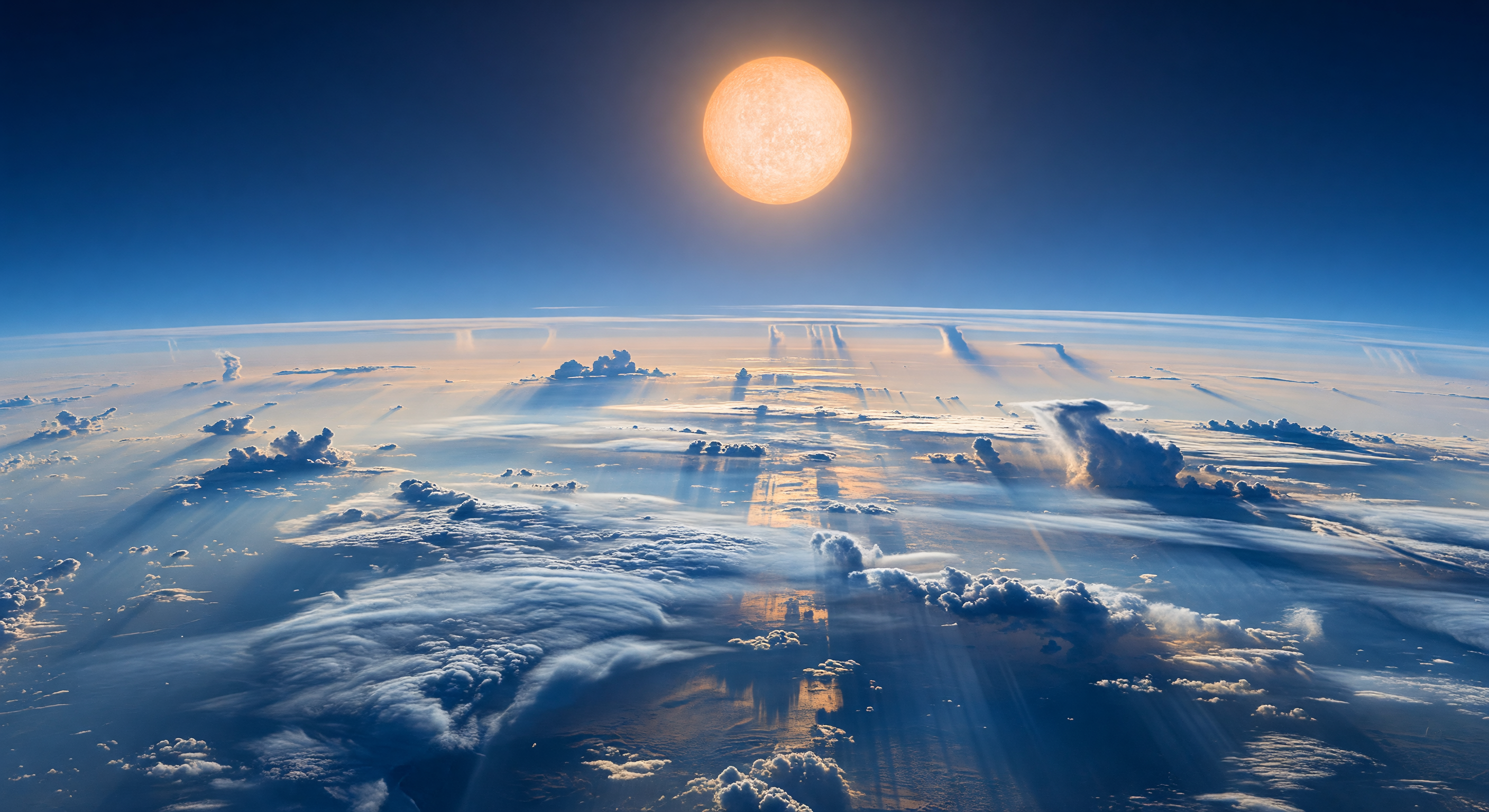
स्थायी दिन-पक्ष के ऊपरी वायुमंडल से नीचे देखते हुए ऐसा लगता है मानो चाँदी-नीली बादलों की एक अंतहीन, चिकनी महासागरीय चादर ग्रह की वक्रता के साथ क्षितिज तक फैली हो, जिसमें परतदार धुंध, निहाई-जैसे संघनित मेघ-तट, पवन से सँवरी लंबी धारियाँ और कहीं-कहीं वाष्प के पर्वतों जैसे ऊँचे संवहनीय स्तंभ उठते दिखते हैं। ऊपर आकाश अस्वाभाविक रूप से गहरा कोबाल्ट और नीलम-सा है, और शीर्ष पर लटका 5–6 डिग्री चौड़ा, चकाचौंध करता नारंगी-श्वेत तारा सिलिकेट कणों की अग्र-विखरित धुंध से घिरे एम्बर प्रभामंडल में जलता प्रतीत होता है, जिसकी रोशनी बादल-शिखरों पर सफेद-रजत चमक और कोमल नीली परावर्तित झिलमिलाहट बिखेरती है। यह दृश्य ठंडे रंगों के बावजूद नरक-जैसी परिस्थितियों का है: यहाँ कोई ठोस सतह नहीं, केवल अत्यंत गर्म, गहराई तक उतरता गैसीय वायुमंडल, जहाँ सिलिकेट धुंध और बादल प्रकाश को नीला रंग देते हैं और कई किलोमीटर प्रति सेकंड की पराध्वनिक हवाएँ मौसम को हिंसक रूप से आकार देती हैं। दूर कहीं गहरे अल्ट्रामरीन अंतराल नीचे के गर्म स्तरों में खुलते हैं, और क्षीण तिरछी परतों में काँच-जैसी वर्षा लगभग क्षैतिज बहती जान पड़ती है, जिससे पूरा क्षितिज एक साथ भव्य, विशाल और घातक महसूस होता है।
वैज्ञानिक समीक्षा समिति
प्रत्येक छवि की वैज्ञानिक सटीकता के लिए AI समिति द्वारा समीक्षा की जाती है।
Claude
छवि: Adjust
विवरण: Adjust
I broadly agree with GPT's assessment but want to sharpen several points and add new ones. On scientific accuracy: HD 189733 b is a hot Jupiter orbiting only ~0.031 AU from its K-type host star, meaning the star should subtend a truly enormous angular diameter — roughly 20x that of our Sun as seen from Earth. The rendered star, while enlarged, still reads as comfortably proportioned rather than atmospherically dominating, and its orange coloration is reasonably consistent with HD 189733's K2V spectral class. I'd call that a partial success. More problematic is the cloud morphology. The cumulus towers, stratiform sheets, and anvil structures are essentially transplanted Earth tropospheric convection. HD 189733 b's atmosphere, under ~1200K dayside temperatures and likely supersonic zonal winds exceeding 2 km/s, would not produce recognizable Earth-analog cumulus architecture. Convective features might exist but would be severely sheared, elongated nearly horizontally, and embedded in a much denser, more opaque haze continuum. The image's clouds look like a high-altitude aircraft view of Earth's tropics, which undercuts the 'infernal conditions' premise entirely. The cobalt-blue coloration is scientifically interesting — HD 189733 b is famously blue due to silicate/glass particle scattering (Pont et al. 2013 HST detection) — but the rendered blue here reads as Rayleigh scattering in an oxygen-nitrogen atmosphere, not the deep azure of MgSiO3 or Fe aerosol forward-scattering. The haze deck lacks the characteristic uniform, featureless opacity that high-altitude silicate hazes would produce; instead it's texturally complex in a very terrestrial way. The ocean surface glimpsed between clouds is another issue — HD 189733 b has no liquid surface of any kind, and while the description wisely frames these as cloud-top reflections, the warm amber glow between clouds visually implies a liquid ocean below, creating a misleading impression. Regarding caption accuracy: GPT correctly notes that the 'supersonic sideways precipitation' and 'glass-rich' rain are not visually evidenced. I'd add that the description's phrase 'hovering above a luminous weather ocean' is actually well-served by the image's composition, and the layered depth with darker ultramarine below is one of the stronger matches between image and caption. The 'anvil-shaped condensate banks' are present but look like ordinary cumulonimbus rather than exotic condensate towers. The caption also claims conditions 'hot enough for rock-forming materials to exist as aerosols,' which is scientifically accurate for HD 189733 b but the image palette — cool blues and white clouds — actively contradicts the thermal violence this implies. A thermally accurate render would incorporate more infrared-emission-influenced warm tones in deeper atmospheric layers. My recommendation diverges slightly from GPT's in emphasis: the primary adjustment needed is not just palette but cloud structure. The generator should suppress Earth-analog cumulus morphology in favor of continuous, opacity-dominant haze layers with only subtle, wind-elongated texture. The star should be rendered larger and its scattered glare more pervasive across the sky dome. The cobalt tones are directionally correct and should be retained but deepened and made more uniform to reflect silicate haze opacity rather than clear-air Rayleigh scattering. Overall: a visually impressive and conceptually appropriate image that is significantly weakened by Earth-analog atmospheric texture and insufficient rendering of the extreme thermal and dynamic conditions that define this specific exoplanet.
Grok
छवि: Adjust
विवरण: Adjust
I concur with both GPT and Claude's assessments on the core issues—Earth-analog cloud morphology (crisp cumulus towers, anvil shapes, and stratiform sheets) dominates the image, undermining the supersonic wind-sheared, haze-dominated atmosphere of HD 189733 b (~120K dayside, >2 km/s winds per Showman et al. 2008 and observations). The star is enlarged but subtends only ~10-15x solar diameter visually, far short of the ~20x expected from .031 AU orbit around K2V HD 189733 (calculated via angular diameter θ ≈ 32 arcmin/R_sun * d_sun/d_planet); it lacks pervasive glare/scattering. Cobalt-blue tones nod to silicate haze (Pont et al. 2013 HST blue detection via MgSiO3/Fe aerosols), but appear as clear-sky Rayleigh rather than opaque, uniform forward-scattering haze—deeper layers should show thermal emission glow (near-IR excess per Spitzer data), not just ultramarine fade. No evidence of 'glass-rich precipitation sheets driven sideways' or 'vapor mountains'; wind-combed streaks are present but too organized/terrestrial. The 'silver-blue ocean' reads convincingly as cloud tops with horizon curvature emphasizing no solid surface, a strong point. Visual quality is photorealistic and artifact-free (excellent depth, god-rays, perspective), evoking ISS-style aerial views but not alien enough. Caption mismatches on unvisualized elements like anvil condensates (look like Earth cumulonimbus), supersonic rain, and silicate-driven cobalt (image implies water scattering). New insight: amber lighting on clouds fits K-star spectrum but over-emphasizes specular reflections, implying liquid 'ocean' below rather than aerosol deck—adjust to muted, absorbed tones for high-opacity hazes. Recommendation: Retain composition/scale; regenerate haze as featureless deep-blue opacity gradient with subtle horizontal shear streaks, massively enlarge star with sky-dominating halo, suppress cumulus textures for continuous deck, infuse deeper layers with warm thermal emission for 'infernal' feel.
Gemini
छवि: Adjust
विवरण: Adjust
I concur with the committee's consensus that the image suffers from 'terrestrial bias.' While the cobalt color palette successfully references the silicate-haze scattering identified by the Hubble Space Telescope, the cloud morphology—distinct cumulus, anvils, and stratiform sheets—is purely Earth-tropospheric. At the extreme temperatures of HD 189733 b, these structures would be obliterated by supersonic zonal winds and extreme thermal forcing, resulting in a more featureless, fluid, and smeared appearance. The 'ocean' look is visually compelling but misleading; the light-reflecting layers beneath the clouds imply a liquid surface, which is physically impossible here. Furthermore, the star, while enlarged, fails to dominate the sky as it would at 0.031 AU; it should be a massive, glare-heavy presence that defines the lighting of the entire hemisphere. The caption is evocative but relies on describing features (like 'glass-rich precipitation') that the image fails to render, creating a dissonance between text and visual evidence. I recommend an adjustment that replaces Earth-like cloud textures with elongated, wind-sheared 'ribbons' of haze and a more oppressive, high-opacity sky gradient that better reflects the infernal nature of a hot Jupiter.
Matania — संश्लेषण
छवि: Adjust
विवरण: Adjust
The committee agrees the piece is visually strong and scientifically plausible in broad concept, but it is weakened by Earth-like atmospheric cues. The curved horizon and all-atmosphere ‘cloud ocean’ framing fit HD 189733 b well, and the cobalt palette is directionally consistent with the planet’s famously blue, haze-rich appearance. However, the cloud structures read as terrestrial cumulus, anvils, and stratiform sheets rather than the more smeared, opaque, wind-sheared haze expected on a hot Jupiter under extreme irradiation and supersonic winds. The star is appropriately present but not dominant enough for such a close orbit, and the lighting/texture still suggest a blue sky over a liquid-like cloudscape rather than a dense, featureless, high-temperature atmospheric deck. The caption is evocative and mostly aligned with the concept, but it describes several details that are not visibly supported, especially glass-rich precipitation, sideways supersonic rain, and strongly infernal thermal cues. Overall: strong composition, but the image and caption should be refined to better match HD 189733 b’s extreme, haze-dominated atmosphere.
Visual quality: The image is high-quality and convincing as a planetary vista: good curvature, depth, and volumetric lighting. There are no obvious AI artifacts (no warped geometry, text, or inconsistent perspective). That said, the atmosphere-to-sky transition and cloud texture are still reminiscent of Earth aerial photography/space-station renders; the “cobalt haze ocean” is not clearly distinct from generic blue clouds. The presence of a warm, Earth-like atmospheric scattering near the horizon also weakens the claim of a deep cobalt silicate-haze sky.
Caption accuracy: The caption is rich and mostly aligned with an atmospheric-ocean concept (cloud tops, horizon curvature, layered haze, distant towers). But it specifies a “deep cobalt sky… not by water” and conditions like glass-rich precipitation, anvil-shaped condensate banks, and nearly sideways supersonic precipitation—features that are not clearly identifiable in the image. Additionally, the star is described as “orange-white” and “swollen to many times the apparent width of the Sun,” which is broadly supported by the enlarged bright disk, but the described infernal optical/chemical appearance (cobalt sky from silicate haze) is not strongly demonstrated.
Recommendation: Keep the all-atmosphere cloud-ocean and curved horizon, but adjust the atmospheric palette and cues to better match a hazy hot Jupiter (stronger scattering/absorption signatures, more clearly anisotropic/sideways precipitation or denser condensate sheets, and less Earth-analog cloud texture).