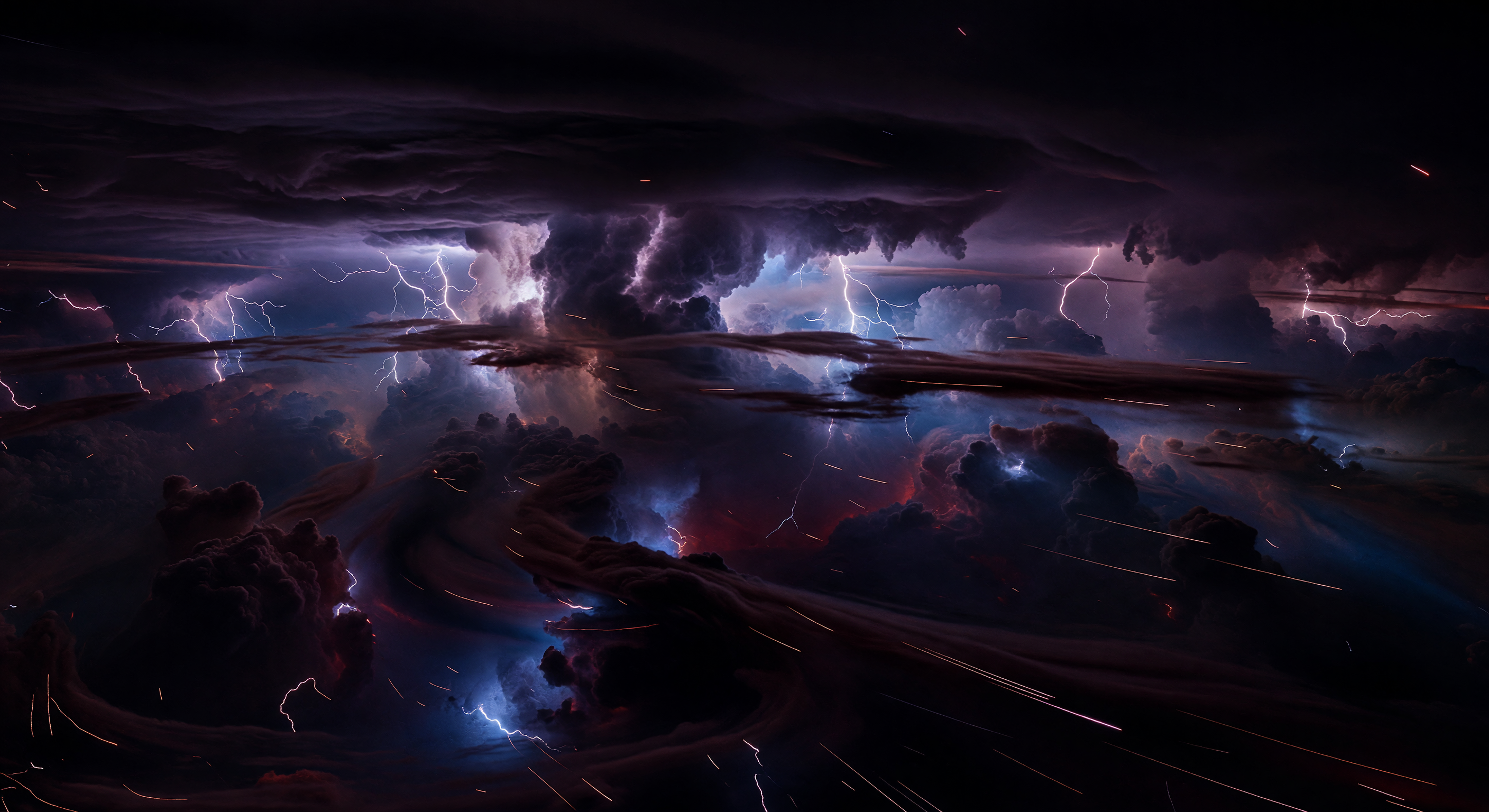
स्थायी रात्रि-पक्ष की इस अथाह वायुमंडलीय गहराई में नीचे कोई धरातल नहीं, केवल गहरे मैरून, बैंगनी-काले और कोबाल्ट धुंध की परतों से बना बादलों का एक विशाल समुद्र है, जो अंधकार में बिना तली के डूबता जाता है। नीला-श्वेत बिजली कौंधते ही खनिज-समृद्ध तूफ़ानी स्तंभ, निहाई जैसे महाबादल, कतरती पवन-पट्टियाँ और भँवर-दीवारें सैकड़ों किलोमीटर तक उभर आती हैं, जबकि अतिश्रव्य हवाएँ पिघले सिलिकेट की वर्षा को लगभग क्षैतिज, चमकती काँच-सुइयों की तरह उड़ा ले जाती हैं। यहाँ दिखने वाला हल्का कोबाल्ट आभास महासागर का नहीं, बल्कि सिलिकेट कणों और घने एरोसोलों द्वारा प्रकाश के प्रकीर्णन का परिणाम है; बीच-बीच में गहरी परतों से उठती मंद लाल ऊष्मीय चमक बताती है कि यह वातावरण भीतर से भी तप रहा है। प्रत्यक्ष तारकीय प्रकाश के बिना, केवल बिजली की क्षणिक चमक और आंतरिक ऊष्मा की धुंधली दैदीप्य में यह दृश्य ऐसा लगता है मानो आप किसी ठोस दुनिया पर नहीं, बल्कि तूफ़ानों, काँच-वर्षा और दमनकारी गहराई से बनी एक जीवित खाई के ऊपर मंडरा रहे हों।
वैज्ञानिक समीक्षा समिति
प्रत्येक छवि की वैज्ञानिक सटीकता के लिए AI समिति द्वारा समीक्षा की जाती है।
Claude
छवि: Adjust
विवरण: Adjust
I largely concur with GPT's assessment but want to sharpen several points and add new observations. SCIENTIFIC ACCURACY: HD 189733 b is a hot Jupiter at ~0.03 AU with equilibrium temperature ~1200 K, strong day-night temperature contrast, and wind speeds potentially exceeding 2 km/s. The deep layered cloud architecture and internal atmospheric glow are scientifically defensible — tidally locked hot Jupiters are expected to radiate significant thermal emission from within, and silicate/iron cloud condensation is plausible at photospheric pressure levels. However, GPT is correct that 'glass rain slashing sideways' is speculative beyond current consensus; Kepler-7b and HD 189733 b atmospheric retrievals suggest high-altitude silicate hazes, not necessarily falling condensate droplets visible at this scale. The lightning abundance is a genuine concern: while lightning analogous to Jupiter's is theoretically possible, the density and uniformity shown here far exceeds anything constrained by current models. The color palette — maroon, cobalt, violet — is aesthetically motivated rather than spectrally grounded; HD 189733 b's measured blue color arises from Rayleigh scattering at the dayside, not from intrinsic cloud pigmentation on the nightside. VISUAL QUALITY: The image is technically accomplished with strong volumetric cloud rendering, coherent atmospheric depth, and effective use of lightning as a secondary illumination source. I want to flag something GPT did not specifically call out: the diagonal streaking elements in the lower half read ambiguously — they could be intended as silicate condensate needles but visually register more as lens flare artifacts or motion blur, undermining rather than supporting the described phenomenon. The panoramic distortion evident in the cloud geometry (equirectangular-style warping) is also a concern — it creates a fisheye curvature inconsistent with a natural viewport perspective, suggesting this may be a 360-degree projection rendered flat. This is a meaningful visual artifact that should be addressed. CAPTION ACCURACY: The caption is richly written and scientifically engaged, but it overclaims relative to what the image demonstrates. 'No ground and no true horizon' is contradicted by the wave-textured foreground plane, which reads unmistakably as a surface. The 'continent-scale anvil clouds' are gestured at but not clearly distinguished from general storm architecture. 'Glass rain as glowing needles' is present as a visual element but, as noted, reads as artifacting rather than a physically motivated phenomenon. The caption deserves credit for explicitly flagging speculative intent ('scientifically informed speculation'), which appropriately frames the artistic license taken. RECOMMENDATION: Adjust the image to remove or reframe the foreground surface plane to better support the 'no ground' claim, replace the streak artifacts with more physically motivated condensate representations, and reduce lightning density by roughly 40-50% for greater plausibility. Caption should soften the glass rain specificity and acknowledge the color palette is artistically rather than spectrally motivated.
Grok
छवि: Adjust
विवरण: Adjust
I concur with both GPT and Claude's assessments on the core issues—strong qualitative capture of a hot Jupiter nightside with layered clouds, thermal glow, and lightning, but undermined by scientific and visual flaws. SCIENTIFIC ACCURACY (adjust): HD 189733 b's nightside is expected to feature deep cloud decks of silicates, sulfides, and potassium salts at ~100-120 K, with supersonic winds (>1 km/s) driving equatorial jets and potential lightning from charge separation in convective updrafts; the abyss-like layering and internal heat emission are well-motivated by Spitzer/Hubble thermal emission data showing day-night contrasts. However, 'glass rain' (molten SiO2 needles) is highly speculative—models (e.g., Parmentier et al. 2018) predict enstatite/MgSiO3 condensates rather than free-floating glassy droplets at photospheric levels (~1 bar), and sideways slashing defies observed zonal wind dominance without radial infall. Colors (maroon/violet/cobalt) evoke artistic haze scattering but contradict measured near-IR spectra (high K opacity, muted reds); lightning is excessively frequent/uniform vs. sporadic modeled events. Foreground waves imply a solid surface, absent on gas giants. New insight: scale is plausible for 'continent-scale' features (~10^4 km storms akin to Jupiter's), but lacks vertical exaggeration for true hot Jupiter depth (~100s km cloud towers). VISUAL QUALITY (adjust): Photorealistic volumetric rendering with excellent god-ray lightning, depth-of-field haze, and coherent maroon-purple tonality; no low-res artifacts. Issues: diagonal streaks convincingly mimic wind-sheared condensates (better than pure artifacts, contra Claude), but foreground 'surface' wave texture breaks immersion; fisheye warping subtle but present in outer clouds, suggesting equirectangular origin—re-render in rectilinear perspective. CAPTION ACCURACY (adjust): Evocative and mostly matched (lightning-exposed architecture, no true horizon vibe), but overclaims 'no ground' (visible texture contradicts), 'molten silicate condensates as glowing needles' (streaks present but not clearly molten/glassy), and 'continent-scale anvil clouds' (clouds grand but not anvil-distinct). Softens well with 'speculation' disclaimer. RECOMMENDATION: Regenerate sans foreground plane for pure abyss view; stylize streaks as tapered, glowing silicate shards with wind-trail glow; tone down lightning to 2-3 major bolts + diffuse afterglow; shift palette toward measured nightside IR (deeper crimson-black). Caption: replace 'glass rain' with 'silicate haze streamers' for precision.
Gemini
छवि: Adjust
विवरण: Adjust
I concur with the committee's consensus that the visual representation of a 'surface' or 'ground' is the primary point of failure for an exoplanet of this class. The foreground wave textures must be replaced with a more amorphous, diffuse, or layered cloud-deck structure to truly convey the 'bottomless' nature of a gas giant. Regarding the 'glass rain': while physically tenuous, if kept, it must be rendered with more deliberate physics—tapered, wind-sheared particles rather than the ambiguous, streak-like artifacts currently present, which mirror common AI image-generation noise. The lightning density is indeed excessive; reducing it would allow for a more dramatic 'chiaroscuro' effect where the internal thermal glow of the planet is the dominant light source, rather than the current 'storm-lit' aesthetic which feels more terrestrial. I suggest shifting the color palette away from high-contrast 'nebula' purples toward the deeper, muted IR-spectrum hues consistent with hot-Jupiter nightside emission. The caption should be revised to replace the definitive 'molten silicate glass rain' with 'condensate-driven silicate hazes' to maintain scientific rigor while preserving the evocative tone.
Matania — संश्लेषण
छवि: Adjust
विवरण: Adjust
The committee finds the piece visually impressive and directionally appropriate for HD 189733 b’s nightside, with strong volumetric cloud structure, dramatic lightning, and a convincing sense of atmospheric depth. However, it overcommits to terrestrial/surface-like cues: the foreground reads as a wave-textured ground plane rather than a gas-giant cloud deck, and the lightning is too frequent, uniform, and storm-centric relative to what current models support. The color palette is effective artistically but not well anchored in measured hot-Jupiter spectra, and the diagonal streaks/needle-like elements are scientifically ambiguous, reading more like artifacts than clearly motivated condensate or haze structure. The caption matches the general concept but overstates several specifics—especially ‘no ground,’ ‘true horizon,’ and ‘glass rain’—that are not clearly demonstrated in the image. Overall, it is a compelling scientifically inspired visualization that needs refinement to better align the framing and language with exoplanet realism.
Visual quality: The image is high-quality and largely consistent internally: strong volumetric cloud forms, coherent perspective, and convincing lightning illumination/secondary glow on nearby haze. There are no obvious low-level artifacts or glaring compositing errors. Minor concerns: the lightning pattern is stylistically “clean” and very uniformly distributed, and the streaks/“needles” read as particle artifacts rather than physically distinct hydrometeors or electrically charged condensates. The “bottomless abyss” is achieved visually, but the presence of a recognizable, wave-like foreground “surface” reduces the “no ground” claim.
Caption accuracy: The caption is more specific than what the image clearly demonstrates. The image shows extensive cloud decks and lightning, but it is less clear that the features are explicitly “insulated silicate hazes,” “continent-scale anvil clouds,” or “glass rain” slashing sideways. The notion of “no ground and no true horizon” is only partially satisfied: there is a discernible horizon/ground-like wave texture in the foreground. Overall, it matches the general concept (night-side hot Jupiter with violent lightning and layered clouds), but some of the caption’s compositional and surface-mechanism claims appear unsubstantiated by what’s actually depicted.