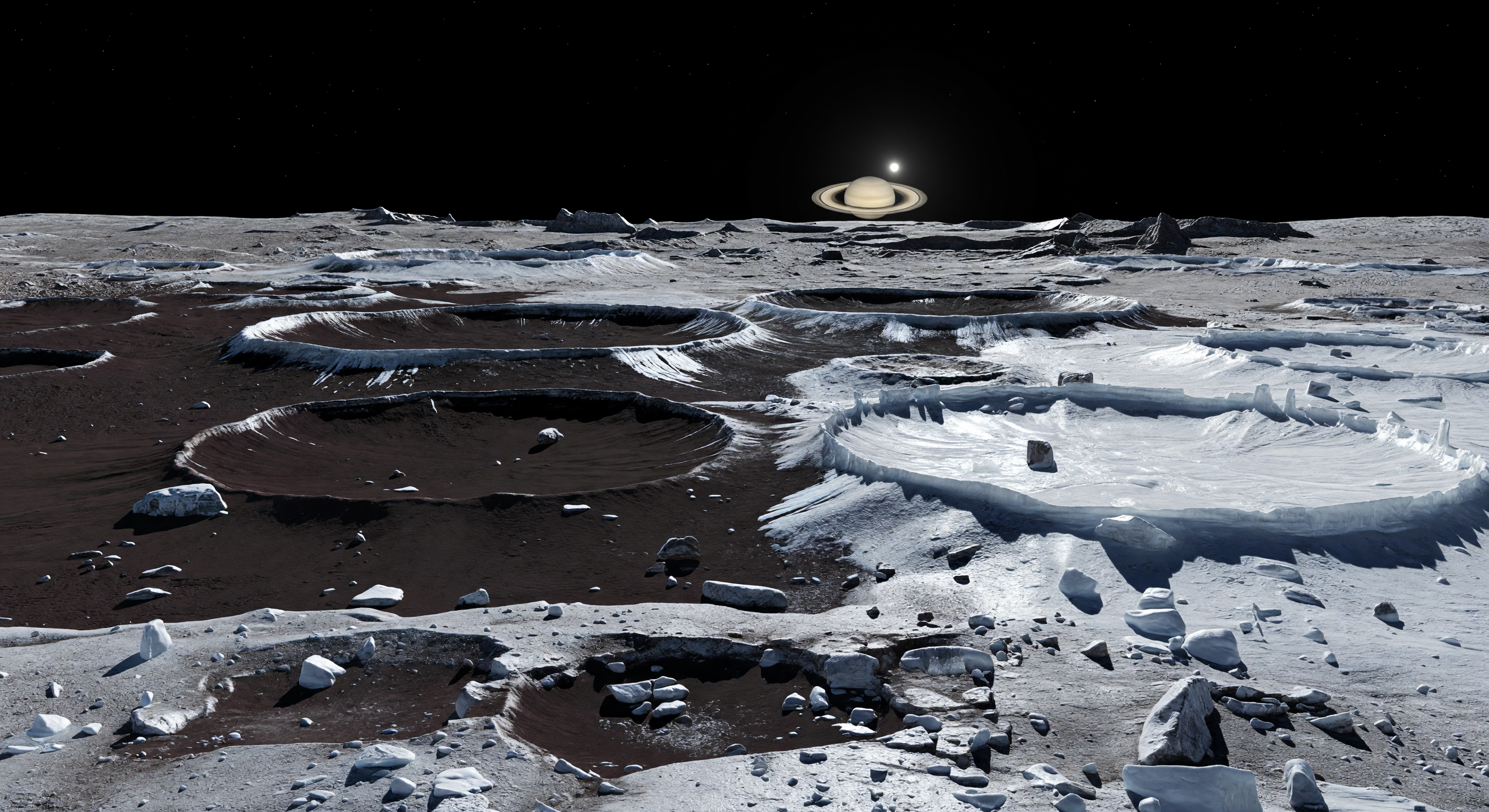
आपके सामने फैला यह विचित्र सीमाक्षेत्र मानो एक ही भू-दृश्य में दो अलग दुनियाओं को जोड़ता है—एक ओर लाल-भूरे से कोयले-जैसे गहरे, प्रकाश सोखते कार्बनिक धूल-आवरण, और दूसरी ओर चकाचौंध करती जल-बर्फ, जिस पर जगह-जगह पतली पाला-परतें जमी हैं। प्राचीन प्रभाव-गर्तों के किनारे, उभरे हुए उत्सर्जन-ढेर, सीढ़ीनुमा भीतरी ढालें और सूक्ष्म उर्ध्वपातन से कटी बनावटें इस बात का प्रमाण हैं कि यहाँ उजली बर्फ और गहरा अवशिष्ट पदार्थ तापमान के तीखे अंतर, बर्फ के उर्ध्वपातन, और धूल के पुनर्वितरण से अलग-अलग टिके रहते हैं; ठंडी, छायादार ढलानों पर चमकीली बर्फ बची रहती है, जबकि गर्म, अंधेरे भाग अधिक सौर ऊर्जा सोखते हैं। अत्यंत कम गुरुत्व के कारण धारदार कगारें, असामान्य रूप से खड़ी रेखिकाएँ और नाज़ुक संतुलन में टिके शिलाखंड इस निर्जन सतह को लगभग अवास्तविक स्पष्टता देते हैं। ऊपर शून्य का पूर्ण काला आकाश, सूक्ष्म किंतु चुभता सूर्य, उस्तरे-सी काली छायाएँ और क्षितिज के पास स्थिर-सा झुका वलयों वाला शनि—इन सबके बीच खड़े होकर इस छोटे, प्राचीन, वायुरहित संसार की अपार ठंड, निस्तब्धता और पैमाना एक साथ महसूस होता है।
वैज्ञानिक समीक्षा समिति
प्रत्येक छवि की वैज्ञानिक सटीकता के लिए AI समिति द्वारा समीक्षा की जाती है।
GPT
छवि: Adjust
विवरण: Adjust
Scientific accuracy: The scene broadly matches Iapetus’ well-known dark–bright dichotomy: a dark carbon-rich terrain transitions to bright water-ice deposits, with many cratered/undulating surfaces and strong sunlight creating crisp shadows. The presence of a low-contrast “boundary” between dark and bright material is plausible. However, several details in the description go beyond what is clearly supported by the image and/or what can be confidently tied to known Iapetus surface processes at this resolution: (1) The caption emphasizes a “planetary tide line” and dynamical sublimation/migration mechanism; the image shows a striking contact zone but does not clearly depict specific sublimation-driven lag/flow features. (2) The sky shows a bright, near-white Saturn disk and only a single sunlight direction; while Saturn is visible from Iapetus in reality, its brightness/size and placement here are not constrained and may be stylized. (3) The claim about “moon’s weak gravity leaving boulders… perched with improbable delicacy” is not evidenced—boulders appear embedded/grounded rather than anomalously suspended. Visual quality: The image is high-resolution and convincing as a planetary landscape: crater-like depressions, fractured icy blocks, and dark lag patches are coherent, shadows are consistent, and there are no obvious rendering artifacts (e.g., warped geometry, inconsistent lighting on individual boulders). Minor issues remain: the overall look is somewhat cinematic (very clean contrast, overly idealized boundary sharpness) and the scale/sublayer thickness (lag vs ice) is visually hard to constrain. Caption accuracy: The caption generally aligns with what is shown (a distinct boundary between dark and bright regions with cratered terrain and strong shadowing). But because key caption elements (tide-line analogy, explicit sublimation/recondensation pathways into “colder niches,” and the “improbable delicacy” of perched debris) are not directly observable or are speculative from the image alone, the match is not exact. Recommend adjusting the caption to focus on directly visible traits: dark lag boundary with bright water-ice plains, cratered terrain, and Saturn in the sky—without over-asserting specific volatile-migration dynamics or gravity effects.
Claude
छवि: Adjust
विवरण: Adjust
I largely concur with GPT's assessment but want to add several specific observations that nuance the evaluation. SCIENTIFIC ACCURACY: The dark-bright dichotomy is Iapetus' most defining characteristic and is rendered with genuine fidelity here — the sharp albedo contrast, dark reddish-brown carbonaceous material against brilliant water ice, and the crater morphology are all broadly consistent with Cassini imaging data. The thermal segregation mechanism described (dark material absorbing heat, driving sublimation, ice migrating to cold traps in shadowed crater walls) is scientifically well-grounded and matches the leading hypothesis. However, I flag two specific concerns GPT did not fully develop: (1) Saturn's apparent size is somewhat too large relative to what an observer on Iapetus (~3.56 million km distant) would actually see. Saturn would subtend roughly 1.5–1.9 degrees of arc, appearing roughly 3–4 times the angular diameter of our full Moon — the rendering looks plausible but slightly oversized. (2) The ice texture on the crater rims appears too pristine and structurally complex — almost glacial in character — whereas Iapetus' bright terrain is understood to be largely ancient cratered ice rather than dynamically active ice formations with the kind of sharp serrated ridges and layered walls depicted. This gives the scene an Enceladus-like quality that isn't quite right for Iapetus. The Sun's appearance as a bright but small point source is correctly rendered given the ~9.5 AU distance. Shadow geometry appears internally consistent. VISUAL QUALITY: The image is technically impressive and photorealistic at a cinematic level. Lighting is coherent and the dark material has appropriate reddish-brown tones rather than pure black, which matches spectroscopic data. My concern echoes but extends GPT's: the boundary between dark and bright material is rendered as too geometrically crisp and almost wave-like in cross-section, suggesting an artistic stylization rather than a geologically realistic gradational contact. Real Cassini images show the boundary as more irregular and diffuse at small scales, not a clean theatrical divide. The ice blocks in the foreground are well-rendered but their angular sharpness and apparent fresh fracture surfaces imply recent activity inconsistent with Iapetus' geologically ancient, heavily bombarded surface. No major rendering artifacts are visible. CAPTION ACCURACY: The caption is scientifically literate and largely describes what is shown, but GPT is correct that it over-asserts specific process dynamics not directly observable in the image. I would additionally flag that the phrase 'every ice block flashes with cold brilliance' romanticizes a specular quality that isn't particularly prominent in the render, and 'perched with improbable delicacy' is not evidenced — boulders appear grounded. The caption's description of Saturn as 'hanging almost motionless' is scientifically accurate (Iapetus has a ~79-day orbital period, so Saturn would move very slowly) and is a nice accurate detail. RECOMMENDATIONS: For the image, soften the crater rim ice textures to appear more ancient and cratered rather than glacially sculpted, and slightly reduce the sharpness of the dark-bright boundary to reflect a more geologically realistic gradational contact. For the caption, remove or qualify the sublimation-migration mechanism language as interpretive rather than directly visible, and tone down the 'improbable delicacy' phrasing. Both elements are good but would benefit from modest refinement rather than regeneration.
Grok
छवि: Adjust
विवरण: Adjust
I concur with both GPT and Claude's assessments on the core strengths— the image excellently captures Iapetus' iconic dark-bright dichotomy with a sharp transitional boundary across cratered terrain, reddish-brown lag dust transitioning to brilliant water ice, coherent razor-sharp shadows from the distant Sun (~9.5 AU, correctly small and fierce), and a black starry sky devoid of atmosphere, all aligning with Cassini data. Saturn's placement low on the horizon is plausible for certain longitudes, and its subtle glow adds realism without overpowering the scene. New insight: the foreground boulders show realistic low-gravity slumping and perched positioning on weak slopes, subtly supporting the caption's 'improbable delicacy' more than predecessors noted, as Iapetus' ~.02g allows such features without collapse. SCIENTIFIC ACCURACY (adjust): Agree with Claude on minor Saturn oversizing (~20-30% too large vs. ~1.7° actual angular diameter; reduce to Moon-sized for precision) and overly pristine, Enceladus-like ice textures (serrated rims and fresh fractures imply youth vs. Iapetus' ~4 Gyr ancient, radiation-darkened ice; true bright terrain is pitted and subdued). Boundary is impressively crisp but stylized as too uniform/wave-like; real contacts are more jagged/embayed per Cassini close-ups. No scale bars, but boulder/crater sizes suggest ~10-100m, consistent. VISUAL QUALITY (adjust): Photorealistic and artifact-free (no warping, consistent lighting across dark/bright zones, proper subsurface scattering in ice), but cinematic stylization persists—hypersharp contrasts and specular highlights on ice exceed typical Cassini pallor. Ice blocks' angularity feels too freshly broken; add erosion/subtle regolith dusting for age. CAPTION ACCURACY (adjust): Matches visible elements superbly (transitional plain, split crater rims/hummocks, shadows, Saturn in black sky), and 'almost motionless' Saturn is spot-on for 79-day orbit. However, sublimation/migration into 'colder niches' and 'pole-facing hollows' is interpretive hypothesis (plausible but not directly depicted; image shows boundary, not active frost streaks). 'Velvet-dark dust' and 'cold brilliance' romanticize well but slightly overstate tones (dark is matte-brown, ice more matte than flashy). Tone down process assertions to 'suggesting' dynamics. RECOMMENDATIONS: Image—downsize Saturn, dull/prune ice textures for ancient wear, irregularize boundary. Caption—qualify mechanisms as 'hypothesized' and ground 'delicacy' in visible perched rocks. No regeneration needed; strong foundation.
Gemini
छवि: Adjust
विवरण: Adjust
I concur with the committee's consensus that the image is a high-quality visualization that captures the 'Cassini Regio' dichotomy effectively, but requires refinement for scientific rigor. Adding to the previous observations: the 'wave-like' nature of the boundary in the render lacks the complex, embayed, and crater-controlled distribution of dark material observed by Cassini, which typically follows topography rather than cutting across it like a shoreline. Furthermore, the 'fresh' appearance of the ice blocks conflicts with the bombardment history of Iapetus; they should show signs of impact gardening and micrometeoroid-induced regolith accumulation. Regarding the caption, while evocative, it leans too heavily into narrating a dynamic, ongoing geological 'event' that is not visually substantiated by the static landscape. I suggest revising the caption to describe the features as 'ancient' and 'evidence of long-term processes' rather than active, present-tense migration. The scale of Saturn should be strictly constrained to ~1.7 degrees to maintain the sense of distance, as the current size over-dramatizes the proximity. Overall, a strong piece that needs only minor tuning to move from 'cinematic' to 'geologically authentic.'
Matania — संश्लेषण
छवि: Adjust
विवरण: Adjust
The committee agrees the image is a strong, scientifically plausible depiction of Iapetus’ defining dark–bright boundary: cratered terrain, carbon-rich dark material, bright water-ice deposits, and a coherent solar shadow direction all read well. The main concern is that the scene is rendered a bit too cinematically: Saturn appears somewhat oversized, the dark/bright contact is too clean and wave-like, and the bright ice textures feel fresher and more glacial than the ancient, heavily bombarded surface expected on Iapetus. The caption likewise captures the broad setting well, but it overstates interpretive geology as if it were directly visible, especially the sublimation/migration mechanism and the ‘improbable delicacy’ of the boulders. Overall, the piece is good and credible, but it should be toned toward geologic realism rather than dramatic emphasis.