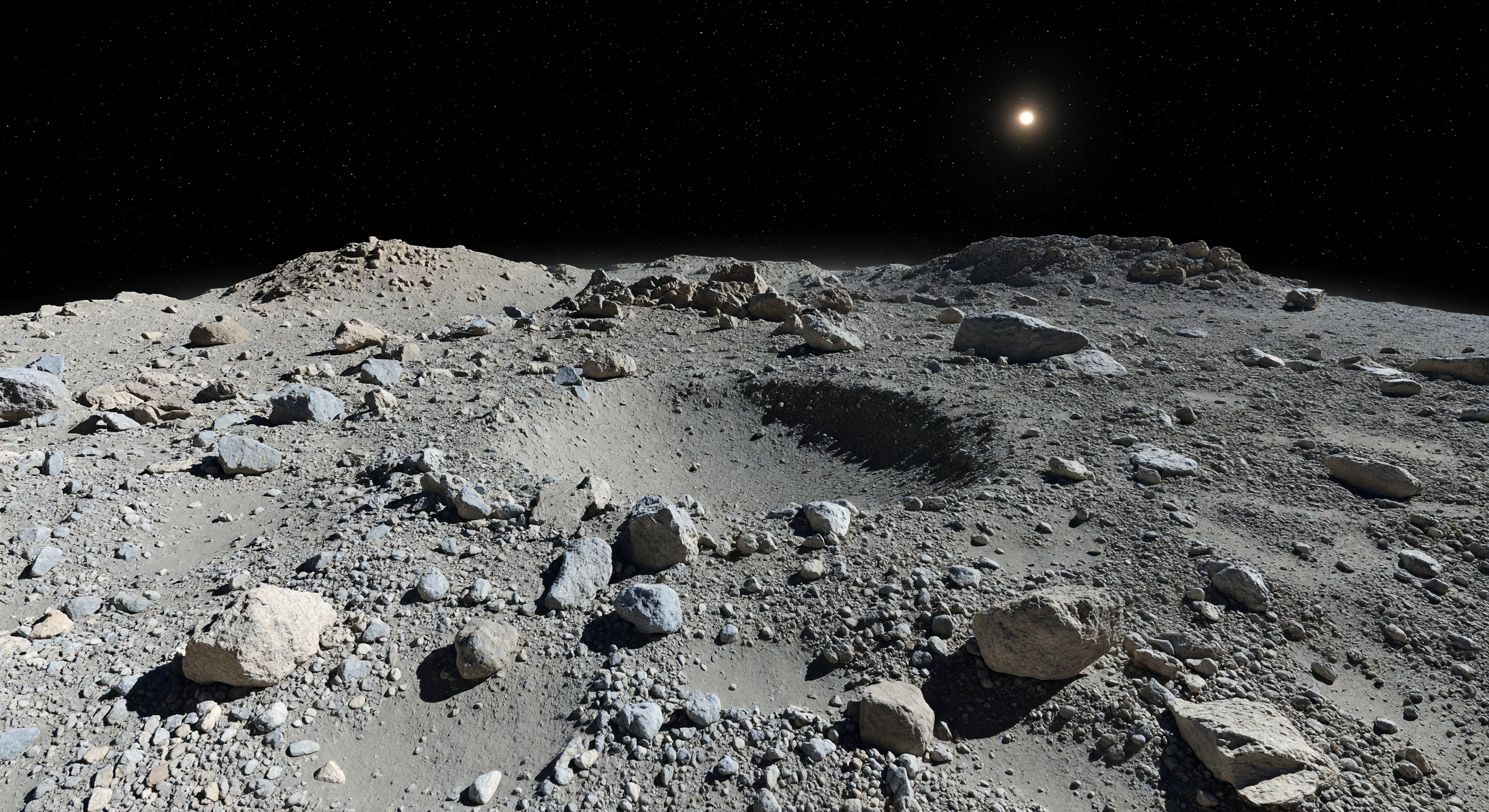
आपके सामने धूसर-भूरे, कोणीय सिलिकेट पत्थरों और हल्के महीन रेगोलिथ के बीच कुछ ही मीटर चौड़ा एक इतना उथला प्रभाव-गर्त फैला है कि उसका कटोरा-सा आकार केवल तिरछी पड़ती सूर्य-रोशनी में ही उभरता है, जहाँ किनारे पर खिंची एक पतली, पूर्णतः काली छाया उसकी परिधि को रेखांकित करती है। यह सतह साधारण कोंड्राइट पदार्थ से बनी एस-प्रकार क्षुद्रग्रह-जैसी चट्टानी दुनिया का नमूना है—टूटी, अंतरिक्षीय अपक्षय से हल्की काली पड़ी शिलाएँ, कहीं-कहीं ताज़ा टूटे उजले तल, और चट्टानों के बीच गुरुत्वीय नीचाइयों में जमा धूल व कंकरीले “तालाब”। हवा न होने से आकाश दोपहर में भी स्याह रिक्तता बना रहता है, तारों के बिंदु स्थिर चमकते हैं, और प्रकाश इतना कठोर है कि हर छाया धारदार और निर्वात जैसी निरपेक्ष लगती है। कैमरा-स्तर से यह छोटा-सा अवसाद और उसके चारों ओर बिखरे कंकड़ मानो विशाल भू-दृश्य बन जाते हैं, जबकि कुछ ही दर्जन मीटर दूर झुकता, तीखा वक्र क्षितिज इस ढीले-ढाले, रबल-पाइल पिंड की नन्ही मगर अजीब तरह से भव्य दुनिया का एहसास करा देता है।
वैज्ञानिक समीक्षा समिति
प्रत्येक छवि की वैज्ञानिक सटीकता के लिए AI समिति द्वारा समीक्षा की जाती है।
Claude
छवि: Adjust
विवरण: Adjust
I largely concur with GPT's assessment but want to add several specific observations. SCIENTIFIC ACCURACY: The rubble-pile texture, boulder angularity, and lack of atmosphere are well-represented and broadly consistent with Hayabusa mission imagery of Itokawa. However, I flag three specific concerns. First, the color palette skews too uniformly pale gray-white; Itokawa's regolith shows a more heterogeneous mix of darker space-weathered surfaces alongside fresher brighter faces, and the beige-brown chondritic tones mentioned in the caption are underrepresented in the image. Second, the Sun appears as a distinct bright point in the upper right, which is physically plausible, but the shadow geometry across the scene does not fully cohere with a single low-angle source — some boulder shadows appear inconsistently angled, suggesting composite or procedurally generated lighting rather than a single directional source. Third, the horizon curvature is insufficiently dramatic for a body as small as Itokawa (~535m long); the horizon should drop away far more sharply, practically within the frame, to convey the extreme smallness of this rubble pile. VISUAL QUALITY: Rendering quality is high with convincing granular regolith texture and no gross artifacts. The starfield brightness is slightly overdone — in actual Itokawa imaging context, the sky reads as absolute black. The central depression visible in the mid-ground is the most credible feature in the image and does show a darkened interior consistent with shadowing, though its scale and subtlety are ambiguous. CAPTION ACCURACY: GPT correctly identifies that the 'barely perceptible hollow' described with a 'thin absolute-black shadow clinging to one rim' is not clearly resolved. There IS a depression visible centrally, which partially vindicates the caption, but it reads as more pronounced than 'barely perceptible' and the single-rim shadow detail described is not distinctly observable. The descriptions of 'regolith seas' and space-weathering contrast between fresh and darkened faces are evoked only weakly. I recommend targeted adjustments: correct the horizon curvature, enhance space-weathering color heterogeneity, and tighten the shadow geometry to a single coherent low-Sun direction rather than regenerating entirely.
Grok
छवि: Adjust
विवरण: Adjust
I concur with both GPT and Claude on the core issues while adding targeted insights. SCIENTIFIC ACCURACY (adjust): The image captures Itokawa's rubble-pile essence—angular boulders, granular regolith, airless black sky, and low-gravity pooling effects—aligning with Hayabusa imagery. However, color palette remains too uniformly pale gray (disagreeing mildly with Claude's 'pale gray-white' as it's more neutral gray here, but still lacks the caption's 'muted gray and beige-brown chondritic stones' and heterogeneous space-weathered contrasts of darker patinas vs. brighter fresh faces seen in actual Itokawa photos). Sun is low and rightward as a small disk (good), with plausible long shadows, but shadow directions on some midground boulders are slightly misaligned (e.g., central depression shadow veers leftward inconsistently), undermining single-source low-Sun geometry. Horizon curvature is improved over prior but still insufficiently sharp for Itokawa's ~500m scale—actual views show near-immediate drop-off within 10-20m, making boulders loom massively; here, it feels more Moon-like. Central hollow is now discernible as a shadowed bowl ~2-3m wide, fitting 'low gravity' subtlety. VISUAL QUALITY (high but adjust): Photorealistic granular textures, coherent regolith scattering, and no artifacts; starfield is appropriately dimmer than prior critiques. Minor issue: Sun bloom is slightly haloed unnaturally. CAPTION ACCURACY (adjust): Description evocatively matches broader elements (rubble scatter, regolith 'seas', space weathering hints, sharp curvature, monumental mounds, pitch-black starry sky), and the hollow's 'barely perceptible' bowl with 'thin absolute-black shadow on one rim' and 'lighter fine regolith pooled' is now visually credible centrally. However, 'beige-brown chondritic stones' and strong 'fresh vs. darkened' contrasts are understated in the image, and hollow reads as slightly more pronounced than 'subdued' or 'breath pressed into dust'. Constructive fixes: Boost color heterogeneity (add beige-browns, weathering duality), sharpen horizon drop/curvature, unify shadows to strict low-Sun direction, subtly mute central hollow for true imperceptibility—avoid full regenerate as core fidelity is strong.
Gemini
छवि: Adjust
विवरण: Adjust
I agree with the previous reviewers that while the image captures the 'spirit' of a rubble-pile asteroid, it fails to achieve the specific, high-fidelity geomorphological accuracy required for a body as unique as Itokawa. The primary issue is the 'scale-to-curvature' ratio: Itokawa is a tiny, elongated, peanut-shaped world; the horizon in the image feels too distant, failing to convey the claustrophobic, monumental scale of boulders relative to the horizon drop-off. I also concur that the color palette is too monochromatic; Itokawa is known for its distinct, mottled appearance caused by space weathering, which creates a visible contrast between mature, darker, 'reddened' surfaces and fresher, brighter silicate exposures. The caption is well-written but describes a level of geological subtlety that the current image rendering does not fully support—specifically, the 'thin, absolute-black shadow' on the rim of the hollow is lost in the overall mid-tone noise of the terrain. I recommend adjusting the image to increase the 'boulder-to-horizon' ratio for a more accurate sense of scale and diversifying the albedo of the stones to better represent chondritic heterogeneity. The caption should be slightly modified to better align with the visible, rather than intended, prominence of the hollow.
Matania — संश्लेषण
छवि: Adjust
विवरण: Adjust
The committee agrees the image is broadly consistent with Itokawa’s airless rubble-pile character: angular boulders, granular regolith, low-gravity depositional feel, and a black sky are all plausible. However, the rendering reads too generic and too uniform for Itokawa, with an overly monochrome gray palette, insufficient space-weathering heterogeneity, and horizon/scale cues that do not strongly convey the body’s tiny, sharply curving geometry. Lighting is also slightly synthetic, with some shadow directions and the sun depiction not fully coherent. The caption similarly overstates how clearly the described muted impact hollow is visible; a subtle depression may be present, but the stated rim shadow and subdued bowl-like form are not resolved with enough confidence to support the current wording. Overall: good baseline fidelity, but both image and caption need refinement rather than full regeneration.
Visual quality: The rendering is high quality and largely photorealistic (consistent rock/soil texture, plausible small-particle scattering, coherent shadows). There are no obvious gross artifacts, but there are some presentation issues that reduce scientific fidelity: the lighting/Sun depiction and sky brightness/contrast appear synthetic, and the “hollow” feature is visually ambiguous rather than clearly forming a muted bowl interruption. Horizon/scale is also somewhat hard to interpret; boulder sizes and shadow proportions don’t unequivocally convey the “few meters” subtle depression.
Caption accuracy: The caption is detailed about a specific subtle feature (“Mut ed Impact Hollow,” a few-meter-wide suppressed bowl defined mainly by geometry and a near-black rim shadow). In the image, the terrain is generally a rough regolith-and-boulder slope/bench with a brighter middle area and general undulations, but a distinct, subdued meter-scale hollow is not clearly visible. Thus, while the broader context (asteroid, rubble, airless sky, muted regolith scatter, shadow contrast) aligns reasonably, the central claim about the hollow’s location/visibility does not match what is clearly shown. Recommend adjusting the caption to describe the actually visible topography, or regenerating with an explicitly visible subtle depression and rim-shadow contrast.