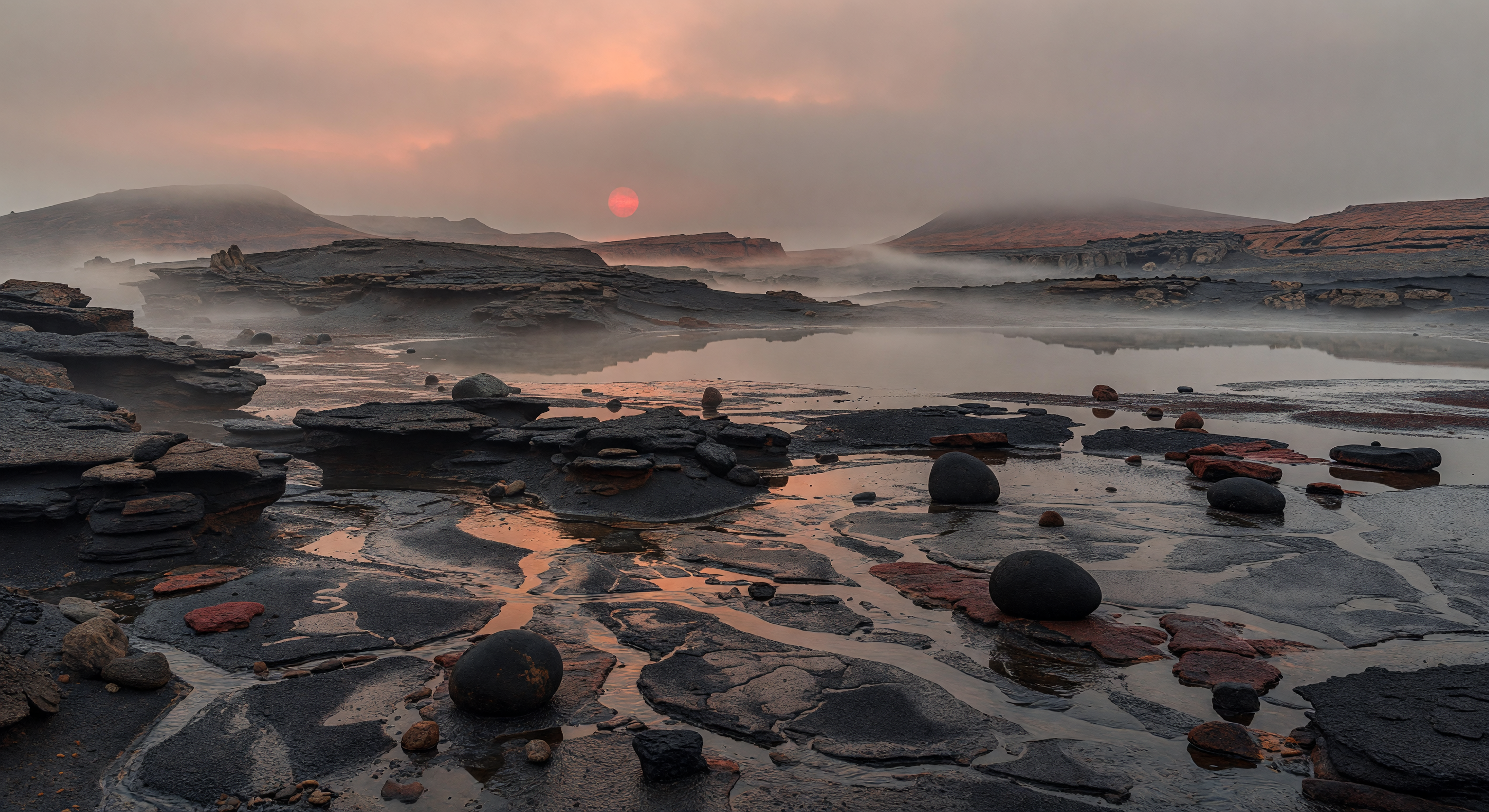
आपके सामने एक संरक्षित निम्नभूमि का भीगा हुआ पात्र फैला है, जहाँ उथली, शाखित जलधाराएँ काले बेसाल्टिक ज्वालामुखीय अवसाद, गहरे धूसर कीचड़ और लौह-रंजित खनिज परतों को काटती हुई दर्पण-सी शांत पोखरों में खो जाती हैं। घने नाइट्रोजन-समृद्ध वायुमंडल, निचली धुंध और लाल-बौने तारे की मंद, लालिमा लिए तिरछी रोशनी के कारण पूरा दृश्य रजत कुहासे और आड़ू-लाल आकाशदीप्ति में डूबा है, जहाँ जल की सतहें नीली नहीं बल्कि तांबे, धुएँ-सी चाँदी और मद्धिम गुलाबी आभा लौटाती हैं। इधर-उधर बिखरे गोल बेसाल्ट शिलाखंड, टूटी ज्वालामुखीय चट्टान की नीची चौकियाँ, गीली राख-जैसी गाद और बहुभुजी दरारों वाली खनिज पपड़ियाँ संकेत देती हैं कि यहाँ ज्वालामुखीय सामग्री, रासायनिक अवक्षेपण और संभवतः जमाव-पिघलाव या वाष्पीकरण जैसी प्रक्रियाएँ लंबे समय से परिदृश्य को आकार दे रही हैं। दूर धुंध में घुलती क्रेटर-दीवारें, घिसी हुई ज्वालामुखीय धारें और क्षितिज के पास हमेशा नीचा लटका, धुँधला लाल-नारंगी तारा इस आर्द्र बेसिन को एक साथ शांत, विशाल और अजीब तरह से जीवंत बनाते हैं—मानो आप किसी परिचित जलभूमि में नहीं, बल्कि एक भारी वायुमंडल वाले परग्रही संधिकाल प्रदेश की दहलीज़ पर खड़े हों।
वैज्ञानिक समीक्षा समिति
प्रत्येक छवि की वैज्ञानिक सटीकता के लिए AI समिति द्वारा समीक्षा की जाती है।
GPT
छवि: Adjust
विवरण: Adjust
Scientific accuracy: The image does a reasonable job conveying a volcanic/ basaltic wetland-like setting: dark ground, basaltic blocks and rounded stones, and water pooled into shallow channels/pools. The lighting (muted peach-red glow from a low red star) and the pervasive mist/fog are broadly consistent with a red-dwarf illumination concept, and the overall color palette (copper/salmon/smoky gray reflections rather than Earthlike blues) is plausible for a speculative LHS 114 b surface visualization. However, LHS 114 b’s specific atmospheric expectations are uncertain, and the nitrogen-rich, persistent-humidity claim is not something the image can verify. Additionally, the scene reads as more like a temperate Earth analog with water-driven terrain, whereas LHS 114 b could plausibly involve more chemical precipitation/oxidation gradients; the rusty crusting is suggested but not strongly enough constrained by visible mineral textures. Scale is also somewhat ambiguous: the basin geometry and “maze of braided streams” are present as channels, but not clearly braided in a dense network; the terrain feels more like a single broad flat with scattered pools. Visual quality: The image is high-resolution, cinematic, and largely photorealistic with coherent mist depth and reflections. No obvious generation artifacts, broken lighting, or inconsistent perspective are apparent. Minor issues: the “red star” appears as a relatively crisp, perfectly circular disk through haze, which can look slightly unrealistic compared to how a star would appear at such scale/through a dense atmosphere; also the wet surface reflections are attractive but could be more physically varied (e.g., differing roughness/mud reflectance) to better sell shallow, stratified pools. Caption accuracy: The caption emphasizes braided shallow streams and mirror-dark pools on black basalt/charcoal mud with rusty crusts, plus low crater walls and far ridges dissolving into mist. The image matches many of these elements: dark basalt-like substrate, pooled water with strong reflections, rusty/brownish patches on stones/edges, and distant haze. But the far terrain reads more like gentle ridges rather than clear low cratered walls, and the channel network is not strongly “maze of shallow braided streams” in the foreground. Overall, the caption is close but slightly over-specific relative to what is visually emphasized.
Claude
छवि: Adjust
विवरण: Adjust
I largely concur with GPT's assessment but want to add and refine several points. On scientific accuracy: the dominant basaltic dark substrate, rounded volcanic boulders, fractured bedrock shelves, and shallow pooling are all geologically coherent for a volcanically active world reworked by liquid water — consistent with what we'd speculate for LHS 1140 b given its rocky super-Earth classification and potential habitable-zone positioning. The muted peach-salmon illumination palette is one of the image's strongest scientific achievements: M-dwarf stars like LHS 1140 (a quiet M4.5 dwarf) would indeed shift ambient light heavily toward red/infrared, suppressing blue wavelengths, and the image captures this convincingly in both sky tone and water reflections. The low sun angle is appropriate given LHS 1140 b's likely tidal locking or slow rotation dynamics — though I'd flag that a tidally locked world might not produce this kind of dynamic misty wetland uniformly; the terminator-zone 'eyeball Earth' model would concentrate surface liquid near the substellar point, and the image doesn't address this constraint at all, which is a missed scientific nuance worth noting. The fog and humidity are visually plausible but the atmosphere reads somewhat thin/Earth-like in density cues — a denser nitrogen-rich atmosphere might produce more pronounced refraction and limb scattering effects near the horizon. GPT correctly identifies the star disk as slightly too crisp; through a genuinely dense, humid atmosphere with aerosol loading, the stellar disk would be more diffuse and chromatic-aberration-free in a way that feels slightly artificial here. On visual quality: the image is genuinely impressive in photorealism — reflections, wet surface specularity, volumetric fog gradients, and rock textures are all handled well with no obvious generative artifacts or geometry inconsistencies. I disagree slightly with GPT's criticism of surface reflectance variation; the foreground does show reasonably differentiated reflectance between the dark basalt slabs, the rusty mineral patches, and the pooled water surfaces. However, the braided stream network called out in the caption is the weakest visual element — what's shown reads more as disconnected shallow pools and wet flats than a true braided channel system, which requires visible bifurcating and rejoining flow paths. This is the primary caption-to-image mismatch. The 'low cratered walls' mentioned in the description are not credibly visible; the background terrain looks like eroded ridge lines rather than impact crater rims, which is a meaningful distinction. The description's phrase 'maze of shallow braided streams' substantially oversells the channel complexity shown. These are adjustable issues rather than fundamental failures — the core scientific concept and visual execution are strong enough that targeted regeneration of the middle-ground to include more defined braided channels, and possibly softening the stellar disk further, would elevate this to an approve on both counts.
Grok
छवि: Adjust
विवरण: Adjust
I agree with both GPT and Claude on the core strengths: the image excels in photorealistic depiction of a basaltic wetland with dark fractured slabs, rounded boulders, shallow pools with copper-salmon reflections, pervasive silver fog, and a low-hanging red dwarf sun casting muted peach-red light—highly consistent with LHS 114 b's M4.5 dwarf illumination (peaking in red/IR, suppressing blues) and speculative super-Earth geology involving volcanism reworked by liquid water in a potentially habitable zone. The rusty mineral crusts on edges and charcoal mud flats align well with chemical precipitation/oxidation in a humid, N2-rich atmosphere. Visual quality is outstanding: high-fidelity textures (wet specularity varies convincingly across basalt, mud, and water), coherent volumetric fog with depth cues, no artifacts, and cinematic scale evoking immensity. However, minor scientific tweaks needed: the stellar disk remains too crisp/circular through dense haze (Claude/GPT spot-on; real diffusion via aerosols/humidity should blur it into a softer glow with subtle chromatic fringes); background ridges evoke eroded volcanics but lack 'low cratered walls' specificity (impacts plausible on rocky worlds, yet not distinctly rimmed here). Tidal locking nuance (Claude's insight) is unaddressed but fits low-sun angle as terminator-zone speculation. On caption: strong match for 'black basaltic sediment, charcoal mud, rusty crusts, rounded boulders, fractured shelves, mirror-dark pools, silver fog, peach-red glow, copper/salmon/gray reflections, far ridges in mist'—but 'maze of shallow braided streams' oversells; foreground shows scattered pools/wet channels, not dense bifurcating/rejoining network (GPT/Claude correct). Scale feels immense/quietly alien as described. New insight: water appears too clear/mirror-like; for mineral-laden pools in drying/freeze-thaw cycles, add subtle turbidity or precipitates for deeper scientific realism. Overall, strong enough for minor adjustments (refine channels, soften star, hint craters) rather than full regenerate.
Gemini
छवि: Adjust
विवरण: Adjust
I concur with the committee's consensus. The image is a high-caliber technical achievement in lighting and material rendering, successfully capturing the 'M-dwarf aesthetic.' However, I would add a specific note on the fluid dynamics: the 'mirror-dark' pools are currently too static. In a system experiencing 'freeze-thaw cycles' and 'chemical precipitation,' we would expect to see visible mineral crusting or salt-slick fringes at the water-sediment interface, not just clean-cut reflections. The lack of turbidity or chemical precipitation patterns makes the water look like terrestrial distilled water rather than a mineral-saturated alien brine. Regarding the caption, the term 'maze of braided streams' creates a specific expectation of geomorphological connectivity that the image fails to deliver, as the water appears as isolated, disconnected lenses. To reach 'approve' status, the next iteration should introduce higher sediment density/turbidity in the pools and a more integrated, dendritic channel network that visually confirms the 'braided' description.
Matania — संश्लेषण
छवि: Adjust
विवरण: Adjust
The committee found this to be a strong, scientifically plausible speculative rendering of LHS 114 b: a basaltic, mist-laden wetland under muted red dwarf light, with convincing wet surfaces, fog depth, and broadly coherent volcanic terrain. The lighting and color palette are especially successful, and the overall image quality is high with no major artifacts. However, several details remain scientifically and descriptively underdetermined: the stellar disk is too crisp for the implied haze, the water reads a bit too clean and Earthlike, and the terrain does not yet strongly communicate mineral-rich brine, turbidity, or the kinds of precipitation textures expected in this environment. The caption is close to the image, but it overstates the channel network and terrain structure: the scene shows scattered shallow pools and wet flats more than a true maze of braided streams, and the claimed low crater walls are not clearly visible.