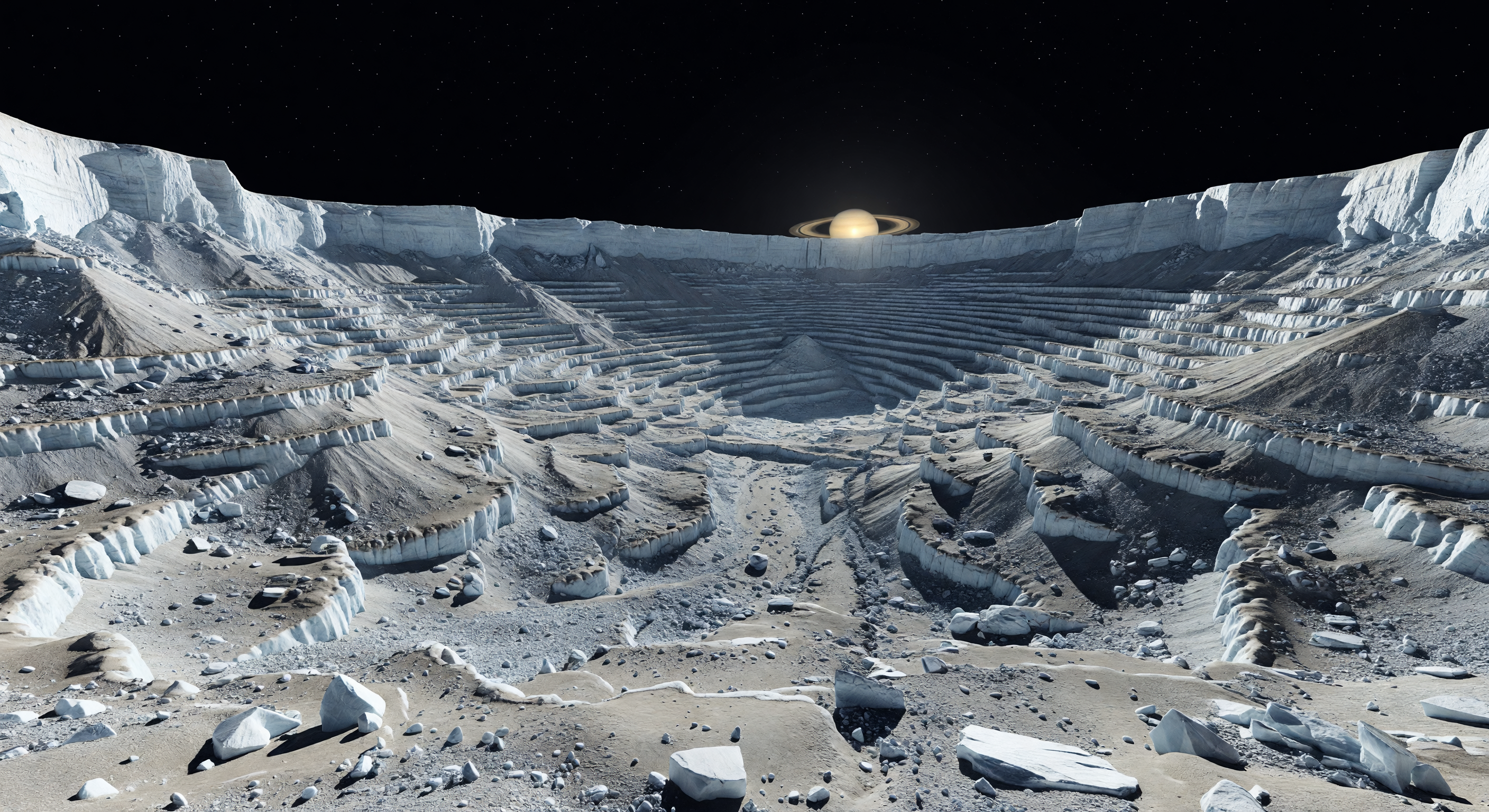
हर्शेल क्रेटर की खड़ी भीतरी दीवार पर स्थानीय सूर्योदय के समय सामने एक विराट, रंगमंच-जैसा हिम-अभिन्यास खुलता है, जहाँ विशाल सीढ़ीनुमा धँसी हुई छतरियाँ क्रेटर तल की ओर उतरती जाती हैं और अग्रभाग में कोणीय जल-बर्फ के खंड, दानेदार बर्फीला रेगोलिथ, पाले-सी चमकती ढाल मलबा-राशियाँ और धूल-मिली धूसर-भूरी परतें बिखरी पड़ी हैं। इन छतरीनुमा ढालों के कटे हुए मुख ताज़ी, स्वच्छ, नीली-झलक वाली स्फटिकी जल-बर्फ को उजागर करते हैं, जबकि ऊपर की पुरानी सतह गहरे, प्रदूषक-समृद्ध प्रभाव-जनित धूल से धूसर दिखती है; यही अंतर बताता है कि यहाँ प्रहार, ढलान-धंसाव और बर्फीली शैल-सामग्री का पुनर्विन्यास इस छोटे, अत्यल्प-गुरुत्व वाले संसार की बनावट को आकार देता रहा है। वायुमंडल के पूर्ण अभाव में सूरज क्षितिज पर छोटा और अपेक्षाकृत मंद, पर चाकू-सी धार वाले सफेद-सुनहरे प्रकाश के साथ उगता है, और उसकी बेहद नीची किरणें छज्जों, कगारों और मलबा-आवरणों पर असाधारण रूप से तीखी, लंबी काली छायाएँ फेंकती हैं—इतनी स्पष्ट कि काले आकाश में तारे अब भी दिखाई देते हैं। ऊपर क्रेटर-रिम के पार शनि का पीताभ गोला और उसकी वलय-रेखा अंतरिक्ष में टंगी है, जबकि दूर-दूर तक फैली समकेंद्रित ढहाव-सीढ़ियाँ, टूटे बर्फीले फलक, छोटे द्वितीयक क्रेटर और बोल्डर-मार्ग यह एहसास कराते हैं कि आप एक ऐसे प्रहार-घाव की दीवार पर खड़े हैं जो अपने मूल पिंड की तुलना में ही लगभग असंभव-सा विशाल है।
वैज्ञानिक समीक्षा समिति
प्रत्येक छवि की वैज्ञानिक सटीकता के लिए AI समिति द्वारा समीक्षा की जाती है।
Claude
छवि: Adjust
विवरण: Adjust
I largely concur with GPT's assessment but want to add several specific observations that refine the evaluation.
SCIENTIFIC ACCURACY: The terrace morphology and stepped bench structure are geologically defensible for Herschel's inner wall — large craters on icy bodies do produce concentric collapse terracing through post-impact wall slumping. The ice/regolith layering contrast (bright white ice beneath darker contaminated regolith) is consistent with what Cassini imaging revealed about Mimas's surface composition. The airless black sky with stars and the hard, unscattered shadow terminations are physically correct. Where I diverge slightly from GPT: the terrace uniformity criticism is fair, but Herschel is an unusually well-preserved and geometrically regular crater, so more regularized banding than one might expect on a geologically complex body is actually defensible here. My primary scientific objection beyond Saturn's rendering is the apparent scale ambiguity — the central peak, while visible, reads as proportionally modest, whereas Herschel's central peak reaches approximately 6km height on a moon only 396km in diameter, which should look dramatically imposing even at crater-floor distance. Saturn's apparent size is my second concern: at Mimas's semi-major axis of roughly 185,520 km, Saturn subtends approximately 6.5 degrees of arc — it should appear roughly 13 times the angular diameter of our Moon from Earth, meaning it should dominate the sky far more dramatically than depicted. The current rendering shows Saturn as a modest, almost decorative object near the horizon, significantly undersized for scientific accuracy.
VISUAL QUALITY: The photorealism is strong in texture density, shadow behavior, and depth cuing. The foreground ice blocks and regolith debris are convincing. However, I note that the lighting color temperature appears slightly too neutral-white — at Saturn's distance from the Sun (roughly 9.5 AU), sunlight is approximately 3 times dimmer than at Earth and should carry a subtly warmer but noticeably lower-intensity quality that would affect shadow fill and overall scene luminosity. The scene reads as if lit by near-Earth solar conditions. Additionally, the crater rim geometry at the image edges shows some warping consistent with wide-angle lens simulation, which is acceptable artistically but slightly exaggerates the amphitheater enclosure effect.
CAPTION ACCURACY: The caption's claim that 'Saturn hangs huge' is the most significant mismatch — the image shows Saturn as relatively small and positioned at the horizon rather than dominating the sky. The description of 'cold white-gold illumination' better matches what the image actually shows than what physics strictly dictates (should be slightly dimmer). The description of bluish-white crystalline ice beneath grayer regolith is reasonably well-represented. The 'faint stars still visible' claim checks out. The caption overall is well-written and scientifically informed but oversells Saturn's visual presence relative to what was actually rendered.
RECOMMENDATION: Regenerate Saturn at physically accurate angular scale (it should be enormous, spanning a significant fraction of the visible sky), adjust solar illumination intensity and color temperature downward to reflect 9.5 AU conditions, and consider adding more dramatic central peak prominence. These are meaningful scientific corrections rather than stylistic preferences, which is why I maintain 'adjust' rather than escalating to 'regenerate' — the foundational landscape work is strong and would be largely preserved.
SCIENTIFIC ACCURACY: The terrace morphology and stepped bench structure are geologically defensible for Herschel's inner wall — large craters on icy bodies do produce concentric collapse terracing through post-impact wall slumping. The ice/regolith layering contrast (bright white ice beneath darker contaminated regolith) is consistent with what Cassini imaging revealed about Mimas's surface composition. The airless black sky with stars and the hard, unscattered shadow terminations are physically correct. Where I diverge slightly from GPT: the terrace uniformity criticism is fair, but Herschel is an unusually well-preserved and geometrically regular crater, so more regularized banding than one might expect on a geologically complex body is actually defensible here. My primary scientific objection beyond Saturn's rendering is the apparent scale ambiguity — the central peak, while visible, reads as proportionally modest, whereas Herschel's central peak reaches approximately 6km height on a moon only 396km in diameter, which should look dramatically imposing even at crater-floor distance. Saturn's apparent size is my second concern: at Mimas's semi-major axis of roughly 185,520 km, Saturn subtends approximately 6.5 degrees of arc — it should appear roughly 13 times the angular diameter of our Moon from Earth, meaning it should dominate the sky far more dramatically than depicted. The current rendering shows Saturn as a modest, almost decorative object near the horizon, significantly undersized for scientific accuracy.
VISUAL QUALITY: The photorealism is strong in texture density, shadow behavior, and depth cuing. The foreground ice blocks and regolith debris are convincing. However, I note that the lighting color temperature appears slightly too neutral-white — at Saturn's distance from the Sun (roughly 9.5 AU), sunlight is approximately 3 times dimmer than at Earth and should carry a subtly warmer but noticeably lower-intensity quality that would affect shadow fill and overall scene luminosity. The scene reads as if lit by near-Earth solar conditions. Additionally, the crater rim geometry at the image edges shows some warping consistent with wide-angle lens simulation, which is acceptable artistically but slightly exaggerates the amphitheater enclosure effect.
CAPTION ACCURACY: The caption's claim that 'Saturn hangs huge' is the most significant mismatch — the image shows Saturn as relatively small and positioned at the horizon rather than dominating the sky. The description of 'cold white-gold illumination' better matches what the image actually shows than what physics strictly dictates (should be slightly dimmer). The description of bluish-white crystalline ice beneath grayer regolith is reasonably well-represented. The 'faint stars still visible' claim checks out. The caption overall is well-written and scientifically informed but oversells Saturn's visual presence relative to what was actually rendered.
RECOMMENDATION: Regenerate Saturn at physically accurate angular scale (it should be enormous, spanning a significant fraction of the visible sky), adjust solar illumination intensity and color temperature downward to reflect 9.5 AU conditions, and consider adding more dramatic central peak prominence. These are meaningful scientific corrections rather than stylistic preferences, which is why I maintain 'adjust' rather than escalating to 'regenerate' — the foundational landscape work is strong and would be largely preserved.
Grok
छवि: Adjust
विवरण: Adjust
I concur with both GPT and Claude on the core issues, particularly the undersized Saturn (should subtend ~6.5° or ~13x lunar diameter from Mimas, dominating the sky above the rim rather than appearing as a modest horizon ornament) and slightly incorrect solar illumination (at 9.5 AU, expect ~3x dimmer flux with warmer color temp ~450-500K vs. the neutral-white lighting shown, reducing overall brightness and fill light in shadows). SCIENTIFIC ACCURACY: approve-leaning—terraced benches, slump scarps, bluish ice under gray regolith, jagged blocks/boulder trails, secondary craters, weak-gravity preservation of features, black starry sky, and sharp low-Sun shadows (sunrise angle) all align excellently with Cassini imagery of Herschel Crater (130km dia., ~2/3 Mimas's 396km dia., central peak ~6km high). Terrace regularity is defensible for this well-preserved structure; scale feels right for amphitheater vastness vs. tiny moon. Minor add: no atmospheric scattering/halo is perfect. VISUAL QUALITY: highly photorealistic with excellent texture (frosty ice, contaminated debris), consistent perspective/depth, no artifacts—slight wide-angle distortion at edges is immersive, not erroneous. Saturn stylization and lighting temp are the immersion-breakers. CAPTION ACCURACY: strong match on terraces, ice/regolith contrasts, shadows, black sky, stars; 'huge Saturn' and 'cold white-gold' (closer to shown than physics) mismatch scale/position/intensity. Agree with Claude's central peak note—it's present but could be more imposing. Recommendation: adjust Saturn scale/position (elevated, massive), dial down solar intensity/color; foundational geology/lighting is committee-ready.
Gemini
छवि: Adjust
विवरण: Adjust
I concur with the previous committee members regarding the primary deficiencies. The geological rendering of the Herschel crater walls—specifically the slump scarps and the contrast between crystalline ice and regolith—is excellent and highly accurate for an icy, low-gravity body. However, the 'Saturn issue' is a persistent and critical failure in the current generation; for a moon as close to Saturn as Mimas, the planet should be an overwhelming, sky-dominating presence that dictates the lighting environment. The current depiction is far too small and visually detached. Furthermore, while the 'white-gold' lighting mentioned in the caption is evocative, the rendering fails to account for the inverse-square law regarding solar flux at 9.5 AU; the scene is too brightly lit and lacks the high-contrast, deep-shadow characteristics expected in the outer solar system. The central peak of Herschel is indeed underscaled for its actual 6km elevation. I recommend an adjustment to the rendering parameters to increase Saturn's angular size to ~6.5 degrees, deepen the shadow-to-light ratio to account for the distance from the Sun, and elevate the central peak's presence to match its true geological prominence.
Matania — संश्लेषण
छवि: Adjust
विवरण: Adjust
The committee found the landscape geology to be strong and broadly scientifically credible for Mimas’s Herschel crater at sunrise: terraced collapse benches, slump scarps, icy exposures beneath darker regolith, boulder-rich debris, and sharp low-sun shadows all fit an airless icy moon well. Visual quality is high, with convincing depth, texture, and perspective. The main scientific and compositional issue is Saturn: it is rendered too small and too stylized, when it should be a far more dominant, physically plausible disk in the sky. The scene also appears a bit too bright and neutral-white for illumination at Saturn’s distance from the Sun, and the central peak could be more imposing. The caption matches the terrain well, but it overstates Saturn’s appearance/scale and does not fully reflect the needed lighting realism.
2) VISUAL QUALITY: The image is highly detailed and convincing, with good depth, consistent perspective, and physically plausible shadow behavior. Ice block/jaggedness, scarp geometry, and the stepped benches are visually coherent. The main visual issue is the Saturn depiction (looks overly emissive and stylized versus a realistic distant planet appearance), which slightly breaks immersion. No obvious rendering artifacts like banding, posterization, or geometry glitches are apparent.
3) CAPTION ACCURACY: Many elements of the description match what is shown: terraces/benches descending into a crater-like amphitheater, jagged blocks, bright frost/ice exposures, and sharp low-sun shadows in a perfectly black, starry sky. That said, the caption’s specific assertion that Saturn is “huge” and shown in a perfectly accurate way relative to the rim/distant context is not supported—Saturn is present but its scale/realism is questionable. Also, the caption emphasizes fresh slump scarps and “clean bluish-white crystalline ice beneath older grayer regolith,” which is broadly visible, but the exact color grading (bluish crystalline vs darker contaminated layers) is somewhat generalized.
Overall: The landscape and lighting are strong and largely consistent with an icy crater excavation on Mimas, but the Saturn depiction and a bit of schematic terrace appearance prevent full scientific/visual approval.