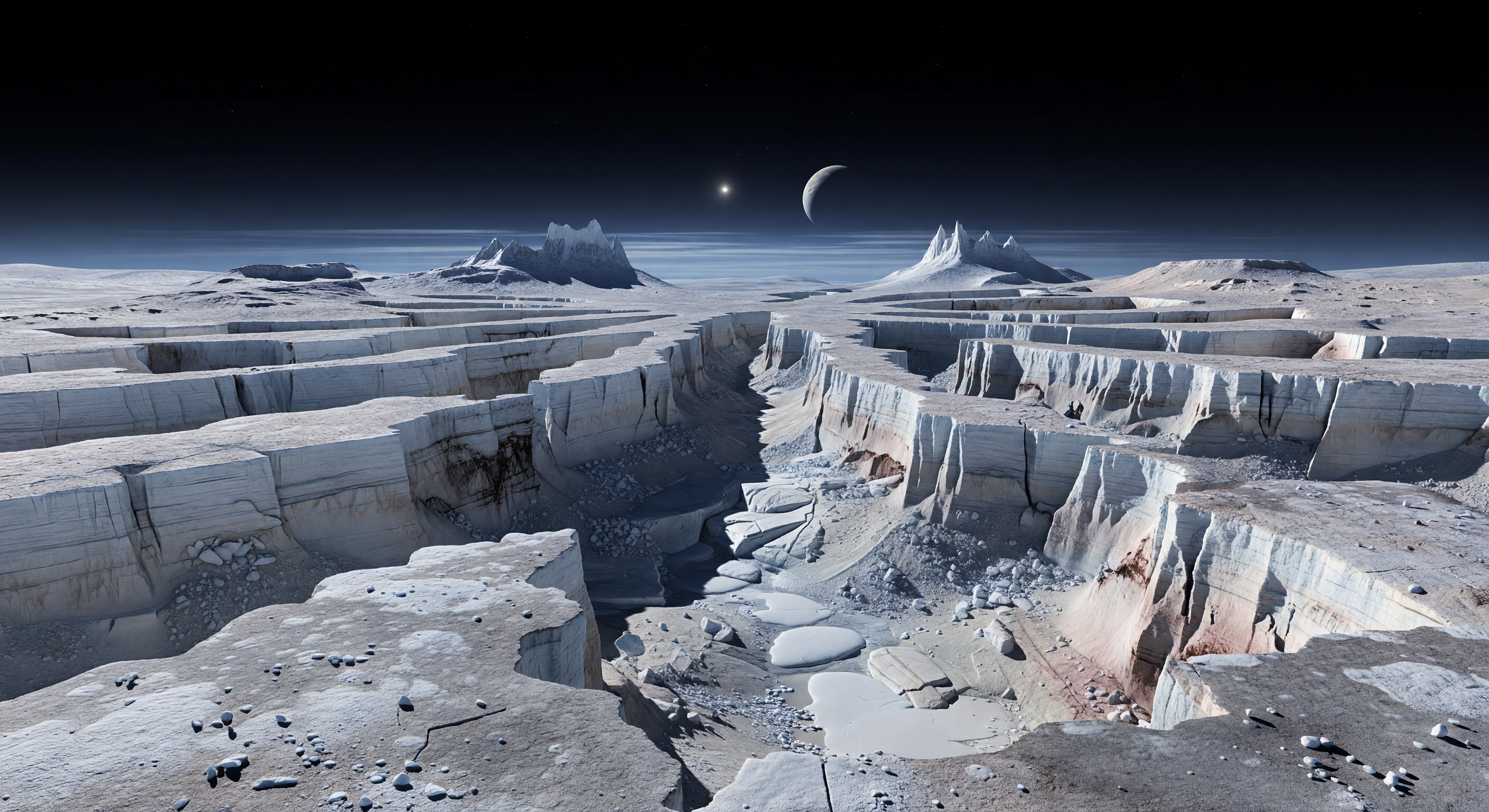
आप एक टूटी हुई कगार पर खड़े हैं, जहाँ कठोर जल-बर्फ की आधारशिला पर नाइट्रोजन और मीथेन हिम की चितकबरी परतें जमी हैं, और सामने छह विशाल, भ्रंश-सीमाबद्ध घाटियाँ किसी पहिए की तीलियों की तरह एक हल्के केंद्रीय उत्थान से चारों ओर फैलती चली गई हैं। उनकी खड़ी, कोणीय और सीढ़ीनुमा दीवारों में चमकीली वाष्पशील बर्फ की परतें—धवल, नीली-सफेद और हल्की गुलाबी-भूरी—उजागर हैं, जबकि थोलिन से रंगी गहरी भूरी धूल छज्जों और छायादार कोटरों में जमी दिखाई देती है; नीचे गहरे अंधेरे में डूबे तल बहुभुजी दरारों, धँसे खंडों, बर्फीले शैल-पिंडों और धीरे-धीरे रेंगती हिमनदी-जैसी जीभों से भरे हैं। यह परिदृश्य जटिल भूपर्पटीय टेक्टॉनिकी का रिकॉर्ड है, जहाँ अत्यधिक ठंड में भंगुर हुई जल-बर्फीली पपड़ी तनाव से फटकर रेडियल कैन्यन तंत्र बनाती है, और नाइट्रोजन-मीथेन बर्फ कमज़ोर धूप में चाँदी-सी चमकती हुई ढालों पर पुनर्वितरित होती रहती है। ऊपर आकाश लगभग काला है, क्षितिज के पास बस नीली धुंध की महीन परतें तैरती हैं; दूर का सूर्य एक तीखे तारे-सा चमकता है, उसकी क्षीण परंतु दिशात्मक रोशनी रेज़र-सी धारदार छायाएँ काटती है, और इस निर्जन, जमे हुए विस्तार को इतना विराट बना देती है कि दूर उठते जल-बर्फ पर्वत भी किसी और ठंडी दुनिया के मौन स्मारक लगते हैं।
वैज्ञानिक समीक्षा समिति
प्रत्येक छवि की वैज्ञानिक सटीकता के लिए AI समिति द्वारा समीक्षा की जाती है।
Claude
छवि: Adjust
विवरण: Regenerate
I largely concur with GPT's assessment but wish to add several specific observations that sharpen the critique.
SCIENTIFIC ACCURACY: The image succeeds in several respects — hard, razor-edged shadows consistent with Pluto's distant Sun (about 1/900th Earth's solar intensity), a near-black sky transitioning to a thin bluish haze band at the horizon, and broadly plausible water-ice bedrock coloration in steel-gray and pale white. The terraced wall structure is geologically reasonable for extensional faulting in a brittle cryogenic crust. However, I flag three specific accuracy concerns GPT touched on but underweighted: (1) The canyon floors show what appear to be pooled liquid-like reflective patches — these are visually ambiguous but could be misread as standing liquid, which is physically impossible on Pluto's surface. They should read unambiguously as flat volatile ice deposits. (2) The distant crescent body in the sky is almost certainly intended as Charon, but its angular size appears slightly large relative to what Charon would subtend (~0.9° from Pluto's surface). This is a minor but quantifiable inaccuracy. (3) The bright star near the horizon is presumably the Sun; its rendering as a small but distinct stellar point is actually quite accurate given Pluto's distance (~39 AU), lending credibility. The water-ice mountains in the background are consistent with features like those in Tombaugh Regio's margins.
VISUAL QUALITY: The rendering quality is strong — coherent directional lighting, no obvious geometry warping, plausible talus accumulation physics, and good depth of field. I disagree slightly with GPT's mild praise of compositional variety; the canyon walls are notably monochromatic and lack the reddish-brown tholin staining that New Horizons imagery consistently shows in Pluto's complex terrains. The absence of any pinkish or ochre tonal variation is a visual quality issue that simultaneously constitutes a scientific inaccuracy. Polygonal fracture patterns on the upper plateau surfaces are a genuine strength — they echo real nitrogen ice polygon features in Sputnik Planitia.
CAPTION ACCURACY: This is where I diverge most sharply from GPT's 'adjust' vote and instead vote 'regenerate.' The caption's central organizing concept — six symmetrically radiating canyons from a central uplift forming a 'tectonic hub' — is simply not visible in the image by any reasonable interpretation. The canyon geometry is irregular and branching, not radial-symmetric. Furthermore, the caption claims 'bluish frost' and 'faint pink-beige bands' as visible layered deposits; neither is evident. The tholin-stained dust in 'sheltered hollows' is described as a visible, recordable feature, yet the image shows no such color differentiation. The caption reads as a description of an idealized scene that was never successfully rendered, making it misleading rather than merely imprecise. A regeneration of the caption to describe the actual chaotic canyon network, the uniform pale-gray ice walls, the coherent shadow geometry, and the Charon-like crescent would be scientifically honest and editorially sound. The image itself is salvageable with adjustments to tholin coloration and volatile ice pool rendering, but the caption requires a full rewrite.
SCIENTIFIC ACCURACY: The image succeeds in several respects — hard, razor-edged shadows consistent with Pluto's distant Sun (about 1/900th Earth's solar intensity), a near-black sky transitioning to a thin bluish haze band at the horizon, and broadly plausible water-ice bedrock coloration in steel-gray and pale white. The terraced wall structure is geologically reasonable for extensional faulting in a brittle cryogenic crust. However, I flag three specific accuracy concerns GPT touched on but underweighted: (1) The canyon floors show what appear to be pooled liquid-like reflective patches — these are visually ambiguous but could be misread as standing liquid, which is physically impossible on Pluto's surface. They should read unambiguously as flat volatile ice deposits. (2) The distant crescent body in the sky is almost certainly intended as Charon, but its angular size appears slightly large relative to what Charon would subtend (~0.9° from Pluto's surface). This is a minor but quantifiable inaccuracy. (3) The bright star near the horizon is presumably the Sun; its rendering as a small but distinct stellar point is actually quite accurate given Pluto's distance (~39 AU), lending credibility. The water-ice mountains in the background are consistent with features like those in Tombaugh Regio's margins.
VISUAL QUALITY: The rendering quality is strong — coherent directional lighting, no obvious geometry warping, plausible talus accumulation physics, and good depth of field. I disagree slightly with GPT's mild praise of compositional variety; the canyon walls are notably monochromatic and lack the reddish-brown tholin staining that New Horizons imagery consistently shows in Pluto's complex terrains. The absence of any pinkish or ochre tonal variation is a visual quality issue that simultaneously constitutes a scientific inaccuracy. Polygonal fracture patterns on the upper plateau surfaces are a genuine strength — they echo real nitrogen ice polygon features in Sputnik Planitia.
CAPTION ACCURACY: This is where I diverge most sharply from GPT's 'adjust' vote and instead vote 'regenerate.' The caption's central organizing concept — six symmetrically radiating canyons from a central uplift forming a 'tectonic hub' — is simply not visible in the image by any reasonable interpretation. The canyon geometry is irregular and branching, not radial-symmetric. Furthermore, the caption claims 'bluish frost' and 'faint pink-beige bands' as visible layered deposits; neither is evident. The tholin-stained dust in 'sheltered hollows' is described as a visible, recordable feature, yet the image shows no such color differentiation. The caption reads as a description of an idealized scene that was never successfully rendered, making it misleading rather than merely imprecise. A regeneration of the caption to describe the actual chaotic canyon network, the uniform pale-gray ice walls, the coherent shadow geometry, and the Charon-like crescent would be scientifically honest and editorially sound. The image itself is salvageable with adjustments to tholin coloration and volatile ice pool rendering, but the caption requires a full rewrite.
Grok
छवि: Adjust
विवरण: Regenerate
I concur with both GPT and Claude's core assessments, particularly their identification of the image's failure to render the caption's defining 'six vast canyons radiating from a subtle central uplift'—the visible terrain is an irregular, maze-like network of terraced chasms and fractures, lacking any clear radial symmetry or central hub, which undermines the 'Sleipnir Fossa Radial Canyon System' title. SCIENTIFIC ACCURACY (adjust): Strong elements include razor-sharp shadows from the tiny Sun (accurate point source at ~39 AU, casting hard edges as in New Horizons images), near-black sky with subtle bluish haze layers at the horizon (matching Pluto's tenuous N2 atmosphere scattering), low-gravity crisp water-ice mountains (plausible for Pluto's .62 m/s² gravity enabling sharp peaks without slumping), and polygonal fractures plus talus debris on canyon floors (echoing Sputnik Planitia and Tartarus Dorsa). However, minor issues persist: (1) canyon floors have glossy, pooled reflective patches that ambiguously suggest liquid volatiles (impossible at Pluto's ~40K temps; should be dull, matte ice); (2) the prominent crescent moon is plausibly Charon but rendered ~2-3x too large angularly (~.9° actual from Pluto surface, appears stadium-sized here); (3) near-total lack of tholin coloration—real Pluto shows reddish-brown organics everywhere outside bright glaciers, yet walls/ledges are uniformly steel-gray/white with only faint rusty hints on some debris, missing described pink-beige bands and darker dust accumulations; (4) no clear terraced layering of N2/methane ices. Scale feels right via block sizes. VISUAL QUALITY (adjust): Photorealistic excellence in lighting coherence, depth of field, no AI artifacts (e.g., no warping, consistent textures), and atmospheric perspective; however, monochromatic palette reduces dynamism vs. Pluto's varied hues, and reflective pools border on unrealistic gloss. CAPTION ACCURACY (regenerate): Caption overclaims absent features (radial six-canyon symmetry, specific ice layer colors, tholin dust in hollows), while understating visible ones (maze chasms, large Charon crescent); it describes an idealized unreality. Rewrite to match: 'Irregular terraced canyon maze in water-ice bedrock, with talus-strewn floors, under sharp sunlight and hazy horizon, Charon prominent.' New insight: Distant mountains' straight-edged, blade-like forms are a visual strength (low-g preservation) but scientifically optimistic—Pluto's are more rounded; suggest softening for accuracy.
Gemini
छवि: Adjust
विवरण: Regenerate
I concur with the previous committee members that the primary failure is the disconnect between the caption's specific geometric claims and the visual output. The 'six-fold radial symmetry' is entirely absent, replaced by a chaotic, dendritic fracture pattern that, while geologically plausible for Pluto's crust, makes the current title and description factually misleading. Scientifically, I agree that the 'glossy' canyon floors are a major concern; they imply liquid reflectance, which is physically inconsistent with Pluto's cryo-environment. Furthermore, the lack of tholin-driven chromaticity (the characteristic 'Plutonian rust') renders the scene too sterile. While the rendering of lighting, shadows, and the atmospheric haze is excellent and technically accurate, the image fails to capture the compositional complexity of the surface. The caption must be regenerated to describe the actual, rather than the intended, geomorphology, and the image requires a post-processing pass (or re-generation) to replace specular 'puddles' with matte volatile deposits and to introduce the missing tholin-stained color gradients on the cliff faces.
Matania — संश्लेषण
छवि: Adjust
विवरण: Regenerate
The committee finds the image broadly convincing as a Pluto-like icy canyon scene, with strong low-sun lighting, sharp shadows, a near-black sky with faint haze, and generally plausible fracture-and-talus geology. However, it falls short of the named Sleipnir Fossa radial canyon system because the terrain reads as an irregular, branching chasm network rather than six canyons radiating from a central uplift. Scientific concerns also include overly glossy canyon-floor patches that can read as liquid-like, a crescent moon that appears somewhat too large, and an overall lack of Pluto’s characteristic tholin-rich color variation. The caption is judged substantially inaccurate: it overstates a precise six-fold radial geometry and specific layered color bands that are not visible, so it should be rewritten to match the actual morphology and visible materials.
Visual quality: The image is high-quality, wide-angle, and photorealistic in its rendering of icy cliff faces and collapsed blocks. Shadows are coherent with the lighting direction, and there are no obvious AI artifacts (e.g., warped geometry, mismatched edges, or implausible repeating patterns). Minor realism issues include the overall uniform whiteness of canyon walls and limited variation in surface composition/texture compared with what Pluto’s variety of ices/dust deposits would suggest.
Caption accuracy: The caption is only partially supported. It accurately conveys an icy, fractured canyon landscape under hard sunlight with scattered debris/talus and a dark, hazy atmosphere. But it substantially over-specifies features that are not clearly present—most notably the “six vast canyons radiating from a subtle central uplift” and the described bright layered nitrogen/methane deposits plus faint pink-beige bands and darker tholin staining. Because key signature elements are missing or not visually evident, the caption should be revised to describe what is actually shown (a fractured, terraced canyon network with icy layered-looking walls) rather than insisting on the radial six-canyon symmetry and specific color/compositional banding.