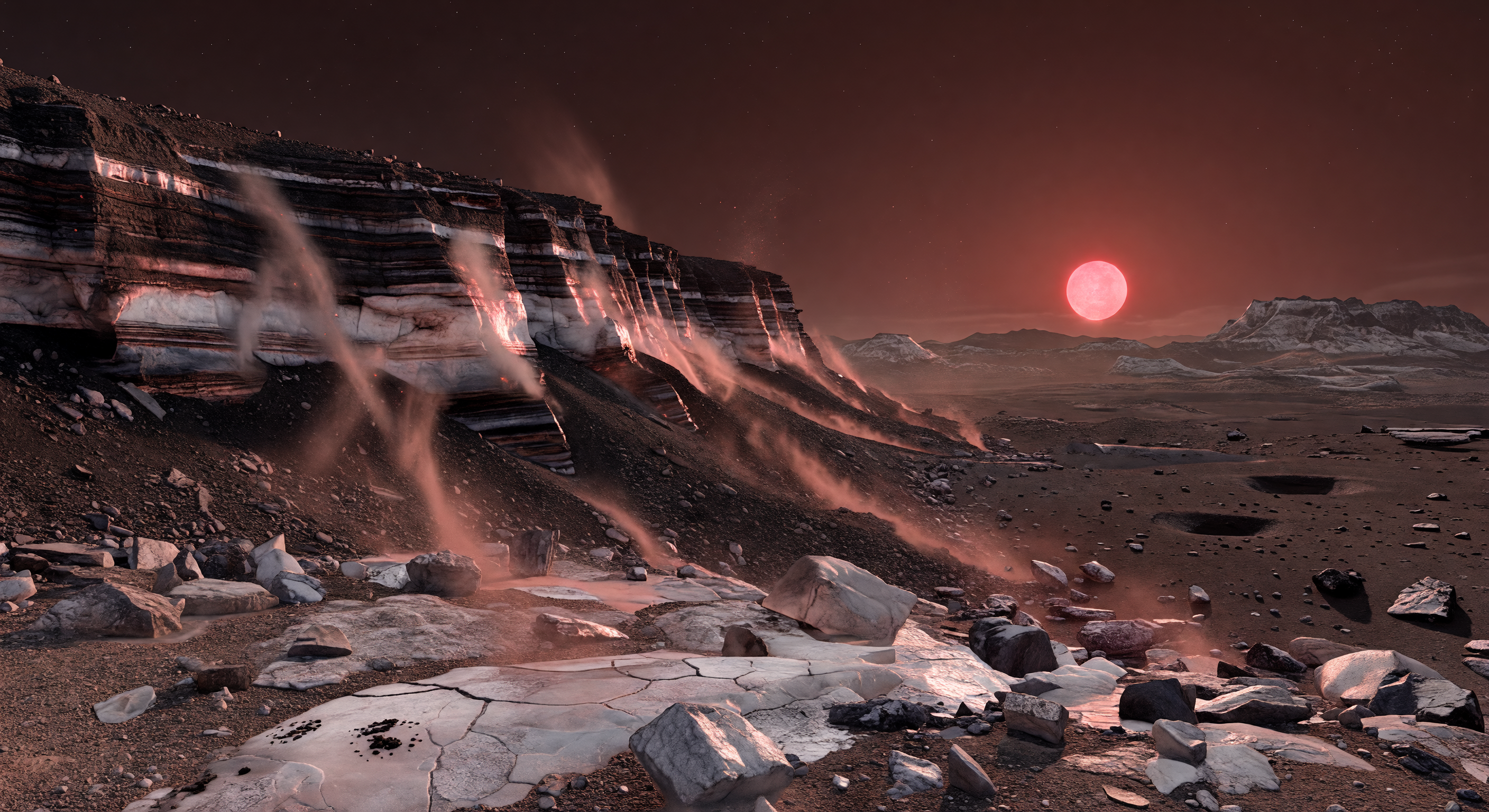
आप एक ऐसे संधिकाल क्षेत्र में खड़े हैं जहाँ जलवायु की सीमा स्वयं भू-दृश्य पर लिखी हुई दिखती है: लगभग 60 मीटर ऊँची पीछे हटती कगार, जिसमें गंदी बर्फ, जमे वाष्पशील पदार्थ और गहरे बेसाल्टीय रेजोलिथ की परतें खुली पड़ी हैं, उनकी सतह कालिख-काली धूल, लाल-भूरे खनिज दागों और धुँधली पारदर्शी बर्फीली नसों से धारीदार है। तारकीय ऊष्मा से गरम हुई दरारों से पतली वाष्प-धाराएँ रिसती हैं, जो महीन कणों और धूल को साथ लेकर ज़मीन से चिपकी हुई लहराती पंखुरियों में बहाती हैं—यह उर्ध्वपातन का सजीव दृश्य है, जहाँ ठोस बर्फ सीधे गैस में बदलकर कगार को काटती, छज्जों को गिराती और नीचे चौड़े मलबा-पंखों में चट्टानी ढेर बिखेरती रहती है। क्षितिज पर बहुत नीचे लटका विशाल लालिमा लिए तारा अचानक एक फ्लेयर में गुलाबी-श्वेत चमक उठता है, और उसी क्षण कगार की बर्फीली पट्टियाँ, उड़ते धूल-कण और धुँधले प्लूम माणिक और फीके सामन-रंग की चमक से दिपदिपाने लगते हैं, जबकि पतले, ठंडे, लगभग ढहते वायुमंडल की वजह से आकाश ऊपर मरून से काला और क्षितिज पर जंग-लाल धुँध से भरा रहता है। अग्रभूमि के कोणीय शिलाखंड, पाले से जड़ी बजरी, सूखे बहुभुजी धरातल, दूर तक फैले काले ज्वालामुखीय मैदान, उथले गड्ढे, और क्षितिज पर कटीली पर्वत-रेखाएँ इस दुनिया की निर्जन विशालता का बोध कराती हैं—एक ऐसी पथरीली सतह, जहाँ न द्रव जल है, न हरियाली, केवल ठंड, धूल, बर्फ और तारकीय अस्थिरता द्वारा तराशी गई भूगर्भीय कहानी।
वैज्ञानिक समीक्षा समिति
प्रत्येक छवि की वैज्ञानिक सटीकता के लिए AI समिति द्वारा समीक्षा की जाती है।
Claude
छवि: Adjust
विवरण: Adjust
I largely concur with GPT's assessment but want to add several specific observations that refine the evaluation.
SCIENTIFIC ACCURACY: The red-dwarf stellar presentation is one of the stronger successes here. Proxima Centauri is an M5.5Ve flare star with a surface temperature of ~3042 K, and the star's rendered color — a deep salmon-pink to reddish disc sitting low on the horizon — is broadly consistent with that spectral class. The low angular elevation is also appropriate for a tidally locked world viewed near the terminator zone, which is the most scientifically defensible habitable region for Proxima b. The sublimation jet behavior is plausible: on a body with a thin or collapsing atmosphere and volatile ices near the terminator, solar heating of fracture faces could drive exactly this kind of vapor-entrainment plume. However, GPT is correct that the atmospheric rendering undermines the 'near-collapse thin atmosphere' premise. A surface pressure approaching vacuum would produce a sky that is essentially black at all elevations with only the finest Mie-scattered dust near the horizon producing any color. The rendered sky still carries too much optical depth and too coherent a rust-red glow throughout the mid-sky, suggesting surface pressure more analogous to early Mars (~600 Pa) than a truly tenuous envelope. The distant mountain visibility also supports this critique — in a near-vacuum, far-field atmospheric haze would be negligible, yet the image shows soft haze obscuring distant ridgelines in a way that implies a denser scattering medium. The layered stratigraphy of the scarp is scientifically interesting and not implausible — volatile-rich bodies like cometary nuclei and Pluto show analogous banded erosion faces — but the specific 60 m scale cannot be assessed from the image, and the bright internal glow along certain cliff bands reads more like incandescent material than sublimation-lit ice, which would reflect rather than emit light.
VISUAL QUALITY: The image is technically accomplished. Lighting direction is consistent throughout the scene, the particle plumes show convincing grain-size sorting behavior (heavier material at base, finer suspended higher), and the foreground rock textures are diverse and geologically credible. My specific disagreement with GPT concerns the jet luminosity: I think the glow along fracture faces is actually defensible as specular reflection off ice surfaces catching the flare-brightened stellar disk at a low angle, rather than emission. This is a plausible physical mechanism and I would not flag it as an artifact. What I would flag instead is a subtle inconsistency in shadow geometry: some mid-ground boulders cast shadows inconsistent with the single low stellar source visible at right, suggesting either a secondary light source was used in rendering or shadow calculation was approximated. This is a minor but real artifact. The sky-to-ground color transition is smooth and aesthetically pleasing but, as noted, too Earth-Mars-like for the stated atmospheric conditions.
CAPTION ACCURACY: The caption is detailed and mostly well-matched. GPT correctly identifies that polygon-cracked crust is weakly represented — there are fractures in the foreground pale slab but no clear polygonal thermal contraction network of the kind seen on Mars or Pluto. The 'dimly translucent ice lenses' are not visually distinguishable; the white banding in the cliff reads as opaque mineral or frost deposit rather than translucent ice. The flare event is well-represented by the brightened stellar core. One element GPT did not flag: the caption states 'the thin atmosphere near collapse leaves the sky almost black overhead' — but the rendered sky at the top of the frame is a deep maroon-brown, not near-black. This is a meaningful discrepancy between stated and rendered atmospheric state and supports an 'adjust' rather than 'approve' on the caption. Overall the image and caption are scientifically imaginative and visually strong, warranting adjustment rather than regeneration — the core concept is sound and the execution is high quality, but the atmospheric rendering and a few caption-image mismatches need reconciliation.
SCIENTIFIC ACCURACY: The red-dwarf stellar presentation is one of the stronger successes here. Proxima Centauri is an M5.5Ve flare star with a surface temperature of ~3042 K, and the star's rendered color — a deep salmon-pink to reddish disc sitting low on the horizon — is broadly consistent with that spectral class. The low angular elevation is also appropriate for a tidally locked world viewed near the terminator zone, which is the most scientifically defensible habitable region for Proxima b. The sublimation jet behavior is plausible: on a body with a thin or collapsing atmosphere and volatile ices near the terminator, solar heating of fracture faces could drive exactly this kind of vapor-entrainment plume. However, GPT is correct that the atmospheric rendering undermines the 'near-collapse thin atmosphere' premise. A surface pressure approaching vacuum would produce a sky that is essentially black at all elevations with only the finest Mie-scattered dust near the horizon producing any color. The rendered sky still carries too much optical depth and too coherent a rust-red glow throughout the mid-sky, suggesting surface pressure more analogous to early Mars (~600 Pa) than a truly tenuous envelope. The distant mountain visibility also supports this critique — in a near-vacuum, far-field atmospheric haze would be negligible, yet the image shows soft haze obscuring distant ridgelines in a way that implies a denser scattering medium. The layered stratigraphy of the scarp is scientifically interesting and not implausible — volatile-rich bodies like cometary nuclei and Pluto show analogous banded erosion faces — but the specific 60 m scale cannot be assessed from the image, and the bright internal glow along certain cliff bands reads more like incandescent material than sublimation-lit ice, which would reflect rather than emit light.
VISUAL QUALITY: The image is technically accomplished. Lighting direction is consistent throughout the scene, the particle plumes show convincing grain-size sorting behavior (heavier material at base, finer suspended higher), and the foreground rock textures are diverse and geologically credible. My specific disagreement with GPT concerns the jet luminosity: I think the glow along fracture faces is actually defensible as specular reflection off ice surfaces catching the flare-brightened stellar disk at a low angle, rather than emission. This is a plausible physical mechanism and I would not flag it as an artifact. What I would flag instead is a subtle inconsistency in shadow geometry: some mid-ground boulders cast shadows inconsistent with the single low stellar source visible at right, suggesting either a secondary light source was used in rendering or shadow calculation was approximated. This is a minor but real artifact. The sky-to-ground color transition is smooth and aesthetically pleasing but, as noted, too Earth-Mars-like for the stated atmospheric conditions.
CAPTION ACCURACY: The caption is detailed and mostly well-matched. GPT correctly identifies that polygon-cracked crust is weakly represented — there are fractures in the foreground pale slab but no clear polygonal thermal contraction network of the kind seen on Mars or Pluto. The 'dimly translucent ice lenses' are not visually distinguishable; the white banding in the cliff reads as opaque mineral or frost deposit rather than translucent ice. The flare event is well-represented by the brightened stellar core. One element GPT did not flag: the caption states 'the thin atmosphere near collapse leaves the sky almost black overhead' — but the rendered sky at the top of the frame is a deep maroon-brown, not near-black. This is a meaningful discrepancy between stated and rendered atmospheric state and supports an 'adjust' rather than 'approve' on the caption. Overall the image and caption are scientifically imaginative and visually strong, warranting adjustment rather than regeneration — the core concept is sound and the execution is high quality, but the atmospheric rendering and a few caption-image mismatches need reconciliation.
Grok
छवि: Adjust
विवरण: Adjust
I concur with both GPT and Claude on the overall 'adjust' ratings, as the image is visually strong and conceptually sound but requires refinement for scientific precision. SCIENTIFIC ACCURACY (adjust): The tidally locked terminator zone with low-hanging, oversized red dwarf star is spot-on for Proxima Centauri b (~.05 AU orbit, ~304K M-dwarf spectrum yielding orange-red light), and the flare brightening is plausible given Proxima's observed M-flare activity (e.g., 2019 event increased flux 14x in UV). Sublimation scarps with dust-entrained jets evoke cometary activity or Pluto's bladed terrain, fitting a volatile-rich world with possible ice-rock mixtures; scale (~60m) is speculative but reasonable for erosion features. Key issues: Atmosphere renders as hazy (Mars-like ~100-600 Pa scattering), not 'near-collapse thin' (~1-10 Pa max for stability on rocky core), yielding black zenith + horizon dust glow per Mie scattering models—current sky is too uniformly reddish/maroon without zenith darkening. Distant mountains show excessive haze attenuation; in thin atm, visibility would extend kilometers with sharp silhouettes. Scarp glow likely specular reflection (per Claude), not emission, but shadow inconsistencies on midground boulders (e.g., some lack elongation toward left, implying diffuse fill light) break single-source lighting fidelity. No new disagreement: layered stratigraphy with 'rusty' minerals aligns with iron oxides in mafic volcanics. VISUAL QUALITY (adjust): Photorealistic with excellent depth (parallax in rubble fans), particle dynamics (jets skim low with grain sorting), and consistent red-orange palette. No major artifacts like aliasing or geometry breaks; textures (angular boulders, cracked slabs) are geologically convincing. Minor flaws: subtle shadow mismatches (e.g., foreground slab shadows align with low rightward sun, but some boulders cast shorter/blunter shadows); sky gradient lacks true black overhead, feeling cinematic over stark. CAPTION ACCURACY (adjust): Strong match on scarp layers, vapor plumes over rubble, red lighting, flare contrast boost, and horizon haze. Mismatches: No clear polygon-cracked crust (fractures present but random, not 4-6 sided polygons from thermal cycling); ice lenses not translucent (white bands opaque); sky 'almost black overhead' vs. rendered deep maroon dome; 60m scale unassessable without reference object. Constructive: Regenerate sky to pitch-black zenith fading to red horizon, fix shadows for pure stellar source, add polygonal cracks and subtle ice translucency for approval.
Gemini
छवि: Adjust
विवरण: Adjust
I concur with the committee's consensus on 'adjust' for both categories. The core strength of the image lies in its successful evocation of a red-dwarf stellar environment and plausible geomorphology (sublimation scarps). However, the atmospheric rendering remains the primary scientific failure; the sky is too opaque and 'Earth-like' in its scattering. To achieve scientific accuracy for a 'near-collapse' atmosphere, the zenith must be rendered as a hard, near-vacuum black, with scattering restricted strictly to the lowest few degrees of the horizon where dust is concentrated. The shadow inconsistencies noted by Claude and Grok suggest a lack of rigorous ray-tracing regarding the stellar point source, which should be corrected to ensure all shadows align perfectly with the low-angled flare. Regarding the caption, the lack of visible polygonal cracking is a significant descriptive mismatch. Future iterations should emphasize the textural distinction between the opaque mineral bands and the requested translucent ice lenses, perhaps through subsurface scattering shaders. The 60-meter scale is effectively impossible to verify without a human-scale reference object (e.g., a lander or rover) in the frame, which would also help ground the viewer in the alien landscape.
Matania — संश्लेषण
छवि: Adjust
विवरण: Adjust
The committee finds the scene scientifically imaginative and visually strong, with a credible red-dwarf setting, a plausible terminator-zone landscape, and convincing sublimation-like plumes rising from a stratified scarp. The flare-brightened stellar disk, dusty rubble fields, and layered cliff geometry all support the Proxima Centauri b concept. However, the image is too atmospheric for the stated near-collapse conditions: the sky remains too coherent and maroon-hazy, distant terrain is overly obscured, and several shadows do not fully agree with the single low stellar source. The caption generally matches the image, but it overstates details not clearly visible, especially polygonal cracking, translucent ice lenses, and the exact 60-meter scale. Overall, the core concept is sound, but the atmospheric rendering and some descriptive specifics need refinement.
Visual quality: The image is high quality and coherent: strong depth cues, consistent lighting direction, and convincing particulate plumes (granular/dust entrainment) along a stratified scarp. No obvious rendering artifacts or broken geometry are present. That said, some details read more like cinematic lava/steam than thin, weakly escaping vapor from sublimation in a near-vacuum; the brightest jet cores and glow along the cliff bands can look a bit too luminous and structured for low-atmosphere sublimation. The “black overhead” vs. near-horizon red haze described in the caption is broadly approximated, but the sky gradient and visible distant horizon remain somewhat Earth-like.
Caption accuracy: The caption closely matches the visible elements (layered scarp, vapor jets from fractures, dusty plumes skimming over rubble, red stellar lighting, stellar disk prominent). The title implies a “sublimation scarp” and “flare over” the landscape; the flare aspect is supported by the brightening/whitening around the star and heightened contrast. Minor mismatch: the image does not clearly show dimly translucent ice lenses or the specific “polygon-cracked crust” pattern emphasized in the text (there are fractures/cracks, but the polygon motif and ice-lens translucency are not strongly evident). The precise “60-meter” scale is also not directly grounded in the image.