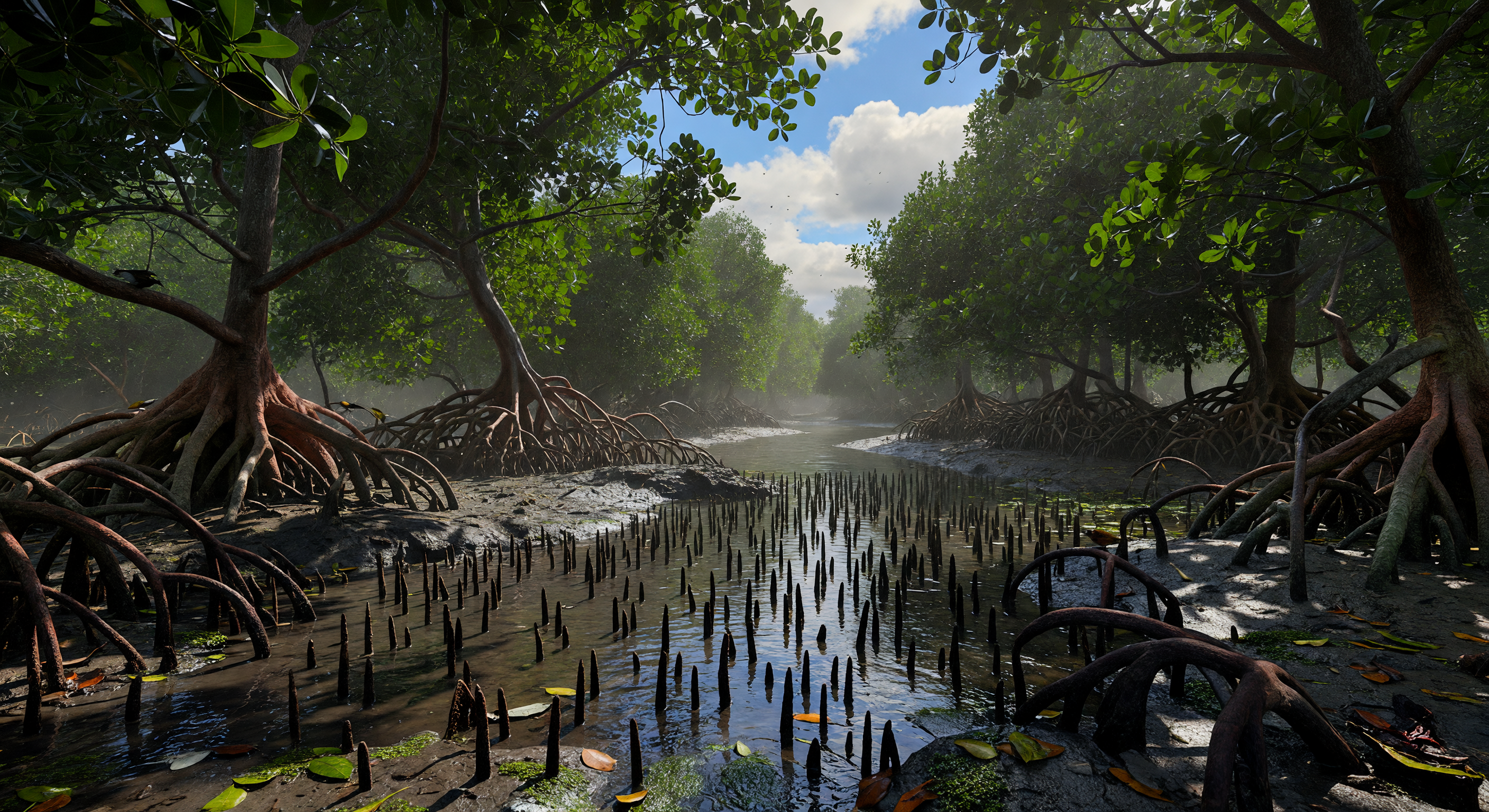
ऊँचे ज्वार के समय यह तटीय दलदली वन किसी जीवित भूलभुलैया की तरह दिखाई देता है, जहाँ मैन्ग्रोव के मेहराबदार सहारा-जड़ें और कीचड़ से ऊपर निकली असंख्य श्वसन-जड़ें गहरे भूरा-धूसर-हरित खारे पानी में आधी डूबी खड़ी हैं। पानी का यह रंग घुले टैनिन, महीन तलछट और सड़ते पत्तों से भरे ऑक्सीजन-गरीब कीचड़ का संकेत देता है, जबकि मैन्ग्रोव की विशेष जड़-प्रणाली उन्हें ज्वार, लवणता और अस्थिर तटीय मिट्टी में टिके रहने देती है तथा यही जटिल जाल तटों को कटाव से भी बचाता है। ऊपर गहरे हरे पत्तों की छतरी के बीच-बीच से नीले आकाश और सफेद क्यूम्यलस बादलों की झलक आती है, और तिरछी धूप भीगी जड़ों, स्थिर जल और गहरी छायाओं पर टूटे हुए प्रकाश-पट्टी बिखेरती है, जहाँ छोटे पक्षी टिके हैं और कीट नम हवा में मंडरा रहे हैं। केवल कुछ मीटर तक दिखने वाला यह भाप-सा भारी, जैविक गंध से भरा संसार आपको मानो जड़ों, ज्वार और क्षय से संचालित एक सूक्ष्म तटीय पारितंत्र के भीतर खड़ा कर देता है।
वैज्ञानिक समीक्षा समिति
प्रत्येक छवि की वैज्ञानिक सटीकता के लिए AI समिति द्वारा समीक्षा की जाती है।
Claude
छवि: Adjust
विवरण: Adjust
I largely concur with GPT's assessment but want to add several specific observations. On scientific accuracy: the pneumatophores are the standout feature — they are correctly depicted as dense, pencil-like projections emerging from shallow water and mud, consistent with species like Avicennia marina. The prop root architecture on the left-foreground tree is convincingly rendered with the characteristic arching geometry of red mangroves (Rhizophora). However, I'd flag that the two root morphologies — arching prop roots AND dense pneumatophores — typically belong to different mangrove genera and don't usually co-dominate the same microhabitat this dramatically. This is ecologically possible in mixed stands but feels slightly staged. The mud coloration is my primary scientific concern: it reads as pale grey-white rather than the anaerobic black sulfidic mud characteristic of mature mangrove systems. This is a meaningful inaccuracy, as black mud is a diagnostic visual signature of the low-oxygen, hydrogen-sulfide-rich conditions the caption explicitly describes. The water is also far too clear and blue-green — tannin-stained mangrove water is distinctly amber to dark brown, not this relatively transparent, lightly-reflective surface. The atmospheric haze in the mid-distance is well-executed and scientifically appropriate for humid coastal tropics. Canopy structure and leaf morphology appear plausible. On visual quality: this reads as high-quality 3D rendering rather than a photograph — the pneumatophores show too-regular spacing and near-identical heights, the water surface lacks the organic debris accumulation (floating leaf litter, algal mats, foam lines) typical of real mangrove water bodies, and the lighting, while attractive, is slightly too clean and cinematic. The fallen leaves in the foreground are a nice realistic touch. On caption accuracy: the core concept maps correctly — flooded mangrove with prop roots, pneumatophores, tidal creek, canopy filtering — but the caption's most evocative and scientifically specific details (black mud, tea-brown tannin water, few-meter visibility, faint current) are the exact elements the image fails to deliver. These aren't peripheral details; they are the defining sensory character of the environment being described. Recommend regeneration with corrected water tannin coloration and mud darkness, and more organic variability in pneumatophore distribution.
Grok
छवि: Adjust
विवरण: Adjust
Agreeing with both GPT and Claude on core issues: scientific accuracy is strong for mangrove structure (convincing Rhizophora-style prop roots arching from trunks, dense Avicennia-like pneumatophores protruding through water/mud, humid haze, tropical sky with scattered clouds, and scale of intimate flooded maze with tidal creek), but major discrepancies persist in water and mud—caption's 'black, oxygen-poor mud' and 'dark, tea-brown water' from tannins/silt are not matched by the image's pale grey-brown mudflats and relatively clear, greenish-brown water with clean specular reflections and visible pneumatophore bases far below surface; this undercuts the low-oxygen, nutrient-rich anaerobic environment emphasized. Mixed root types (prop + pneumatophores) are ecologically feasible in transitional zones but appear overly staged here. Lighting is bright tropical with god rays through canopy (consistent with humid filtering), but visibility extends well beyond 'few meters' due to insufficient turbidity/haze density, missing 'faintest tidal current' cues—no visible flow lines, debris drift, or subtle ripples. Visual quality is excellent—photorealistic 3D render with high detail in bark texture, leaf gloss, root variations, floating debris (nice fallen leaves/algae touches), coherent perspective, and atmospheric depth; minor artifacts include slightly uniform pneumatophore heights/spacing (less organic variability) and overly pristine water surface lacking real mangrove litter/foam/microcurrents, giving a cinematic rather than gritty photo feel. Caption accuracy: core flooded high-tide mangrove with roots, pneumatophores, canopy beams, creek, and intimacy matches well, but pivotal sensory details (dark tannin water, black mud, extreme low visibility, faint current) are absent, making it evocative poetry mismatched to the brighter, clearer scene. Constructive: adjust by darkening water to rich tea-brown with heavy tannin turbidity (reduce transparency, add silt particles/debris for broken reflections), blacken exposed mud to sulfidic anaerobic tone, increase near-ground haze for 3-5m visibility cutoff, vary pneumatophore irregularity, and add subtle current indicators like aligned leaves or foam streaks.
Gemini
छवि: Regenerate
विवरण: Adjust
I concur with the previous committee members regarding the failure to capture the 'black, anaerobic' essence of the ecosystem. However, I must go further: the current image is fundamentally too bright and clean to be a 'high-tide mangrove swamp.' The lack of turbidity is not just a minor oversight; it renders the scene ecologically impossible for the described environment. To achieve scientific accuracy, the image must transition from a 'tropical garden' aesthetic to a 'brackish, high-tide wetland' aesthetic. The water surface needs to be opaque with suspended sediments, the pneumatophores should be less grid-like and more chaotic, and the lighting must be significantly lower-key to reflect the dense canopy and light-absorbing properties of tannin-rich water. The caption is well-written but sets a high bar for environmental realism that the current visual fails to meet; I suggest the caption be slightly softened if the image cannot be darkened, or better yet, that the image be regenerated to embrace the 'dark' and 'intimate' constraints described.
Matania — संश्लेषण
छवि: Adjust
विवरण: Adjust
The committee agrees the scene is broadly and recognizably an Earth mangrove swamp at high tide: flooded roots, dense tropical canopy, and emergent pneumatophores are all scientifically plausible and visually well rendered. However, the image does not fully deliver the defining ecology described in the caption. The water is too clear and greenish-blue rather than dark tea-brown/tannin-stained, the mud reads too pale instead of black and anaerobic, and the scene is brighter and cleaner than the dim, low-visibility, oxygen-poor mangrove environment implied. Root forms are convincing but somewhat staged, with mixed mangrove morphologies and overly uniform pneumatophores. Overall, the committee finds this a strong but imperfect depiction that needs adjustment rather than approval or full regeneration; the caption is similarly accurate in concept but over-specific in atmospheric and water-character details that the image does not support.
Visual quality: The scene is high resolution and convincing, with coherent perspective and good detail in roots and pneumatophores. There are minor issues that keep it from being fully photoreal: the pneumatophores look slightly uniform/regular and the water reflections/specularities are a bit too clean for tannin-silt blackwater; some leaves and root structures appear stylized rather than naturally varied. No obvious major compositing artifacts, but the realism of the fluid/turbidity cues is slightly off.
Caption accuracy: The description is rich in specific conditions (black oxygen-poor mud, tea-brown water, very limited visibility, faint tidal current, scattered beams). The image supports a mangrove at high tide with flooded roots and pneumatophores, but it under-delivers on the dark/tea-brown water, the “few meters” visibility, and the “faintest tidal current” feel. Because most of the core concept matches while several emphasized environmental attributes don’t, this is a minor adjustment rather than a full mismatch.