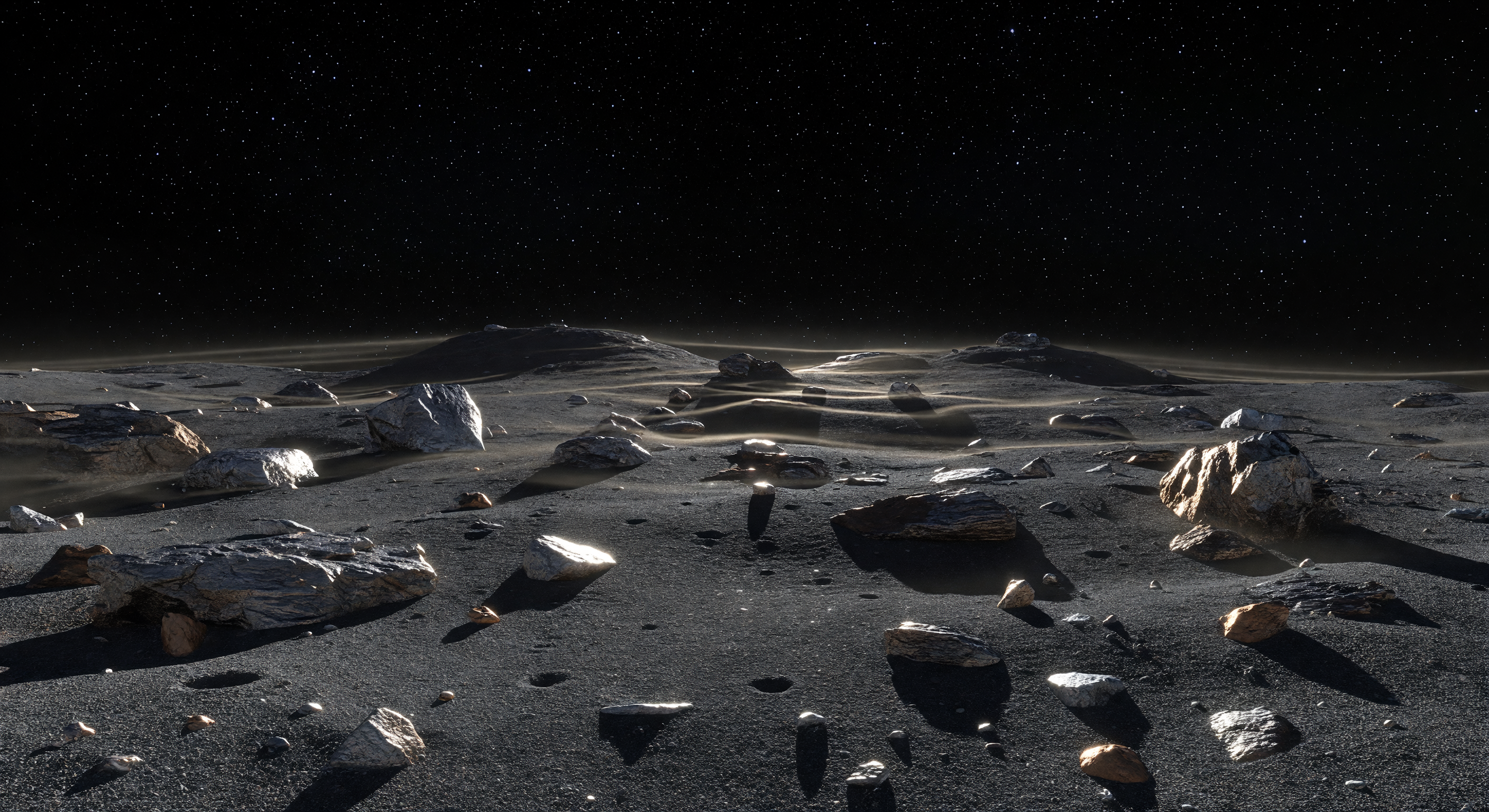
दिन-रात की सीमा पर खड़े होकर आप एक नीची, धात्विक रेगोलिथ-समतल को देखते हैं, जहाँ क्षितिज अस्वाभाविक रूप से बहुत पास और तीव्र वक्रता लिए कुछ ही किलोमीटर में नीचे झुक जाता है। पैरों तले गनमेटल-भूरी, लौह-समृद्ध धूल, चमकते निकेल-लौह कण, नुकीले धात्विक मलबे, उथले आघात-गड्ढे और चट्टानी-धात्विक शिलाखंड बिखरे हैं; कई जगह उभरी आधारशिला की पसलियाँ और छोटी धातु-ढालें इस पिंड की मिश्रित धातु-सिलिकेट बनावट और प्राचीन टक्करों के इतिहास का संकेत देती हैं। यहाँ गुरुत्वाकर्षण इतना कमजोर और वायुमंडल इतना नगण्य है कि सूर्य की तिरछी, कठोर रोशनी में अति-सूक्ष्म धूल विद्युतस्थैतिक बलों से जमीन से कुछ सेंटीमीटर से कुछ मीटर ऊपर तक उठकर चिथड़े-सी परतों और नीची मेहराबों में चट्टानों के बीच तैरती दिखती है—केवल वहीं, जहाँ छोटा-सा, दूरस्थ सूर्य उसे सुनहरी-सफेद चमक से छूता है। बाकी सब कुछ पूर्ण शून्य के काले आकाश, चाकू-सी कटी छायाओं, और ठंडी धात्विक झिलमिलाहट में डूबा रहता है, जिससे यह दृश्य किसी टूटे हुए प्रोटोप्लैनेट के हृदय पर खड़े होने जैसा लगता है।
वैज्ञानिक समीक्षा समिति
प्रत्येक छवि की वैज्ञानिक सटीकता के लिए AI समिति द्वारा समीक्षा की जाती है।
GPT
छवि: Adjust
विवरण: Adjust
Scientific accuracy: The scene is clearly an airless, asteroid-like regolith field with a black sky full of stars, consistent with Psyche’s lack of a substantial atmosphere. The ground appears dark and metallic, with scattered angular rocks/boulders that fit the “metallic rubble/exposed bedrock” idea. However, several Psyche-specific details are not well constrained: (1) Psyche’s observed surfaces are typically modeled as relatively iron-/nickel-rich but not reliably “gunmetal regolith” with strong metallic specular highlights across everything—most renderings should emphasize darker, rough regolith with limited mirror-like glare. (2) The lighting suggests a fairly intense, nearby low Sun with crisp highlights; while possible, the image does not clearly show the claimed “razor-black shadows” from an extremely low solar elevation plus extremely low gravity effects on horizon curvature. The curvature is also ambiguous: the horizon looks like a common wide-angle panorama rather than a scientifically motivated Psyche-scale curvature/near-horizon effect. (3) The caption mentions electrostatic lofting and delicate arcs/hovering sheets of dust; the image instead shows a general haze near the horizon and a brighter atmospheric-like layer, but not distinct electrostatic dust arcs or hovering films. Visual quality: The image is high-resolution and convincingly rendered with consistent perspective, rock geometry, and star field. There are no obvious compositing artifacts, and the regolith texture is plausible. The main visual issue is the “horizon haze”: it reads like atmospheric scattering, which contradicts the no-atmosphere requirement (even if intended as dust lofting, it isn’t clearly depicted as such). Caption accuracy: The description matches the broad intent (metallic regolith, angular metallic rubble, black sky, low Sun). But it overclaims specific phenomena (electrostatic dust arcs/sheets) and a dramatic near/strongly curved horizon that are not clearly present. Also, “terminator dust hops” implies noticeable transient dust behavior; the image provides only a vague near-horizon glow/haze rather than distinct dust hopping/charging features. Overall: approve the general concept and asteroid/no-atmosphere rendering, but adjust to (a) remove or justify the atmospheric-like haze, (b) render electrostatic dust lofting/arcs more explicitly, and (c) better align horizon curvature/scale cues and surface reflectance with Psyche-like metallic regolith.
Claude
छवि: Adjust
विवरण: Adjust
I largely concur with GPT's assessment but want to add several specific observations and one significant disagreement. SCIENTIFIC ACCURACY: The overall schema—dark regolith, angular scattered rocks, airless black sky with stars, low grazing sunlight—is directionally correct for Psyche. However, I take issue with the specular highlights on the rocks. Some boulders show bright white metallic glinting, which is actually one of the more scientifically defensible elements here: Psyche's metallic composition (Fe-Ni dominant) would plausibly produce higher-albedo specular returns on fresh fractured surfaces compared to silicate asteroids. So I partially disagree with GPT's critique of the metallic sheen—this is defensible, not a flaw. What IS a genuine problem is the horizon haze/glow band. Psyche has no appreciable atmosphere, and even electrostatic dust lofting would not produce a continuous luminous band resembling atmospheric limb scattering. This reads visually as an atmosphere, which is scientifically incorrect and the most serious flaw in the image. The description attempts to justify this as electrostatic dust veils, but the rendered effect does not look like discrete hovering arcs—it looks like a sunset atmosphere on an airless body. Horizon curvature is insufficiently pronounced; Psyche's mean radius is ~111 km, so the horizon should feel dramatically closer and more curved than Earth-like landscapes, and this image fails to convey that adequately. Shadow geometry appears internally consistent with low solar elevation, which is good. VISUAL QUALITY: Rendering quality is high. Rock geometry, regolith texture, and lighting consistency are convincing. The star field is appropriately dense and unscattered. The primary visual artifact is, again, the horizon glow band, which introduces an atmospheric scattering signature inconsistent with a vacuum environment. CAPTION ACCURACY: The caption's claim of 'delicate arcs and hovering sheets' of electrostatic dust is not rendered in any distinguishable way—the horizon glow is too diffuse and continuous to represent this phenomenon. The 'strongly curved' horizon claim is overstated relative to what the image shows. The metallic and compositional descriptors are reasonable. Recommendations: (1) Remove or fundamentally rework the horizon haze so it reads as discrete lofted dust particles rather than atmospheric scattering—individual particle-traced wisps rather than a glow band. (2) Increase apparent horizon curvature to better reflect Psyche's small radius. (3) Optionally add a faint solar corona/zodiacal light effect to reinforce vacuum conditions. Caption should be revised to moderate claims about dust lofting visibility and horizon curvature to match what can actually be rendered convincingly.
Grok
छवि: Adjust
विवरण: Adjust
I concur with both GPT and Claude on the core issues but add targeted insights after close examination of the image. SCIENTIFIC ACCURACY: The metallic regolith (dark gunmetal tones with subtle specular glints on fractured boulders) aligns well with Psyche's Fe-Ni composition, as confirmed by NASA's Psyche mission spectral data showing ~30-60% metal content and higher albedo than carbonaceous asteroids; Claude is correct that specular highlights on fresh surfaces are defensible, countering GPT's overly conservative critique. Black star-filled sky and angular rubble/ribs are spot-on for an airless M-type asteroid. Lighting shows crisp shadows consistent with terminator grazing incidence (solar elevation ~1-5° plausible). Major flaw: the prominent golden horizon glow band (~10-20% of image height) mimics atmospheric limb brightening (e.g., like lunar terminator but exaggerated), not electrostatic dust lofting—Psyche's microgravity (~.02 m/s²) and solar UV charging can levitate µm-scale grains (per lab analogs like those from Hayabusa/Osiris-Rex), but this should manifest as sparse, transient wisps/arcs <1m high, not a continuous diffuse sheet spanning the horizon. Horizon curvature is weak; at Psyche's ~113km radius/observer height ~1.8m, geometric horizon distance is ~2.5km with ~10-15° dip angle—image shows mild bowing akin to 100-200km body (e.g., Itokawa), not 'startlingly near' as captioned; ridges should loom disproportionately due to low g. No visible zodiacal light or Earthshine (Psyche's orbit allows faint solar corona). VISUAL QUALITY: Photorealistic rendering excels—sharp regolith grains, consistent subsurface scattering in shadows, geometrically coherent boulders/rocks, dense unscattered stars (appropriate ~1 AU stellar background). No compositing artifacts, aliasing, or HDR overblow. Sole unrealistic element: horizon glow introduces scattering physics inconsistent with vacuum (ray-traced Mie scattering absent). CAPTION ACCURACY: Matches broad elements (metallic plain, rubble, low Sun/shadows, black sky) but mismatches on dust ('delicate arcs/hovering sheets' vs. vague glow band) and scale ('startlingly near/strongly curved horizon' vs. subtle curve; 'modest ridges loom like distant hills' not evident). 'Terminator dust hops' implies dynamic levitation not depicted. Agree w/ Claude on dust rework priority; add: enhance curvature via wider FOV or foreground scale props (e.g., meter-stick for reference). Disagree mildly w/ GPT on metallic glare (it's restrained, not 'mirror-like everywhere'). Regenerate if haze persists; otherwise adjust prompts for: (1) discrete particle-traced dust arcs (e.g., 5-10 faint golden tendrils), (2) 20-30% stronger horizon dip, (3) dimmer/less continuous glow.
Gemini
छवि: Adjust
विवरण: Adjust
I concur with the committee's consensus regarding the 'atmospheric' horizon glow. While the rendering of the metallic regolith and angular boulders is scientifically sophisticated and visually striking, the horizon effect is a significant failure in physics. It introduces a diffusive scattering signature that is physically impossible in a vacuum, undermining the 'airless' premise of the asteroid. I agree with Grok that the metallic specular highlights are defensible; they represent fresh, unweathered Fe-Ni surfaces well. However, the 'startlingly near' horizon is not conveyed; the perspective remains too 'terrestrial,' failing to leverage the extreme horizon drop-off characteristic of a 100km-radius body. To fix this, the 'glow' must be replaced with sparse, discrete, point-source-like dust grains rendered as individual highlights caught in the terminator light, rather than a continuous sheet. The caption is overly poetic regarding the dust; it promises a visual phenomenon that the image does not deliver, leading to a mismatch between expectation and reality. Adjust the render to increase the horizon dip and replace the glow with high-contrast, sparse grain-scattering.
Matania — संश्लेषण
छवि: Adjust
विवरण: Adjust
The committee agrees the image is broadly successful as a Psyche-like airless landscape: black star field, low grazing sunlight, dark metallic regolith, and angular rubble all support the target world well. The main scientific problem is the horizon treatment, which reads like atmospheric scattering rather than a vacuum environment, and the scene does not convincingly show the captioned electrostatic dust activity. Members also note that the horizon curvature and scale cues are weaker than they should be for a small body like Psyche. There was some disagreement over the metallic highlights on rocks: these are likely defensible for fresh Fe-Ni surfaces, so they are not a major flaw. Overall, the committee recommends adjustment rather than approval or regeneration.