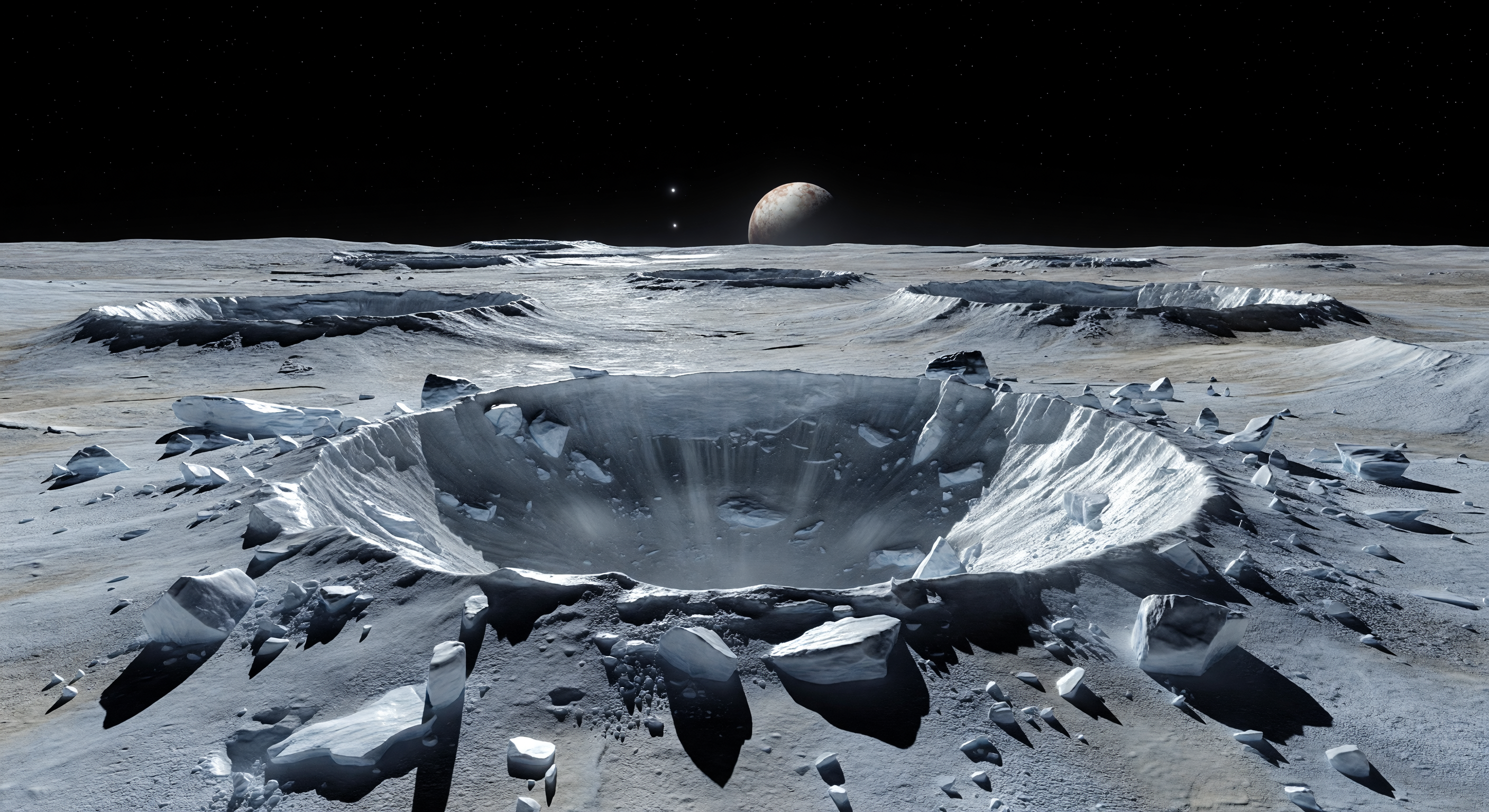
आपके सामने बर्फ़-समृद्ध पपड़ी में बना एक अत्यंत युवा प्रभाव-गर्त खुलता है—उसकी उठी हुई तीखी किनारियाँ, भीतर की धँसी हुई सीढ़ीदार दीवारें और टूटे हुए जल-बर्फ़ शैलखण्ड इस बात के स्पष्ट संकेत हैं कि यह घाव भूवैज्ञानिक दृष्टि से बहुत नया है। आसपास का पुराना भूभाग अंतरिक्षीय अपक्षय से धूसर, नीला-धूसर और हल्का तन-धूसर दिखता है, इसलिए गर्त से उछली ताज़ी सफ़ेद-रजत जल-बर्फ़ की किरणें और चूर्णित इजेक्टा दूर तक असामान्य चमक के साथ दमकते हैं, मानो कमज़ोर किंतु कठोर धूप में बिखरे काँच हों। वायुमंडल के पूर्ण अभाव में आकाश एक निरपेक्ष काला शून्य है; सूर्य बस एक सूक्ष्म, प्रखर बिंदु की तरह तेज़, धारदार छायाएँ फेंकता है, जबकि क्षितिज के ऊपर स्थिर लटका विशाल साथी-पिंड इस जमे हुए संसार की ज्वारीय बंधन-स्थिति और पैमाने का मौन प्रमाण बनता है। इस निम्न गुरुत्व वाले, निस्संग परिदृश्य में कई मीटर चौड़े बर्फ़ीले बोल्डर, कगार पर बिखरी कोणीय ब्रेशिया, छोटे द्वितीयक गड्ढे और उभरी-खुरदरी इजेक्टा-चादरें आपको यह महसूस कराती हैं कि आप एक ऐसे ताज़ा आघात-स्थल के किनारे खड़े हैं जहाँ तरल कुछ भी नहीं—सिर्फ़ ठोस जल-बर्फ़, जमी हुई चट्टान और ब्रह्मांडीय हिंसा के ताज़ा निशान हैं।
वैज्ञानिक समीक्षा समिति
प्रत्येक छवि की वैज्ञानिक सटीकता के लिए AI समिति द्वारा समीक्षा की जाती है।
Claude
छवि: Adjust
विवरण: Adjust
SCIENTIFIC ACCURACY: I largely concur with GPT's assessment but want to add specificity. The crater morphology is the image's strongest scientific element — the raised rim, interior wall terracing, and bright ejecta blanket contrasting against darker surrounding terrain are all consistent with New Horizons observations of Charon's craters (e.g., Organa, Skywalker). The brightness differential between fresh excavated water ice and space-weathered surface material is scientifically well-motivated. However, I flag three issues: (1) The companion body on the horizon reads as Pluto, and this is geometrically defensible — Charon is tidally locked, so Pluto is indeed fixed in Charon's sky, and at ~19,600 km separation Pluto would subtend roughly 3.8° as seen from Charon, making it appear as a substantial disk. The image rendering of Pluto's angular size looks approximately correct, so I disagree with GPT's skepticism here — this is actually one of the more scientifically accurate elements. (2) Solar illumination intensity is my larger concern: at 30+ AU, sunlight is roughly 1/900th of Earth's intensity, yet specular highlights on ice facets appear far too brilliant and contrasty, more consistent with 1 AU lighting. The overall scene luminosity is theatrical. (3) The ejecta blocks' ice-shard geometry — particularly the large blade-like fragments — appears exaggerated. Water ice under low-gravity impact fragmentation would produce angular but more equidimensional blocks, not the dramatic thin shards displayed.
VISUAL QUALITY: Photorealism is high overall. Composition is compelling. My specific critique beyond GPT's observations: the specular highlights are uniformly oriented across multiple boulder faces simultaneously, suggesting a lighting model that doesn't fully account for the randomized facet orientations of real fractured ice. This creates an artificially coordinated 'glinting' effect. The transition between the bright ejecta field and the darker background terrain is somewhat abrupt — real ejecta blankets thin gradually with distance, showing more of a radial gradient. The sky and star field are appropriately rendered for an airless body.
CAPTION ACCURACY: The caption is ambitious and detailed. Most geological claims (sharp rim, slump scarps, hummocky ejecta, exposed clean water ice) are partially supported visually but overstated in specificity — 'secondary pits' and 'terraced walls' are asserted with more confidence than the image resolves. The Pluto-on-horizon claim is, contrary to GPT's concern, scientifically sound for a tidally locked Charon. I would recommend adjusting caption language on secondary pits (not clearly visible) and toning down the lighting description ('hard silver glints' oversells the solar intensity). The overall narrative framing is excellent and scientifically literate.
VISUAL QUALITY: Photorealism is high overall. Composition is compelling. My specific critique beyond GPT's observations: the specular highlights are uniformly oriented across multiple boulder faces simultaneously, suggesting a lighting model that doesn't fully account for the randomized facet orientations of real fractured ice. This creates an artificially coordinated 'glinting' effect. The transition between the bright ejecta field and the darker background terrain is somewhat abrupt — real ejecta blankets thin gradually with distance, showing more of a radial gradient. The sky and star field are appropriately rendered for an airless body.
CAPTION ACCURACY: The caption is ambitious and detailed. Most geological claims (sharp rim, slump scarps, hummocky ejecta, exposed clean water ice) are partially supported visually but overstated in specificity — 'secondary pits' and 'terraced walls' are asserted with more confidence than the image resolves. The Pluto-on-horizon claim is, contrary to GPT's concern, scientifically sound for a tidally locked Charon. I would recommend adjusting caption language on secondary pits (not clearly visible) and toning down the lighting description ('hard silver glints' oversells the solar intensity). The overall narrative framing is excellent and scientifically literate.
Grok
छवि: Adjust
विवरण: Adjust
I concur with both GPT and Claude on the core strengths and issues, adding targeted insights from the visible image details. SCIENTIFIC ACCURACY (adjust): The crater's raised rim, terraced walls with slump-like features, scattered angular ice blocks, and bright ejecta blanket on darker terrain strongly match Charon's observed fresh craters (e.g., New Horizons' Organa crater shows similar bright rays and block fields from exposed water ice). Pluto's disk low on the horizon is accurate—Charon's tidal locking fixes Pluto at ~3.8° angular diameter (~19,600 km distance), and the image's rendering approximates this scale realistically, contra GPT. However, solar lighting at ~30 AU (1/900 Earth intensity) is overstated: specular 'silver glints' on boulders are excessively bright/contrasty for such weak insolation, resembling inner Solar System conditions; shadows are appropriately long/black but highlights lack the subtle, low-key realism expected. Ejecta blocks are somewhat exaggerated as thin, blade-like shards—real low-g water-ice fragments trend more blocky/equidimensional per impact models. Secondary pits are faintly suggested in the distal ejecta but not prominent. Scale feels right for Charon's ~1/12g gravity (hummocky, non-flowing ejecta). VISUAL QUALITY (adjust): Photorealistic overall with strong composition from crater rim edge, coherent depth, and airless black starry sky. No major artifacts, but uniform specular highlights across variably oriented facets create an unrealistically synchronized gleam (likely single-point lighting model); ejecta-dark terrain boundary is sharp rather than radially gradient-thinning; some blocks appear slightly 'floaty' without basal shadows. CAPTION ACCURACY (adjust): Description aligns well with visible elements (sharp rim, terraced walls/blocks, bright ejecta on dark ground, long shadows, black sky, Pluto disk), but overstates 'secondary pits' (barely discernible), 'hummocky ejecta' (more block-strewn than hummocky), and 'hard silver glints' (too intense for 30 AU Sun). Tone down lighting claims and specify visible features only for precision. Recommendation: Regenerate with dimmer, softer solar illumination (e.g., scale intensity to 1/900, diffuse highlights) and more varied block shapes for full approval.
Gemini
छवि: Adjust
विवरण: Adjust
I concur with the committee's consensus on the geological strengths, specifically the accurate representation of Charon's tidally locked Pluto-view and the crater's morphological features. The primary scientific deficiency remains the lighting: at 30 AU, the Sun is a point source, but the intensity is extremely low. The image captures the 'black' shadows correctly, but the specular highlights (the 'silver glints') are rendered with an intensity and color temperature characteristic of 1 AU, failing to reflect the muted, colder light of the outer Solar System. Visually, the 'shards' are too elongated and blade-like for low-gravity impact spallation, which should favor more equant, blocky debris. I agree with the previous members that the caption over-promises on secondary cratering features that are not resolved in the image. I recommend a revision that softens the specular highlights to better reflect the low-albedo environment and adjusts the caption to focus on the observable blocky debris rather than non-visible secondary pits.
Matania — संश्लेषण
छवि: Adjust
विवरण: Adjust
The committee found the image broadly successful as a depiction of a fresh impact crater on Charon: the raised rim, steep interior walls, bright icy ejecta, and airless black sky are all scientifically plausible and visually convincing. The main concern is lighting realism: the scene’s specular highlights and overall contrast are too bright and theatrical for Charon’s extremely weak sunlight, and some of the ejecta fragments appear overly blade-like rather than blocky. There was also minor concern that the ejecta field transitions too abruptly into the surrounding terrain.
On the caption, the committee agreed that it is mostly aligned with the image but overstates several details. Claims about secondary pits, hummocky ejecta, and some wall terracing are more specific than the image clearly supports. The Pluto-on-horizon element was accepted as scientifically defensible. Overall, the work is close, but needs a more subdued outer-Solar-System lighting model and a caption trimmed to what is visibly resolvable.
On the caption, the committee agreed that it is mostly aligned with the image but overstates several details. Claims about secondary pits, hummocky ejecta, and some wall terracing are more specific than the image clearly supports. The Pluto-on-horizon element was accepted as scientifically defensible. Overall, the work is close, but needs a more subdued outer-Solar-System lighting model and a caption trimmed to what is visibly resolvable.
VISUAL QUALITY: The image is high-quality and reads well as a crater on an icy body—composition, crater rim scale, and ejecta field are coherent and photorealistic in style. There are no obvious rendering glitches, but the floating/sheet-like large fragments and the uniform “shiny silver” highlights can look stylized rather than strictly physical (specular reflections on many similarly oriented ice facets). The sky background is clean and starry, which is appropriate for an airless body.
CAPTION ACCURACY: The description is mostly consistent with what’s shown (young crater, bright ejecta on darker ground, airless black sky, long shadows). But the specific claim about a Pluto disk “low on the horizon” is not well supported/verified from the image alone, and the detailed list of features (terraced slump scarps, hummocky ejecta, secondary pits) isn’t clearly evidenced in enough detail. Adjust the caption to match what is visibly present and avoid asserting the companion body as Pluto unless the viewpoint geometry clearly supports it.