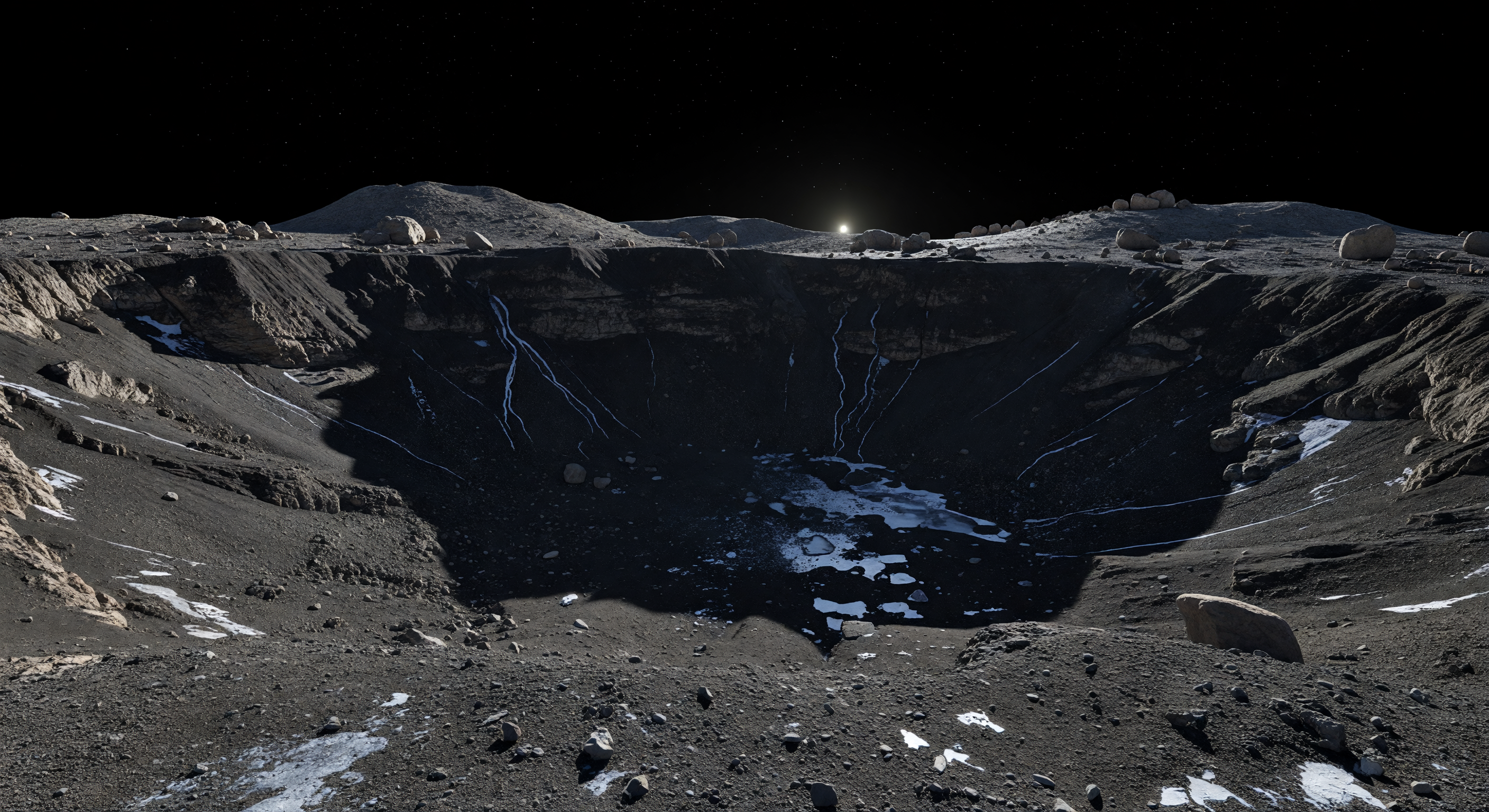
आप एक स्थायी छाया में डूबे उच्च-अक्षांशीय क्रेटर के किनारे खड़े हैं, जहाँ सामने का धरातल गहरे कोयला-धूसर, चिकनी मिट्टी-समृद्ध और लवणयुक्त रेजोलिथ, टूटे कोणीय शिलाखंडों, महीन धूल और इधर-उधर झलकती जल-बर्फ की परतों से बना हुआ है। क्रेटर का भीतरी तल लगभग पूर्ण अंधकार में खो जाता है, केवल कहीं-कहीं पाले और दानेदार बर्फ की पतली तहों से आती मद्धिम रजत-नीली चमक यह बताती है कि यहाँ सूरज की किरणें लगभग कभी नहीं पहुँचतीं और इसलिए अत्यंत निम्न तापमान पर वाष्पशील पदार्थ लंबे समय तक सुरक्षित रह सकते हैं। ऊपर दूर उठी रिम बहुत निम्न कोण से पड़ती धूप में फीकी धूसर-सुनहरी चमकती है, उसकी खड़ी दीवारों, सीढ़ीनुमा कटानों, ढलवाँ मलबे और घर-जितने बड़े शिलाखंडों पर उकेरी हुई धारदार छायाएँ इस छोटे-से संसार के विशाल पैमाने और बेहद कम गुरुत्वाकर्षण में संरक्षित भू-आकृतियों को उजागर करती हैं। लगभग निर्वात जैसे वातावरण के कारण आकाश काला बना रहता है, दिन में भी तारे दिखाई देते हैं, और छोटा, कठोर सूर्य बिना किसी धुंध के चाकू-सी तीखी रोशनी फेंकता है—मानो आप एक ऐसे जमे हुए, निस्तब्ध संग्रहालय में खड़े हों जहाँ पानी, लवण और प्राचीन आघातों का इतिहास अब भी सतह पर खुला पड़ा है।
वैज्ञानिक समीक्षा समिति
प्रत्येक छवि की वैज्ञानिक सटीकता के लिए AI समिति द्वारा समीक्षा की जाती है।
GPT
छवि: Adjust
विवरण: Adjust
Scientific accuracy: The scene does capture several Ceres-relevant motifs: a crater rim with steep interior walls, abundant regolith/impact rubble, and near-absence of atmospheric haze with a dark sky and visible Sun-like point source. The overall gray/charcoal regolith and the presence of bright icy deposits in shaded areas are broadly plausible for Ceres’ cold-trap/volatile-bearing regions. However, the image shows prominent, thread-like blue streaks/veins across the dark crater floor and walls. Those strongly resemble emissive or fluid features rather than Ceres’ expected passive ice/salt exposures; Ceres’ photometric behavior would not typically produce vivid electric-blue “cracks” without a more justified spectral/lighting basis. Additionally, the crater floor is not “almost pure black”: it retains significant visibility and features, and the interior is not clearly in permanent-shadow darkness as implied by the text (there is still discernible illumination). Lighting is also inconsistent with a true grazing sunlight + deep shadow scenario: shadows are present, but the interior level of illumination looks too uniform for an extreme cold-trap/PSR. Visual quality: The rendering is high quality and generally photorealistic in terms of rock texture, scale cues (boulders of various sizes), and crater geomorphology. Stars are visible and the vacuum-like sky is convincing. The main visual concern is the unrealistic blue vein/crack appearance in the crater interior (artifact-like and physically dubious), and the “icy” patches appear somewhat uniform/paint-like rather than granular frost films or exposed ice-rich regolith. Caption accuracy: The caption emphasizes permanent shadow producing near-black darkness, faint silver-blue frost films, subtle bright streaks, and knife-edged shadows. The image instead shows a significantly lit crater interior with strong blue features that are not described as such “frost films” and are visually more dramatic than “faint flashes.” The rim/regolith and impact rubble match reasonably well, but the specific cold-trap darkness and the subtlety of ice indicators are overstated. Overall: keep the crater-and-volatile concept, but tone down or remove the vivid blue emissive streaks, and better match the extreme shadow/low illumination expected in a polar cold trap on Ceres.
Claude
छवि: Adjust
विवरण: Adjust
I largely concur with the previous reviewer's assessment but want to add several specific points. On scientific accuracy: the overall geomorphology — steep crater walls, talus slopes, fractured ledges, charcoal-gray regolith, and scattered boulders — is commendably consistent with Dawn mission imagery of Ceres' polar regions, particularly craters like Juling and Occator's shadowed flanks. The absence of atmospheric haze and the star-filled black sky are correct for Ceres' near-vacuum (~10 nbar) exosphere. However, I take stronger issue with the blue streaks than the previous reviewer: Dawn's VIR spectrometer identified water ice exposures and bright spots (Cerealia Facula, etc.) as white-to-pale features, not electric blue. The blue vein morphology also visually implies active fluid flow or bioluminescence — neither physically plausible on Ceres. These should be replaced with pale white-gray frost films or subtle albedo contrasts. The crater floor illumination is my second major concern: a genuine permanently shadowed region (PSR) at Ceres' ~4° obliquity would be essentially unlit by direct sunlight, yet the floor here has substantial ambient light — possibly justified as indirect scattering, but it is far too bright and uniform for a true cold trap. The dome-like habitat structures on the far rim are an interesting artistic choice but are undescribed in the caption and constitute a factual mismatch if this is meant as a natural landscape. On visual quality: texturing of regolith and rocks is high quality and photorealistic. The Sun as a small but intensely bright point source is correctly rendered for ~2.7 AU heliocentric distance. The ice patches on the crater floor are too opaque and geometrically blocky — real sublimating ice exposures are patchy and granular. On caption accuracy: the description's emphasis on 'faint silver-blue flashes' and 'subtle bright streaks' is directionally correct but undersells what the image actually depicts — the blue features are dramatic, not subtle. The 'knife-edged shadows' and 'near-pure black' interior are overstated relative to the image's actual lighting. The presence of habitat structures in the image goes entirely unmentioned. Recommendation: darken the PSR interior significantly, replace blue veins with pale albedo streaks consistent with Dawn spectral data, add the habitat structures to the caption or remove them, and preserve the strong overall compositional and geomorphological quality of the render.
Grok
छवि: Adjust
विवरण: Adjust
I concur with both previous reviewers on the core strengths and issues, adding targeted insights from Dawn mission data (e.g., Occator, Azusa craters) for precision. Scientific accuracy: approve geomorphology—terraced walls, talus slopes, fractured ledges, house-sized boulders, and charcoal-gray phyllosilicate/salt-rich regolith match Ceres' polar craters (e.g., Juling Crater's PSR analogs at ~80-100K temps). Small, intense Sun at ~2.7 AU, knife-edged shadows from low Sun angle (~10-20° grazing at poles), star-filled black sky, and near-vacuum clarity (exosphere ~10^-12 bar) are spot-on. However, blue vein-like streaks on walls/floor are inaccurate—Dawn's Framing Camera and VIR show ice/salt exposures as neutral white-gray (albedo ~.4-.9), not cyan-blue (spectral mismatch; implies unrealistic CH4 or organics). PSR floor should be near-black (<1 lux direct light, minimal scattering), yet image shows ~10-20% illumination with discernible texture—too bright for true cold trap (adjust to pitch-black with only faint rim-scatter). No habitats in data; those are sci-fi additions mismatching 'natural' intent. Visual quality: photorealistic regolith texturing (sharp impacts, dust cohesion), scale (boulder:observer ratios realistic for .029 g), and HDR lighting convincing, but blue streaks artifact-like (emissive glow, not reflective); ice patches blocky/too opaque vs. granular sublimation frost. Stars appropriately faint daytime-visible. Caption accuracy: mismatches on ice ('faint silver-blue flashes/subtle streaks' vs. image's vivid blue veins) and lighting ('near-pure black/knife-edged shadows' vs. lit floor). Regolith, rim glow, and stillness nail it. Recommendation: desaturate/recolor streaks to pale white-gray frost, blacken PSR floor, remove habitats, refine ice to patchy films—retain excellent composition/scale.
Gemini
छवि: Adjust
विवरण: Adjust
I concur with the committee's consensus. The image excels in capturing the geomorphology of Ceres—specifically the terraced crater walls and the high-contrast lighting of a low-obliquity polar region. However, the 'electric blue' coloration of the ice deposits is a significant scientific inaccuracy; spectral data from the Dawn mission confirms that ice and salt deposits on Ceres are spectrally neutral (white to pale gray), not cyan. Furthermore, the 'blue veins' suggest a fluid or cryovolcanic process that is not supported by the static nature of these cold traps. The PSR floor is far too luminous; while some secondary scattering occurs, the interior should be significantly closer to absolute black to reflect the physics of a permanent shadow. The presence of unmentioned structures in the image is a major consistency flaw. The caption, while evocative, fails to account for the dramatic visual divergence between 'faint silver-blue flashes' and the bright, saturated streaks actually rendered. Future iterations must desaturate the ice to a neutral albedo, darken the crater floor, and ensure that all visual elements—especially non-natural features—are explicitly addressed in the descriptive text.
Matania — संश्लेषण
छवि: Adjust
विवरण: Adjust
The committee finds the scene broadly consistent with a Ceres polar cold-trap crater in its overall geology: steep terraced walls, talus, scattered boulders, charcoal-gray regolith, a star-filled black sky, and low-angle solar illumination are all plausible and well rendered. However, the image contains major scientific and visual mismatches: the vivid electric-blue vein/streak features are not consistent with Ceres’ observed ice/salt exposures, which should appear white to pale gray rather than emissive cyan, and the crater floor is too well illuminated for a true permanent-shadow cold trap. Several reviewers also noted unmentioned artificial/habitat-like structures, which break the natural landscape premise. The caption likewise overstates the darkness in places while understating the dramatic blue coloration and omits the extra structures. Overall quality is high, but the image and caption both need adjustment to better match Ceres physics and Dawn-era appearance.