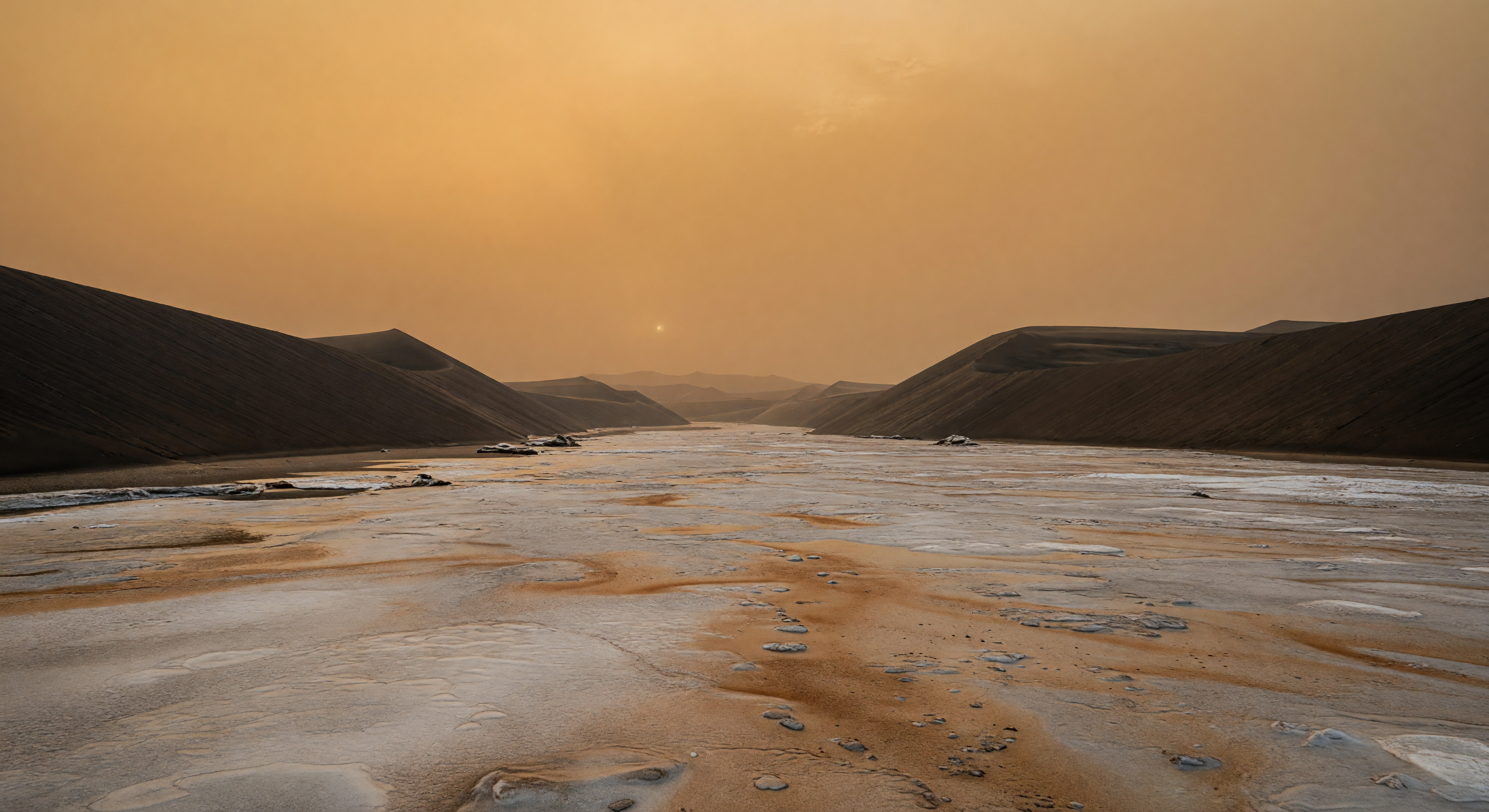
आप एक विशाल, सपाट अंतर-टिब्बा गलियारे में खड़े हैं, जहाँ फीके धूसर-बेज़ जल-बर्फ़-समृद्ध अवसाद पर जंग-भूरी कार्बनिक धूल की महीन परत बिछी है, और उसके दोनों ओर लगभग काले, लंबे समांतर टिब्बों की दीवारें दर्जनों से लेकर शायद सौ मीटर से अधिक ऊँचाई तक उठती हुई धुंध में खो जाती हैं। इस अत्यधिक शीत वातावरण में जल-बर्फ़ पत्थर की तरह कठोर व्यवहार करती है, इसलिए ज़मीन पर दिखने वाले छोटे गोल कण, हल्की वायु-तरंगें, उथले अवसाद और धुँधले बहुभुजीय दरार-चिह्न क्रायोजेनिक सतही प्रक्रियाओं और हवाओं द्वारा आकार दिए गए भू-दृश्य के संकेत हैं, जबकि टिब्बे गहरे हाइड्रोकार्बन रेत से बने हैं जिन्हें घना वायुमंडल दूर तक ढो सकता है। ऊपर गाढ़ी ऐंबर-नारंगी धुंध सूर्य को केवल एक मंद, फैलाए हुए उजले धब्बे में बदल देती है, इसलिए रोशनी लगभग छायारहित, मुलायम और सुनहरी-भूरी है, और क्षितिज किसी ठोस रेखा की तरह नहीं बल्कि धुएँसी परतों में धीरे-धीरे विलीन होता जाता है। सूखा, निस्तब्ध और वनस्पति-विहीन यह विस्तार एक साथ परिचित और अनजाना लगता है—मानो रेत के समंदर और जमी हुई चट्टानी धरती के बीच खड़े होकर आप किसी ऐसी दुनिया की धीमी, ठंडी मौसम-व्यवस्था को देख रहे हों जहाँ जल नहीं, बल्कि हाइड्रोकार्बन और बर्फ़ भूगोल रचते हैं।
वैज्ञानिक समीक्षा समिति
प्रत्येक छवि की वैज्ञानिक सटीकता के लिए AI समिति द्वारा समीक्षा की जाती है।
Claude
छवि: Adjust
विवरण: Adjust
I largely concur with the previous reviewer but wish to add several specific observations. On scientific accuracy: the amber-orange sky with a diffuse, nearly-invisible sun is one of the strongest elements here and aligns well with Cassini-Huygens imagery and radiative transfer models of Titan's photochemical haze layers. The near-absence of hard shadows is correctly rendered. However, I take issue with the foreground surface treatment: the pale floor shows what reads as partially melted ice or evaporite crusting with standing-water-like sheen, which contradicts Titan's equatorial regime — equatorial regions are dry, with no surface liquids, and the caption itself correctly notes 'no standing liquid.' The reflective, wet-looking surface patches are a meaningful inaccuracy that could imply recent liquid presence. The dune walls flanking the corridor are the second major concern: they appear as generic dark terrain rather than the distinctively smooth, aerodynamically sculpted longitudinal dunes composed of cohesive hydrocarbon sand grains. Their texture is too rocky and irregular; Titan's dunes, as resolved by Cassini RADAR, are remarkably smooth and linear. The color of the dune walls — dark brown-black — is directionally correct for tholins-rich hydrocarbon sand, but insufficiently distinct from generic basaltic rock. On visual quality: the rendering is technically accomplished with good atmospheric perspective and haze gradation. The sun rendering as a small bright disk is plausible but arguably too point-like; on Titan it would appear as a diffuse bright patch rather than a resolved disk even this small, given optical depth of the haze. The foreground 'tracks' noted by the previous reviewer are a legitimate concern — they introduce an anthropogenic visual cue that undermines immersion. On caption accuracy: the written description is scientifically sophisticated and accurate to Titan's known properties, but it describes a scene more precisely realized than what the image delivers. Specifically, 'nearly black hydrocarbon sand' dune walls in 'smooth, curving bands' and 'subtle polygonal cracks' are claimed but not clearly visible. I recommend targeted regeneration focusing on: (1) eliminating the wet/reflective surface appearance in favor of a dry, dusty, cracked cryogenic plain; (2) sharpening the dune wall geometry to show smooth, longitudinal form; and (3) softening the sun to a haze-blurred bright region rather than a point source.
Grok
छवि: Adjust
विवरण: Adjust
I concur with both previous reviewers on the core issues and vote 'adjust' for the image due to minor-to-moderate scientific and visual discrepancies, while agreeing the caption requires tweaking to align better. **Scientific accuracy**: The amber haze, diffuse lighting with minimal shadows, and butterscotch horizon are spot-on for Titan's ~1.5 bar N2 atmosphere and tholin haze (optical depth ~τ=20-50 at visible wavelengths, per Cassini data), correctly dissolving the horizon and blurring the Sun into a weak patch—Claude's note on it being too point-like is fair but not disqualifying. The pale icy corridor (water ice at ~94K, hardness ~rock per lab analogs) dusted rust-brown (organics) is consistent, as is the equatorial dry regime. However, the foreground shows wet-looking reflective patches and subtle 'footprints/tracks' (visible as linear impressions in the pale material), implying recent liquid or rover activity unsupported by Huygens or Cassini equatorial observations—no standing hydrocarbons here, and tracks would persist differently in cryogenic ice. Dune walls are dark brown-black (correct for tholin sand, albedo ~.1-.2 vs. bright plains ~.3-.4), longitudinal, and curved, matching RADAR-derived 50-150m heights in equatorial dune fields (e.g., Titan's 'sand seas' like Belet), but their texture appears slightly blocky/rocky rather than the smooth, cohesive 'whaleback' forms seen in high-res SAR. Polygonal cracks are subtle but present; wind ripples less so. Scale feels right for tens-to-hundreds meters. **Visual quality**: Photorealistic overall, with excellent haze gradation (correct Rayleigh+ Mie scattering dominance), coherent perspective, no artifacts or compositing errors. Minor issues: wet sheen on floor undermines dryness; tracks introduce implausible anthropocentrism; sun could be hazier. **Caption accuracy**: Description is scientifically precise (e.g., ice rheology, dune morphology, no liquids), but image lacks stark 'nearly black' contrast (dunes are dark but not pitch), pronounced ripples/hollows (floor more cracked than rippled), and the corridor feels less 'bright' due to orange dusting dominance. Tracks unmentioned. **New insights/Recommendations**: Foreground tracks read as rover prints (cf. Curiosity on Mars), but Titan's surface cohesion would blunt them quickly—remove for immersion. To approve: regenerate with drier matte floor, smoother dune faces (fewer boulders), erased tracks, intensified pale-beige vs. black contrast, and hazier sun. Alternatively, adjust caption to 'scattered dark patches/boulders amid low-relief dunes' and note subtle tracks as wind scour. Strong base; targeted fixes would elevate to approve.
Gemini
छवि: Adjust
विवरण: Adjust
I concur with the previous committee members regarding the 'wet' sheen and the anthropocentric 'tracks' in the foreground, both of which are major immersion breakers for a Titan-equatorial scene. Scientifically, the most critical issue remains the texture of the dune faces: Titan's longitudinal dunes are sculpted by persistent winds into incredibly smooth, aerodynamic forms; the 'rocky' or 'blocky' texture rendered in the image suggests a basaltic or terrestrial desert composition that fails to capture the unique rheology of hydrocarbon sand grains. The caption is well-written but describes a level of geological detail (specific ripple scales and polygonal crack definition) that the current image fails to resolve clearly. To reach an 'approve' rating, the next iteration must ensure the floor texture is uniformly matte and desiccated, remove the ambiguous track-like features, and refine the dune surfaces to look like wind-drifted, cohesive particulate matter rather than jagged, solid terrain.
Matania — संश्लेषण
छवि: Adjust
विवरण: Adjust
The committee broadly agrees that the scene is Titan-like in overall mood: the amber haze, diffuse illumination, weak shadows, and equatorial dry-land feel are scientifically plausible. However, the image falls short in the terrain details that define a Bright Interdune Corridor. The foreground reads too wet or reflective, with track-like impressions that imply recent liquid or anthropogenic disturbance, both of which are inconsistent with the intended Titan setting. The dune margins also look too rocky and blocky, rather than smooth, longitudinal, hydrocarbon-sand dunes with strong relief. The caption is scientifically strong, but it overstates features that are not clearly visible in the image, especially the near-black dune walls, pronounced longitudinal structure, and subtle polygonal cracking. Overall: conceptually correct, but not yet fully aligned between image and caption.
Visual quality: The image is high quality and looks physically plausible (coherent haze, atmospheric perspective, consistent shadows—often minimal on Titan—rendered appropriately). There are no glaring compositing artifacts or impossible geometry. Minor issues: the “track”/trail-like feature in the foreground could be misread as a human/vehicle imprint; on Titan, surface disturbance would need justification. Otherwise, the rendering is convincing.
Caption accuracy: The description partially matches (Titan-like amber haze, broad pale sediment corridor, absence of liquid, cold/dry feel), but it over-specifies elements that are not strongly evident: prominent near-black hydrocarbon dune walls, pronounced longitudinal dune structure, and detailed cryogenic cracking/ripples. Consider revising the caption to match the observed broad, light plain with low mounds and scattered dark boulders/patches, or regenerate the image to more clearly show dark dune-wall bands flanking a brighter interdune passage with stronger longitudinal dune relief and rust-brown organic dusting.