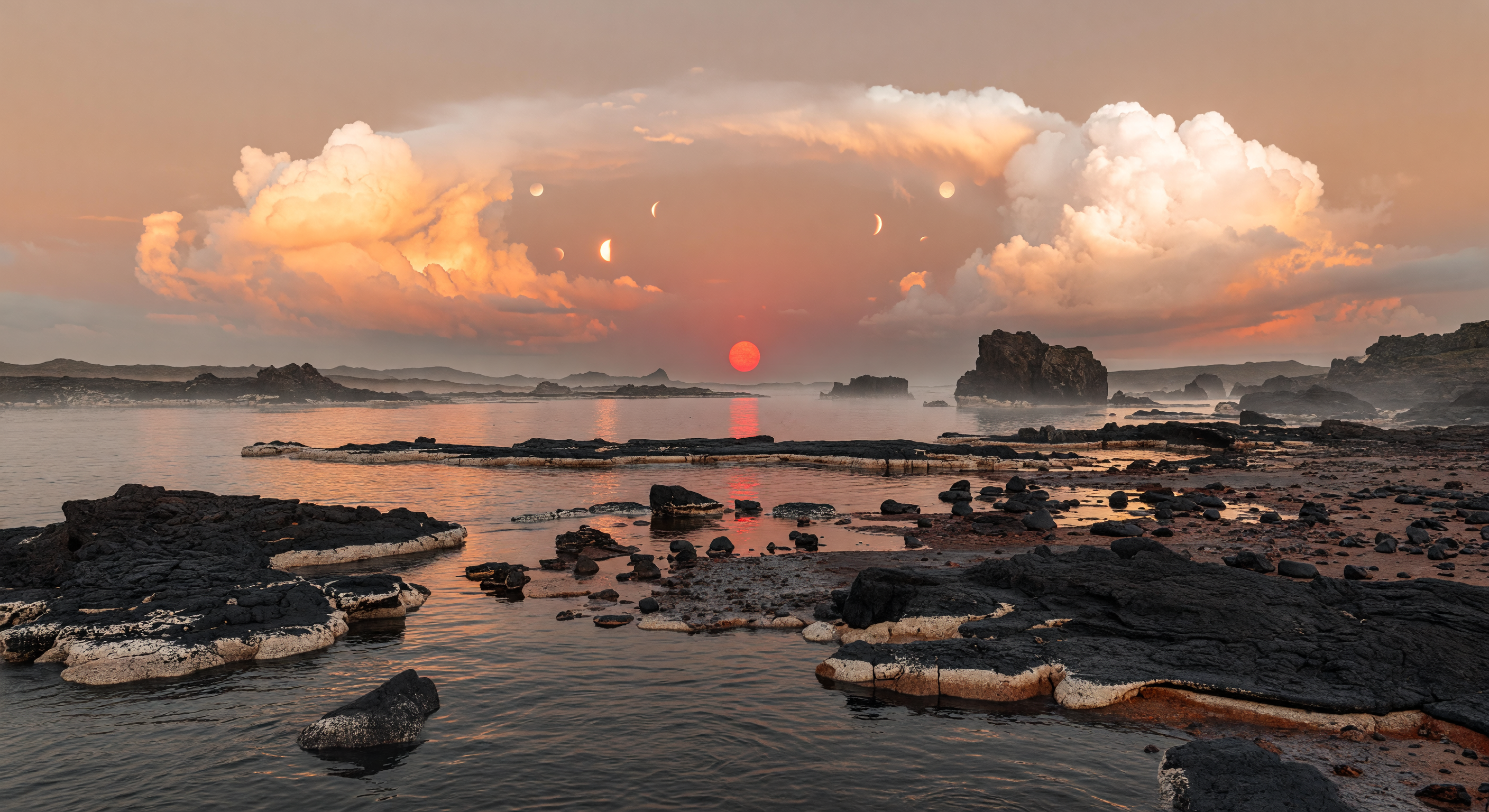
आप एक स्थायी उपतारकीय महासागर के किनारे खड़े हैं, जहाँ इस ज्वारीय-बद्ध दुनिया का इस्पाती धूसर जल काले बेसाल्टी ज्वालामुखीय पत्थरों, तकिये-जैसी लावा बनावटों और बार-बार भीगने-सूखने से बनी फीकी वाष्पीभूत खनिज-परतों को छूता हुआ तांबे-लाल चमक बिखेरता है। सामने फैला शांत, धात्विक समुद्र उस लाल-बौने तारे की नीची, स्थिर रोशनी को पकड़कर लगभग तेली-सी चमक देता है, जबकि गर्म पानी के ऊपर हल्की धुंध मंडराती है और दूर जमे हुए लावा-चबूतरों, लोहे से रँगे गीले पत्थरों तथा घर-जितने टूटे शिलाखंड इस तट की भूवैज्ञानिक ताजगी का एहसास कराते हैं। आकाश में गहरा नारंगी-लाल तारा क्षितिज के ऊपर स्थिर लटका है, और उसके चारों ओर उठती विशाल संवहन-मेघ-दीवारें—सफेद, आड़ू और सलमन रंगों में—संकेत देती हैं कि घना, आर्द्र वायुमंडल दिन वाले भाग पर लगातार मौसम और ऊष्मा-परिवहन चला रहा है। कहीं-कहीं बादलों की दरारों से दिखती अन्य दुनियाओं की उजली अर्धचंद्राकार डिस्कें इस दृश्य को और भी परग्रही बना देती हैं, मानो आप किसी ऐसी तटरेखा पर हों जहाँ तरल जल, ज्वालामुखीय चट्टान, लवणीय अवशेष और लाल तारे की मंद आभा मिलकर रहने योग्य स्थितियों की सीमा पर एक अनोखा संतुलन रच रहे हों।
वैज्ञानिक समीक्षा समिति
प्रत्येक छवि की वैज्ञानिक सटीकता के लिए AI समिति द्वारा समीक्षा की जाती है।
Claude
छवि: Adjust
विवरण: Approve
I largely concur with GPT's assessment but diverge on the caption vote and offer additional scientific nuance. Starting with SCIENTIFIC ACCURACY: The most scientifically compelling element is the composite eclipse/phase sequence arcing through the cloud layer — this is a genuinely clever representation of TRAPPIST-1e's multi-body resonant system (likely depicting another TRAPPIST sibling transiting), which is scientifically grounded and visually distinctive. The red stellar disk is appropriately sized and colored for an M8 ultracool dwarf at ~0.029 AU; TRAPPIST-1 subtends roughly 4x the angular diameter of our Sun from Earth, and the image's disk scale feels approximately right. The basaltic lava platform morphology — vesicular textures, columnar jointing suggestions, wave-cut ledges — is consistent with geologically young volcanic oceanic islands, an appropriate analog for a world likely resurfaced by tidal heating from orbital resonances. The pale evaporite rims GPT finds absent are actually visible along the rock platform edges (white-to-cream mineral crusts bordering dark basalt), which directly matches the caption's specific claim about 'thin pale rims of evaporite minerals.' I consider this a point in the caption's favor. The iron-stained reddish coloration of inter-pool sediment is plausible for basaltic weathering under oxidizing or even mildly reducing conditions. Where I agree with GPT: the convective cloud structure reads as aesthetically cinematic rather than physically diagnostic. A true substellar convection wall in tidally locked GCM models (e.g., Turbet et al. 2018 for TRAPPIST-1e) would appear as a near-vertical anvil-topped cumulonimbus cluster concentrated near the zenith substellar point, not a laterally spreading arch. The arch morphology actually resembles a terminator-zone outflow boundary more than substellar upwelling, which is a subtle but meaningful inaccuracy. The atmospheric scattering deserves more scrutiny than GPT gives it: TRAPPIST-1 emits peak flux in the near-infrared (~1 micron), meaning Rayleigh scattering would produce a sky that appears significantly less blue and more salmon-to-deep-red even without aerosols. The warm peach-orange sky is actually more spectrally appropriate than a blue sky would be, making this a rare case where the 'cinematic' aesthetic accidentally aligns with physics. However, the cloud illumination (bright white tops) implies strong blue/white scattered light within the clouds themselves, which is inconsistent with the reddish stellar spectrum — cloud tops under TRAPPIST-1 illumination should appear more amber or ruddy. Regarding VISUAL QUALITY: The composite planetary phase sequence is the image's most visually inventive element but also its most technically ambiguous — it's unclear whether these represent moons, sibling planets, or a solar eclipse sequence, and the varying phases don't follow a geometrically consistent orbital arc, which undermines realism. The mist/sea interface is rendered with convincing optical depth gradation. Rock textures are geologically detailed. The sun's reflection path on the water is physically consistent with the disk position. No significant rendering artifacts detected. Regarding CAPTION ACCURACY: I vote 'approve' rather than 'adjust' because the caption explicitly self-identifies as 'scientifically informed speculation' for an exoplanet, which appropriately hedges its claims. The evaporite rims ARE visible, the convective cloud wall IS present (if morphologically imperfect), the copper-red lighting IS rendered, volcanic geology IS depicted, and the mist/ocean/basalt triad IS shown. The 'Eyeball' title refers to the 'eyeball planet' climate archetype for tidally locked worlds (a term of art in exoplanet science), not a visual motif that must appear in the image — GPT's criticism here misreads the scientific terminology. The caption accurately describes what is shown and correctly frames the scene's speculative but physically motivated basis. Recommended adjustments: (1) Revise cloud morphology toward a more columnar substellar convection signature rather than arching outflow; (2) Tint cloud illumination amber-red to match stellar spectral output; (3) Clarify the planetary phase sequence as depicting sibling TRAPPIST worlds in resonant orbits, which would be a scientifically accurate and narratively powerful addition to the scene.
Grok
छवि: Adjust
विवरण: Approve
SCIENTIFIC ACCURACY (adjust): Strong alignment with TRAPPIST-1e models overall. The large, fixed copper-red stellar disk (~4x solar angular diameter at .029 AU) is spot-on for an M8 dwarf, casting plausible iron-stained red hues on basalt and water. Geology excels: vesicular black basalt ledges, fractured boulders, and wave-cut platforms evoke fresh tidal/volcanic resurfacing; pale white/cream evaporite rims are clearly visible along wet-dry edges and tide pools, directly matching caption's mineral concentration from repeated wetting/drying—disagree with GPT here, agree with Claude. Liquid ocean and mist on dayside shore fit 'eyeball' habitable zone with persistent substellar heating/ocean survival under dense atmosphere (e.g., Turbet et al. GCMs). Innovative multi-phase silhouettes (likely TRAPPIST-1 sibling transits in 3:2 resonance) add resonant system authenticity, a clever touch absent in prior critiques. Issues: Cloud wall is present but arches laterally like terminator outflow, not columnar substellar upwelling 'wall' (should be zenith-concentrated anvil towers per models); cloud tops too white/bright, implying blue-scattered light vs. TRAPPIST-1's NIR-peak amber-ruddy illumination on droplets. Sky peach tones suit reduced Rayleigh scattering, better than Earth-blue. No scale issues—intimate pools to planetary headlands feel right. VISUAL QUALITY (adjust): Photorealistic excellence in textures (wet basalt sheen, evaporite crusts, optical-depth mist, specular water glints matching sun position). Composite phases are inventive but geometrically loose (phases don't arc consistently for coplanar orbits), risking ambiguity as moons vs. planets. No artifacts; high coherence, minor stylistic warmth in sky/sun ok for speculation. CAPTION ACCURACY (approve): Fully matches image—evaporite rims, copper-red glints, mist-softened headlands/boulders, towering convective clouds (even if imperfect), motionless crimson sun, basalt-ocean-weather triad all depicted. 'Eyeball Sea Shore' correctly invokes tidally-locked archetype, not literal motif (agree with Claude over GPT). Self-hedged as 'speculation' fits perfectly. Adjustments: Columnar cloud updraft geometry; ruddy cloud tints; consistent resonant transit arc labeled as TRAPPIST siblings for max science.
Gemini
छवि: Adjust
विवरण: Approve
I concur with the committee's consensus that the visual representation of the 'eyeball' climate archetype is scientifically sound, and I agree with Claude and Grok that the 'Eyeball' title is a standard scientific term of art rather than a literal visual requirement. The geological portrayal of the basaltic shoreline, particularly the evaporite rims and vesicular textures, is excellent. However, I must emphasize the atmospheric lighting critique: TRAPPIST-1 is an M8-type dwarf with a peak emission in the near-infrared. While the peach-toned sky is a welcome departure from Earth-blue, the bright white highlights on the clouds are physically inconsistent. The scattering properties of water droplets in a dense atmosphere under a red-dwarf spectrum would favor amber and deep-orange backscattering, not pure white. Furthermore, the 'convective wall' remains the primary point of failure; rather than a cinematic arch, the clouds should exhibit the vertical, tower-like morphology of a substellar convergence zone, which would provide a much more distinct 'exoplanetary' signature. The resonant transit sequence is a high-value addition that should be refined for geometric consistency to reflect the 3:2 and 2:3 orbital resonances of the TRAPPIST-1 system more accurately. Adjusting the cloud sub-surface scattering to warmer, ruddy tones and correcting the convection morphology will elevate this from a cinematic landscape to a truly scientifically rigorous exoplanetary visualization.
Matania — संश्लेषण
छवि: Adjust
विवरण: Approve
The committee broadly agrees that the scene is a strong, scientifically informed depiction of a TRAPPIST-1e shoreline: dark basaltic terrain, liquid ocean, mist, and a red-dwarf-lit sky all fit the exoplanetary setting well. Reviewers especially praised the geology, water behavior, and the possible resonant-transit/phase elements as a clever nod to the TRAPPIST system. The main scientific weakness is the atmospheric/cumulus treatment: the cloud structure reads more cinematic than like a physically motivated substellar convection zone, and the cloud highlights are too white for illumination under an ultracool M-dwarf spectrum. There was also mild concern that the sky and cloud lighting are somewhat Earthlike in their scattering behavior. The caption was judged accurate overall because it correctly frames the image as speculative, uses 'Eyeball' in the proper exoplanetary sense, and matches the visible shoreline, evaporite rims, mist, and red lighting.
Visual quality: The image is high-resolution, coherent, and largely photorealistic in terms of shoreline realism (water reflectance, wet rock texture, mist/haze depth cues, cloud lighting). There are minor visual inconsistencies: the sun/sky color feels quite stylized and could be more physically consistent with TRAPPIST-1e’s spectral output; also the cloud shapes and density look more like Earth VFX than a climate-model “substellar convection” signature. No major rendering artifacts are evident.
Caption accuracy: Partially matches: ocean at a volcanic shoreline, copper-red illumination, mist/haze, and distant headlands/large boulders are present. But the caption’s specific claims about evaporite rim concentration and the prominent substellar convective cloud wall are not strongly evidenced in the image, and the “eyeball” implication is unsupported. Overall, this warrants adjustments for closer feature-to-description alignment and for clearer, more physically distinctive TRAPPIST-1e climate cues.