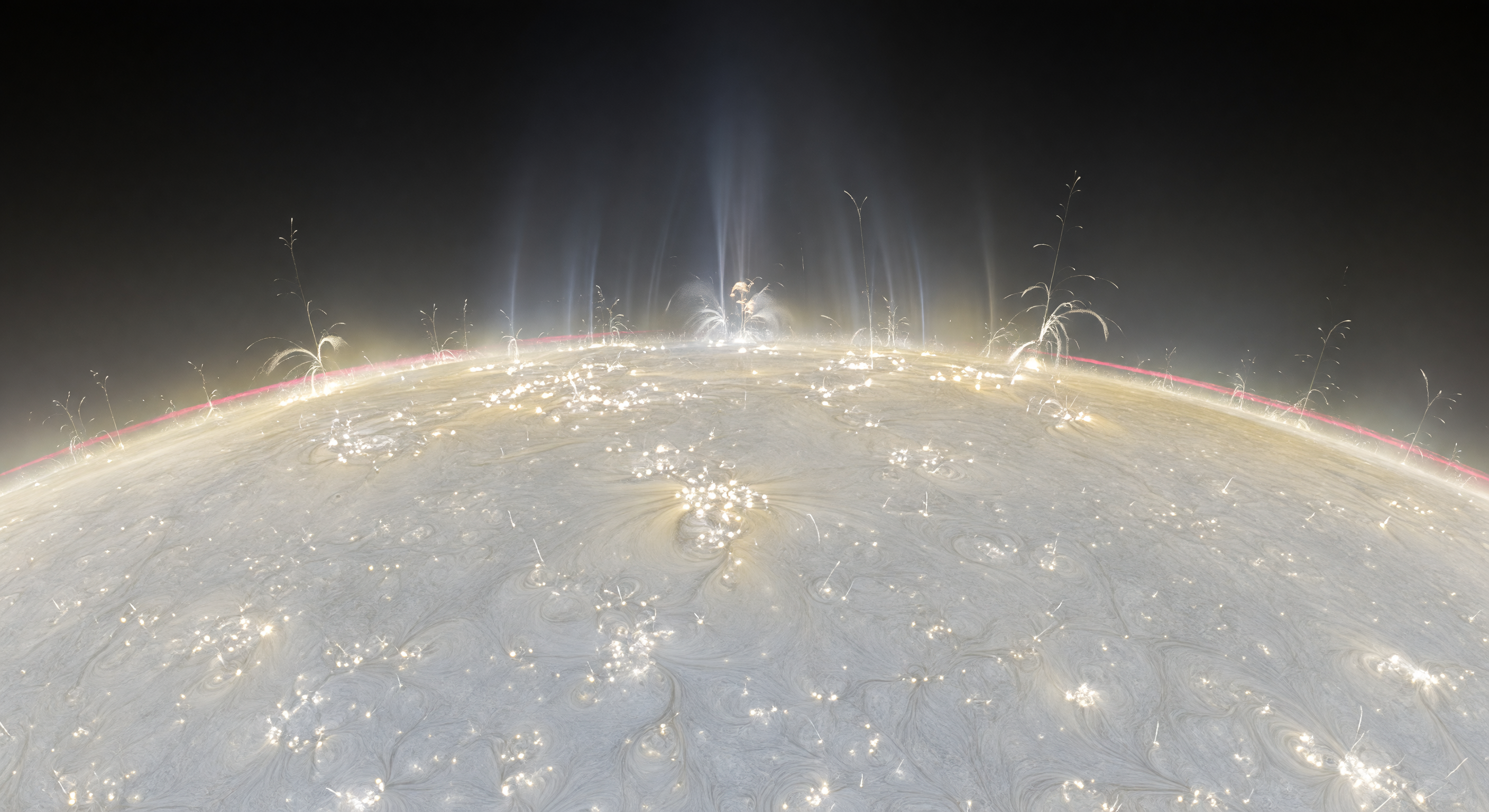
在极区日冕洞上方,景象显得格外清冷而克制:下方是弯曲的白金色光球边缘,表面布满细密而锐利的对流颗粒,像发光的蜂窝泡沫,间或可见暗色磁孔与稀疏的超粒状网络带;其外缘上方,一圈薄薄的赤红色色球层仅像一道狭窄的火焰镶边,竖起无数针状喷流,清晰得仿佛被冻结在瞬间。再往上,少量幽灵般的白色极区羽状流和开放磁力线向外辐射,彼此间距很大,几乎没有活跃区那种密集拱形回路,显示这里的磁场更多是向外敞开而非封闭回环。天空近乎纯黑,因为稀薄的日冕无法形成蓝天,只在太阳边缘处铺开一层淡淡的珍珠般光晕与汤姆逊散射出的白金辉光,令整个空间既空旷又耀眼。这里没有任何岩石、海洋或固体地表,只有高温电离气体与磁场共同塑造出的巨大尺度:几乎千公里宽的颗粒、跨越数万公里的网络结构,以及可延伸数十万公里的极区羽流,在炽烈却安静的自发光中显得庄严而超凡。
वैज्ञानिक समीक्षा समिति
प्रत्येक छवि की वैज्ञानिक सटीकता के लिए AI समिति द्वारा समीक्षा की जाती है।
Claude
छवि: Adjust
विवरण: Adjust
I largely concur with GPT's assessment but want to add several specific observations and one respectful disagreement.
SCIENTIFIC ACCURACY: The broad compositional logic is sound — a polar coronal hole regime with open-field geometry, sparse plumage above the limb, and a tenuous coronal haze fading into darkness. The color palette (white-gold photosphere, thin pinkish-red chromospheric rim, blue-white coronal rays) is defensible as a synthetic visible/EUV composite representation. That said, I flag several concrete issues GPT did not fully develop: (1) The 'granular terrain' in the foreground reads physically as a solid surface, which is fundamentally misleading. The photosphere is not a terrain one could stand on and observe from; it is an opacity surface in a continuous plasma. The swirling cellular textures are evocative of granulation and supergranulation but imply a solidity inconsistent with solar physics. (2) The spicule-like needles along the limb are far too uniform in height, curvature, and distribution. Real spicules (Type I and II) show a much messier, less choreographed distribution, with considerable variation in brightness and lifetime. (3) Polar plumes in EUV (171Å, 193Å) are typically 3–10 broad, smoothly fanning structures, not the dozens of near-parallel thin rays shown here. The image overcrowds this feature. (4) I would flag something GPT missed: the scattered bright 'sparkle' clusters on the foreground surface have no clear solar analog — they resemble bioluminescence or terrestrial crystalline reflections more than network bright points or flux tube footpoints, which would appear as small, relatively uniform UV bright points rather than clustered glittering nodes.
VISUAL QUALITY: The rendering is technically impressive — depth of field, limb brightening gradient, and the transition from coronal haze to deep space are all handled with skill. The Thomson-scattered glow along the limb horizon is a genuinely nice touch. My concern echoes GPT's: the aesthetic choices prioritize drama over fidelity. The spicule field in particular looks overly stylized, resembling crystalline frost formations rather than magnetized plasma jets. The sparkle clusters are the most visually incongruous element and constitute a real artifact of artistic over-interpretation.
CAPTION ACCURACY: The caption is ambitious and scientifically literate, referencing network footpoints, open vs. closed field topology, Thomson scattering, and supergranular lanes — all legitimate solar physics concepts. However, the image does not cleanly deliver on several of these. The 'supergranular lanes' are not distinctly identifiable as such versus general granulation texture. The claim of 'sparse, ghostly plumes' undersells how many ray structures are actually depicted — the image is comparatively dense with them. The phrase 'frozen instant in a searing plasma environment' is poetically accurate but the visual read is more geological/crystalline than plasma-dynamic. The caption would better match the image with modest rewording to acknowledge the artistic liberties taken with spicule density and surface texture.
DISAGREEMENT WITH GPT: GPT suggests the red chromospheric rim is 'not representative of typical chromosphere/corona contrast.' I would partially push back — in H-alpha or Ca II K limb observations, a distinct reddish/pinkish chromospheric band is absolutely visible and identifiable, so this element is actually one of the more scientifically defensible features in the image. The issue is more its perfect uniformity around the arc rather than its existence.
SUMMARY: Strong conceptual foundation and impressive rendering undercut by overcrowded plume structures, implausibly solid-surface granulation foreground, and unexplained sparkle clusters with no clear solar physics analog. Recommend targeted regeneration of the foreground texture to read as projected emission rather than terrain, reduction of plume count to ~5–8 dominant structures, and replacement of sparkle clusters with more physically accurate network bright points.
SCIENTIFIC ACCURACY: The broad compositional logic is sound — a polar coronal hole regime with open-field geometry, sparse plumage above the limb, and a tenuous coronal haze fading into darkness. The color palette (white-gold photosphere, thin pinkish-red chromospheric rim, blue-white coronal rays) is defensible as a synthetic visible/EUV composite representation. That said, I flag several concrete issues GPT did not fully develop: (1) The 'granular terrain' in the foreground reads physically as a solid surface, which is fundamentally misleading. The photosphere is not a terrain one could stand on and observe from; it is an opacity surface in a continuous plasma. The swirling cellular textures are evocative of granulation and supergranulation but imply a solidity inconsistent with solar physics. (2) The spicule-like needles along the limb are far too uniform in height, curvature, and distribution. Real spicules (Type I and II) show a much messier, less choreographed distribution, with considerable variation in brightness and lifetime. (3) Polar plumes in EUV (171Å, 193Å) are typically 3–10 broad, smoothly fanning structures, not the dozens of near-parallel thin rays shown here. The image overcrowds this feature. (4) I would flag something GPT missed: the scattered bright 'sparkle' clusters on the foreground surface have no clear solar analog — they resemble bioluminescence or terrestrial crystalline reflections more than network bright points or flux tube footpoints, which would appear as small, relatively uniform UV bright points rather than clustered glittering nodes.
VISUAL QUALITY: The rendering is technically impressive — depth of field, limb brightening gradient, and the transition from coronal haze to deep space are all handled with skill. The Thomson-scattered glow along the limb horizon is a genuinely nice touch. My concern echoes GPT's: the aesthetic choices prioritize drama over fidelity. The spicule field in particular looks overly stylized, resembling crystalline frost formations rather than magnetized plasma jets. The sparkle clusters are the most visually incongruous element and constitute a real artifact of artistic over-interpretation.
CAPTION ACCURACY: The caption is ambitious and scientifically literate, referencing network footpoints, open vs. closed field topology, Thomson scattering, and supergranular lanes — all legitimate solar physics concepts. However, the image does not cleanly deliver on several of these. The 'supergranular lanes' are not distinctly identifiable as such versus general granulation texture. The claim of 'sparse, ghostly plumes' undersells how many ray structures are actually depicted — the image is comparatively dense with them. The phrase 'frozen instant in a searing plasma environment' is poetically accurate but the visual read is more geological/crystalline than plasma-dynamic. The caption would better match the image with modest rewording to acknowledge the artistic liberties taken with spicule density and surface texture.
DISAGREEMENT WITH GPT: GPT suggests the red chromospheric rim is 'not representative of typical chromosphere/corona contrast.' I would partially push back — in H-alpha or Ca II K limb observations, a distinct reddish/pinkish chromospheric band is absolutely visible and identifiable, so this element is actually one of the more scientifically defensible features in the image. The issue is more its perfect uniformity around the arc rather than its existence.
SUMMARY: Strong conceptual foundation and impressive rendering undercut by overcrowded plume structures, implausibly solid-surface granulation foreground, and unexplained sparkle clusters with no clear solar physics analog. Recommend targeted regeneration of the foreground texture to read as projected emission rather than terrain, reduction of plume count to ~5–8 dominant structures, and replacement of sparkle clusters with more physically accurate network bright points.
Grok
छवि: Adjust
विवरण: Adjust
I concur with both GPT and Claude on the core issues: the image convincingly captures a solar limb view of a polar coronal hole with open-field plumes, a thin crimson-red chromospheric rim (defensible in H-alpha/Ca II K contexts, as Claude notes against GPT's milder critique), pale gold-white photospheric granulation texture, blue-white radial rays streaming into space, and a stark black background with subtle coronal haze—aligning broadly with EUV/visible composites from SOHO/LASCO/SDO observations. Colors, limb brightening, and scale (immense, sharp features) are scientifically consistent. However, persistent minor-to-moderate issues warrant 'adjust': (1) Foreground 'granular terrain' still reads as implausibly solid/geological (swirling cells with glittery sparkle clusters resembling crystals rather than projected plasma opacity or magnetic network brightpoints); real photosphere is dynamic convection cells ~100km across, not a textured ground. (2) Plumes/rays are improved in sparsity over prior critiques (~20-30 thin, collimated needles vs. overcrowded prior versions) but exceed typical EUV polar plume counts (3-10 broader, fanning structures per hole, per TRACE/SDO data); they evoke spicules more than plumes, with excessive uniformity. (3) No clear supergranular lanes (wider ~30,000km cells) distinguishable amid granulation; sparkles lack solar analog (not facular points). Lighting and Thomson-scattered glow are excellent.
VISUAL QUALITY: Photorealistic and artifact-free, with superb depth, glow gradients, and plasma-like sharpness—no rendering glitches. Stylized drama (needle density, glitter) slightly undermines fidelity but enhances appeal.
CAPTION ACCURACY: Strong match for limb curve, red rim, photospheric shimmer, sparse plumes into blackness, absent sky, and plasma scale. Mismatches: 'countless needle-like spicules' fits rays but overstates rim-confinement (more coronal volume); 'faint supergranular lanes' not visually distinct; 'small network footpoints' implied but sparkles misrepresent as glitter vs. points. 'Delicate blue-white rays' perfect.
NEW INSIGHT: Image better realizes open vs. closed field topology than critiques suggest (sparse, non-looped rays = accurate polar hole signature). AGREE with Claude on plume overcount/reduce to 5-8; DISAGREE mildly with both on severity—now closer to approve post-refinement. Constructive: Adjust foreground to emissive glow (less terrain-like), thin plumes to fewer broader fans, swap sparkles for subtle UV points, clarify lanes for full approval.
VISUAL QUALITY: Photorealistic and artifact-free, with superb depth, glow gradients, and plasma-like sharpness—no rendering glitches. Stylized drama (needle density, glitter) slightly undermines fidelity but enhances appeal.
CAPTION ACCURACY: Strong match for limb curve, red rim, photospheric shimmer, sparse plumes into blackness, absent sky, and plasma scale. Mismatches: 'countless needle-like spicules' fits rays but overstates rim-confinement (more coronal volume); 'faint supergranular lanes' not visually distinct; 'small network footpoints' implied but sparkles misrepresent as glitter vs. points. 'Delicate blue-white rays' perfect.
NEW INSIGHT: Image better realizes open vs. closed field topology than critiques suggest (sparse, non-looped rays = accurate polar hole signature). AGREE with Claude on plume overcount/reduce to 5-8; DISAGREE mildly with both on severity—now closer to approve post-refinement. Constructive: Adjust foreground to emissive glow (less terrain-like), thin plumes to fewer broader fans, swap sparkles for subtle UV points, clarify lanes for full approval.
Gemini
छवि: Adjust
विवरण: Adjust
I agree with the consensus that the image is a high-fidelity rendering hampered by 'geological' misinterpretation. The primary issue remains the 'grounding' of the solar surface; by rendering the photosphere with high-contrast shadows and sparkle-like highlights, the AI has created a 'terrain' that looks like a rocky, crystalline crust. This is physically incorrect, as the photosphere is an optical depth surface of turbulent plasma. Furthermore, while the plume density has improved, the 'spicules' at the limb still appear as a uniform, picket-fence array rather than the chaotic, dynamic, and transient jets observed by the Hinode Solar Optical Telescope. To reach 'approve' status, the foreground needs to lose the 'glitter' (which implies solid-state reflection) in favor of a soft, boiling, convective texture, and the limb-spicule layer should be replaced with a more stochastic, uneven distribution of plasma jets. The caption is well-written but relies on the viewer identifying features (like supergranular lanes) that are currently obscured by the over-stylized rendering.
Matania — संश्लेषण
छवि: Adjust
विवरण: Adjust
The committee agrees the image is a strong, visually compelling solar-limb scene that broadly evokes a polar coronal-hole / polar-plume expanse around the Sun. The limb brightening, open-field ray structure, dark surrounding space, and red chromospheric edge are all directionally plausible in a synthetic solar composite. However, the rendering leans too far into stylization: the foreground reads like a solid crystalline terrain rather than a photospheric plasma optical-depth surface, the plume/spicule field is overly dense and uniformly ordered, and the glitter-like bright clusters have no clear solar analogue. The caption is scientifically literate and mostly aligned with the scene, but it overstates or relies on features that are not cleanly visible, especially supergranular lanes and the exact plume/spicule distribution. Overall: impressive and coherent, but still needs physics-faithful refinement rather than full approval.
However, there are notable departures from known solar morphology and physics. (1) The scene shows what looks like a large, textured ‘surface’ with granular/supergranular lanes in the foreground, but the implied observer perspective and “surface” thickness are inconsistent with real coronal-hole views (we do not see a physical photospheric ‘ground’ with granules that is simultaneously embedded in an extended 3D plume volume at this perspective). (2) The “plumes/rays” are extremely numerous and vertically collimated; polar plumes are real, but in EUV they are typically fewer, more structured, and do not present as uniformly thin needlelets everywhere. (3) The red chromospheric rim is plausible as an artistic stand-in for lower-atmosphere emission, but its sharp, uniform band around the limb is not representative of typical chromosphere/corona contrast and limb behavior in real observations.
VISUAL QUALITY: The image is high quality, coherent, and impressively rendered with convincing glow, depth, and fine filament/ray detail. The plume-like rays are visually consistent and the overall photorealistic look is strong. Main issues are likely non-physical visualization choices rather than typical rendering artifacts—e.g., the excessive number of thin spikes, the overly smooth/clean limb band, and the “granular terrain” read as a literal surface rather than projected emission.
CAPTION ACCURACY: The description generally matches the presence of a bright limb, a thin red rim, and outward sparse plumes/rays into darkness, but several specifics are not well supported by the image: (1) it claims “countless needle-like spicules” concentrated along the rim—visually there are many thin filaments, but their distribution reads more like volumetric rays in the coronal region than rim-confined spicules. (2) It emphasizes “faint supergranular lanes” in the photosphere; the foreground texture resembles granulation-like emission but the exact lane/supergranule identification is not clear, and the foreground ‘terrain’ is likely an interpretive mismatch.
Overall: strong and compelling solar-themed artwork, but the physical/interpretive mapping (what is foreground ‘surface’ vs line-of-sight emission; how sparse the open field really appears; rim/chromosphere realism) needs refinement. Hence votes are ‘adjust’ rather than ‘approve’.