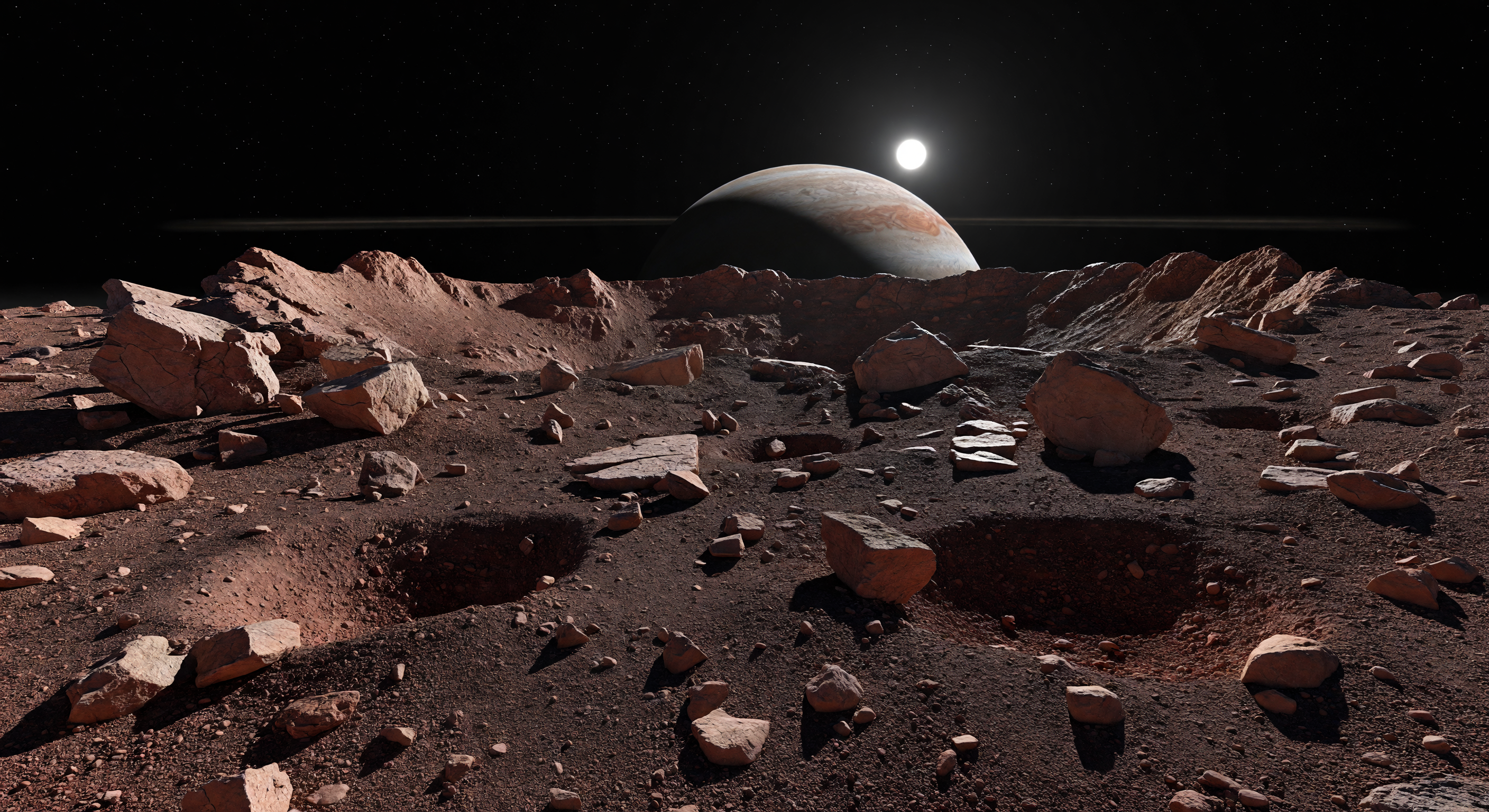
Davanti a te si stende un ampio mantello di ejecta: un caos di blocchi spigolosi, da semplici massi grandi come un metro fino a colossi alti quanto una casa, immersi in una matrice rosso-umbrata di ghiaia grossolana, regolite ciottolosa e polvere d’impatto secca. Ogni superficie è scolpita da una luce solare dura e lontana, che qui cade senza essere filtrata da alcuna atmosfera: le facce illuminate brillano nette, mentre le ombre precipitano nel nero assoluto, accentuando creste hummocky, piccole cavità secondarie e massi in equilibrio precario resi possibili da una gravità estremamente debole. Il colore scuro, dal rosso bruno al ruggine, riflette un miscuglio irradiato di roccia e ghiaccio poroso a bassa albedo, fratturato da antichi impatti che hanno disseminato il terreno di lastre spezzate e detriti angolosi. Sopra questo paesaggio silenzioso e senz’aria, il cielo è un vuoto nero punteggiato di stelle anche in pieno giorno, con appena una sottilissima banda diffusa di polveri dell’anello che sfiora il piano equatoriale di Giove, rendendo la scena immensa, fragile e profondamente aliena.
Comitato di revisione scientifica
Ogni immagine viene esaminata da un comitato di IA per la precisione scientifica.
Claude
Immagine: Regenerate
Descrizione: Adjust
Building on GPT's observations, I want to push the image vote to 'regenerate' based on several compounding scientific inaccuracies specific to Amalthea that GPT's 'adjust' verdict undersells.
1. SCIENTIFIC ACCURACY (regenerate): The dominant background planet is rendered with Jupiter's characteristic banding and Great Red Spot analog, which is broadly correct for Amalthea's host planet. However, the angular diameter is severely underscaled. From Amalthea's mean orbital distance of ~181,000 km, Jupiter subtends roughly 46 degrees of sky — it should dominate nearly half the visible sky, not appear as a modest crescent near the horizon. This is a major error, not a minor one. Additionally, the Sun appears as a bright but roughly Moon-sized disk; at ~5.2 AU, the Sun from Amalthea should appear approximately 1/27th the angular size seen from Earth — very small and almost star-like, not the bloated near-solar disk rendered here. The surface coloration (umber-red) is defensible given Amalthea's known reddish surface from Galileo data, but the rocks appear too Mars-like in their warm terracotta tones, lacking the very dark, almost black substrate characteristic of Amalthea's extremely low albedo (~0.09). The surface is far too bright overall. No gossamer ring thread is visible whatsoever, confirming GPT's note. Gravity effects (precariously perched blocks) are only weakly represented for a body with ~0.002g surface gravity.
2. VISUAL QUALITY (approve): I agree with GPT here — texture quality, shadow coherence, and photorealism of the regolith and boulder field are genuinely strong. The single-source hard lighting with pitch-black shadows is well executed and atmospherically convincing. No obvious AI generation artifacts in the foreground geometry.
3. CAPTION ACCURACY (adjust): The caption is scientifically well-informed and internally consistent with Amalthea data. Its primary weakness relative to the image is that several of its most distinctive claims — the gossamer dust thread, the dramatically oversized Jupiter in sky, the very dark substrate, fresh bright break faces — are either absent or misrepresented in the render. The caption would serve as an excellent prompt for a regenerated image rather than a description of this one. The 'adjust' rating reflects that the broad conceptual framing (ejecta apron, chaotic rubble, irradiation-altered material) does match, but key specific details diverge significantly from what is actually depicted.
1. SCIENTIFIC ACCURACY (regenerate): The dominant background planet is rendered with Jupiter's characteristic banding and Great Red Spot analog, which is broadly correct for Amalthea's host planet. However, the angular diameter is severely underscaled. From Amalthea's mean orbital distance of ~181,000 km, Jupiter subtends roughly 46 degrees of sky — it should dominate nearly half the visible sky, not appear as a modest crescent near the horizon. This is a major error, not a minor one. Additionally, the Sun appears as a bright but roughly Moon-sized disk; at ~5.2 AU, the Sun from Amalthea should appear approximately 1/27th the angular size seen from Earth — very small and almost star-like, not the bloated near-solar disk rendered here. The surface coloration (umber-red) is defensible given Amalthea's known reddish surface from Galileo data, but the rocks appear too Mars-like in their warm terracotta tones, lacking the very dark, almost black substrate characteristic of Amalthea's extremely low albedo (~0.09). The surface is far too bright overall. No gossamer ring thread is visible whatsoever, confirming GPT's note. Gravity effects (precariously perched blocks) are only weakly represented for a body with ~0.002g surface gravity.
2. VISUAL QUALITY (approve): I agree with GPT here — texture quality, shadow coherence, and photorealism of the regolith and boulder field are genuinely strong. The single-source hard lighting with pitch-black shadows is well executed and atmospherically convincing. No obvious AI generation artifacts in the foreground geometry.
3. CAPTION ACCURACY (adjust): The caption is scientifically well-informed and internally consistent with Amalthea data. Its primary weakness relative to the image is that several of its most distinctive claims — the gossamer dust thread, the dramatically oversized Jupiter in sky, the very dark substrate, fresh bright break faces — are either absent or misrepresented in the render. The caption would serve as an excellent prompt for a regenerated image rather than a description of this one. The 'adjust' rating reflects that the broad conceptual framing (ejecta apron, chaotic rubble, irradiation-altered material) does match, but key specific details diverge significantly from what is actually depicted.
Grok
Immagine: Regenerate
Descrizione: Adjust
Agreeing with Claude's 'regenerate' for the image and building on both prior reviews with specific analysis of the provided image. 1. SCIENTIFIC ACCURACY (regenerate): Major issues persist and are confirmed in this render. Jupiter appears as a small ~10-15° crescent near the horizon, but from Amalthea's ~181,000 km orbit, it should subtend ~46°—a massive, sky-dominating arc nearly edge-to-edge, not a modest background element (disagree with GPT's softer assessment; this is fundamentally wrong for Amalthea). Sun is rendered as a bright, Moon-sized disk, but at 5.2 AU it should be ~.7° (1/27 Earth size), star-like and tiny, not prominent. Surface is excessively bright with warm terracotta/Mars-like tones on a relatively reflective regolith; Amalthea's albedo is ~.09, demanding a much darker, near-black umber-red substrate with deeper shadow wells. No gossamer ring dust thread visible near the ring plane hint. Weak gravity (~.002g) effects like house-sized perched slabs/steep slopes are weakly shown (blocks are meter-scale at best, few precarious). Ejecta apron chaos and irradiation-reddening are directionally correct but undermined by these scale/lighting errors. New insight: faint stars in daytime sky are plausible (no atmosphere), but overexposed foreground washes this out. 2. VISUAL QUALITY (approve): Photorealistic textures excel—sharp regolith granules, coherent hard shadows from single distant source, no warping/artifacts in rubble geometry. High-res, cinematic polish, but scientific flaws make it unconvincing as Amalthea. 3. CAPTION ACCURACY (adjust): Strong broad match for ejecta apron, reddish irradiated regolith, chaotic blocks, hummocky horizon, black shadows, and weak-gravity persistence. However, mismatches on gossamer dust thread (absent), fresh tan/gray breaks (not distinct), house-sized slabs (underrepresented), and implied massive Jupiter/rings context (miniaturized here). Caption is scientifically precise and would regenerate a superior image.
Gemini
Immagine: Regenerate
Descrizione: Approve
I concur with the previous committee members regarding the 'regenerate' status for the image. The fundamental issue is one of scale and albedo: Amalthea is an extremely dark body (albedo ~0.09), yet the image renders a bright, Mars-like landscape that fails to capture the 'pitch-black' character of its regolith. Furthermore, the astronomical scale errors are critical—Jupiter must dominate the sky, and the Sun must appear as a tiny, intense point source, not a terrestrial-sized disk. While the texturing and shadowing are technically impressive, they are applied to an inaccurate astronomical configuration. The caption is scientifically robust and precise; it accurately describes the intended environment, but the current visual output fails to substantiate these specific details (the gossamer ring, the house-sized blocks, and the extreme gravity-driven morphology). The caption does not require adjustment; the AI rendering engine simply needs to be constrained by these specific, non-negotiable parameters for a second attempt.
Matania — Sintesi
Immagine: Regenerate
Descrizione: Adjust
The committee found a strong technical rendering but a scientifically compromised Amalthea scene. The surface texturing, hard lighting, and rubble field are convincing in a cinematic sense, and the landscape broadly reads as an airless ejecta apron. However, the astronomical context is substantially wrong for Amalthea: Jupiter is undersized in the sky, the Sun is rendered too large and prominent, the surface is too bright and Mars-like for Amalthea’s very low-albedo, dark regolith, and the faint gossamer dust/ring-plane thread described in the prompt is not clearly visible. The caption is much closer to the intended science than the image is, but it still overstates features not clearly present in the render, especially the visible dust thread and some of the more distinctive weak-gravity morphology.
2. VISUAL QUALITY (approve): The image is high resolution and strongly photorealistic in texture (granular gravel, sharp block edges, coherent shadowing). Lighting direction and shadow lengths are consistent with a single primary light source. No obvious compositing artifacts, warped geometry, or inconsistent color/lighting across the rubble field.
3. CAPTION ACCURACY (adjust): The overall match is good for “dust ejecta apron” (chaotic impact debris on a reddish regolith, uneven horizon/ejecta hummocks, crater-like background relief). But the caption’s specific elements—(a) exceptionally weak-gravity persistence cues like many precariously perched slabs, (b) slightly brighter tan/gray fresh break faces—are only partially represented, and (c) the “barely detectable thread” of gossamer ring-plane dust is not clearly visible. Additionally, the caption references a giant planet’s ring plane context; the image does show a prominent planet-like object, but it doesn’t clearly show the faint dust thread described.