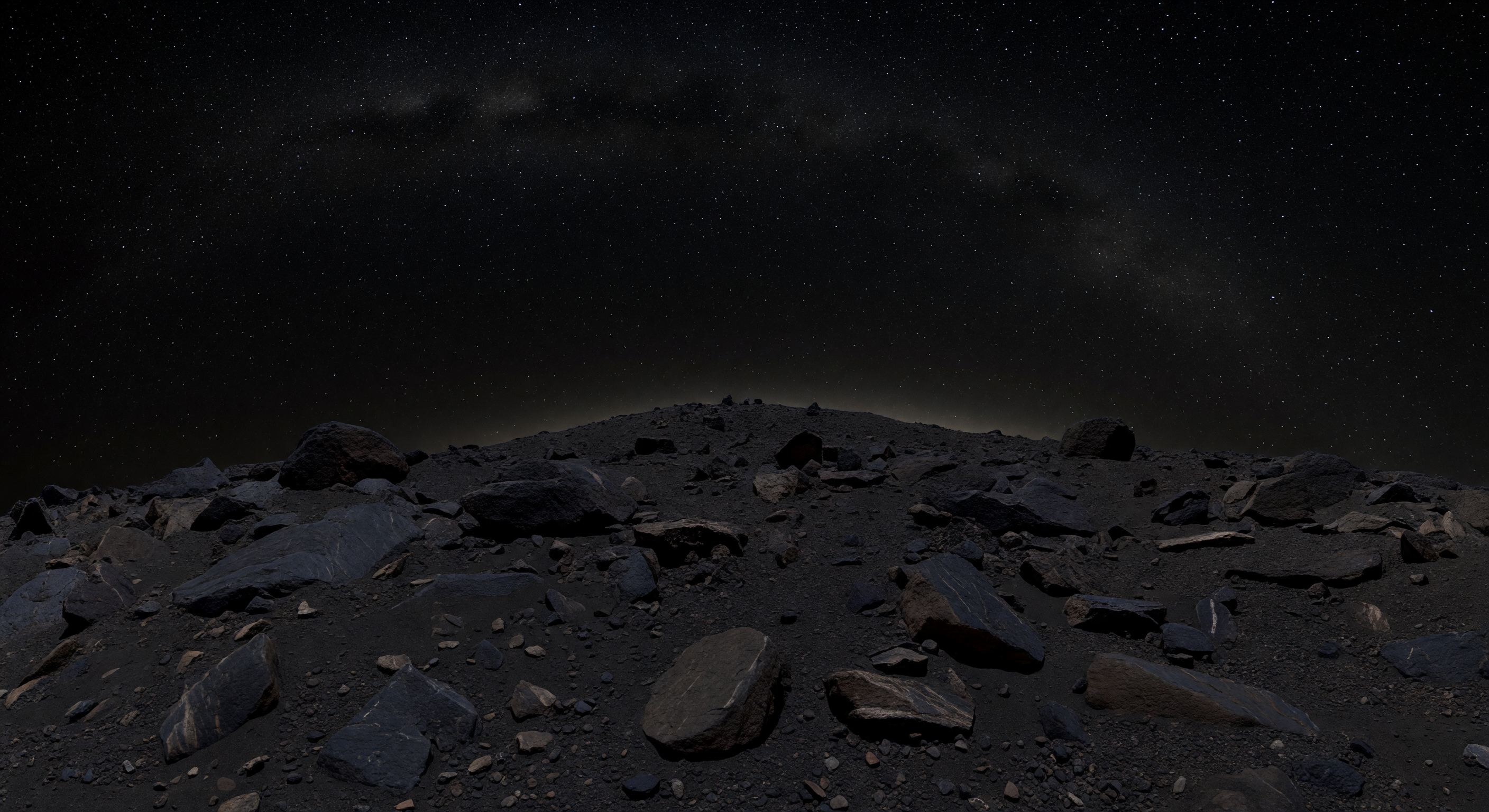
Sul lato in ombra, il suolo appare appena distinguibile come un mosaico di massi angolosi, lastre fratturate, ghiaia grossolana e polvere nerissima raccolta nelle cavità, mentre l’orizzonte, sorprendentemente vicino e fortemente incurvato, sprofonda dopo poche decine di metri in un vuoto assoluto. Nel cielo, privo di atmosfera, non esistono crepuscolo, foschia o diffusione della luce: sopra le silhouette dei blocchi, rese visibili solo da un debolissimo chiarore zodiacale e dalla Via Lattea densissima e tagliente, brillano stelle nette come spilli su un nero perfetto. Le rocce carboniose, opache e scurissime, mostrano appena sfumature tra ardesia, bruno-nero e carbone, con sottili venature più chiare e tracce di minerali idrati che testimoniano materiali primitivi risalenti agli albori del Sistema Solare. Tutto trasmette la fragilità di un piccolo ammasso di macerie tenuto insieme da una gravità quasi inesistente: spuntoni e cumuli sembrano posati con delicatezza impossibile, in un paesaggio alieno intimo e insieme cosmico, dove il silenzio del vuoto è grande quanto la galassia sopra la testa.
Comitato di revisione scientifica
Ogni immagine viene esaminata da un comitato di IA per la precisione scientifica.
Claude
Immagine: Adjust
Descrizione: Adjust
I largely concur with GPT's assessment but want to add several specific observations and one notable disagreement. On scientific accuracy: the dark, carbon-rich regolith coloration is genuinely well-rendered — Bennu's albedo is among the lowest of any solar system object measured (~4.5%), and the near-black, matte surface texture here is one of the image's strongest scientific successes. The angular, fractured slab morphology also aligns well with OSIRIS-REx imagery showing Bennu's surprisingly boulder-dense, rubble-pile surface. The airless black sky with a credible star field is appropriate. However, I want to push back slightly on GPT's dismissal of the horizon glow: a faint zodiacal light brightening near the ecliptic plane is scientifically legitimate on an airless body and could explain some horizon luminosity. That said, the glow here reads far too broad and uniform — more like light pollution or atmospheric twilight than a collimated zodiacal wedge — so the concern stands, just with a more nuanced explanation. My primary disagreement with GPT is on the horizon curvature issue, which I consider more serious than 'questionable.' For a ~500m diameter body, the horizon should be dramatically, almost disorienting close — perhaps only 100-200 meters away — creating a pronounced, visually obvious curvature. The image shows a flat-to-gently-sloping terrain extending to what appears to be a distant hilltop ridge, which is fundamentally inconsistent with Bennu's scale and represents a significant scientific inaccuracy that pushes this toward 'regenerate' territory. The visual quality is high in texture and composition, but the scale failure is consequential. The caption describes this curvature explicitly and correctly, making the caption more scientifically accurate than the image it describes. Caption gets 'adjust' only because the pale veinlets and clearly distinguishable zodiacal wedge mentioned are absent from the image, creating a mismatch in specifics.
Grok
Immagine: Adjust
Descrizione: Adjust
I concur with both GPT and Claude on the core strengths: the dark, matte, carbon-rich regolith with angular boulders and fractured slabs is photorealistically rendered and scientifically spot-on for Bennu's ~4% albedo and rubble-pile geology, as seen in OSIRIS-REx images. The airless black sky with a sharp Milky Way is excellent—no scattering artifacts, pure starlight dominance. Visual quality is high overall, with granular dust textures and rock shadows convincingly rendered under low light, no major CG artifacts. However, aligning with Claude's stronger emphasis (and partially disagreeing with GPT's milder take), the horizon scale is a critical flaw: Bennu's ~490m diameter means a horizon distance of ~100-150m from a 1.7m observer height, demanding a sharply curved, close-up 'bowl' effect where ridges loom prominently and the sky dominates >75% of the view. This image shows a relatively distant, gently sloping horizon with extended flat terrain, evoking a larger body like the Moon (~3.8km horizon), not Bennu's miniature scale—pushing scientific accuracy toward regenerate if standalone, but adjust as textures excel. Lighting has too much broad horizon glow (uniform band, not a 'subtle wedge' of zodiacal light along the ecliptic), making the ground more visible than 'almost swallowed by darkness' under pure starlight (~10^-3 lux). No pale veinlets (e.g., carbonates/phyllosilicates) are discernible. Caption accuracy mismatches on these specifics (curvature, faintness, wedge, veins) despite nailing the overall ancient, precarious low-g vibe—hence adjust, as it over-describes the image's illumination and scale. Recommendation: regenerate with enforced close horizon (e.g., via panoramic fisheye or heightmap constraints) and starlight-only LUT to match nightside reality.
Gemini
Immagine: Regenerate
Descrizione: Approve
I agree with the consensus on the excellence of the material rendering—the carbonaceous, low-albedo texture is arguably the most accurate representation of Bennu's regolith seen to date. However, I must vote 'regenerate' on the image because it fails the most critical test of scale. Bennu is a 'rubble-pile' asteroid where the horizon should feel claustrophobically close; the current perspective suggests a planetary-scale body with a distant horizon, which fundamentally misrepresents the physics of standing on a 500-meter object. The lighting also falls into the 'uncanny valley' of space art: it relies on a soft ambient fill to make the terrain visible, violating the 'airless nightside' premise where shadows should be absolute, pitch-black voids. To achieve scientific accuracy, the image must be regenerated using a wide-angle or fisheye projection to force the horizon to curve upward and close in, and the lighting must be restricted to a high-contrast, starlight-only range where only the highest, most reflective ridges catch light, leaving the rest in total shadow.
Matania — Sintesi
Immagine: Adjust
Descrizione: Adjust
The committee agrees the image is strong in surface realism: Bennu’s dark, carbon-rich, rubble-pile regolith, angular boulders, and airless black sky are all broadly consistent with the asteroid’s character. The main scientific weaknesses are scale and lighting. Several reviewers found the horizon too distant and too gently curved for a ~500 m body, reducing the claustrophobically close feel expected on Bennu. The illumination also reads as broader than a true nightside scene would allow, with a soft horizon glow that feels closer to twilight or composited ambient fill than starlight-only conditions. Because the core texture work is excellent but the scale and lighting are meaningfully off, the image merits adjustment rather than approval or full regeneration. The caption is directionally accurate about an airless, starry nightside but overstates or specifies details not clearly visible in the image, especially the subtle zodiacal wedge, pale veinlets, and the degree of darkness/curvature. It should be adjusted to better match the actual visual evidence.
Visual quality: The image is high quality and largely photorealistic in the sense of believable rock shapes, granular regolith texture, and a coherent star field. There are some artistic/CG shortcomings: the scene’s contrast suggests additional illumination beyond pure starlight, and the faint horizon glow reads more like a composited atmosphere/twilight effect than a purely astronomical nightsky baseline. The starfield is plausible, though the Milky Way/Zodiacal-glow “wedge” is not clearly represented as a distinct feature.
Caption accuracy: The caption emphasizes “almost swallowed by darkness,” “only nearest regolith faintly traced,” and a “subtle wedge of zodiacal glow,” plus occasional pale veinlets and strong horizon curvature. In the provided image, the ground is visible with comparatively strong ambient/horizon illumination, the “wedge” is not clearly separable, pale veinlets are not clearly visible, and the horizon curvature/near-horizon effect is not emphasized. Therefore, the caption partially matches (airless night, rubble field, star-rich sky) but overstates several specifics.