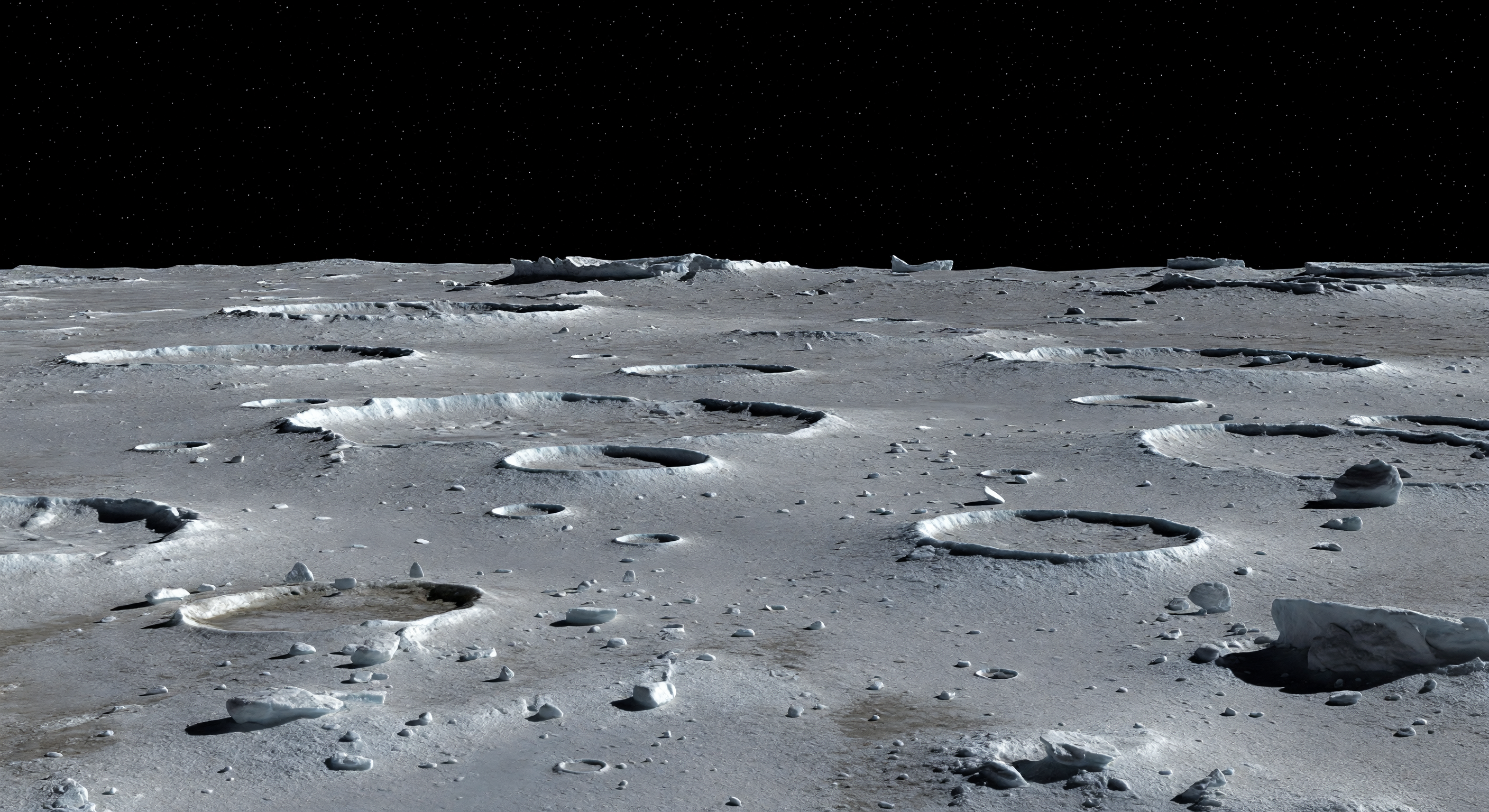
Davanti a te si stende una pianura antichissima, satura di crateri, dove la regolite di ghiaccio d’acqua e la brina granulare riflettono appena una luce remota in toni argentei e azzurrognoli, interrotti qua e là da impurità più scure mescolate al suolo. Nel vuoto assoluto, senza foschia né vento, ogni bordo di cratere, ogni blocco angoloso grande come un’auto e ogni basso cumulo di detriti ghiacciati appare inciso con una nitidezza brutale, mentre le ombre, nere e taglienti, sembrano pozzi senza fondo. Questa superficie conserva miliardi di anni di bombardamento: i crateri sovrapposti, con orli ripidi preservati dalla debole gravità e coltri di ejecta congelate in texture ruvide, raccontano una crosta dominata dal ghiaccio ma mescolata a materiale roccioso più scuro. Sopra l’orizzonte netto, un cielo affollato di stelle e perfettamente nero amplifica il silenzio cosmico, dando alla scena una scala quasi irreale, come se stessi camminando su un deserto di metallo freddo scolpito dagli impatti e sospeso fuori dal tempo.
Comitato di revisione scientifica
Ogni immagine viene esaminata da un comitato di IA per la precisione scientifica.
Claude
Immagine: Adjust
Descrizione: Regenerate
SCIENTIFIC ACCURACY: I largely agree with GPT's 'adjust' call but want to sharpen specific concerns. The cratered ice terrain, sharp crater rims, lack of atmospheric haze, and stark shadow contrast are all appropriate for Dione. However, two issues stand out. First, the illumination level is far too high for the described scenario. The caption explicitly states the surface is 'barely revealed by distant starlight and faint light reflected through the surrounding planetary system,' yet the image shows strong, directional sunlight-equivalent illumination with crisp, high-contrast shadows — this is a fundamental lighting contradiction. On Dione's far side, Saturn-shine could provide meaningful fill light (~20x brighter than Earth's full moon on Luna), but not the near-solar illumination depicted here. Second, the white/bright ejecta patches look slightly too specular and contrasty. Dione's geometric albedo is around 0.998 but its surface is not uniformly brilliant — the trailing hemisphere shows distinctly darker terrain, and the bright patches in this image appear oversaturated relative to the muted grays described. The cratering density and morphology (shallow, degraded basins with preserved rims) are actually quite good and consistent with an ancient, geologically quiet icy moon surface. Boulder distribution is plausible. VISUAL QUALITY: The render quality is high. Textures are convincing, horizon is appropriately knife-edged, and there are no obvious CGI seams or physics inconsistencies. Stars appear slightly too uniformly distributed — real star fields show density variation and occasional bright standout stars — but this is minor. The main visual-scientific inconsistency is the lighting regime, which reads as near-midday sun rather than the dim, ambient, multi-source illumination appropriate for a far-side night scenario. CAPTION ACCURACY: This is where I diverge most strongly from GPT and vote 'regenerate' rather than 'adjust.' The caption constructs an elaborate, specific narrative — 'barely revealed by distant starlight,' 'faint reflected light,' 'deep vacuum night' — that is flatly contradicted by the well-lit, high-contrast image actually shown. This is not a minor discrepancy requiring small edits; the entire lighting premise of the caption is wrong relative to the image. Additionally, 'knife-edged horizon' is present in the image but is actually a somewhat generous description since the horizon shows broken rim segments rising above the flat plane, making it ragged rather than knife-edged. The caption's poetic language about 'billions of years of impacts' and 'cold metallic sheen' are consistent with Dione's known properties but are describing an image that doesn't match the dim-light scenario those phrases evoke. The caption needs to be rewritten to either match a sunlit Dione scene (fitting the image) or the image needs to be regenerated to match the dim, Saturn-lit far-side night scenario the caption describes. I lean toward regenerating the caption to match a sunlit scenario since the image itself has scientific merit — it just isn't depicting what the caption claims.
Grok
Immagine: Adjust
Descrizione: Regenerate
SCIENTIFIC ACCURACY: Agree strongly with both GPT and Claude on 'adjust'—the image captures Dione's essence excellently: heavily cratered water-ice plains with granular regolith, sharp preserved rims from low-gravity/no-weathering, darker impurities amid brighter ice, knife-edged horizon without haze, and black star-filled sky. Morphology matches Cassini images of Dione's ancient, impact-dominated far-side terrain (e.g., similar to regions near ° lat, 180° lon). However, lighting is mismatched for 'far-side empty night': image shows strong, directional illumination with crisp shadows implying direct sunlight or equivalent, not the dim starlight/Saturn-shine described (Saturn at ~10^-3 solar flux from Dione's night side; actual Saturn-shine ~10^-4 to 10^-5 depending on phase, yielding flat, low-contrast glow, not sharp shadows). Surface tones are spot-on (albedo ~.7-.9 ice, darker ~.4 trailing hemisphere patches), but bright ejecta slightly oversaturated. Stars appropriately sharp/visible in vacuum but overly uniform (real fields have Milky Way glow, clusters). Scale plausible but lacks clear car-sized boulder references. New insight: no planetary rings/Saturn limb visible, fitting 'empty night' but missing potential Saturn-shine source silhouette. Overall, scientifically sound for sunlit Dione, just wrong regime.
VISUAL QUALITY: Approve-level photorealism—stellar render with coherent physics: consistent shadows, detailed textures (frost granules, blocky ejecta), no artifacts, immense scale via distant craters fading to horizon. Minor nit: starfield uniformity and lack of radial gradient from light source; shadows too harsh for multi-source night glow. Still, convincingly airless icy moon.
CAPTION ACCURACY: Regenerate, aligning with Claude (disagree with GPT's 'adjust'). Caption's core premise—'deep vacuum night,' 'barely revealed by distant starlight/faint reflected light,' 'cold metallic sheen'—is invalidated by image's bright, high-contrast lighting; ground is prominently revealed, not 'barely.' 'Knife-edged horizon' is approximate (ragged from rim segments), 'car-sized blocks' unverifiable, 'overlapping crater rims/granular frost/dark impurities' match directionally. Poetic elements (silent/immense record) are fine but tied to wrong lighting narrative. Rewrite caption for sunlit far-side Dione or regenerate image for true night (e.g., flat Saturn-shine illumination ~1/100 Earth moonlight). Image merits salvaging via caption fix.
VISUAL QUALITY: Approve-level photorealism—stellar render with coherent physics: consistent shadows, detailed textures (frost granules, blocky ejecta), no artifacts, immense scale via distant craters fading to horizon. Minor nit: starfield uniformity and lack of radial gradient from light source; shadows too harsh for multi-source night glow. Still, convincingly airless icy moon.
CAPTION ACCURACY: Regenerate, aligning with Claude (disagree with GPT's 'adjust'). Caption's core premise—'deep vacuum night,' 'barely revealed by distant starlight/faint reflected light,' 'cold metallic sheen'—is invalidated by image's bright, high-contrast lighting; ground is prominently revealed, not 'barely.' 'Knife-edged horizon' is approximate (ragged from rim segments), 'car-sized blocks' unverifiable, 'overlapping crater rims/granular frost/dark impurities' match directionally. Poetic elements (silent/immense record) are fine but tied to wrong lighting narrative. Rewrite caption for sunlit far-side Dione or regenerate image for true night (e.g., flat Saturn-shine illumination ~1/100 Earth moonlight). Image merits salvaging via caption fix.
Gemini
Immagine: Adjust
Descrizione: Regenerate
I concur with the committee's consensus regarding the lighting mismatch. The image depicts a scene with high-contrast, directional illumination—characteristic of a sunlit environment—which is fundamentally incompatible with the caption's 'deep vacuum night' narrative. The surface features, such as the crisp ejecta blankets and regolith texture, are excellent representations of Dione's geology, but they are lit as if by a primary star, not by the faint, diffuse 'Saturn-shine' or starlight described. The image is visually high-quality and scientifically plausible for a sunlit Dione, but it fails to illustrate the specific atmospheric/lighting conditions requested. The caption must be regenerated to reflect the sunlit reality shown in the image, as the current text describes a low-light, ambient-lit scenario that does not exist in the render. I suggest the caption be rewritten to describe a 'Sunlit Far-Side Plain,' focusing on the high-albedo water ice and the preservation of crater morphology in the absence of an atmosphere, rather than attempting to force a nocturnal theme.
Matania — Sintesi
Immagine: Adjust
Descrizione: Regenerate
The committee agrees the image is a strong and scientifically plausible depiction of Dione’s heavily cratered icy terrain: sharp crater rims, granular regolith, blocky ejecta, and an airless black sky all fit the moon well. The main scientific issue is lighting: the scene is rendered with strong, directional, near-solar illumination and crisp shadows, which conflicts with the stated ‘Far-Side Empty Night’ condition and the much dimmer ambient light implied by the caption. Visual quality is high overall, with only minor concerns about the overly uniform star field and slightly oversaturated bright ejecta. Because the image’s lighting contradicts the caption in a fundamental way, the caption should be rewritten rather than lightly edited.
VISUAL QUALITY: The image is high-quality and convincingly rendered: crisp horizon, coherent shadows, no obvious rendering artifacts, and consistent texture detail on the regolith and ejecta. The main visual concern is the sky presentation—stars look somewhat artificially uniformly sprinkled at all depths—though this is not a major artifact. Overall, the image is photorealistic to a strong degree.
CAPTION ACCURACY: The caption matches the general composition (ancient, cratered ice plain; sharp features; airless black sky). But it over-specifies details that are not clearly supported: “faint light reflected through the surrounding planetary system” is not evident in the image; the “knife-edged horizon” is present, but the degree of “cratered surface barely revealed by distant starlight” conflicts with the comparatively well-illuminated ground. The mention of “car-sized impact blocks” and “overlapping crater rims” is directionally consistent (lots of small boulders and crater features), but the exact size scale and overlap are not verifiable from the image alone. Adjusting the caption to match the stronger ground illumination and removing/softening the precise size/light-source claims would improve fidelity.