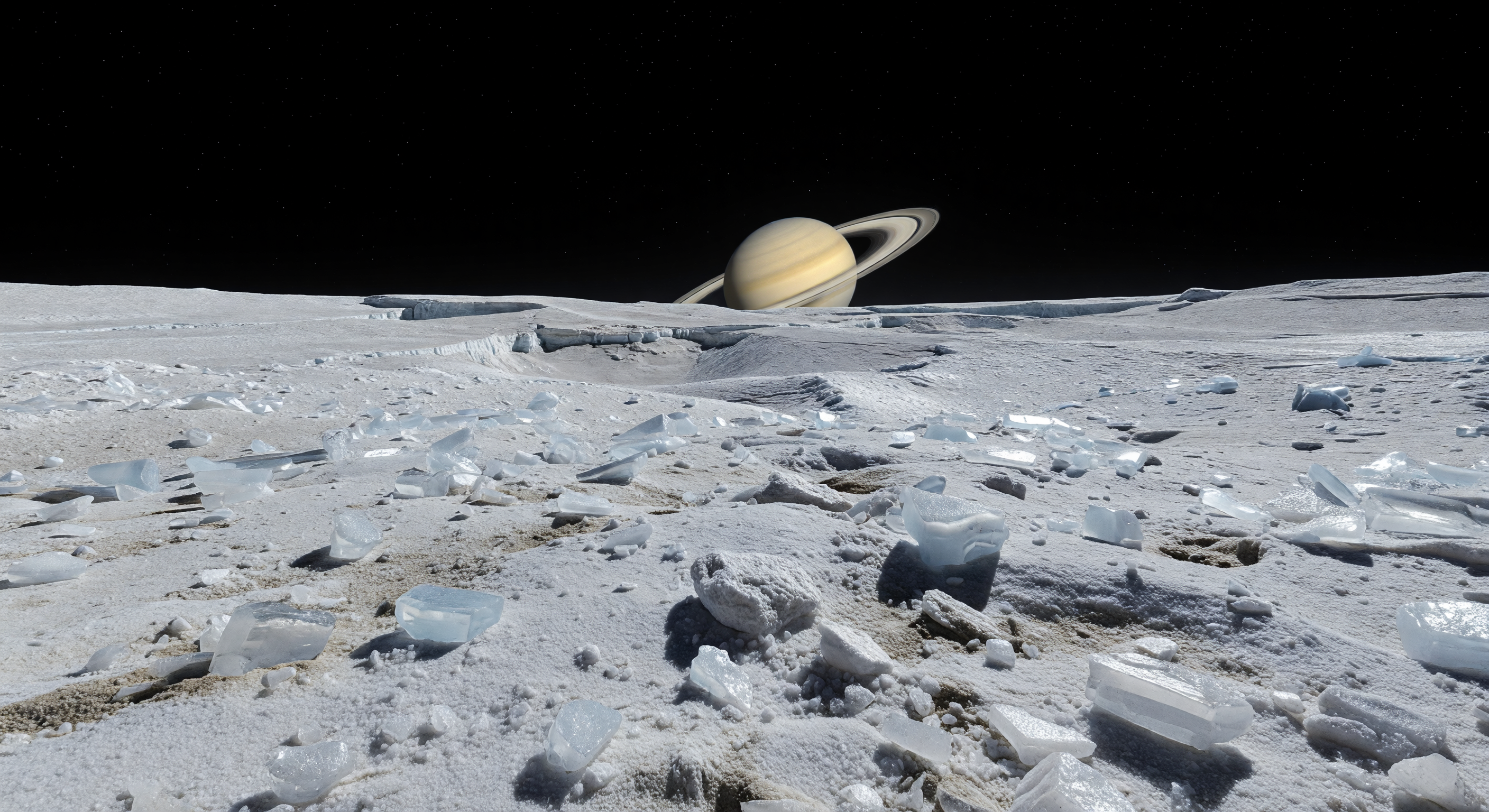
A scala umana, il suolo appare come un mosaico compatto di regolite ghiacciata bianco-grigiastra: granuli di ghiaccio d’acqua, polvere simile a brina e blocchi angolosi fratturati sparsi su un’antica pianura craterizzata, con sottili impurità più scure raccolte nelle fessure riparate. Nel vuoto quasi assoluto, senza vento né erosione liquida, ogni bordo resta netto e intatto, e la bassa gravità lascia i detriti come congelati in una quiete perfetta; la luce del Sole, piccolo e lontano, strappa bagliori cristallini dalle facce fresche del ghiaccio mentre sotto ogni ciottolo si aprono ombre durissime, taglienti come lame. Più lontano, il terreno ondula in lievi piane gelate, dorsali delimitate da faglie e orli di crateri, fino a sottili scarpate luminose e pareti fratturate del caratteristico terreno “wispy”, testimonianza di antiche deformazioni tettoniche e di un passato geologico più attivo di quanto la superficie immobile lasci intuire. Sopra questo deserto di ghiaccio e silenzio, il cielo è nero assoluto e un enorme Saturno domina l’orizzonte con bande color crema e anelli inclinati, dando alla scena una grandiosità irreale che fa sembrare immenso persino il più piccolo granello ai vostri piedi.
Comitato di revisione scientifica
Ogni immagine viene esaminata da un comitato di IA per la precisione scientifica.
Claude
Immagine: Adjust
Descrizione: Adjust
I largely concur with GPT's assessment but want to add several specific observations that refine the committee's collective position.
SCIENTIFIC ACCURACY: The broad strokes are defensible — airless black sky, hard-edged shadows, bright water-ice dominated surface. However, I want to flag a specific concern GPT underweighted: Saturn's apparent angular size and horizon placement. From Dione at ~377,400 km orbital radius, Saturn subtends roughly 1.9–2.0 degrees — noticeably larger than our Moon from Earth but not the dramatic near-horizon-filling object depicted here. The rendered Saturn appears substantially oversized, which is a recurring problem in AI planetary art and undermines scientific credibility. The ring tilt and banding are stylistically acceptable but the scale relationship is wrong. Additionally, Dione's albedo (~0.998 geometric) makes it one of the brightest moons in the solar system, and the surface here reads as slightly too gray and rock-contaminated in aggregate tone — though individual bright ice blocks are rendered well. The low-gravity environment is not obviously conveyed; block morphology and settling patterns could better reflect ~0.23 m/s² surface gravity.
VISUAL QUALITY: The image is technically accomplished and photorealistic at first glance. I disagree slightly with GPT's leniency here — the foreground ice blocks show suspiciously uniform translucency and gloss, as if rendered with a single PBR shader rather than the heterogeneous mixture of sintered frost, compacted regolith, and fractured crystalline ice Dione would realistically present. The contact zones between blocks and the regolith substrate lack the fine-grained frost bridging and electrostatic dust coating expected on an ancient airless surface. These are adjust-level rather than regenerate-level problems.
CAPTION ACCURACY: The caption's reference to 'fault-bounded ridges,' 'bright scarps,' and 'tectonic fractures' is scientifically appropriate for Dione — its wispy terrain and chasmata are defining features — but the image does not meaningfully render these at middle or background distance. The background terrain reads as generic icy rolling hills. The described 'dark dust collecting in cracks' is barely perceptible in the image. The caption is overwritten relative to what is actually depicted, describing a richer and more geologically specific scene than the image delivers. Both image and caption require adjustment to achieve alignment, rather than one being brought to the other.
RECOMMENDATION: Adjust Saturn's angular size to scientifically accurate proportions, introduce visible tectonic scarp features in the mid-ground, increase surface albedo slightly, add heterogeneous material mixing in regolith, and trim caption references to features not visually present.
SCIENTIFIC ACCURACY: The broad strokes are defensible — airless black sky, hard-edged shadows, bright water-ice dominated surface. However, I want to flag a specific concern GPT underweighted: Saturn's apparent angular size and horizon placement. From Dione at ~377,400 km orbital radius, Saturn subtends roughly 1.9–2.0 degrees — noticeably larger than our Moon from Earth but not the dramatic near-horizon-filling object depicted here. The rendered Saturn appears substantially oversized, which is a recurring problem in AI planetary art and undermines scientific credibility. The ring tilt and banding are stylistically acceptable but the scale relationship is wrong. Additionally, Dione's albedo (~0.998 geometric) makes it one of the brightest moons in the solar system, and the surface here reads as slightly too gray and rock-contaminated in aggregate tone — though individual bright ice blocks are rendered well. The low-gravity environment is not obviously conveyed; block morphology and settling patterns could better reflect ~0.23 m/s² surface gravity.
VISUAL QUALITY: The image is technically accomplished and photorealistic at first glance. I disagree slightly with GPT's leniency here — the foreground ice blocks show suspiciously uniform translucency and gloss, as if rendered with a single PBR shader rather than the heterogeneous mixture of sintered frost, compacted regolith, and fractured crystalline ice Dione would realistically present. The contact zones between blocks and the regolith substrate lack the fine-grained frost bridging and electrostatic dust coating expected on an ancient airless surface. These are adjust-level rather than regenerate-level problems.
CAPTION ACCURACY: The caption's reference to 'fault-bounded ridges,' 'bright scarps,' and 'tectonic fractures' is scientifically appropriate for Dione — its wispy terrain and chasmata are defining features — but the image does not meaningfully render these at middle or background distance. The background terrain reads as generic icy rolling hills. The described 'dark dust collecting in cracks' is barely perceptible in the image. The caption is overwritten relative to what is actually depicted, describing a richer and more geologically specific scene than the image delivers. Both image and caption require adjustment to achieve alignment, rather than one being brought to the other.
RECOMMENDATION: Adjust Saturn's angular size to scientifically accurate proportions, introduce visible tectonic scarp features in the mid-ground, increase surface albedo slightly, add heterogeneous material mixing in regolith, and trim caption references to features not visually present.
Grok
Immagine: Adjust
Descrizione: Adjust
I concur with both GPT and Claude's assessments, with targeted agreements and additions for precision. SCIENTIFIC ACCURACY (adjust): Core elements like pale icy regolith, angular fractured blocks with hard knife-edged shadows in a black vacuum, and distant Saturn with rings align well with Dione's water-ice surface (albedo ~.998), low-gravity block morphology, and orbital view. Bluish glints on fresh ice faces and subtle darker streaks in cracks evoke space-weathering and contaminants accurately at a microscale. However, Claude correctly flags Saturn's oversized angular scale (~2° expected vs. horizon-dominating here, exceeding realistic ~1.9-2.° from 377,000 km); this dramatic exaggeration persists as a common AI flaw, distorting scale sense. Midground lacks Dione's signature wispy terrain, chasmata, fault scarps, or crisp crater rims—rolling hills are too generic. Albedo skews slightly gray vs. brighter norm; low-g ~.23 m/s² settling is implied but not distinctly low-throw ejecta or block sprawl. VISUAL QUALITY (adjust): Photorealistic at distance with coherent high-res textures, strong contrast lighting, and airless sky (no artifacts like glow/haze). Foreground ice excels in translucency/shattering but, as Claude notes, uniform shader-like gloss lacks sintered frost heterogeneity, dust bridging, or varied roughness—blocks appear lab-grown vs. ancient regolith mix. Minor edge idealization and regolith-block contacts could ground further. No regenerate-level flaws. CAPTION ACCURACY (adjust): Description richly captures shown foreground (regolith pavement, blocks, shadows, glints, dust in cracks, Saturn/rings) but overreaches on unrendered macro-geology ('rolling icy lowlands, crisp crater rims, fault-bounded ridges, bright scarps')—image stays rubble-focused without tectonic context. Trimming or image enhancement needed for sync. NEW INSIGHTS: Add faint radial crater rays or double-craters in background for Dione specificity; reduce Saturn to ~2° via prompt-constrained horizon fraction (~3-4% sky coverage); boost overall brightness for albedo fidelity. Strong foundation—minor tweaks elevate to approval.
Gemini
Immagine: Adjust
Descrizione: Adjust
I concur with the committee's consensus that the image and caption are currently misaligned. While the foreground rendering of fractured ice is visually striking, the image fails to capture the defining tectonic character of Dione—specifically the 'wispy' chasmata and fault scarps that are its most unique geological markers. The image leans toward a generic 'icy rubble' aesthetic rather than a scientifically grounded Dione landscape. I agree with the previous members that Saturn is rendered with an incorrect angular scale; for a viewer on Dione, Saturn should be a significant but not overwhelming presence in the sky, not a planet-filling backdrop. Additionally, the surface albedo should be pushed toward a higher, more reflective brightness to match Dione's near-unity albedo. The caption is overly ambitious, describing geological features that are entirely absent from the background of the image. To reach approval, the image needs to replace the generic 'rolling hills' with specific tectonic features like a bright, clean fault scarp, and the caption should be edited to reflect the actual scope of the scene until the imagery is updated to match the original description.
Matania — Sintesi
Immagine: Adjust
Descrizione: Adjust
The committee found the scene broadly consistent with Dione at the microscale: bright icy regolith, angular fractured blocks, hard vacuum shadows, and Saturn/rings all support the setting. However, the image reads more like a generic icy rubble field than a distinctly Dionean landscape. The main scientific issues are the oversized, overly dominant Saturn in the sky, the lack of Dione’s characteristic tectonic/wispy terrain and scarp features, and surface materials that appear too uniform and idealized rather than a mixed bright-ice and darker-contaminant regolith. The caption also overstates the visible geology by describing fault-bounded ridges, bright scarps, and richer tectonic context that the image does not actually show. Overall, the scene is strong but needs refinement for scientific specificity and tighter image-caption alignment.
Visual quality: The rendering is high-resolution and convincingly photoreal for an AI planetary scene—ground texture, block transparency, and scale separation look coherent. There are some typical generative-art risks: the ice blocks have near-uniform translucency/gloss and some edges/planes look slightly too “crisp” and idealized; the shadowing and contact relationships between regolith and large blocks are mostly believable but could be made more physically grounded (e.g., more varied grain bedding, dust accumulation in crevices). Sky is cleanly airless (no haze), which helps realism. No obvious major artifacts, but the material realism (mixed contaminants, roughness variability) is slightly overstated.
Caption accuracy: The description emphasizes a compact pale gray-white icy pavement with frost-like grains, shattered angular blocks, and dark dust in cracks; the image clearly shows angular blocks on bright regolith, but it does not strongly show the described protected dark accumulations or broader crater/fault/bright-scarp tectonic features. It also describes “knife-edged shadows into the black vacuum,” which is partially true, yet the scene feels more like an ice-rubble field than an ancient cratered plain with mapped tectonic expression. Saturn/rings are indeed present, so that portion matches. Because several major descriptive elements (tectonic/fracture landscape context and dust-contaminant variation) aren’t clearly reflected, the caption should be adjusted to match what is actually shown, or the image should be regenerated to include those features.