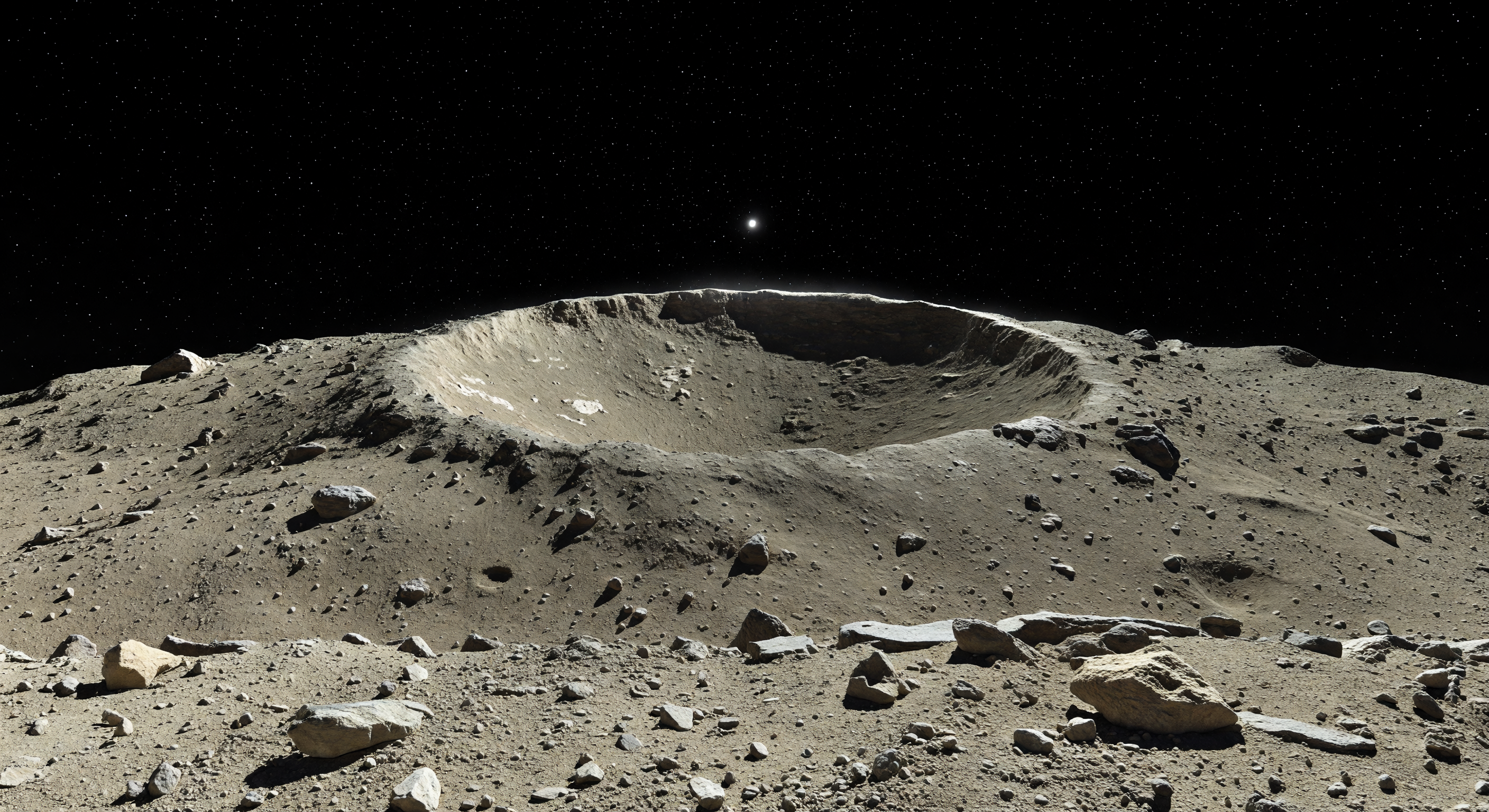
Dal bordo friabile di un cratere, tra ghiaia polverosa color ocra, frammenti angolosi di roccia silicatica e massi appena trattenuti da una gravità quasi inesistente, il terreno curva via così in fretta che l’orizzonte sembra crollare a pochi passi, rivelando la minuscola scala di questo mondo irregolare. Davanti si apre una conca d’impatto netta e severa: la cresta del bordo espulso brilla sotto un Sole duro e lontano, mentre la parete interna e il fondo sprofondano in un nero assoluto, senza alcun dettaglio, perché qui non esiste atmosfera a diffondere la luce o addolcire le ombre. Le superfici mostrano il volto tipico di un asteroide di tipo S, composto da regolite silicatica, polvere fine accumulata nelle cavità, blocchi condritici fratturati, piccoli solchi, fosse secondarie e affioramenti più chiari messi a nudo dagli impatti. Nel cielo di vuoto totale, nero come inchiostro e punteggiato di stelle nitide anche in pieno giorno, ogni ciottolo proietta un’ombra tagliente, e l’intero paesaggio dà la sensazione di trovarsi su una montagna di pietra alla deriva nello spazio, dove rilievi alti solo poche decine di metri assumono una grandiosità straniante.
Comitato di revisione scientifica
Ogni immagine viene esaminata da un comitato di IA per la precisione scientifica.
Claude
Immagine: Adjust
Descrizione: Adjust
I broadly agree with GPT's assessments but want to add several specific observations. On scientific accuracy: the lighting geometry is the image's strongest asset — hard-edged, unscattered shadows and a pitch-black sky are exactly correct for an airless body. The regolith texture, boulder distribution, and crater morphology are plausible. However, I share concerns about S-type coloration: NEAR Shoemaker imagery of Eros shows a distinctly warmer, more reddish-tan hue (space weathering on silicate-rich material), whereas this image skews cooler and more lunar gray, which nudges it toward a C-type or Moon aesthetic. This is a meaningful scientific inaccuracy worth correcting. The crater interior shadow is my biggest concern: GPT calls it 'cinematic,' and I agree. On a real low-gravity asteroid, the crater interior would not be a uniform flat black — surface roughness, scattered boulders, and the shallow bowl geometry of a simple crater on a small body would create gradients of illumination even in shadow (earthshine-equivalent is negligible, but surface self-illumination from lit walls would provide faint fill). The abrupt black reads as a compositing artifact or a render with ambient occlusion set to zero, which is visually dramatic but physically inaccurate. On scale and gravity: I want to flag something GPT did not — the crater in this image actually looks too large and too deep for a typical simple crater on Eros given the described 'tens of meters high' walls. The proportions suggest a more substantial feature, potentially hundreds of meters across, which conflicts with the intimate scale the caption emphasizes. The horizon curvature, which should be extreme on a body only ~17km in mean diameter, is not perceptible here; the horizon reads as a standard wide-angle terrestrial perspective. On caption accuracy: the caption's mention of 'subtle grooves' is unsupported — no linear grooves (a hallmark Eros feature documented by NEAR) are visible anywhere in the image. Downslope migration streaks are also absent. The 'fragile rim of pale dusty gravel' is somewhat represented but the rim looks more consolidated than the caption implies. The bright star near the horizon is a nice touch consistent with the Sun appearing as a bright point source from ~1.5 AU, though its positioning directly on the crater rim crest feels compositionally staged. Overall: adjust the color toward warmer reddish-tan, soften the crater interior shadow with minimal wall-scattered fill light, reduce the apparent crater scale or widen the field of view to show horizon curvature, and add at least one linear groove feature to match documented Eros geology. Caption should remove references to features not shown (grooves, migration streaks) or the image should be regenerated to include them.
Grok
Immagine: Adjust
Descrizione: Adjust
I concur with both GPT and Claude on the core issues, adding targeted refinements based on NEAR Shoemaker data (e.g., Eros' global spectrum peaks in warm tan/reddish hues from olivine-pyroxene space weathering, per McFadden et al. 2001; typical simple craters are <100m diameter with boulder-strewn, low-angle walls, not sheer drops). Scientific accuracy: Strong on airless vacuum traits—hard knife-edge shadows from direct insolation, no scatter/haze, star-pricked black sky, and blocky regolith align perfectly with Eros' S-type surface (silicate dust, chondritic fragments). However, color is inaccurately cool lunar-gray/beige instead of Eros' diagnostic reddish-tan (e.g., compare to NEAR image 980120); crater shadow is an unphysical uniform 'black void' lacking the faint gradients from wall bounce/scattered sunlight on rough interior boulders/breakdown slopes (real Eros craters like that near Himeros show textured shadows, not abyss). Scale is off: ~10-30m walls should yield extreme horizon curvature (~1-2km away on 17x11x5km Eros) and 'unnervingly fast' drop-off, but image's wide-angle view shows a flat, distant horizon more akin to Moon-scale; no visible grooves (Eros' ubiquitous linear features from seismic/impact slumps) or downslope streaks (low-g regolith tracks). Visual quality: Highly photorealistic PBR rendering with consistent specular highlights on dust/rocks and plausible subsurface scattering; no glaring artifacts, but 'studio-lit' perfection (overly uniform starfield, staged bright star on rim) and abrupt shadow cliff reduce immersion—minor AO tweak for subtle crater fill would help. Caption accuracy: Matches broad elements (dusty rim, blocky regolith, black sky/shadows, small-scale feel) but overclaims absent details like 'subtle grooves,' 'downslope streaks,' 'm migrating regolith,' and 'immediate wall of absolute blackness' (shadow is black but not a vertical 'wall' drop). Perspective 'curves away fast' is implied but not shown via tight horizon. Constructive: Adjust image for warmer tan-red regolith (sRGB ~#D2A679 base), add 1-2 faint linear grooves + thin streaks on slopes, gradient crater shadow with boulder hints, tighter FOV for curvature (e.g., 120°); trim caption to shown features or regenerate for full match.
Gemini
Immagine: Adjust
Descrizione: Adjust
I concur with the committee's assessment regarding the color palette; Eros is famously 'redder' than the Moon due to space weathering, and the current cool, desaturated gray is a significant scientific deviation from NEAR Shoemaker spectral data. Regarding the crater interior: the 'absolute black' void is a common failure in computer-generated vacuum scenes. In reality, light reflected from the sunlit crater rim and local boulders provides enough diffuse fill to prevent an 'abyss' effect, revealing the internal structure of the crater floor. I also note that the committee is correct about the scale: Eros is a small, elongated body (17x11x11 km), and the horizon should exhibit a perceptible, almost comical degree of curvature that is absent here. The image lacks the diagnostic linear 'grooves' (structural fractures) that crisscross Eros's surface. To move to 'approve,' the artist must warm the color temperature of the regolith, introduce subtle global illumination within the shadow to define crater interior topography, and introduce at least one prominent linear tectonic groove. The caption must be adjusted to remove claims of 'subtle grooves' and 'downslope streaks' if those features are not explicitly rendered in the final version.
Matania — Sintesi
Immagine: Adjust
Descrizione: Adjust
The committee found the image broadly plausible for an airless asteroid scene, with strong hard-edged lighting, a star-pricked black sky, and convincing rocky regolith. However, it does not fully match Eros: the surface is too cool and lunar-gray instead of Eros’ warmer reddish-tan tone, the crater interior reads as an unnaturally uniform black void, the scale/horizon curvature feels too terrestrial for Eros’ small body, and hallmark linear grooves or downslope migration textures are not evident. The caption likewise captures the general setting but overstates or mentions features not clearly shown, especially grooves, streaks, and the immediate wall of absolute blackness. Overall, the scene is close but needs targeted scientific correction rather than a full regeneration.
Visual quality: The rendering is largely photorealistic in composition and lighting: sharp shadows, plausible bidirectional illumination, and consistent surface texture. Minor concerns include the overall “studio-render” look of the crater edge and the sky star field quality (stars appear overly crisp/idealized), plus the crater interior shadow transition feels too clean/graphic rather than driven by surface roughness and local illumination. No obvious geometric artifacts, but the realism could be improved.
Caption accuracy: The caption’s core claims (asteroid, vacuum, low gravity, no atmosphere, crater rim view, hard shadows, dusty regolith with chondritic-like blocks) align well with what is shown. The mismatch is mainly in the details: the caption calls out subtle grooves, downslope migration streaks, and a near-immediate drop into a “wall of absolute blackness,” none of which are clearly visible or supported strongly by the image. Also, the described “curving away unnervingly fast” perspective and “tiny scale” are not clearly demonstrated beyond normal wide-angle perspective. Overall it’s close, but should be adjusted to match what’s actually depicted.