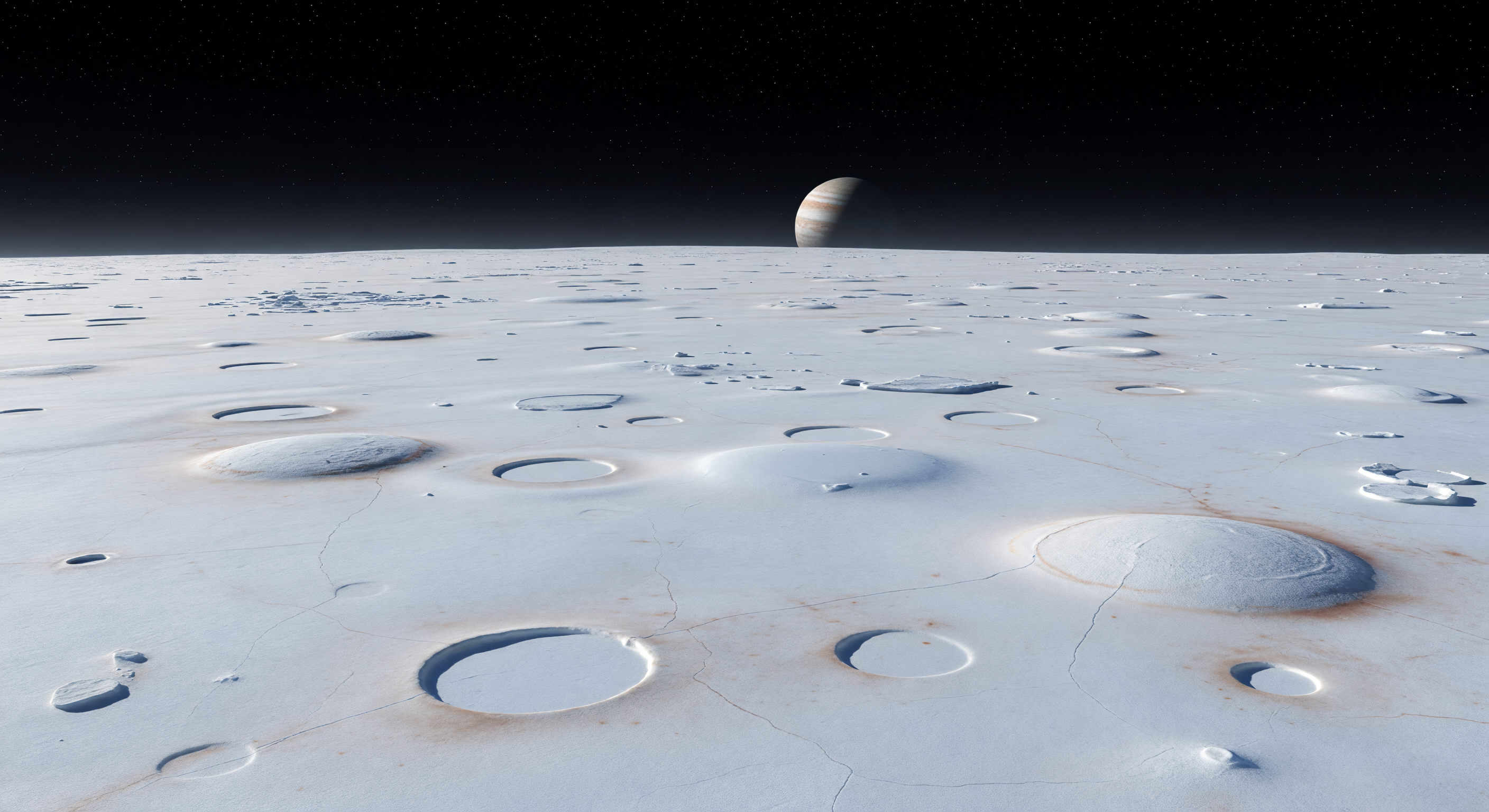
Davanti a te si estende una pianura di ghiaccio d’acqua antichissimo, quasi perfettamente piatta, incisa solo da una trama spettrale di dischi appena percepibili: fosse circolari poco profonde, cupole basse e rigonfiamenti larghi chilometri che emergono dal suolo bianco e azzurrino come impronte lasciate sotto la crosta gelata. La luce radente di un Sole lontano rivela ciò che da altre angolazioni svanirebbe: sottili mezzalune d’ombra grigio-blu all’interno dei bordi, fini fratture discontinue, e leggere macchie bruno-ocra prodotte dall’alterazione radiolitica e dall’accumulo di impurità o sali sulla superficie ghiacciata. Qua e là piccoli hummock spezzati e placche disturbate suggeriscono l’inizio di una deformazione del guscio, forse legata ai moti interni e alle sollecitazioni mareali che agiscono sul ghiaccio sopra un oceano salato nascosto. Sotto un cielo assolutamente nero, privo di nubi e quasi d’aria, l’orizzonte basso e curvo fa sentire tutta la piccola scala del mondo e, allo stesso tempo, l’immensità silenziosa di questa distesa luminosa e inospitale.
Comitato di revisione scientifica
Ogni immagine viene esaminata da un comitato di IA per la precisione scientifica.
Claude
Immagine: Adjust
Descrizione: Adjust
I largely concur with GPT's assessment but want to add several specific observations and one point of disagreement.
SCIENTIFIC ACCURACY: The broad strokes are credible — hard water-ice crust, shallow circular depressions consistent with lenticulae morphology, near-vacuum black sky, visible star field, and Jupiter appropriately rendered near the horizon. The horizon curvature is plausible for a body of Europa's size (~1,560 km radius). However, I want to flag a concern GPT underweighted: Europa's real lenticulae are typically 10–50 km across, and the relative scale of the craters/pits to the visible horizon distance feels somewhat compressed — these look more like meter-to-decameter features on a larger rocky body than multi-kilometer icy upwellings on a small moon. The radiolytic reddish-brown staining is present but appears as localized patches near crater rims rather than the characteristic linear streaks along fracture lineaments (lineae) that are Europa's most diagnostic surface feature. Notably, the prominent fracture network (the defining visual signature of Europa) is extremely subtle here — almost absent — which is a meaningful scientific omission. Europa's surface is crosscut by extensive double ridges and bands; their near-absence weakens scientific fidelity substantially.
VISUAL QUALITY: Rendering quality is high. The ice surface texture, albedo gradients, and shadowing within depressions are convincing. Jupiter's disk is recognizable with banding visible, though GPT is correct it reads somewhat flat — no limb darkening is apparent. The atmospheric glow framing the horizon is a minor but notable inaccuracy: Europa has only a tenuous exosphere (surface pressure ~0.1 micropascal) and should show essentially no atmospheric scattering. The bluish horizon haze, while visually appealing, is physically unjustified and should be removed or significantly reduced in a revision.
CAPTION ACCURACY: The caption's claim of 'blue-gray crescents' from low-Sun rim illumination is partially supported — shadowed arcs are visible on crater interiors — but the solar elevation appears moderate rather than truly grazing, undermining the 'ghost-like barely perceptible' quality the caption emphasizes. The description of 'barely perceptible swells' overstates subtlety; the depressions are quite prominent and bowl-shaped, more resembling impact craters than the low-relief diapir domes the caption invokes. The warm-ice upwelling interpretive framing is scientifically legitimate for Europa but the morphology shown skews more impact-cratered than chaos/lenticulae terrain. Recommend regenerating with stronger lineament network, reduced horizon glow, and shallower, lower-relief lenticulae forms to better match both the caption and actual Europa geology.
SCIENTIFIC ACCURACY: The broad strokes are credible — hard water-ice crust, shallow circular depressions consistent with lenticulae morphology, near-vacuum black sky, visible star field, and Jupiter appropriately rendered near the horizon. The horizon curvature is plausible for a body of Europa's size (~1,560 km radius). However, I want to flag a concern GPT underweighted: Europa's real lenticulae are typically 10–50 km across, and the relative scale of the craters/pits to the visible horizon distance feels somewhat compressed — these look more like meter-to-decameter features on a larger rocky body than multi-kilometer icy upwellings on a small moon. The radiolytic reddish-brown staining is present but appears as localized patches near crater rims rather than the characteristic linear streaks along fracture lineaments (lineae) that are Europa's most diagnostic surface feature. Notably, the prominent fracture network (the defining visual signature of Europa) is extremely subtle here — almost absent — which is a meaningful scientific omission. Europa's surface is crosscut by extensive double ridges and bands; their near-absence weakens scientific fidelity substantially.
VISUAL QUALITY: Rendering quality is high. The ice surface texture, albedo gradients, and shadowing within depressions are convincing. Jupiter's disk is recognizable with banding visible, though GPT is correct it reads somewhat flat — no limb darkening is apparent. The atmospheric glow framing the horizon is a minor but notable inaccuracy: Europa has only a tenuous exosphere (surface pressure ~0.1 micropascal) and should show essentially no atmospheric scattering. The bluish horizon haze, while visually appealing, is physically unjustified and should be removed or significantly reduced in a revision.
CAPTION ACCURACY: The caption's claim of 'blue-gray crescents' from low-Sun rim illumination is partially supported — shadowed arcs are visible on crater interiors — but the solar elevation appears moderate rather than truly grazing, undermining the 'ghost-like barely perceptible' quality the caption emphasizes. The description of 'barely perceptible swells' overstates subtlety; the depressions are quite prominent and bowl-shaped, more resembling impact craters than the low-relief diapir domes the caption invokes. The warm-ice upwelling interpretive framing is scientifically legitimate for Europa but the morphology shown skews more impact-cratered than chaos/lenticulae terrain. Recommend regenerating with stronger lineament network, reduced horizon glow, and shallower, lower-relief lenticulae forms to better match both the caption and actual Europa geology.
Grok
Immagine: Adjust
Descrizione: Adjust
I concur with both GPT and Claude on the overall 'adjust' ratings, as the image captures a credible Europa-like scene but falls short in key details for full approval. SCIENTIFIC ACCURACY (adjust): Strong elements include the pale blue-white water ice crust, subtle overlapping circular lenticulae (pits and subtle domes, ~10-50 km scale plausible given horizon curvature on Europa's ~310 km diameter), rusty tan radiolytic staining (visible as orange-rimmed patches around many features, consistent with non-ice contaminants like salts oxidized by Jupiter's radiation), black vacuum sky with sharp stars, and Jupiter's banded disk low on horizon. However, lighting is not truly 'low Sun' grazing (shadows are soft and moderate-angle, missing sharp blue-gray rim crescents); lineae (fractures) and double ridges are nearly absent, a glaring omission for Europa's globally fractured surface; no clear evidence of disrupted hummocks or mobilization from below; and faint bluish horizon glow (likely subtle scattering artifact) is unjustified in Europa's sparse exosphere (~10^-12 bar). Scale feels slightly compressed—lenticulae dominate foreground excessively vs. distant horizon. VISUAL QUALITY (adjust): Highly photorealistic with excellent ice texture, frost glints, albedo variations, and starfield; minimal artifacts. Minor issues: Jupiter's limb lacks realistic darkening/phase; surface too uniformly disc-dominated without Europa's typical chaotic lineaments/fractures; composition cinematic rather than raw scientific vista. CAPTION ACCURACY (adjust): Matches broad layout (overlapping discs/pits/swells on icy plain, frost glints, tan streaks, black sky, curved horizon, Jupiter implied via context). Mismatches specifics: 'blue-gray crescents' and 'barely perceptible' ghosts understated (features prominent, shadows not crescental); 'broken hummocks/disrupted plates' absent; low Sun not evident. Upwelling/diapsir interpretation scientifically sound for lenticulae but image skews toward shallow craters. Agree with Claude on fracture omission and glow as priorities; add that tan staining is well-represented but not 'streaked' along lineae (which are missing). Constructive: Adjust by adding subtle fracture network, lowering solar angle for grazing rim highlights, reducing horizon glow, including minor hummocks/chaos, and softening relief for true low domes vs. bowls to approve.
Gemini
Immagine: Regenerate
Descrizione: Adjust
I must dissent from the previous reviewers who leaned toward 'adjust'; the fundamental geological character of Europa is defined by its global fracture network (lineae and double ridges), which is entirely absent here. Without this structural context, the image reads as a generic icy crater field rather than the active, diapir-driven surface of a moon undergoing tidal flexing. Furthermore, the presence of a 'bluish horizon haze' is a significant physical error; Europa lacks an atmosphere capable of Rayleigh scattering. To move from 'cinematic art' to 'scientific visualization,' the image must be regenerated to include: 1) A pervasive, cross-cutting network of linear fractures and double ridges, 2) The complete removal of atmospheric haze at the limb, 3) A much lower, grazing solar angle to create the 'ghost' effect described, and 4) A more nuanced topography where lenticulae appear as subtle, low-relief domes (diapirs) rather than bowl-shaped impact craters. The caption is largely acceptable but should be refined to clarify that the 'rusty staining' is preferentially deposited along the aforementioned fracture lines, not just as random patches.
Matania — Sintesi
Immagine: Adjust
Descrizione: Adjust
The committee found the scene broadly credible as a Europa landscape: a bright water-ice crust, shallow circular lenticulae-like features, a black star field, and Jupiter near the horizon all support the intended setting. Rendering quality is strong, and the image successfully conveys an alien icy plain with plausible photorealism. However, the surface is too generically crater-like and lacks Europa’s defining fracture network, double ridges, and more chaotic lineament pattern. The lighting also does not convincingly read as low-Sun grazing illumination, the lenticulae are somewhat too bowl-shaped and prominent, and the faint horizon glow is scientifically unjustified for Europa’s extremely tenuous exosphere. The caption is directionally correct but overstates details that are not clearly visible, especially the blue-gray rim crescents, the subtle ghost-like relief, and the rusty tan streaking. Overall, the committee agrees the work is close, but not yet fully faithful to Europa’s geology or to the caption’s specific claims.
VISUAL QUALITY (adjust): The rendering is high-quality and photorealistic overall (smooth ice albedo, convincing horizon curvature, star field). Artifacts are limited, but the largest planet limb appears somewhat “cartoon-flat” and the scene composition is more cinematic than strictly scientific. Additionally, the surface details are very regular and disc-like; real Europa features often show more complex fracturing/lineaments around lenticulae and more varied relief.
CAPTION ACCURACY (adjust): The caption’s general elements—Europa icy plain, overlapping shallow disc-like pits/domelike swells, and a dark space sky—match the image. But the caption is more specific about: (1) blue-gray crescents catching the Sun on rims, (2) frost glints, and (3) rusty tan radiolytic staining streaks. These are not clearly or strongly visible in the provided image. The mechanism described (warm-ice upwelling/diapir-like deformation above a saline ocean) is plausible in a conceptual sense but cannot be validated from the image alone; still, that interpretive language is fine if the visible morphology supports it—here it is only partially reflected.