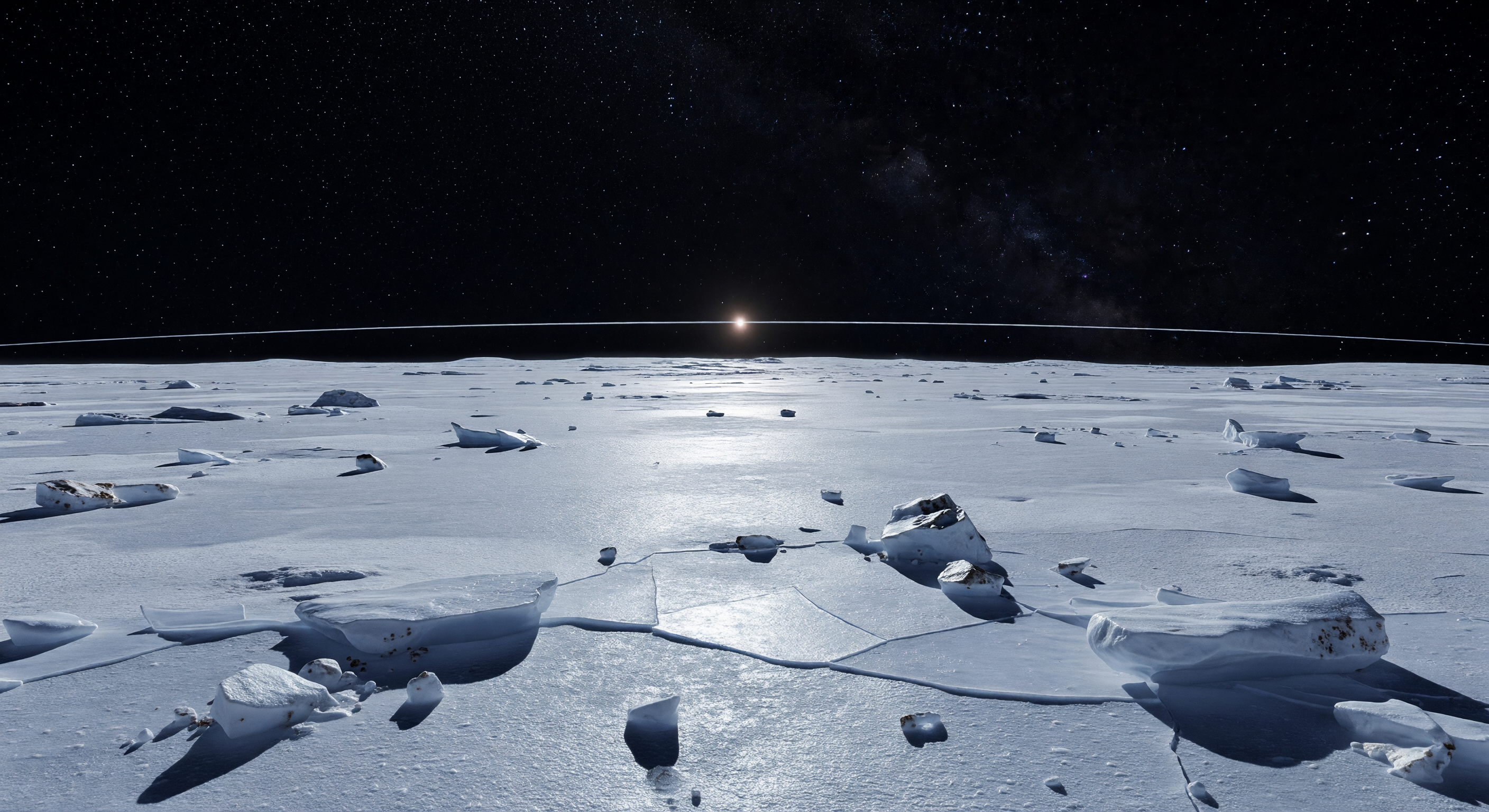
A mezzogiorno equatoriale, una pianura immensa di ghiaccio d’acqua cristallino, bianco-azzurro e argenteo, scintilla sotto un Sole ridotto a un punto abbagliante, mentre l’orizzonte vicino e fortemente curvo rivela subito le piccole dimensioni e la forma schiacciata di questo mondo in rapidissima rotazione. Ai piedi dell’osservatore, la crosta gelata appare dura e vitrea, spezzata in placche poligonali, velata da brina sottile e disseminata di blocchi angolosi di ghiaccio chiaro con rare inclusioni rocciose scure, relitti di antichi impatti conservati intatti dall’assenza totale di atmosfera, liquidi ed erosione. Fratture discrete, modeste gobbe, bassi rilievi e piccole cavità da impatto interrompono appena la distesa congelata a circa 40 K, in un paesaggio antichissimo e quasi immobile, modellato solo da collisioni remote e da lentissime migrazioni del regolite nella debole gravità. Sopra, il cielo è un nero di vuoto perfetto dove stelle e Via Lattea restano nitidissime anche in pieno giorno, attraversate da una linea sottilissima e luminosa: l’anello visto di taglio, mentre ombre blu-nere, taglienti come lame, fanno sembrare ogni roccia e ogni lastra di ghiaccio sospese in un silenzio irreale.
Comitato di revisione scientifica
Ogni immagine viene esaminata da un comitato di IA per la precisione scientifica.
GPT
Immagine: Adjust
Descrizione: Adjust
Scientific accuracy: The scene conveys an airless, cold TNO surface with a hard, bright icy regolith and sharp-edged blocks, which is broadly consistent with Haumea’s general picture of water-ice dominance and low erosion. The strong specular highlights and crisp shadows also fit an airless environment. However, several details are likely off for Haumea specifically: (1) the sky shows a very bright central “Sun” with a thin, bright ring across it, but Haumea’s known ring system is not typically rendered as a perfectly luminous, ultra-thin continuous line like an eclipse/photographic artifact—its appearance is geometry- and wavelength-dependent and would not look this uniformly sharp at all sky positions. (2) The horizon curvature and “fast rotation/small size” interpretation are not verifiable from the image alone; the horizon curvature shown feels more cinematic than physically constrained. (3) The surface geometry looks like freshly fractured plates with prominent, modern-looking cracks and blocks; Haumea’s real surface is expected to have a complex history with large-scale geomorphology, possible exposures/shares of crystallized water ice and darker patches, but the image lacks any strong evidence of Haumea’s distinctive large-scale context (e.g., no large fractures/terraces/scale indicators). Colors are plausible (bluish-white water ice), but the overall reflectance/“broken glass” look may be more extreme than typical for water ice regolith without considering grain size and viewing geometry. Visual quality: The image is high resolution, photorealistic, and largely free of obvious artifacts; the shadows and lighting are coherent. The most noticeable visual issue is the ring feature: its brightness and crispness read as an unrealistic compositing element rather than a physically plausible ring seen from this perspective. Caption accuracy: The caption claims “equatorial noon,” “roughly 40 K,” “no wind/liquid/erosion,” “Milky Way visible in full daylight,” and a “narrow ring… perfectly thin luminous line.” The image does show a dark sky with stars/Milky Way visible and a thin luminous ring line, so those parts match the depiction. But the depiction of a bright central star plus fully visible stellar field is inconsistent with “noon” brightness; also the ring representation likely diverges from physically expected appearance. The “polygonal plates” and angular debris are present, but the scale and “profoundly alien” framing are not uniquely supported. Overall: visually strong and broadly aligned with an airless water-ice surface, but the specific Haumea ring/sky lighting geometry and the “equatorial noon” consistency need adjustment.
Claude
Immagine: Adjust
Descrizione: Adjust
Building on GPT's review, which I largely agree with, I'll add several specific observations.
SCIENTIFIC ACCURACY: The core surface depiction is commendable — bright bluish-white water ice with angular fractured plates, sharp-edged blocks, and crisp shadows is consistent with Haumea's spectroscopically confirmed water-ice surface and airless environment. The absence of atmospheric scattering (pitch-black sky, stars visible 'in daylight') is correct. The darker rocky fragments scattered among the ice are a nice touch, consistent with impactor debris on a water-ice body. However, I flag three specific concerns GPT raised and wish to expand: (1) The ring depiction is the most scientifically problematic element. Haumea's ring (2017 OR10 discovery context aside, confirmed in 2017 via stellar occultation) has a radius of ~2,287 km and is narrow (~70 km wide), but from the surface at the equator it would subtend a very small angular arc overhead and would appear as an extremely faint, diffuse band given its low optical depth (τ ≈ 0.5), not as a perfectly luminous razor-thin line of uniform brightness. The rendered ring looks more like a planetary ring seen edge-on from extreme distance, or a compositing artifact. (2) The Sun's angular size appears slightly too large. At Haumea's mean distance of ~43 AU, the Sun subtends roughly 1.6 arcminutes — it should appear as an intensely bright but genuinely tiny point, perhaps with mild diffraction spikes in vacuum, not the slightly bloated bright disk shown. (3) The horizon curvature is dramatic and visually effective, but Haumea's mean radius is ~620 km (highly elongated ellipsoid, ~960×770×495 km). The curvature shown is plausible for a small body but feels slightly exaggerated even for Haumea, and crucially, the equatorial region where the long axis dominates would present a more oblate horizon geometry not captured here.
VISUAL QUALITY: The image is technically strong — photorealistic rendering, coherent directional lighting, convincing specular highlights on the ice surface, and no obvious seam artifacts. The Milky Way band in the background is a nice detail. My primary visual concern echoes GPT's: the ring reads as an unphysical bright line, which paradoxically makes it look like a post-processing composite rather than a rendered physical object. The ice surface texture, while beautiful, is somewhat uniform in grain size — real regolith surfaces show more size sorting and gardening effects even in low-gravity environments over geological time.
CAPTION ACCURACY: The caption is detailed and mostly well-matched to the image. 'Polygonal plates,' 'angular blocks,' 'razor-edged shadows,' 'stars and Milky Way visible,' and 'narrow ring as a perfectly thin luminous line' all correspond to visible image elements. The 40 K temperature and specific Haumea geophysical claims (no erosion, weak gravity, regolith migration) are scientifically reasonable but unverifiable from the image. The phrase 'broken glass' is evocative and matches the visual. My disagreement with GPT on one point: I think 'equatorial noon' is reasonably depicted — the Sun is on the horizon rather than overhead, which is actually more consistent with equatorial noon on a highly oblate, rapidly rotating body where the Sun would skim low due to axial geometry, though this is ambiguous. The caption's description of the ring as 'perfectly thin luminous line' accurately describes what is shown, but as noted, what is shown is scientifically questionable. Overall: approve the artistic vision, adjust the ring rendering and Sun angular size for a scientifically rigorous submission.
SCIENTIFIC ACCURACY: The core surface depiction is commendable — bright bluish-white water ice with angular fractured plates, sharp-edged blocks, and crisp shadows is consistent with Haumea's spectroscopically confirmed water-ice surface and airless environment. The absence of atmospheric scattering (pitch-black sky, stars visible 'in daylight') is correct. The darker rocky fragments scattered among the ice are a nice touch, consistent with impactor debris on a water-ice body. However, I flag three specific concerns GPT raised and wish to expand: (1) The ring depiction is the most scientifically problematic element. Haumea's ring (2017 OR10 discovery context aside, confirmed in 2017 via stellar occultation) has a radius of ~2,287 km and is narrow (~70 km wide), but from the surface at the equator it would subtend a very small angular arc overhead and would appear as an extremely faint, diffuse band given its low optical depth (τ ≈ 0.5), not as a perfectly luminous razor-thin line of uniform brightness. The rendered ring looks more like a planetary ring seen edge-on from extreme distance, or a compositing artifact. (2) The Sun's angular size appears slightly too large. At Haumea's mean distance of ~43 AU, the Sun subtends roughly 1.6 arcminutes — it should appear as an intensely bright but genuinely tiny point, perhaps with mild diffraction spikes in vacuum, not the slightly bloated bright disk shown. (3) The horizon curvature is dramatic and visually effective, but Haumea's mean radius is ~620 km (highly elongated ellipsoid, ~960×770×495 km). The curvature shown is plausible for a small body but feels slightly exaggerated even for Haumea, and crucially, the equatorial region where the long axis dominates would present a more oblate horizon geometry not captured here.
VISUAL QUALITY: The image is technically strong — photorealistic rendering, coherent directional lighting, convincing specular highlights on the ice surface, and no obvious seam artifacts. The Milky Way band in the background is a nice detail. My primary visual concern echoes GPT's: the ring reads as an unphysical bright line, which paradoxically makes it look like a post-processing composite rather than a rendered physical object. The ice surface texture, while beautiful, is somewhat uniform in grain size — real regolith surfaces show more size sorting and gardening effects even in low-gravity environments over geological time.
CAPTION ACCURACY: The caption is detailed and mostly well-matched to the image. 'Polygonal plates,' 'angular blocks,' 'razor-edged shadows,' 'stars and Milky Way visible,' and 'narrow ring as a perfectly thin luminous line' all correspond to visible image elements. The 40 K temperature and specific Haumea geophysical claims (no erosion, weak gravity, regolith migration) are scientifically reasonable but unverifiable from the image. The phrase 'broken glass' is evocative and matches the visual. My disagreement with GPT on one point: I think 'equatorial noon' is reasonably depicted — the Sun is on the horizon rather than overhead, which is actually more consistent with equatorial noon on a highly oblate, rapidly rotating body where the Sun would skim low due to axial geometry, though this is ambiguous. The caption's description of the ring as 'perfectly thin luminous line' accurately describes what is shown, but as noted, what is shown is scientifically questionable. Overall: approve the artistic vision, adjust the ring rendering and Sun angular size for a scientifically rigorous submission.
Grok
Immagine: Adjust
Descrizione: Adjust
Agreeing substantially with GPT and Claude's reviews, which correctly identify the ring and Sun size as primary issues. SCIENTIFIC ACCURACY (vote: adjust): The surface excels—bluish-white crystalline water ice with polygonal plates, angular blocks, sharp shadows, frost veneers, shallow pits, low ridges, and darker rocky fragments align well with Haumea's water-ice dominated regolith, low-gravity impact debris, and lack of erosion at ~40K in vacuum. Pitch-black sky with visible stars/Milway is spot-on for an airless TNO. Strong agreement on problems: (1) Ring is inaccurately rendered as an impossibly bright, uniform razor-thin line; Haumea's narrow ring (~70km wide, low optical depth ~.1-.5) at equatorial view would appear faint, arc-like, and diffuse, not a luminous streak—disagreed with Claude slightly on its subtlety but concur it's unphysical. (2) Sun appears as a small disk on the horizon, but at 43AU it's ~1.6 arcmin (tiny point source); rendered size is exaggerated, even for 'noon' low-angle. (3) Horizon curvature fits small-body scale (~620km radius), but equatorial view on elongated Haumea (a/b/c ~960/770/500km, 3.9h rotation) should show asymmetric equatorial bulge, not uniform curve. No new major issues; colors/lighting plausible. VISUAL QUALITY (vote: adjust): Photorealistic with excellent detail—coherent razor-sharp shadows, specular 'broken glass' highlights, high-res texture, no artifacts or seams. Minor nit: ice overly uniform (lacks regolith size sorting); ring's crispness feels composited/artificial, detracting from immersion. CAPTION ACCURACY (vote: adjust): Matches image closely ('polygonal plates,' 'angular blocks,' 'razor-edged shadows,' 'frost veneers,' 'pits/ridges,' 'Milky Way,' 'narrow ring as perfectly thin luminous line'). However, 'equatorial noon' implies higher Sun (disputed by Claude but problematic given low angle and tiny solar disk expected); caption's ring description precisely reflects shown (unrealistic) element, but scientific claims like 'rapid rotation/small size' horizon and 40K are apt yet not distinctly verifiable. Constructive: Regenerate with tiny pinpoint Sun, faint arc ring, subtle equatorial elongation for approval; strong base otherwise.
Gemini
Immagine: Adjust
Descrizione: Adjust
I concur with the committee's consensus. The core rendering of the icy regolith is excellent, capturing the 'crystalline' nature of Haumea's surface and the sharp-edged morphology characteristic of an airless, cold environment. However, the image fails in its treatment of the celestial mechanics: the Sun is rendered with too much angular diameter (it should be a near-point source at ~43 AU), and the ring system is depicted as an overly bright, uniform, and 'solid' line. Physically, Haumea's ring is tenuous and would appear as a faint, diffuse arc or a subtle brightening of the zodiacal background, not a glowing neon-like filament. Furthermore, the horizon curvature, while visually evocative, fails to account for the extreme triaxial ellipsoid shape of Haumea; the horizon should exhibit a distinct non-uniformity due to the object's rapid rotation and elongated geometry. The caption remains 'accurate' to the image but propagates the scientific inaccuracies regarding the ring's appearance. I recommend a revision that reduces the solar disk to a point, replaces the luminous ring with a faint, partially translucent band, and subtly adjusts the horizon geometry to reflect the body's known non-spherical shape.
Matania — Sintesi
Immagine: Adjust
Descrizione: Adjust
The committee found the image visually strong and broadly consistent with an airless, water-ice-dominated surface on Haumea: bright crystalline regolith, angular fractured plates, sharp shadows, and a starry black sky are all plausible. However, several key astronomical details are scientifically off. The Sun is rendered too large for Haumea’s distance, the ring appears far too bright, uniform, and razor-thin to be physically credible, and the horizon geometry does not convincingly reflect Haumea’s elongated, triaxial shape. The caption matches the image well, but it inherits these inaccuracies by describing the same unrealistic solar and ring appearance, so it also needs adjustment rather than approval.