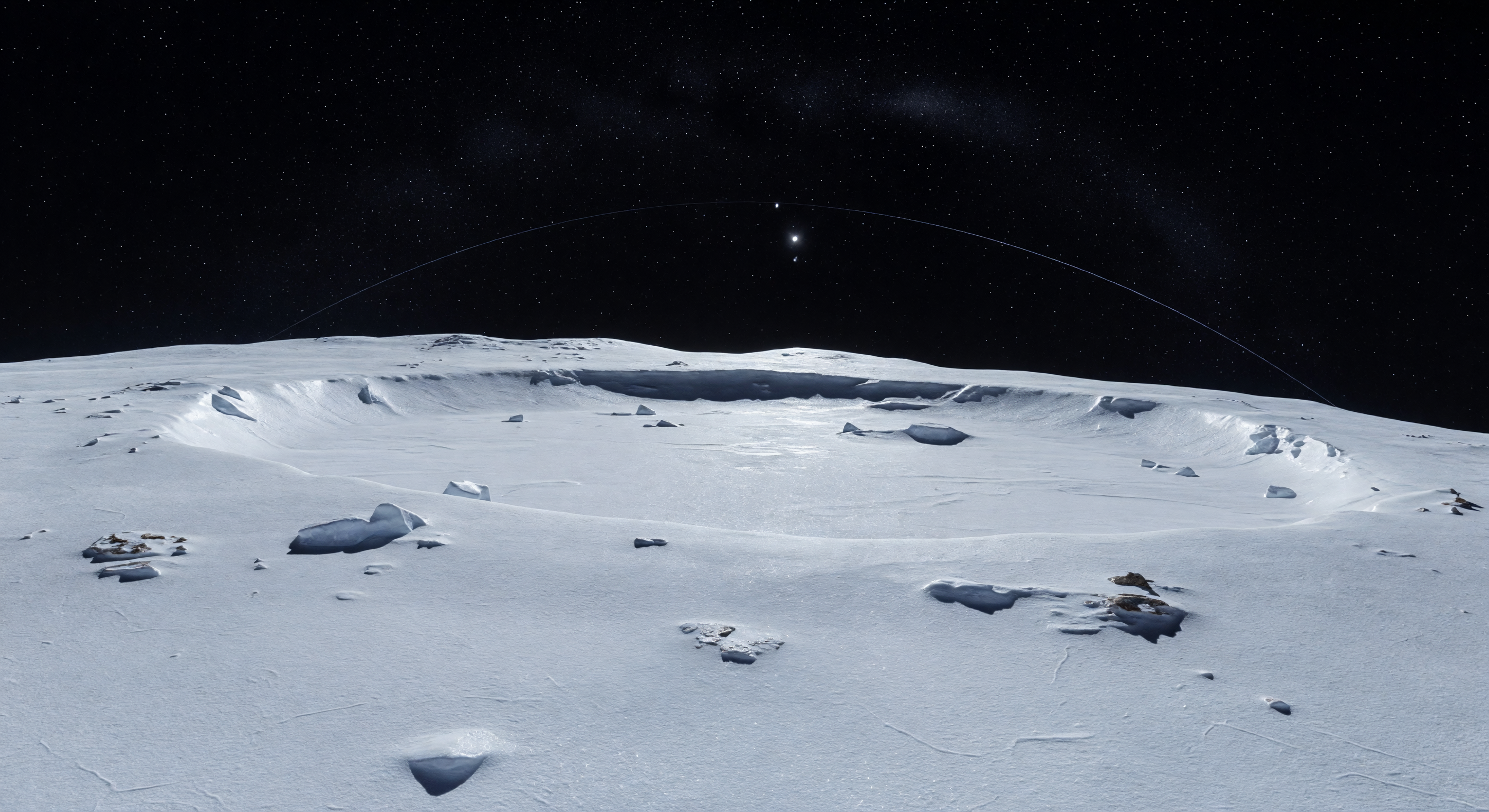
Davanti a te si apre un ampio bacino gelato quasi privo di rilievi, una depressione topografica rivestita da una crosta continua di brina di ghiaccio d’acqua cristallino, finemente granulare e sinterizzato, così riflettente da brillare di bianco azzurrato sotto una luce solare lontanissima ma tagliente. A terra emergono appena lievi ondulazioni del regolite compatto, sottili giunti poligonali di sinterizzazione, piccoli rigonfiamenti di brina e qualche blocco angoloso semisepolto, mentre in lontananza il bordo del bacino si solleva in scarpate basse e creste curve, accentuate dalla gravità debole e dalla forma allungata del corpo. Qui, a circa 40 kelvin, non esistono liquidi né processi atmosferici: nessun vento, nessuna foschia, nessun canale d’erosione, solo il lentissimo rimaneggiamento da impatti e la trasformazione termica di un suolo rimasto intatto per miliardi di anni. Sopra questo paesaggio immobile il cielo è un nero di vuoto assoluto, punteggiato di stelle visibili anche a mezzogiorno, così che ogni ombra appare netta come un’incisione e l’intera distesa sembra sospesa tra silenzio cosmico e gelo antico.
Comitato di revisione scientifica
Ogni immagine viene esaminata da un comitato di IA per la precisione scientifica.
GPT
Immagine: Adjust
Descrizione: Adjust
Scientific accuracy: The scene is clearly in an airless, icy outer-solar-system environment (black space, no haze), and the luminous, whitish surface is broadly consistent with Haumea’s outer icy terrains. However, the image does not strongly display the caption’s specific “Smooth Frost Basin” diagnostics: the surface looks like a textured/managed icy regolith with many discrete dark/dirty patches and irregular boulders rather than primarily fine-grained sintered crystalline water ice with only subtle ripple-like undulations, polygonal seams, and a few half-buried blocks. The lighting is generally plausible for distant solar illumination, but the overall brightness and softness of shadows look somewhat Earth/near-ideal rather than the crisp, high-contrast reflectance and very long-stationary illumination expected at ~40 AU; also, the prominent “horizon arc” and distant starfield are more cinematic than physically tied to a specific Haumea viewing geometry. Visual quality: The image is high-resolution, coherent, and largely free of obvious rendering artifacts; it reads as photorealistic CGI/3D visualization with consistent perspective and sky rendering. Minor issues include somewhat unnatural surface microtexture (too uniform/painted in places) and an implausibly large number of scattered dark stones/patches relative to the caption’s described sparse angular blocks. Caption accuracy: Several elements match (icy basin-like depression, airless black sky, distant stars, presence of blocks). But the caption over-specifies features that are not clearly present in the image (smoothness to near-unreal level, faint bluish cast, delicate ripple-like undulations, subtle polygonal seams, and only a few half-buried angular blocks). The image shows more varied/rocky debris and less evidence of polygonal seam patterns. Overall: accept the broad concept, but adjust the geological description to better match what is actually shown (irregular boulders/dirt patches and a more rugged icy plain rather than an ultra-smooth crystalline frost sheet).
Claude
Immagine: Adjust
Descrizione: Regenerate
I largely concur with GPT's assessment but want to push the caption vote harder toward regenerate and add several specific observations.
SCIENTIFIC ACCURACY: The black vacuum sky, absence of atmosphere, and starfield including a faint Milky Way band are all correct for an airless TNO. The distant Sun rendered as a bright point-like source is appropriate for ~43 AU. However, I have concerns about the surface itself. Haumea's geometric albedo is approximately 0.51, making it one of the most reflective large bodies in the outer solar system, and the brilliant white icy surface broadly captures this. But the abundance of dark, dirty patches and scattered angular blocks implies a more contaminated or gardened regolith inconsistent with a 'Smooth Frost Basin' specifically. At 40 K, ice behaves as an extremely rigid solid; the blocky talus and debris field shown is not implausible geologically, but it contradicts the caption's near-featureless sintered crystalline sheet. The horizon curvature appears too subtle — Haumea's mean radius is only ~620 km and it is notably triaxial (roughly 2,322 × 1,704 × 1,138 km), so surface curvature should be dramatically more pronounced than shown, and the elongated shape should subtly influence ridge geometry at the horizon. The arc drawn in the sky presumably represents an orbital path of one of Haumea's moons (Hi'iaka or Namaka), which is a commendable detail, but the two bright point sources near it are unexplained — if one is the Sun it should appear much smaller and sharper, and the second source is ambiguous.
VISUAL QUALITY: The rendering is technically competent and photorealistic at first glance. Lighting is internally consistent, shadows are sharp and directionless as expected in a vacuum, and there are no obvious seams or generation artifacts. My specific criticism is that the surface microtexture has an overly uniform 'snow field' quality that reads as terrestrial alpine rather than ancient radiation-processed outer solar system ice. True Haumea surface ice would likely show a more crystalline, potentially slightly reddish-tinted character from space weathering rather than the pristine white shown. The soft, rounded snow morphology of some surface features also implies aeolian or thermal creep processes impossible in this environment.
CAPTION ACCURACY: This is where I diverge most sharply from GPT's 'adjust' vote and recommend 'regenerate.' The caption makes extremely specific claims — sintered crystalline water ice, fine-grained texture, ripple-like undulations, polygonal seams, a faint bluish cast, and only a few half-buried angular blocks — virtually none of which are clearly evidenced in the image. The image shows the opposite in several respects: abundant surface debris, no visible polygonal seams, no ripple undulations, and a surface that reads as granular snow rather than sintered crystalline ice. The mismatch is not minor; it is fundamental to the stated landscape concept. A revised caption should acknowledge the boulder-strewn icy plain actually depicted, drop the polygonal seam and ripple claims, and moderate the 'near-unreal smoothness' language entirely. The Haumea-specific orbital arc detail in the sky is a genuine positive that the caption should explicitly describe and credit.
SCIENTIFIC ACCURACY: The black vacuum sky, absence of atmosphere, and starfield including a faint Milky Way band are all correct for an airless TNO. The distant Sun rendered as a bright point-like source is appropriate for ~43 AU. However, I have concerns about the surface itself. Haumea's geometric albedo is approximately 0.51, making it one of the most reflective large bodies in the outer solar system, and the brilliant white icy surface broadly captures this. But the abundance of dark, dirty patches and scattered angular blocks implies a more contaminated or gardened regolith inconsistent with a 'Smooth Frost Basin' specifically. At 40 K, ice behaves as an extremely rigid solid; the blocky talus and debris field shown is not implausible geologically, but it contradicts the caption's near-featureless sintered crystalline sheet. The horizon curvature appears too subtle — Haumea's mean radius is only ~620 km and it is notably triaxial (roughly 2,322 × 1,704 × 1,138 km), so surface curvature should be dramatically more pronounced than shown, and the elongated shape should subtly influence ridge geometry at the horizon. The arc drawn in the sky presumably represents an orbital path of one of Haumea's moons (Hi'iaka or Namaka), which is a commendable detail, but the two bright point sources near it are unexplained — if one is the Sun it should appear much smaller and sharper, and the second source is ambiguous.
VISUAL QUALITY: The rendering is technically competent and photorealistic at first glance. Lighting is internally consistent, shadows are sharp and directionless as expected in a vacuum, and there are no obvious seams or generation artifacts. My specific criticism is that the surface microtexture has an overly uniform 'snow field' quality that reads as terrestrial alpine rather than ancient radiation-processed outer solar system ice. True Haumea surface ice would likely show a more crystalline, potentially slightly reddish-tinted character from space weathering rather than the pristine white shown. The soft, rounded snow morphology of some surface features also implies aeolian or thermal creep processes impossible in this environment.
CAPTION ACCURACY: This is where I diverge most sharply from GPT's 'adjust' vote and recommend 'regenerate.' The caption makes extremely specific claims — sintered crystalline water ice, fine-grained texture, ripple-like undulations, polygonal seams, a faint bluish cast, and only a few half-buried angular blocks — virtually none of which are clearly evidenced in the image. The image shows the opposite in several respects: abundant surface debris, no visible polygonal seams, no ripple undulations, and a surface that reads as granular snow rather than sintered crystalline ice. The mismatch is not minor; it is fundamental to the stated landscape concept. A revised caption should acknowledge the boulder-strewn icy plain actually depicted, drop the polygonal seam and ripple claims, and moderate the 'near-unreal smoothness' language entirely. The Haumea-specific orbital arc detail in the sky is a genuine positive that the caption should explicitly describe and credit.
Grok
Immagine: Adjust
Descrizione: Regenerate
I concur with both GPT and Claude on the core issues while adding precision on Haumea-specific traits. SCIENTIFIC ACCURACY (image: adjust): The black vacuum sky with starfield and faint Milky Way is spot-on for an airless TNO at ~43 AU; the tiny, sharp Sun point source and sharp, long stationary shadows from low solar elevation angle are excellent. The high-albedo white icy surface aligns with Haumea's ~.51 geometric albedo and water-ice dominance (confirmed by spectroscopy). However, the surface shows abundant dark regolith patches, numerous scattered angular boulders, and granular snow-like texture rather than the ultra-smooth, minimally gardened frost basin implied—real TNO regolith at 40K is indeed impact-processed and contaminated, so this is plausible but mismatches the 'smooth' concept. Critically, Haumea's triaxial ellipsoid shape (2,322×1,704×1,138 km) demands a much tighter horizon curvature (viewer ~1-2 km scale should see ~30-50° horizon rise) and asymmetric ridge profiles reflecting its elongation; the shown horizon is too Earth-moon-like and symmetric. The sky arc is likely Hi'iaka's orbit (angular size ~.2° plausible from surface), but the two bright points (one possibly Sun, other unidentified—perhaps Namaka or artifact) need clarification. Overall minor-to-moderate tweaks for geometry/scale. VISUAL QUALITY (image: adjust): Photorealistic CGI with no artifacts, consistent lighting/perspective, and vacuum-appropriate shadow crispness. Minor flaws: terrestrial 'alpine snow' microtexture (lacks radiation-darkened crystallinity or faint red space-weathering tint per lab analogs); boulders too uniformly lit without subtle regolith color gradients. CAPTION ACCURACY (regenerate): Major mismatch—the image depicts a debris-strewn, granular icy plain with abundant blocks/dark patches, not the caption's 'near-unreal' smooth sintered ice with only 'delicate ripple undulations, subtle polygonal seams, faint bluish cast, few half-buried blocks.' No evidence of ripples/seams/bluish hue; rewrite to match shown rugged basin, emphasize orbital arc, Haumea curvature, and drop contradicted smoothness claims. New insight: at 40K, ice is rock-hard (no sintering softness), so blocky debris fits physics better than 'frost mantle' anyway—caption should pivot to realistic 'impact-gardened icy regolith basin'.
Gemini
Immagine: Adjust
Descrizione: Regenerate
I concur with the previous committee members. Scientifically, the image captures the high-albedo, vacuum-lit environment well, but it fails to account for Haumea's unique triaxial geometry; the horizon is far too flat for a body with such extreme dimensions and rapid rotation. The 'alpine snow' texture is a significant visual error—at 40 K, water ice should appear as a rigid, crystalline, and potentially space-weathered surface rather than soft, terrestrial-style snow. The presence of dark, irregular debris directly contradicts the caption's description of a 'smooth, sintered frost basin.' The caption must be completely rewritten to reflect the rugged, boulder-strewn reality shown in the image, while the image itself requires an 'adjust' to introduce more pronounced horizon curvature and a more accurate, crystalline surface texture. The inclusion of the orbital arc is a positive detail, but the ambiguous bright points in the sky need to be clearly defined as either celestial bodies or removed to avoid confusion.
Matania — Sintesi
Immagine: Adjust
Descrizione: Regenerate
The committee agrees that the image is a competent, photorealistic depiction of an airless outer-solar-system icy landscape and broadly fits Haumea in spirit: black vacuum sky, sharp sunlight, high-albedo ice, and a plausible distant-orbit arc. However, the scene is too Earth-like in its surface treatment, with alpine-snow microtexture, overly subtle horizon curvature, and an abundance of dark debris that weakens the Haumea-specific geology. The caption is the larger problem: it overstates a smooth, sintered, subtly banded frost basin that is not actually shown. The image instead presents a more rugged, debris-strewn icy plain with irregular blocks and patchy contamination, so the caption should be rewritten to match the visual evidence rather than describe a near-featureless crystalline sheet.