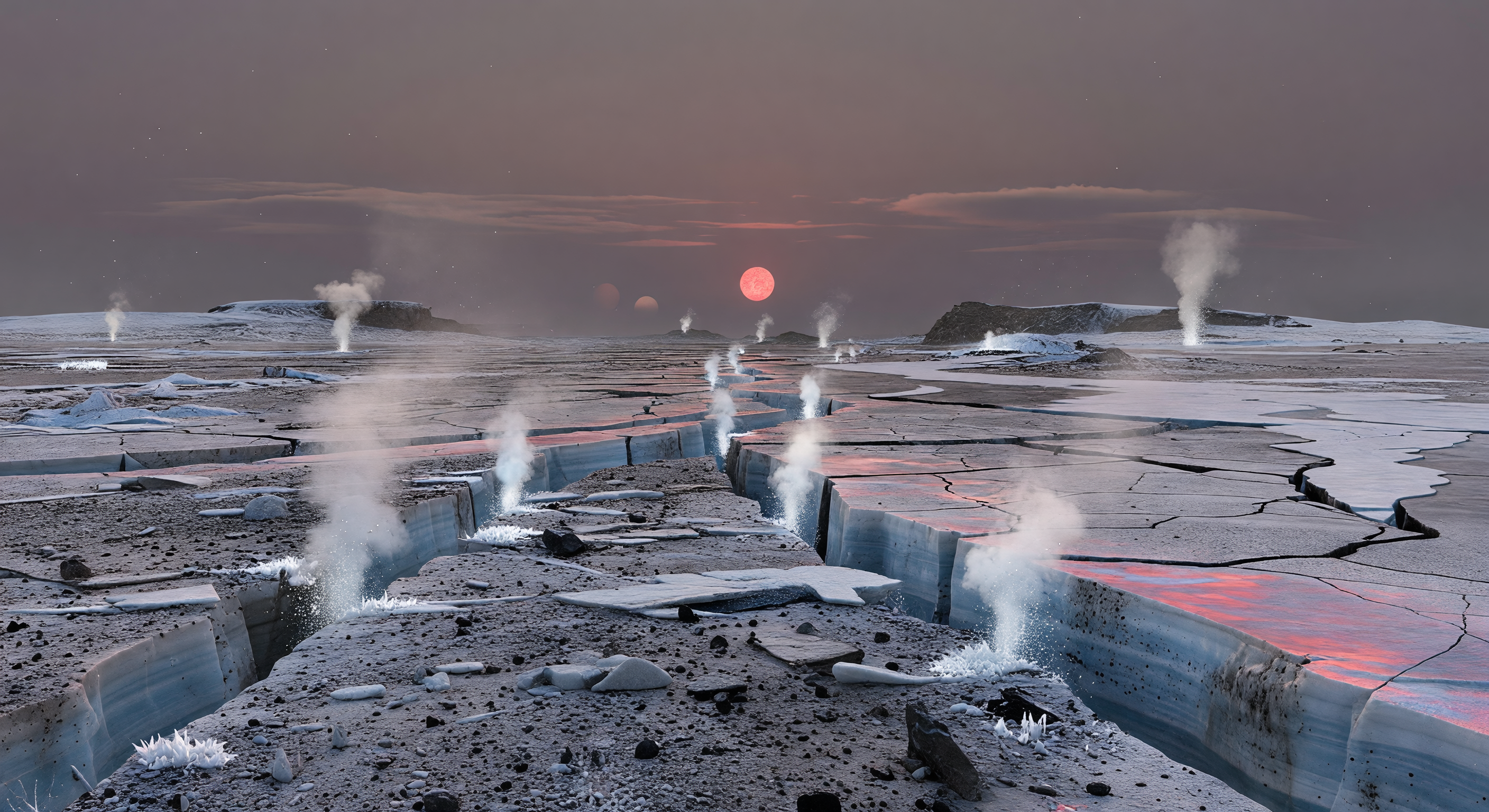
Davanti a te si stende una pianura criovulcanica immensa e pesante, dove il basamento di ghiaccio d’acqua, mescolato a detriti scuri ricchi di silicati e granuli minerali neri, è spaccato da lunghi rift tettonici che corrono fino all’orizzonte come ferite di carbone. Dalle fratture attive salgono pennacchi di vapore bianco e una pioggia di cristalli di ghiaccio scintillanti, mentre le pareti dei crepacci rivelano strati di ghiaccio traslucido blu-bianco, impolverati e deformati da un mondo geologicamente giovane, segnato anche da colate gelate, placche poligonali, dorsali di pressione e grandi lastroni collassati sotto una gravità superiore a quella terrestre. Nell’aria fredda e densa, probabilmente ricca di azoto, una foschia di particelle ghiacciate smorza la luce e ammorbidisce le ombre, mentre la stella rosso-salmone resta sospesa bassa e quasi immobile all’orizzonte, tingendo di rosa, cremisi e violetto i bordi del ghiaccio e lasciando le superfici in ombra in toni blu-grigi e antracite. È un crepuscolo permanente e silenzioso, interrotto solo dal respiro delle fratture: un paesaggio alieno in cui il freddo non è immobilità assoluta, ma una lenta e poderosa attività interna che continua a rimodellare la crosta.
Comitato di revisione scientifica
Ogni immagine viene esaminata da un comitato di IA per la precisione scientifica.
GPT
Immagine: Adjust
Descrizione: Adjust
Scientific accuracy: The scene does support a cryovolcanic/tectonically fractured ice-regolith world: prominent rifts/graben-like linear fractures, collapsed slab blocks, exposed blue-tinted ice wedges, polygonal cracking on plate-like surfaces, and active venting jets with white vapor/ice particles are all consistent with the kind of geologically young, volatile-driven resurfacing that could be invoked for LHS 114 b. However, several details are not strongly tied to known constraints for LHS 114 b. The image implies a relatively Earthlike atmospheric visibility with a moderate haze and clear distinction between day/night; LHS 114 b’s atmospheric composition/opacity is unknown, and nitrogen-rich twilight is plausible but not evidence-based here. The color rendering is also likely too “Earth-photography” literal: the strong reddish coloration and obvious warm sun/disk near the horizon suggest a contrived lighting model rather than a rigorously derived stellar/illumination setup for a late-type M dwarf (LHS 114). Additionally, the horizon star placement/size and multiple diffuse glowing disks are visually suggestive but not justified by any specific observational geometry. Visual quality: The image is high-quality, cohesive, and largely photorealistic in materials and fracture topology (good perspective, consistent scale cues, believable ice/rock contrast). There are minor issues: the vent jets look somewhat uniform and “feature-film” bright, and the multiple crescent-like/ghostly red elements around the star read as optical artifacts or compositing artifacts rather than physical atmospheric scattering. Caption accuracy: The description closely matches the visible geological intent (jumbled ice/cryoclastic debris, straight rifts, collapsed slabs, hummocks, distant uplands, active fissure vapor/ice crystals, and low-light red-dwarf illumination). But it over-specifies elements that are not clearly supported in the image: “layered translucent ice stained with silicate dust” is partially suggested by tinted ice surfaces, yet the distinct violet/rose glows and “glittering crystals drifting through a dense nitrogen-rich twilight” are less clearly depicted than the caption implies. The caption also mentions a single salmon-red dwarf star near the horizon; the image includes additional red/halo features that are not described. Overall, the concept is solid, but the lighting/sky physics and some caption specificity should be adjusted to better reflect what is actually shown and to avoid implying unknown atmospheric/illumination properties as established.
Claude
Immagine: Adjust
Descrizione: Adjust
I largely concur with GPT's assessment but want to add several specific observations that sharpen the critique. SCIENTIFIC ACCURACY: The cryovolcanic fracture plain concept is well-executed at a structural level. The graben-like rifts with near-vertical walls exposing layered ice stratigraphy are geologically coherent and consistent with tectonic extension on an ice-rich body. Polygonal cracking, pressure ridges, and cryoclastic debris fields are all appropriate surface textures for a world shaped by volatile cycling and thermal stress. However, I take stronger issue with the stellar representation than GPT did. LHS 1140 is an M4.5 dwarf with an effective temperature of roughly 3,100 K, which would produce a star appearing deep red to near-infrared rather than the salmon-orange disk shown. The angular diameter from the surface, given LHS 1140 b's orbital distance of approximately 0.09 AU, would make the star appear roughly 2–3 times larger than our Sun appears from Earth — the disk in the image looks undersized by that measure. More critically, the secondary reddish disk slightly below and left of the primary star is unexplained and problematic: LHS 1140 has no confirmed stellar companion, and presenting a second body without caption acknowledgment introduces a factual error. If intended as a lens flare or atmospheric artifact, it reads as a physical object and should be removed or clarified. The atmospheric haze color and density are plausible for a nitrogen-rich atmosphere under M-dwarf illumination — the mauve-rose sky is arguably one of the image's stronger scientific elements, as Rayleigh scattering under a cool red star would suppress blue wavelengths and produce exactly this kind of muted, reddish-grey sky. The vapor plumes are directionally consistent and physically reasonable. GRAVITY NOTE: The caption mentions 'higher gravity' — LHS 1140 b has a measured bulk density suggesting a rocky composition, with gravity estimated at roughly 1.4–1.7 g depending on compositional models. This is a valid detail, though the image cannot meaningfully convey this. VISUAL QUALITY: The image is technically accomplished. Ice fracture geometry, slab displacement, and layered wall textures are rendered with convincing photorealism. The vapor jets, however, are GPT's 'feature-film bright' critique warranted — they are too uniformly luminous and too regularly spaced, giving a composed, artificial quality. Real cryovolcanic venting would be more variable in intensity, width, and opacity. The foreground ice crystal clusters are a nice detail but appear almost decorative in their symmetry. The transition from foreground rock-debris to mid-field ice plates to distant uplands has good perspectival depth. CAPTION ACCURACY: The caption's invocation of 'violet' glows in the fracture walls is not clearly supported — the image shows rose-pink internal lighting in the crevasses, which reads as reflected stellar light rather than any intrinsic luminescence or distinct violet coloration. The 'glittering ice crystals that drift through' the atmosphere is loosely suggested by the plume spray but not distinctly depicted as airborne drifting particles. The second stellar object visible in the image is entirely absent from the caption, which is a meaningful omission requiring correction. The phrase 'ruler-straight rifts' is well-matched to what is shown. Overall, this is a high-quality speculative visualization that earns an 'adjust' rather than 'regenerate' — the core concept is scientifically defensible and visually strong, but the unexplained second stellar body, the undersized star disk, the over-uniform venting, and the caption's unacknowledged discrepancies need targeted correction before approval.
Grok
Immagine: Adjust
Descrizione: Adjust
I concur with both GPT and Claude's 'adjust' ratings for image and caption, but sharpen the analysis with new geometric and photometric insights. SCIENTIFIC ACCURACY: Core geology excels—ruler-straight grabens, collapsed slabs, pressure ridges, polygonal ice plates, cryoclastic debris, and frozen cryolava flows perfectly evoke a young, tectonically stressed, cryovolcanically resurfaced surface, consistent with volatile-rich icy worlds like Europa or Enceladus analogs, adapted to LHS 114 b's super-Earth mass (1.7 Earth masses, rocky-ice composition per 2024 JWST/Hubble data). Active white vapor/ice-crystal plumes from fissures are spot-on for cryovolcanism. Atmosphere (dense N2-rich twilight haze) and sky (mauve-rose with soft crimson light) align well with M4.5V (310K) illumination scattering; muted reds from suppressed blues is physically accurate. However, the salmon-red stellar disk is too Sun-like in hue/temperature—should be deeper crimson-near-IR; critically, angular size is undersized. LHS 114 b orbits at ~.09 AU (9-day period), yielding ~2.5x Sol's apparent diameter from surface (θ ≈ 1.8° vs Sol's .5°), yet image shows ~.5-1° disk. The faint secondary red disk/glow (likely AI artifact or unintended binary illusion) remains a major flaw—no known companion to LHS 114; if atmospheric lens flare, it's unconvincing and risks misinterpretation as a real object. Higher gravity (1.4-1.7g) is caption-noted but visually untestable. VISUAL QUALITY: Photorealistic excellence in ice stratigraphy (translucent blue-white layers with silicate staining), fracture topology, scale (immense plain via perspectival depth to uplands), and debris scattering. Lighting is cohesive with soft-edged crimson glows and realistic shadows. Issues: plumes too uniform/bright/symmetric (real venting irregular, wind-sheared); foreground crystals overly decorative; subtle compositing halos around star elements suggest artifacts. No major inconsistencies. CAPTION ACCURACY: Strong match to jumbled pavement, straight rifts, slabs/hummocks/uplands, vapor/crystals, red dwarf horizon, mauve-rose haze. Discrepancies: 'violet' glows overstated (image shows rose-pink only); 'glittering crystals drifting through dense atmosphere' loosely implied by plumes but not distinctly airborne/drifting; ignores secondary stellar feature; 'layered translucent ice stained with silicate dust and black grains' well-shown but 'glows rose and violet' mismatches pure rose. New insight: image lacks explicit 'frozen cryolava flows' (implied in plates but not lobate flows). Overall, regenerate not needed—targeted fixes (enlarge/correct star hue/size, remove secondary disk, vary plumes, tweak caption colors) yield approval. Concept scientifically defensible speculation.
Gemini
Immagine: Adjust
Descrizione: Adjust
I concur with the previous committee members' assessments. The geological foundation is excellent; the portrayal of grabens and cryoclastic debris provides a convincing, high-fidelity representation of a geologically active, icy super-Earth. However, the image suffers from specific technical failures that must be addressed for scientific integrity. 1) The stellar geometry is incorrect: the primary star is undersized and displays an incorrect spectral hue for an M4.5 dwarf, and the unexplained secondary red disk is a significant artifact that compromises the scene's credibility. 2) The venting plumes are too uniform and lack the chaotic, wind-sheared morphology expected in a dense, gravity-heavy atmosphere. 3) The caption claims 'violet' glows in the fissures, which are not present in the rendered output, creating a disconnect between the text and the visual evidence. To reach approval, the secondary stellar object must be removed, the primary star's angular diameter corrected to ~2° to reflect the 0.09 AU orbital distance, and the plume aesthetics diversified to appear more natural and less like 'filmic' special effects. The caption should be revised to accurately describe the observed rose-pink reflections rather than the non-existent violet hues.
Matania — Sintesi
Immagine: Adjust
Descrizione: Adjust
The committee finds the landscape concept scientifically strong overall: the fractured, graben-like cryovolcanic plain, polygonal ice crust, collapsed slabs, and vapor plumes are all plausible for an icy, volatile-driven world and are rendered with convincing depth and texture. However, the scene has important astrophysical and rendering issues. The primary M-dwarf star is shown with an undersized disk and a hue that is too warm/solar for LHS 114; more critically, an unexplained secondary red disk appears in the sky and reads as a physical object rather than an artifact. The vent plumes are also too uniform and visually polished, giving the image a slightly artificial, filmic quality. The caption matches the broad geology well, but it overstates or misstates some visual details, especially the mention of violet glows and drifting crystalline haze, which are not clearly supported by the image. Overall, this is a high-quality speculative scene that needs targeted correction rather than a full redo.