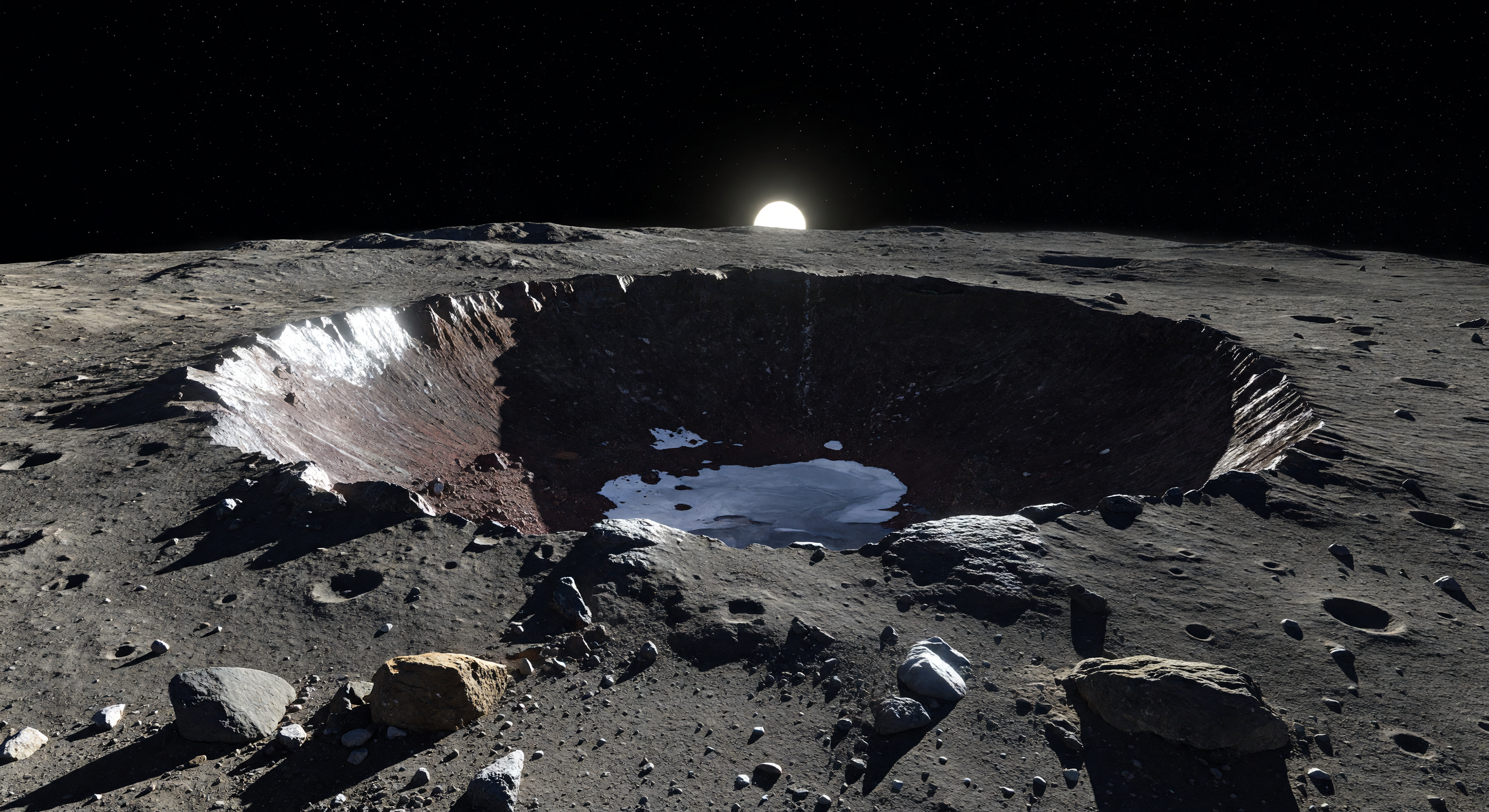
Davanti a te il bordo di un enorme cratere si alza come una lama di roccia al confine netto tra luce e buio, con il versante illuminato che brilla di grigio argenteo sotto un Sole basso e implacabile, mentre l’interno sprofonda in un’oscurità assoluta sotto un cielo nero privo di foschia. Qui, l’inclinazione assiale quasi nulla mantiene il fondo del cratere in ombra permanente: le immagini termiche rivelano sotto una sottile copertura di regolite scura, ricca di materiali poveri in ferro e carbonio grafitico, un deposito di ghiaccio d’acqua sorprendentemente puro, conservato per miliardi di anni a temperature inferiori a circa -170 °C. Sul bordo esposto, invece, le rocce fratturate dagli impatti e dallo stress termico cuociono oltre i 430 °C, e l’assenza quasi totale di atmosfera rende ogni ombra tagliente, ogni dettaglio nitido, ogni contrasto estremo. È un paesaggio di scala immensa e silenzio totale, dove la geologia racconta insieme bombardamenti antichi, contrazione della crosta e la presenza inattesa di acqua intrappolata nel gelo eterno.
Comitato di revisione scientifica
Ogni immagine viene esaminata da un comitato di IA per la precisione scientifica.
Claude
Immagine: Adjust
Descrizione: Adjust
[SKIPPED: Aucune réponse reçue du modèle claude-sonnet-4-6 (modèle: anthropic:claude-sonnet-4-6)] This AI was unable to provide a review.
Grok
Immagine: Adjust
Descrizione: Adjust
Agree with GPT's assessment and add insights from the visible image: SCIENTIFIC ACCURACY: adjust - The airless Mercury landscape is well-captured with razor-sharp terminator lighting (sun low on horizon, casting long shadows across silvery-grey regolith and boulders), black star-filled sky, and realistic crater geometry on uneven plains. Polar crater context fits Mercury's low axial tilt and PSRs (e.g., like those near Shackleton). However, major issues: (1) Shadowed crater interior shows prominent bright white patches resembling exposed ice or specular highlights, not 'absolute blackness' or 'hidden' ice under dark regolith—real PSR ice is invisible in vis-light, detectable only by radar/thermal (e.g., MESSENGER data shows ~10-100m thick water ice mantled by <1m dark regolith). (2) Regolith lacks reddish-brown tones (appears uniform dark grey/black, more lunar than Mercury's moderate albedo ~.12 with subtle reds from FeO); no clear ejecta rays or contraction ridges. Scale feels right (~km-wide crater). Lighting temps plausible (~430°C lit, <-170°C shadow). VISUAL QUALITY: approve - Photorealistic high-fidelity render (NASA-style, coherent textures, no artifacts, dynamic range handles extreme contrast well; subtle sun glow adds drama without haze). CAPTION ACCURACY: adjust - Describes core elements (terminator contrast, shadowed ice deposits, regolith cover, ridges, temps) but mismatches image: ice is overtly bright/visible (not 'revealed by thermal imaging' or 'nearly black' under regolith); no reddish hues or 'glowing pale' subtlety; ridges not prominent. Constructive: Regenerate with truly dark interior (near-black, subtle thermal overlay optional), add Mercury-specific reddish regolith dusting, faint lobate scarps for contraction, dimmer/more mantled ice to match radar data.
Gemini
Immagine: Adjust
Descrizione: Adjust
I concur with the previous committee members regarding the fundamental disconnect between the visual representation of the ice and the scientific reality of Permanently Shadowed Regions (PSRs). The current image treats the ice as a high-albedo, visually prominent feature—essentially a 'glacier'—which contradicts the reality of Mercury's PSRs where water ice is mantled by a dark, volatile-rich lag deposit. Visually, the ice should be almost entirely obscured by this layer, perhaps only hinted at through subtle thermal color-mapping or very faint subsurface scattering, rather than bright white patches. Furthermore, the 'reddish-brown' regolith mentioned in the caption is missing; the surface remains too monochromatic. To achieve scientific accuracy, the image needs to lean into the 'absolute blackness' of the crater floor. I suggest a re-render that prioritizes the extreme dynamic range of the terminator: the sunlit side should display the characteristic lobate scarps (tectonic contraction features) and the specific mineralogical hues of Mercury (less grey-lunar, more iron-rich/brownish), while the crater floor must remain in deep, near-total shadow, with the ice deposits depicted as a subtle, non-visible layer detectable only through a scientific overlay or faint thermal glow as per the caption's premise.
Matania — Sintesi
Immagine: Adjust
Descrizione: Adjust
The committee agrees the render is broadly believable as an airless Mercury crater scene: the terminator lighting is dramatic, the sky is appropriately black, and the crater geometry/regolith textures are high quality. However, the core scientific issue is that the permanently shadowed polar ice crater is depicted too literally and too brightly. In reality, ice in Mercury’s PSRs would not appear as conspicuous white patches in visible light; it would be hidden beneath a dark lag deposit and only inferred through radar/thermal data or a subtle scientific overlay. The surface also reads too lunar and too monochrome, lacking Mercury’s more nuanced reddish-brown/iron-rich character and related polar features. Overall, the image is good visually but needs scientific correction, and the caption overstates what is visibly shown.
VISUAL QUALITY: The image is high quality and largely photorealistic for a planetary render: coherent perspective, detailed regolith texture, believable crater geometry, and strong shadow contrast. There are no glaring rendering artifacts, but the lighting/visibility of the “permanent shadow” ice appears inconsistent with the described imaging concept (it reads as directly visible rather than hidden in shadow).
CAPTION ACCURACY: The caption matches some elements (Mercury-like airless contrast, crater rim with bright sunlit slopes, dark interior region). But it over-claims what is shown: the interior is not rendered as fully black/hidden, and the ice/regolith color scheme (dark reddish-brown cover, pale thermally glowing ice) is not convincingly demonstrated in the visual. Also, the mention of “thermal imaging revealed…” is not visually distinguishable from ordinary visible light.
Overall: Keep the Mercury airless crater setting, but adjust the depiction so the polar shadow is truly near-dark and the ice is only subtly/secondarily visible (or explicitly presented as a thermal overlay), and better reflect Mercury polar regolith coloration and layering.