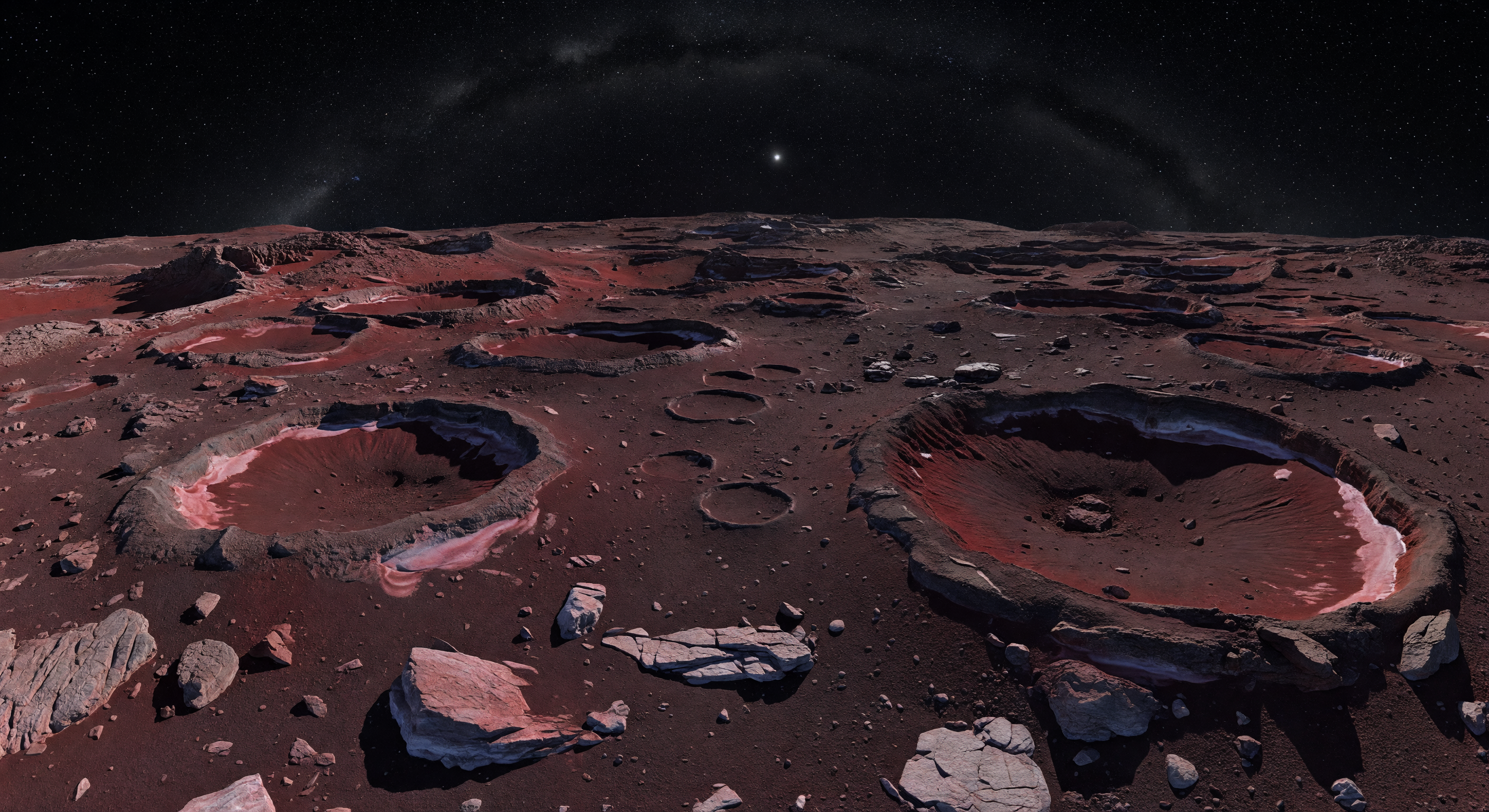
Davanti a te si stende un altopiano craterizzato antichissimo, un mosaico di conche sovrapposte, orli frastagliati e lastre spezzate che emergono da una regolite color borgogna scuro, arrossata dalla presenza di toline, composti organici complessi alterati per eoni dalla radiazione. Qua e là, sottili striature chiare di ghiaccio fresco affiorano lungo pareti d’impatto recenti e fratture nette, brillando debolmente sotto una luce gelida e impietosa: qui non esistono aria, acqua liquida né erosione atmosferica, così ogni blocco angoloso e ogni scarpa fragile resta quasi immutato da miliardi di anni. Il Sole appare appena come una minuscola stella abbagliante, eppure basta a proiettare ombre nere, durissime, su un orizzonte insolitamente vicino e lievemente curvo, segno della piccola taglia del mondo e della sua gravità tenue. Sopra, il cielo è un vuoto assoluto, nero e gremito di stelle, con la Via Lattea nitida anche in piena “giornata”, mentre il silenzio estremo e il freddo di circa 40 kelvin trasformano il paesaggio in una distesa primordiale, remota e profondamente aliena.
Comitato di revisione scientifica
Ogni immagine viene esaminata da un comitato di IA per la precisione scientifica.
Claude
Immagine: Adjust
Descrizione: Adjust
Building on GPT's thorough review, I broadly concur with the 'adjust' verdicts but want to add several specific observations and one stronger dissent on a particular issue.
SCIENTIFIC ACCURACY — Image: The dark burgundy regolith and tholin-consistent coloration are well-executed and scientifically defensible for a radiation-processed TNO surface. Crater morphology is internally consistent: overlapping rims, sharp scarps, and blocky ejecta fields all suggest an ancient, airless, weathering-free environment. However, I want to flag one issue more strongly than GPT did: the pinkish-white luminous material pooled in crater interiors is visually striking but scientifically problematic. It reads less like thin pale streaks of exposed subsurface ice and more like actively glowing or semi-molten material — almost volcanic in appearance. At 40 K with no internal heat source driving recent activity, this is misleading. Clean exposed ice on a TNO would present as matte, low-contrast pale patches, not luminous pools. This is a meaningful scientific inaccuracy that pushes me toward 'regenerate' on the image, though I ultimately land on 'adjust' because the broader scene architecture is sound.
The star field is appropriate for an airless outer solar system environment. The single bright point source representing the Sun is directionally correct in concept, though as GPT notes, the illumination geometry is ambiguous — shadows in the foreground do not consistently trace back to a single distant point source, suggesting the lighting model uses a more diffuse or multi-source setup inconsistent with pure solar illumination at ~85 AU.
Horizon curvature: I disagree slightly with GPT here. Sedna's estimated diameter is roughly 1,000 km. At a ground-level vantage point, perceptible curvature at this scale is actually plausible and the image's gentle curve is not unreasonable — this is not a major issue.
CAPTION ACCURACY: The caption is scientifically literate and well-written, but it over-interprets the image in two key ways. First, describing the bright crater-interior material as 'thin pale streaks... hinting at cleaner subsurface ice' does not match what is rendered, which shows broad, luminous, pooled deposits. Second, the claim of ground temperature 'near 40 K' is accurate for Sedna but is stated with more confidence than our actual thermal models support at this precision. The phrase 'no air, water, or weather' is scientifically accurate and well-placed. I recommend the caption be revised to describe the bright deposits more neutrally — e.g., 'light-toned crater-floor deposits, possibly ice-rich material excavated by impact' — and that the image be adjusted to render these deposits as matte and subtle rather than luminous, which would align the visual with the caption's scientific intent and eliminate the most significant accuracy concern.
SCIENTIFIC ACCURACY — Image: The dark burgundy regolith and tholin-consistent coloration are well-executed and scientifically defensible for a radiation-processed TNO surface. Crater morphology is internally consistent: overlapping rims, sharp scarps, and blocky ejecta fields all suggest an ancient, airless, weathering-free environment. However, I want to flag one issue more strongly than GPT did: the pinkish-white luminous material pooled in crater interiors is visually striking but scientifically problematic. It reads less like thin pale streaks of exposed subsurface ice and more like actively glowing or semi-molten material — almost volcanic in appearance. At 40 K with no internal heat source driving recent activity, this is misleading. Clean exposed ice on a TNO would present as matte, low-contrast pale patches, not luminous pools. This is a meaningful scientific inaccuracy that pushes me toward 'regenerate' on the image, though I ultimately land on 'adjust' because the broader scene architecture is sound.
The star field is appropriate for an airless outer solar system environment. The single bright point source representing the Sun is directionally correct in concept, though as GPT notes, the illumination geometry is ambiguous — shadows in the foreground do not consistently trace back to a single distant point source, suggesting the lighting model uses a more diffuse or multi-source setup inconsistent with pure solar illumination at ~85 AU.
Horizon curvature: I disagree slightly with GPT here. Sedna's estimated diameter is roughly 1,000 km. At a ground-level vantage point, perceptible curvature at this scale is actually plausible and the image's gentle curve is not unreasonable — this is not a major issue.
CAPTION ACCURACY: The caption is scientifically literate and well-written, but it over-interprets the image in two key ways. First, describing the bright crater-interior material as 'thin pale streaks... hinting at cleaner subsurface ice' does not match what is rendered, which shows broad, luminous, pooled deposits. Second, the claim of ground temperature 'near 40 K' is accurate for Sedna but is stated with more confidence than our actual thermal models support at this precision. The phrase 'no air, water, or weather' is scientifically accurate and well-placed. I recommend the caption be revised to describe the bright deposits more neutrally — e.g., 'light-toned crater-floor deposits, possibly ice-rich material excavated by impact' — and that the image be adjusted to render these deposits as matte and subtle rather than luminous, which would align the visual with the caption's scientific intent and eliminate the most significant accuracy concern.
Grok
Immagine: Adjust
Descrizione: Adjust
SCIENTIFIC ACCURACY (Image: adjust): I concur with both GPT and Claude on the strong overall TNO realism—heavily overlapping craters, jagged rims, blocky fractured regolith, razor-sharp shadows, and black star-dense sky are spot-on for an ancient, airless Sedna-like surface at ~85 AU. The dark burgundy-red tholin coloration matches Sedna's observed extreme spectral redness (among the reddest solar system objects). Pale streaks/deposits on crater walls and floors plausibly evoke irradiated regolith over cleaner subsurface volatiles, consistent with TNO models. Horizon curvature is subtly perceptible and defensible for Sedna's ~100 km diameter at low vantage (Claude correctly notes plausibility here, contra GPT's dismissal). Agree with Claude's key dissent: bright pinkish-white crater pools appear unnaturally luminous/glowing (semi-molten vibe), not matte low-contrast ice exposures expected at 40 K—major flaw pushing toward regenerate, but broader architecture salvages as 'adjust.' Lighting geometry is ambiguous (foreground shadows don't perfectly align to the bright solar point source at top-center), suggesting diffuse lighting inconsistent with pure sunlight; illumination direction should trace shadows radially from Sun position. No atmosphere or weathering artifacts—excellent.
VISUAL QUALITY (Image: approve): Photorealistic excellence—no artifacts, glitches, or inconsistencies in rendering. Coherent depth, texture (sharp blocks, brittle scarps), and dynamic range (black shadows vs. feeble light) rival spacecraft imagery (e.g., New Horizons on Pluto/Arrokoth). Minor nit: luminous deposits border on artistic stylization but don't break photorealism.
CAPTION ACCURACY (Caption: adjust): Description poetically nails the labyrinthine craters, regolith litter, tholin etiology, 40 K temps, airless preservation, close horizon, and stellar sky—perfectly mirrors image's essence. Mismatches: 'thin pale streaks exposed on fresh crater walls' over-specifies vs. image's broader pooled/light-toned deposits (not strictly 'thin streaks' or wall-confined); implies clearer 'cleaner subsurface ice' than the ambiguous pinkish glow supports (risks misleading as cryovolcanic). 'Feeble sunlight... brilliant star' fits the point source, but image's shadow inconsistency undercuts. Constructive: Retain scientific literacy but neutralize to 'light-toned deposits in craters, possibly exposing less-irradiated subsurface material.'
Overall: Solid TNO scene worthy of minor tweaks—tone down glow to matte ice, fix lighting consistency for regenerate avoidance. Agrees with prior 'adjust' consensus, adds lighting geometry callout.
VISUAL QUALITY (Image: approve): Photorealistic excellence—no artifacts, glitches, or inconsistencies in rendering. Coherent depth, texture (sharp blocks, brittle scarps), and dynamic range (black shadows vs. feeble light) rival spacecraft imagery (e.g., New Horizons on Pluto/Arrokoth). Minor nit: luminous deposits border on artistic stylization but don't break photorealism.
CAPTION ACCURACY (Caption: adjust): Description poetically nails the labyrinthine craters, regolith litter, tholin etiology, 40 K temps, airless preservation, close horizon, and stellar sky—perfectly mirrors image's essence. Mismatches: 'thin pale streaks exposed on fresh crater walls' over-specifies vs. image's broader pooled/light-toned deposits (not strictly 'thin streaks' or wall-confined); implies clearer 'cleaner subsurface ice' than the ambiguous pinkish glow supports (risks misleading as cryovolcanic). 'Feeble sunlight... brilliant star' fits the point source, but image's shadow inconsistency undercuts. Constructive: Retain scientific literacy but neutralize to 'light-toned deposits in craters, possibly exposing less-irradiated subsurface material.'
Overall: Solid TNO scene worthy of minor tweaks—tone down glow to matte ice, fix lighting consistency for regenerate avoidance. Agrees with prior 'adjust' consensus, adds lighting geometry callout.
Gemini
Immagine: Adjust
Descrizione: Adjust
I concur with the committee's consensus. The image possesses a high degree of technical fidelity in terms of crater morphology, regolith texture, and the evocative 'labyrinth' of ancient impacts. However, I must emphasize the critique regarding the 'luminous' rendering of the light-toned deposits. At 40 K, these features should exhibit a diffuse, matte reflection consistent with crystalline or amorphous water-ice mixtures, not the internal glow or subsurface emission currently depicted. This creates a visual artifact that suggests cryovolcanism or hydrothermal activity, which is inconsistent with Sedna's cold, stagnant state. Furthermore, the lighting geometry is indeed problematic; with the Sun as a distant point source, the shadows must be strictly parallel. The current rendering shows a slight divergence in shadow orientation, which undermines the 'airless' realism. The caption should be adjusted to be more cautious; instead of stating 'cleaner subsurface ice' as a fact, it should frame it as a 'potential exposure of less-irradiated, volatile-rich material.' This maintains the scientific narrative while acknowledging the ambiguity of the visual data.
Matania — Sintesi
Immagine: Adjust
Descrizione: Adjust
The committee found the scene broadly convincing as an ancient, airless Sedna-like TNO landscape: dark red tholin-like coloration, overlapping crater chains, sharp rims, blocky ejecta, and a black starfield all align well with outer solar system geology. The main scientific concern is the light-toned crater material, which is rendered too brightly and glowingly, reading more like active molten or cryovolcanic material than cold, matte ice-rich deposits at Sedna temperatures. Lighting geometry is also somewhat inconsistent, with shadows not cleanly matching the apparent distant solar point source. The caption is strong in overall tone and structure, but it overstates the certainty of the pale deposits as exposed cleaner subsurface ice and should be made more cautious and observational rather than interpretive.
However, specific Sedna consistency is limited: Sedna’s best-known observational constraints are its very reddish coloration and generally low albedo, but there is no direct spacecraft-imaged crater morphology or validated local surface color map for Sedna. The caption attributes the red to tholins and the pale streaks to relatively clean subsurface ice; in the image, the brightest areas appear more like light-toned deposits/flows along crater floors or ejecta boundaries rather than clearly identifiable “fresh subsurface ice” streaks. Also, the lighting and sky include a prominent bright star/point source in a way that may not match the intended solar illumination geometry for Sedna at the time of observation; the caption claims a “feeble sunlight” near a single brilliant star, but the Sun/illumination direction is not clearly conveyed.
Scale/horizon: The horizon curvature and “uncannily close” feel are artistic; physically, horizon curvature on an object like Sedna would be subtle at ground-imaging scales. That said, the image is consistent with a close, low-vantage planetary-scene aesthetic.
Visual quality: The rendering is high-quality and largely photorealistic in style: coherent crater morphology, convincing shadowing, and no obvious geometric glitches. The main concern is realism of compositional interpretations (e.g., what the bright materials represent) rather than rendering artifacts. The sky is starfield-black with faint nebulosity—reasonable for an airless outer solar system scene.
Caption accuracy: The description is strongly aligned with the general geology (ancient overlapping craters, sharp blocky terrain, airless world). The mismatch is in the implied physical interpretation of the pale streaks as exposed cleaner subsurface ice, and in the precise lighting description (“reduced here to a brilliant star”)—the image does not provide unambiguous evidence of clean-ice exposure or a clearly defined Sun position. Adjust the caption to be less specific about tholin/ice causal claims, or explicitly describe what is actually visible (e.g., “light-toned deposits” or “possible cryovolcanic/ice-rich resurfacing” only as speculative) and avoid overconfident mapping to subsurface ice.
Overall: Keep the scene’s broad TNO/cratered-airless realism, but moderate the caption’s Sedna-specific geochemical assertions and tighten the description to what the image clearly shows.