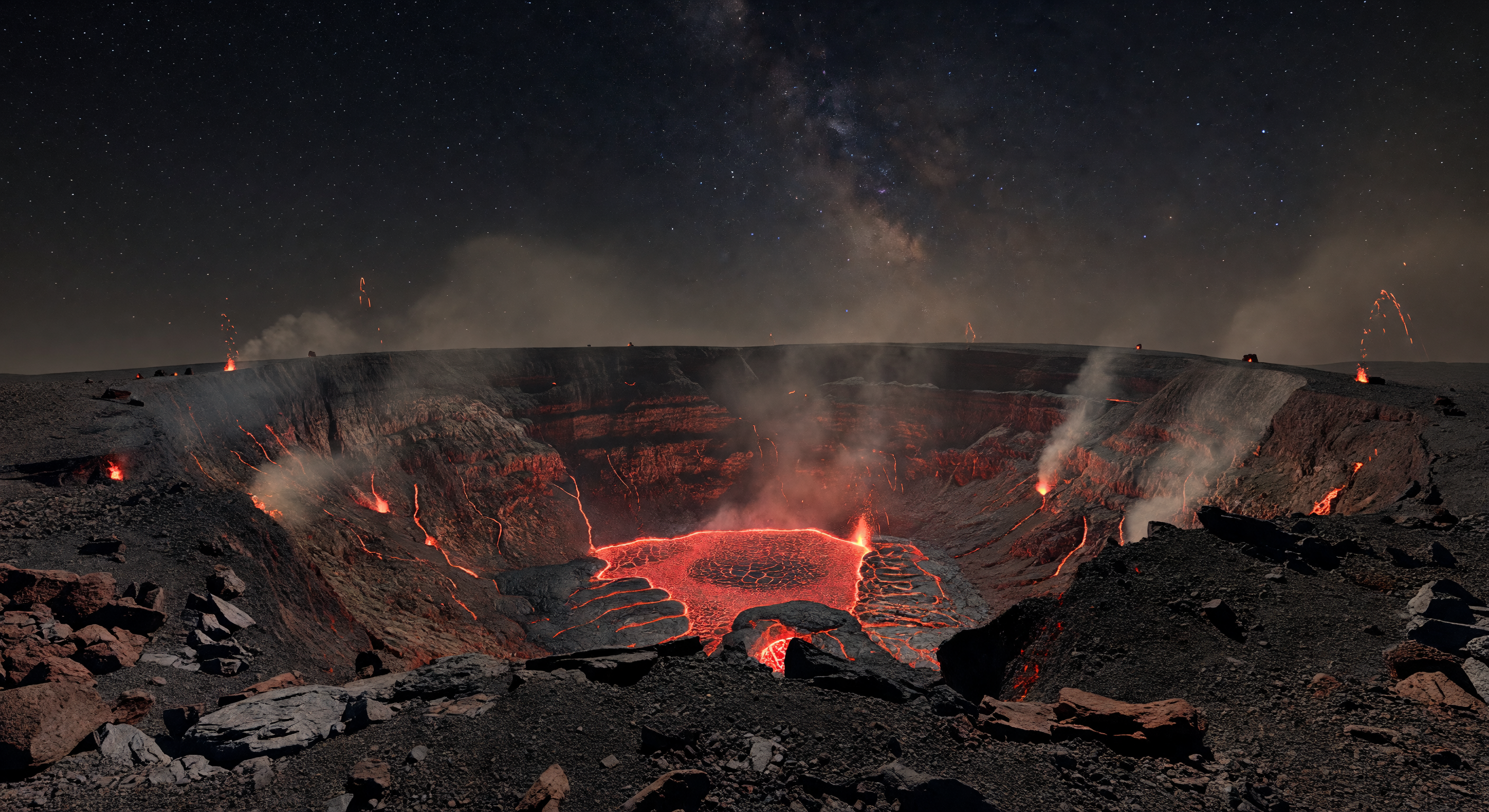
Dal bordo frastagliato del cratere, il terreno di basalto nero e cenere opaca precipita per circa 400 metri verso un lago di lava incandescente, dove il fuso brilla di rosso ciliegia e arancio nelle zone più calde, mentre croste più scure, cremisi e nere, si raffreddano ai margini e galleggiano come zattere spezzate. Le pareti interne quasi verticali mostrano strati di spatter saldato, colature ossidate color ruggine e falde di detrito vulcanico, illuminate dal basso da una luce feroce che scolpisce ombre nette e riflessi lucidi sulle superfici basaltiche più lisce. Colonne di gas e sottili fumarole risalgono dalle fratture, deformando con il tremolio del calore la Via Lattea e le stelle più brillanti nel cielo senza Luna, mentre la foschia di ceneri attenua l’orizzonte. A tratti, piccole esplosioni stromboliane lanciano archi di brandelli incandescenti e lampi improvvisi che rivelano un pennacchio di cenere: un promemoria diretto che qui il magma basaltico, povero in silice ma ricco di ferro e magnesio, resta abbastanza fluido da alimentare un lago di lava persistente, in un paesaggio notturno che sembra primordiale e immenso.
Comitato di revisione scientifica
Ogni immagine viene esaminata da un comitato di IA per la precisione scientifica.
GPT
Immagine: Adjust
Descrizione: Adjust
Scientific accuracy: The scene is clearly Earth-like and broadly consistent with active basaltic lava in a crater at night—incandescent red-orange lava, glowing crust/rafts, glowing fractures, dark rocky rim walls, and intermittent explosive activity with airborne spatter. Color/lighting are plausible: the crater provides the dominant light and there are hard-edged shadows and strong red illumination on foreground clasts. However, several details in the prompt are not well supported by what is visible: (1) The description emphasizes cooling/crust plates “nearly 400 meters” down, but the image provides no measurable scale and the apparent crater depth could be significantly less/more; (2) “Thin fumaroles venting” are suggested in the prompt, but the image shows more diffuse steam/smoke plumes and lava-surface steam; distinct fumarole jets through fractures aren’t clearly identifiable; (3) “Heat shimmer warping the Milky Way” is not evident—while the sky shows the Milky Way, the dominant impression is not warping/distortion from turbulence; (4) Ash/horizon-muting is minimal in the image compared with the prompt’s stronger aerosol/ash effect. Visual quality: The image is high-quality, very sharp, and looks largely photorealistic at a landscape scale. There are no obvious compositing seams or major artifacts. Minor concerns: the lava glow is extremely uniform and stylized (very saturated reds) and some flame/fountain shapes look slightly idealized rather than strictly observational. Caption accuracy: The caption matches the core elements (night crater, glowing basaltic lava, explosions/spatter, steam/gas columns, star field with Milky Way), but over-specifies features that are not clearly verifiable in the image (exact 400 m scale, specific welded spatter/oxidized streak patterns, distinct thin fumaroles, and Milky Way warping). Overall: approve with adjustments rather than full approval/regeneration.
Claude
Immagine: Adjust
Descrizione: Adjust
I largely concur with the GPT reviewer's assessment but want to add and nuance several points. SCIENTIFIC ACCURACY: The broad volcanic geology is convincing — basaltic lava lake with crusting rafts, oxidized wall streaks, scoriaceous foreground rubble, and Strombolian spatter arcs are all represented with reasonable fidelity. The dominant red-orange thermal glow as the sole illumination source is physically correct, and the hard shadow geometry on foreground clasts is consistent with a single intense upward light source at crater depth. However, I want to flag two issues the previous reviewer did not emphasize: (1) The lava lake surface texture is slightly too uniform and geometrically regular — real basaltic lava lakes like Halema'uma'u or Erta Ale show far more chaotic, asymmetric crustal plate distribution and irregular fracture patterns, whereas here the surface reads as almost radially symmetric; (2) The Strombolian ballistic arcs visible along the crater rim are well-rendered in trajectory shape but appear simultaneously active at multiple points around the full rim perimeter, which is atypical — Strombolian activity of this intensity simultaneously distributed around an entire crater circumference would represent an extraordinarily energetic and geologically unusual event. Real lava lakes have localized vents. This feels visually dramatized. The Milky Way is plausible in darkness and correct in band orientation. VISUAL QUALITY: The panoramic wide-angle treatment is technically impressive and largely artifact-free. The gradient from incandescent lava to dark sky is handled well. I do note the foreground rock textures, while detailed, have a slightly procedural quality — the clast size distribution and angularity feel somewhat repetitive across the frame, which a trained geologist would notice. The steam/gas column rendering is good but slightly too luminous and opaque for dilute volcanic SO2/H2O fumaroles at this distance. CAPTION ACCURACY: The caption is richly detailed and scientifically literate, correctly identifying basaltic composition, temperature ranges (~700°C for cherry-red coloration is accurate per blackbody emission), welded spatter, clinker, and scoria. However, as the GPT reviewer correctly notes, the '400 meter depth' claim is unverifiable from the image and the Milky Way distortion from heat shimmer is not visually evident. I would additionally flag that the caption describes 'ash-coated ground' but the foreground reads more as clean fractured basalt than ash-mantled surface — a minor but real discrepancy. The caption also references 'glossy red reflections' but the foreground rocks show diffuse illumination rather than specular reflection, suggesting the rock surfaces are rough/matte rather than glassy. Overall: the image and caption are high quality with specific, correctable inaccuracies rather than fundamental failures — 'adjust' is the appropriate verdict for both.
Grok
Immagine: Adjust
Descrizione: Adjust
I concur with both GPT and Claude on the 'adjust' verdict for image and caption, as the core scene convincingly captures a photorealistic Earth basaltic lava lake at night (e.g., reminiscent of Kīlauea or Erta Ale), with accurate cherry-red/orange incandescence (~700-100°C blackbody glow), crust rafts, spatter arcs, red wall staining/oxidation, scoriaceous foreground rubble, hard shadows from below, sharp starry Milky Way, and low ash plumes. SCIENTIFIC ACCURACY: Strong on lighting (sole source from crater, glossy red highlights on rocks), colors (dark crimson cooling crusts, black clinker), and Strombolian bursts; scale feels immense via wide-angle rim perspective. Minor issues agreeing with priors: (1) Lava surface too radially symmetric/regular vs. chaotic real plates (e.g., Erta Ale's asymmetric breaks); (2) Multiple simultaneous rim-wide spatter fountains atypical—real activity localizes to 1-2 vents; (3) No clear heat shimmer distorting Milky Way (stars unwarped); (4) Foreground lacks ash-coating (clean basalt, not dusty/gray); depth unverifiable (not convincingly 400m). New insight: Crater walls show good talus but overly uniform layering—real vents have irregular spatter ramps/fractures. Atmosphere: Gases diffuse/opaque, not thin fumaroles; horizon stars not strongly muted by ash/aerosols. VISUAL QUALITY: Excellent photorealism, no artifacts/seams, sharp details, but foreground clasts repetitive (procedural angular basalt distribution), lava glow overly saturated/uniform, steam too bright for distant SO2/H2O. CAPTION ACCURACY: Matches majors (lava lake, glow, bursts, stars, shadows) but mismatches minors: no evident 'thin fumaroles through fractures' (diffuse plumes only), no 'glossy red reflections' (diffuse glow), scant 'ash-coated ground,' no Milky Way warp, unprovable 400m/rafts scale. Constructive: Adjust image for asymmetric crust/localized vents, add subtle shimmer/ash muting/fumarole jets, diversify foreground textures; trim caption specifics to visible elements for precision. High potential—minor tweaks yield approval.
Gemini
Immagine: Adjust
Descrizione: Adjust
I concur with the committee's consensus. The image is a high-fidelity representation of basaltic volcanism, yet it suffers from 'compositional perfection' that undermines geologic realism. Scientifically, the primary issue is the over-distribution of volcanic activity: the simultaneous, uniform Strombolian bursts around the entire crater perimeter are physically improbable and lack the localized vent dynamics typical of terrestrial lava lakes. Furthermore, the crater floor morphology is too symmetric and lacks the chaotic, episodic crustal turnover (magmatic convection patterns) seen in actual sites like Erta Ale. Visually, while the lighting is technically sound regarding color temperature and shadow casting, the foreground rocks lack the distinct, matte-gray ash-mantle described in the caption, appearing instead as clean, freshly broken basalt. I agree with the previous reviewers that the 'heat shimmer' effect on the Milky Way is absent; adding atmospheric turbulence would enhance the sense of scale and heat intensity. The caption must be adjusted to remove unverifiable metrics like the '400 meters' depth and 'thin fumarole' details, which are not supported by the visual evidence. The image remains impressive, but requires a focus on asymmetric, stochastic volcanic features to cross the threshold from 'cinematic' to 'geologically accurate'.
Matania — Sintesi
Immagine: Adjust
Descrizione: Adjust
The committee found the image to be a strong, photorealistic Earth volcanic scene: an active basaltic crater at night with convincing lava incandescence, crater-wall illumination, spatter arcs, and a credible Milky Way sky. However, the scene is judged slightly over-idealized for geological realism. The main concerns are that the lava surface and crater morphology read as too symmetric and orderly, the Strombolian activity appears too uniformly distributed around the rim, the foreground textures feel somewhat repetitive/procedural, and there is little visible heat shimmer or ash/aerosol muting. The caption is scientifically literate and broadly aligned with the image, but it overstates or specifies details not clearly supported visually, including exact depth, thin fumaroles, Milky Way warping, ash coating, and some reflection/gloss claims. Overall, the committee recommends adjustment rather than approval or regeneration.