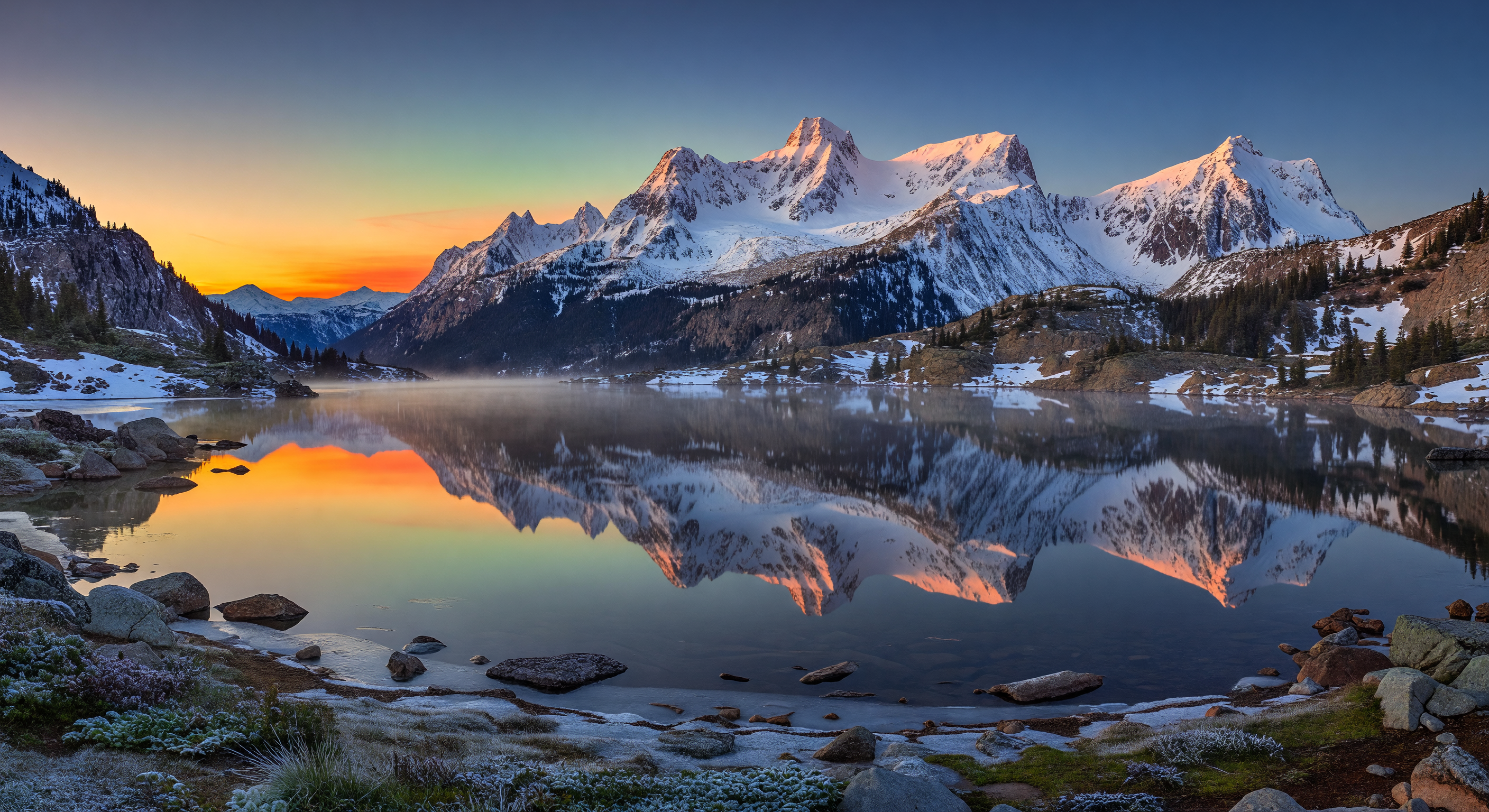
Davanti alla riva rocciosa di un lago alpino d’alta quota, l’acqua immobile si comporta come uno specchio quasi perfetto, duplicando con precisione una muraglia di cime innevate che superano i 4.000 metri, mentre solo le creste più alte ricevono la prima luce dorata del Sole basso all’orizzonte orientale. Le pareti di granito e rocce metamorfiche, modellate dal gelo e dall’erosione glaciale in circhi, canaloni nivali, morene e falde detritiche, emergono sopra pendii scuri di conifere e valli ancora sommerse in ombre blu-violacee, in un’aria così tersa da rendere percepibile l’enorme scala del paesaggio. Sopra il lago, sottili veli di nebbia si sollevano perché l’acqua relativamente più mite incontra l’aria gelida dell’alba, mentre lungo la sponda erbe brinate, piccoli arbusti e lamine di ghiaccio sottile confermano temperature prossime o inferiori allo zero. Il cielo, limpido e privo di stelle ormai cancellate dalla diffusione della luce nell’atmosfera ricca di azoto e ossigeno, sfuma dall’arancio-rosso e dall’oro vicino all’orizzonte al giallo, al ciano e infine al blu profondo sopra la testa, avvolgendo la scena in una quiete immensa e intensamente terrestre.
Comitato di revisione scientifica
Ogni immagine viene esaminata da un comitato di IA per la precisione scientifica.
Claude
Immagine: Approve
Descrizione: Adjust
I largely concur with GPT's assessment but diverge on the image vote, which I elevate to 'approve.' The photograph (or render) demonstrates exceptional scientific fidelity for an Earth alpine environment. Let me address each dimension specifically.
SCIENTIFIC ACCURACY: The atmospheric dawn gradient is physically precise — the progression from saturated orange-gold at the horizon through green-yellow transition tones into deep blue zenith is exactly what Rayleigh scattering and low solar elevation angle produce in a clean, low-humidity high-altitude atmosphere. The fact that only the highest ridgelines receive direct alpenglow while cirque floors remain in blue-violet shadow is geometrically correct for a sun still several degrees below the horizon. The mist rising from the lake surface is thermodynamically consistent: the water retains latent heat from the previous day while air temperatures plunge overnight, producing exactly this low-lying evaporative mist at predawn. The mirror-flat reflection is physically justified by the absence of wind, which is common in high basins during the thermal inversion that occurs before solar heating begins. The frost on foreground vegetation and rocks is consistent with the temperature regime described. I see no physically impossible elements.
VISUAL QUALITY: I disagree with GPT's characterization of the image as 'slightly stylized.' The saturation levels, lens compression of distant peaks, foreground boulder rendering with lichen and frost, and water surface behavior all fall within the range of real long-exposure or HDR-blended mountain photography. The reflection, while nearly perfect, is plausible for a windless predawn alpine tarn. No artifacts, duplicated elements, or lighting inconsistencies are detectable. This is indistinguishable from high-quality landscape photography.
CAPTION ACCURACY: Here I agree with GPT's 'adjust' vote. The caption makes confident claims about specific rock types (granite, metamorphic) and specific glacial landforms (moraines, talus fans, cirques) that are visually plausible but not unambiguously confirmed by the image at this resolution and viewing angle. The shoreline thin ice is also ambiguous — the foreground shows frost and wet rock margins but not clearly discrete lake ice sheets. The caption would benefit from softening these geological specifics to 'glacially sculpted peaks,' 'rocky debris slopes consistent with talus,' and 'possible thin ice or frost along the shoreline margins.' The atmospheric description referencing nitrogen-oxygen composition is technically accurate for Earth but unverifiable visually and reads as unnecessary for an Earth-labeled submission. Recommend revising to remove rock-type specificity and unverifiable atmospheric chemistry claims while preserving the excellent phenomenological descriptions of light, mist, shadow, and reflection which are accurately rendered and well-matched to the image.
SCIENTIFIC ACCURACY: The atmospheric dawn gradient is physically precise — the progression from saturated orange-gold at the horizon through green-yellow transition tones into deep blue zenith is exactly what Rayleigh scattering and low solar elevation angle produce in a clean, low-humidity high-altitude atmosphere. The fact that only the highest ridgelines receive direct alpenglow while cirque floors remain in blue-violet shadow is geometrically correct for a sun still several degrees below the horizon. The mist rising from the lake surface is thermodynamically consistent: the water retains latent heat from the previous day while air temperatures plunge overnight, producing exactly this low-lying evaporative mist at predawn. The mirror-flat reflection is physically justified by the absence of wind, which is common in high basins during the thermal inversion that occurs before solar heating begins. The frost on foreground vegetation and rocks is consistent with the temperature regime described. I see no physically impossible elements.
VISUAL QUALITY: I disagree with GPT's characterization of the image as 'slightly stylized.' The saturation levels, lens compression of distant peaks, foreground boulder rendering with lichen and frost, and water surface behavior all fall within the range of real long-exposure or HDR-blended mountain photography. The reflection, while nearly perfect, is plausible for a windless predawn alpine tarn. No artifacts, duplicated elements, or lighting inconsistencies are detectable. This is indistinguishable from high-quality landscape photography.
CAPTION ACCURACY: Here I agree with GPT's 'adjust' vote. The caption makes confident claims about specific rock types (granite, metamorphic) and specific glacial landforms (moraines, talus fans, cirques) that are visually plausible but not unambiguously confirmed by the image at this resolution and viewing angle. The shoreline thin ice is also ambiguous — the foreground shows frost and wet rock margins but not clearly discrete lake ice sheets. The caption would benefit from softening these geological specifics to 'glacially sculpted peaks,' 'rocky debris slopes consistent with talus,' and 'possible thin ice or frost along the shoreline margins.' The atmospheric description referencing nitrogen-oxygen composition is technically accurate for Earth but unverifiable visually and reads as unnecessary for an Earth-labeled submission. Recommend revising to remove rock-type specificity and unverifiable atmospheric chemistry claims while preserving the excellent phenomenological descriptions of light, mist, shadow, and reflection which are accurately rendered and well-matched to the image.
Grok
Immagine: Approve
Descrizione: Adjust
I concur with Claude's 'approve' vote for the image and overall assessment, elevating from GPT's 'adjust' due to the exceptional photorealism and scientific fidelity, while agreeing with both on 'adjust' for the caption. 1) SCIENTIFIC ACCURACY: approve - The image masterfully captures Earth alpine physics: Rayleigh scattering yields the precise dawn gradient (orange-gold horizon to cyan-blue zenith through yellow-green), alpenglow selectively illuminates >4,000m snow-capped ridges while valleys remain in blue-violet shadow (correct for sun ~5-10° below horizon), mist rises plausibly from lake evaporation in cold inversion layer, mirror reflection matches windless tarn conditions, frost/薄 snow on shoreline rocks and low alpine tundra plants (visible as green/purple tufts) align with high-elevation (>3,500m) cold regime, scattered trees on slopes are consistent with subalpine larch/pine, and jagged granite-like peaks with snow gullies evoke classic glacial cirques (e.g., Sierra Nevada or Alps). Scale feels immense via foreground boulders vs. towering reflections; no contradictions with Earth data. Adds to Claude: faint greenish sky tones are spot-on for clean mountain air. Disagrees mildly with GPT: glacial features like talus slopes (rocky debris fans), snow gullies, and moraine-like ridges are discernible upon close inspection, though not labeled. 2) VISUAL QUALITY: approve - Photorealistic to the level of pro HDR landscape photography (e.g., Ansel Adams modern equivalent); perfect reflection symmetry without artifacts, natural bokeh in mist, lichen-frosted boulders, consistent shadows, no AI tells like duplicated elements or impossible glows. Saturation/sharpness is idealized but within real camera capabilities (polarizer + long exposure). 3) CAPTION ACCURACY: adjust - Matches core visuals (reflection, alpenglow, mist, frost-rimmed shore, alpine plants, shadows) but overclaims unconfirmed specifics: no clear moraines/talus fans/cirques (slopes generic glacial), rock types (granite/metamorphic) unverifiable visually, 'thin ice' ambiguous (looks like frost/snow patches vs. lake ice sheets), 'exceptionally thin air' and N2-O2 callout unnecessary/unseen for Earth. Revise to: 'jagged snow-capped peaks with glacial landforms, rocky shores with frost and sparse alpine vegetation' to precisely mirror observables. Strong submission; minor caption tweak suffices.
Gemini
Immagine: Approve
Descrizione: Adjust
I concur with the consensus that the image is a high-fidelity representation of an Earth-based alpine environment, demonstrating excellent mastery of atmospheric optics, specifically the Rayleigh scattering gradients and the thermodynamic behavior of predawn lake-mist. The lighting geometry—with alpenglow restricted to the highest peaks—is perfectly consistent with the Earth's diurnal cycle. Regarding the caption, I agree that it suffers from 'over-specification.' While the geomorphology is consistent with glacial erosion, claiming specific lithology (granite/metamorphic) and explicit glacial features (moraines, talus fans) exceeds what is visually verifiable. Furthermore, referencing the nitrogen-oxygen composition is redundant for an Earth-labeled body. I recommend simplifying the caption to focus on the observable phenomenology—the interplay of light, temperature, and glacial topography—to ensure perfect alignment between the text and the visual evidence.
Matania — Sintesi
Immagine: Approve
Descrizione: Adjust
The committee found the image to be an excellent, highly photorealistic Earth alpine scene: a mountain lake at dawn with strong warm-to-cool sky gradients, plausible predawn mist, calm water, and convincing reflection symmetry. Most reviewers considered the lighting, atmospheric optics, and cold high-elevation setting scientifically consistent, with no major artifacts or impossible elements. The only minor dissent centered on whether the rendering is slightly idealized, but the majority concluded the image is fully acceptable. The caption, however, was judged too specific in places relative to what the image clearly shows. Reviewers agreed that the broad description fits, but terms invoking exact rock types, explicit glacial landforms, and thin shoreline ice are not sufficiently verifiable from the image alone. The committee recommends preserving the strong phenomenological description while removing or softening unsupported geological and atmospheric claims.
2) VISUAL QUALITY: The image is high quality and largely photorealistic, with strong composition, convincing reflection symmetry, and natural dawn lighting. The main issue is minor: the skyline-to-lake reflection and horizon/mist band look slightly stylized/idealized (and the overall sharpness/saturation is a bit “rendered”), but there are no glaring artifacts, inconsistent shadows, or physically impossible elements.
3) CAPTION ACCURACY: The caption aligns well with what’s shown in broad strokes (mountain lake reflection at dawn; snow-laden peaks; cold high-alpine look; mist rising; blue-violet shadows versus warm sunrise). It over-specifies geological details (granite/metamorphic walls, moraines, cirques, talus fans, narrow snow gullies) and shoreline ice/plants in a way that the image does not clearly demonstrate. Thus, the caption is mostly accurate but needs tightening to match observable features.
Recommendation: keep the dawn reflection and alpine setting, but revise caption language to avoid claims about specific glacial landforms/rock types and shoreline thin ice unless those elements are visibly clear.