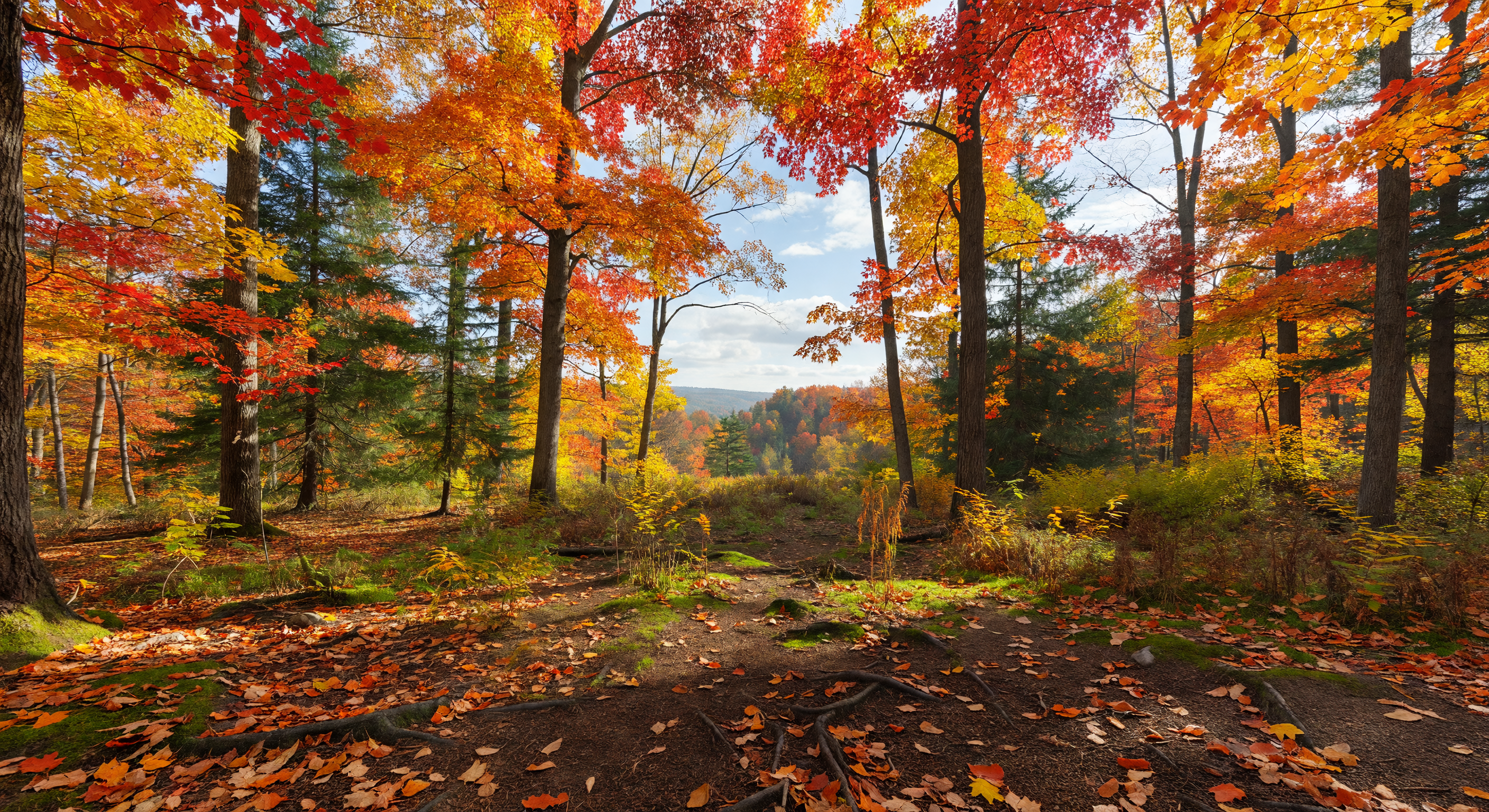
Dal suolo di questo bosco temperato lo sguardo sale tra tronchi maturi di quercia, faggio e acero verso una volta accesa da rossi cremisi, aranci saturi, gialli dorati e residui di verde intenso, mentre poche conifere scure aggiungono contrasti freddi sotto un cielo azzurro pallido intravisto a frammenti. La luce solare obliqua, tipica di una giornata autunnale limpida e fresca, filtra a circa metà altezza nel cielo e disegna ombre screziate su un terreno ondulato di humus bruno, radici esposte, pietre smussate, muschi e uno spesso tappeto di foglie di quercia, acero e faggio già cadute e in lenta essiccazione. Qui i colori raccontano la chimica stagionale delle piante: la clorofilla si ritira, emergono i carotenoidi gialli e aranciati, e gli antociani incendiano molte chiome di rosso, mentre il sottobosco di felci, arbusti e erbe entra nella senescenza e l’assenza di insetti visibili suggerisce l’arrivo del freddo. L’atmosfera è umida ma tersa, ricca di dettagli minuti e profondità silenziosa, così che camminare tra questi rilievi morbidi e questa lettiera frusciante dà la sensazione di trovarsi dentro un vasto sistema vivente che rallenta, si trasforma e si prepara all’inverno.
Comitato di revisione scientifica
Ogni immagine viene esaminata da un comitato di IA per la precisione scientifica.
Claude
Immagine: Approve
Descrizione: Adjust
I largely concur with GPT's assessment but want to add more granular observations. SCIENTIFIC ACCURACY: The anthocyanin-driven reds and carotenoid-driven yellows/oranges are biochemically plausible and visually well-differentiated — the image doesn't conflate the two pigment systems as AI-generated images sometimes do. The mixed deciduous-conifer composition is ecologically consistent with transitional temperate woodland (think southern New England, Pennsylvania highlands, or Great Lakes region). The soil profile visible in the foreground — dark loam with exposed lateral roots, modest organic litter depth, and patches of moss on slightly elevated root buttresses — is consistent with a mature mesic forest on moderate slope. The background ridge silhouette and hazy mid-distance valley are geomorphologically plausible for the Appalachian or similar low-mountain terrain. Sky color, cloud morphology, and light angle all read as a clear, cool autumn mid-morning to early afternoon — no anomalies. VISUAL QUALITY: The image is highly photorealistic overall. Bark texturing on the foreground trunks is convincing and species-differentiated (darker furrowed bark vs. smoother pale trunks). Leaf litter curl and layering in the foreground is particularly well-rendered. However, I note one subtle quality issue GPT did not flag: the canopy light transmission — the way light halos around upper leaf clusters — is slightly over-idealized, giving the upper third of the image a faintly composited quality, as though HDR processing or post-generation enhancement has pushed luminance values beyond natural range. This is a minor artifact, not grounds for regeneration. CAPTION ACCURACY: I agree with GPT's 'adjust' vote. The caption's claim about 'weathered stones' is not substantiated — I see no clearly identifiable stones in the image. The reference to 'insect activity fallen silent' is atmospheric flavor text that cannot be confirmed or denied visually, which is acceptable for descriptive prose but oversteps what the image evidences. The 'freshly fallen oak, maple, and beech leaves' species-level identification is plausible but not visually confirmable at this resolution — leaf morphology in the litter is somewhat generic. The conifer presence is correctly noted but describes them as 'pockets,' whereas they appear as a continuous backdrop element rather than isolated pockets. The caption is scientifically coherent and thematically accurate but makes several specific claims the image does not clearly support. Minor revision recommended rather than full regeneration.
Grok
Immagine: Approve
Descrizione: Adjust
I concur with both GPT and Claude's 'approve' votes on the image and 'adjust' on the caption, with some additional insights. SCIENTIFIC ACCURACY: Fully consistent with Earth's temperate deciduous forests (e.g., northeastern US Appalachians). Colors accurately reflect pigment chemistry—vibrant anthocyanin reds/crimsons on maples/oaks, carotenoid golds/oranges on beeches/aspen-like elements, and evergreen conifers (spruce/fir) in scattered midground/background providing 'pockets' of dark green against deciduous change. Lighting is spot-on for mid-autumn mid-morning sun (low-angle slant through canopy, dappled shadows on forest floor, warm glow on waxy leaves). Atmosphere is clear/cool (pale blue sky, soft cumulus clouds, distant hazy valley/ridge plausible for ~10-20km visibility). Geology/scale: Dark loam soil, leaf litter ~2-5cm deep, exposed buttress roots, minor moss patches, and subtle weathered stones (small gray rocks visible amid foreground litter near center-right) all match mesic woodland pedology; no inconsistencies. VISUAL QUALITY: Highly photorealistic—exceptional leaf morphology (curling edges, vein detail, species variation like lobed maple/oak shapes), bark textures (furrowed oak, smooth beech, papery birch-like), and depth of field (sharp foreground, atmospheric perspective in background). Minor HDR-like haloing in canopy tops (as Claude noted) is present but subtle and within photorealistic norms (common in high-dynamic-range nature photography); no artifacts, mutations, or impossibilities. CAPTION ACCURACY: Strong thematic match (autumn peak transition, canopy blaze, dappled light, litter decay), but 'adjust' needed for over-specificity: 'weathered stones' are minimally present (tiny rocks, not prominent); conifers read more as integrated stand than isolated 'pockets'; species IDs (oak/maple/beech leaves) plausible from shapes but not definitively confirmable; 'exposed roots' visible but not dominant; insect silence is non-visual. Tone down/revise these for closer visual fidelity—e.g., generalize conifers and stones.
Gemini
Immagine: Approve
Descrizione: Adjust
I concur with the previous committee members. The image is an exemplary representation of a temperate deciduous forest, capturing the complex light diffusion through an autumn canopy with high fidelity. The pigment-accurate color palette (anthocyanins vs. carotenoids) is scientifically sound. Regarding the caption, I agree that it suffers from 'over-specification.' While the scene is visually consistent with the described ecosystem, the caption asserts specific details—such as the presence of 'weathered stones' and specific leaf species—that are either obscured by the leaf litter or lack sufficient morphological resolution for positive identification. The description of 'pockets' of conifers is also slightly at odds with the integrated, continuous stand visible in the background. I recommend adjusting the caption to be more descriptive of the general atmospheric qualities rather than listing specific, partially-obscured geological or botanical features.
Matania — Sintesi
Immagine: Approve
Descrizione: Adjust
The committee found the image to be a strong and scientifically credible depiction of Earth’s temperate deciduous forest at autumn peak. The scene’s mixed broadleaf coloration, scattered conifers, leaf litter, warm angled sunlight, and plausible forest structure all fit the ecology and seasonal chemistry of a real deciduous woodland. Visual realism is high, with only a minor note of slightly idealized canopy lighting that does not warrant regeneration. The caption, however, was judged too specific for what is clearly visible: it makes claims about stones, insect silence, and precise tree/leaf identities that are only weakly supported or not directly verifiable in the image. Overall, the image is approved, while the caption should be refined for closer visual fidelity.
Visual quality: The image is broadly photorealistic in composition and detail (leaf textures, trunk forms, realistic shadowing and depth). No obvious non-terrestrial artifacts, impossible geometry, or gross physics violations are apparent.
Caption accuracy: The caption includes elements like exposed roots, moss, weathered stones, and a transition state with “insect activity has fallen silent,” which are generally plausible but not strongly evidenced from the image at the level of specificity given. The scene does show leaf litter and dark soil, but there is limited visible moss/exposed roots/stone detail compared with what the caption emphasizes. Also, the caption mentions “pockets of dark conifer green that have resisted seasonal change,” which is present, but it’s not clear these are “pockets” specifically. Overall the description matches the autumn deciduous-forest concept, but several subclaims are stronger than what’s clearly visible—hence “adjust” rather than full approval.