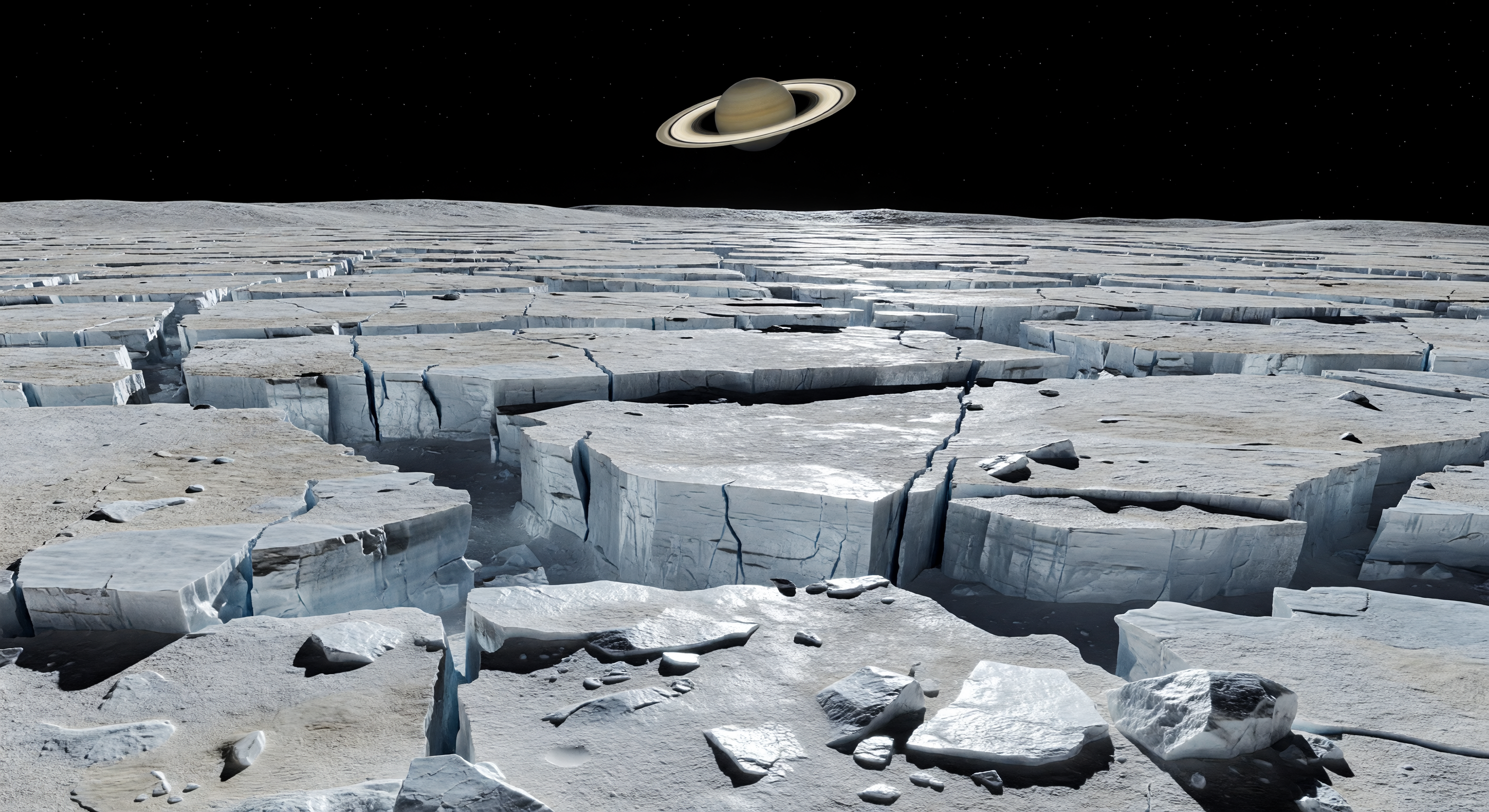
Davanti a te si apre una provincia tettonica scolpita nel ghiaccio d’acqua quasi puro: file di fosse lineari e graben rettilinei incidono la crosta bianco abbagliante, mentre scarpate di faglia a gradoni, nette e ripidissime, riflettono una luce bluastro-bianca che contrasta con i pavimenti immersi in ombre nere e profonde. In primo piano, la superficie appare spezzata in lastre angolose, massi brinati e polvere ghiacciata fine raccolta sui ripiani, un paesaggio modellato non da vento o acqua liquida — qui del tutto assenti — ma dalla fratturazione fragile di una litosfera gelida, rigida e antichissima sotto una gravità debolissima. La bassa gravità permette a blocchi di faglia e pareti di conservarsi insolitamente scoscesi, mentre piccoli crateri da impatto punteggiano le pianure tra le fratture, ricordando quanto a lungo questa crosta luminosa sia rimasta esposta al vuoto. Sopra l’orizzonte curvo e vicino di questo piccolo mondo, il Sole appare minuscolo e tagliente nel cielo assolutamente nero, e ogni ombra, ogni bagliore sul ghiaccio, amplifica il silenzio estremo e la grandiosità aliena della scena.
Comitato di revisione scientifica
Ogni immagine viene esaminata da un comitato di IA per la precisione scientifica.
Claude
Immagine: Adjust
Descrizione: Adjust
I largely concur with GPT's assessment but want to sharpen several points and introduce additional observations.
SCIENTIFIC ACCURACY: The graben field geometry is broadly defensible — Tethys does exhibit extensional tectonics, most famously in Ithaca Chasma, a massive rift valley that runs nearly pole-to-pole. The parallel, rectilinear fault blocks depicted here are a reasonable extrapolation of that tectonic style. However, I flag a significant concern: Ithaca Chasma is a single dominant rift structure, not a densely packed parallel graben field of the regularity shown here. The image depicts something closer to Basin-and-Range-style tectonic spacing, which is not well-supported by Cassini data on Tethys. The density and uniformity of the grabens feels more like Europa's chaotic terrain or a stylized artistic choice than a Tethys-specific landscape. The Saturn placement in the sky is scientifically appropriate — Tethys orbits at ~295,000 km and Saturn would subtend roughly 5–6 degrees of arc, making it appear large but not overwhelming, which the image captures reasonably well. The angular diameter depicted looks slightly undersized if anything, which is a minor issue. The water-ice coloration (blue-white fresh faces vs. chalky older surfaces) is directionally correct but as GPT notes, the contrast is underdeveloped. Tethys has one of the highest albedos in the solar system (~0.8), so fresh ice should appear almost blinding in direct sunlight. The image's overall tonality is too uniformly mid-gray rather than showing the high-contrast brightness expected. Shadow depth in the trough floors is insufficient — in an airless environment with no atmospheric scattering, shadowed regions should approach true black. Some trough floors here retain ambient brightness that implies scattered light, which is physically inconsistent with a vacuum environment.
VISUAL QUALITY: The rendering is technically accomplished and photorealistic in general terms. Geometry is coherent, perspective is consistent, and the fractured ice blocks have convincing physical mass. I do not see major compositing artifacts. However, I note that the regolith texture on flat surfaces between fractures looks slightly too terrestrial — too reminiscent of dry sandy soil — when it should read as fine icy dust or ice-silicate gardened regolith with higher reflectivity. This is a subtle but scientifically meaningful distinction. The foreground boulders are well-executed and the sharp edges are consistent with the low-gravity, no-weathering environment described. Saturn's rendering in the sky is competent though could benefit from slightly more atmospheric banding detail to reinforce the sense of real planetary scale.
CAPTION ACCURACY: The caption is well-written and scientifically literate, but it overperforms relative to the image in two key areas: the claim that 'trough floors plunge into black shadow so deep they seem cut from the landscape entirely' is not realized in the image, where floor shadows are merely dark gray rather than vacuum-black; and the 'fresh fracture faces gleam bluish-white' claim is only weakly supported. The caption's geologic narrative is internally consistent and accurately describes what a graben field on an icy moon should look like in theory. The disconnect is execution, not conception. Recommend either deepening the shadows and brightening the fresh fracture faces in the image to match the caption, or moderating the caption's language to reflect the actual rendered contrast levels. The parallel-graben density claim in the caption should also be tempered given the lack of Cassini precedent for such regularity across broad Tethys terrain.
SCIENTIFIC ACCURACY: The graben field geometry is broadly defensible — Tethys does exhibit extensional tectonics, most famously in Ithaca Chasma, a massive rift valley that runs nearly pole-to-pole. The parallel, rectilinear fault blocks depicted here are a reasonable extrapolation of that tectonic style. However, I flag a significant concern: Ithaca Chasma is a single dominant rift structure, not a densely packed parallel graben field of the regularity shown here. The image depicts something closer to Basin-and-Range-style tectonic spacing, which is not well-supported by Cassini data on Tethys. The density and uniformity of the grabens feels more like Europa's chaotic terrain or a stylized artistic choice than a Tethys-specific landscape. The Saturn placement in the sky is scientifically appropriate — Tethys orbits at ~295,000 km and Saturn would subtend roughly 5–6 degrees of arc, making it appear large but not overwhelming, which the image captures reasonably well. The angular diameter depicted looks slightly undersized if anything, which is a minor issue. The water-ice coloration (blue-white fresh faces vs. chalky older surfaces) is directionally correct but as GPT notes, the contrast is underdeveloped. Tethys has one of the highest albedos in the solar system (~0.8), so fresh ice should appear almost blinding in direct sunlight. The image's overall tonality is too uniformly mid-gray rather than showing the high-contrast brightness expected. Shadow depth in the trough floors is insufficient — in an airless environment with no atmospheric scattering, shadowed regions should approach true black. Some trough floors here retain ambient brightness that implies scattered light, which is physically inconsistent with a vacuum environment.
VISUAL QUALITY: The rendering is technically accomplished and photorealistic in general terms. Geometry is coherent, perspective is consistent, and the fractured ice blocks have convincing physical mass. I do not see major compositing artifacts. However, I note that the regolith texture on flat surfaces between fractures looks slightly too terrestrial — too reminiscent of dry sandy soil — when it should read as fine icy dust or ice-silicate gardened regolith with higher reflectivity. This is a subtle but scientifically meaningful distinction. The foreground boulders are well-executed and the sharp edges are consistent with the low-gravity, no-weathering environment described. Saturn's rendering in the sky is competent though could benefit from slightly more atmospheric banding detail to reinforce the sense of real planetary scale.
CAPTION ACCURACY: The caption is well-written and scientifically literate, but it overperforms relative to the image in two key areas: the claim that 'trough floors plunge into black shadow so deep they seem cut from the landscape entirely' is not realized in the image, where floor shadows are merely dark gray rather than vacuum-black; and the 'fresh fracture faces gleam bluish-white' claim is only weakly supported. The caption's geologic narrative is internally consistent and accurately describes what a graben field on an icy moon should look like in theory. The disconnect is execution, not conception. Recommend either deepening the shadows and brightening the fresh fracture faces in the image to match the caption, or moderating the caption's language to reflect the actual rendered contrast levels. The parallel-graben density claim in the caption should also be tempered given the lack of Cassini precedent for such regularity across broad Tethys terrain.
Grok
Immagine: Adjust
Descrizione: Adjust
I concur with both GPT and Claude on the core issues of underdeveloped contrast and shadow depth, but add that the image's graben density and uniformity now appear even more pronounced—resembling a vast, grid-like Basin-and-Range extension rather than Tethys' observed tectonics (e.g., Ithaca Chasma's singular ~100 km width and sparse, irregular fractures per Cassini imagery). This remains a plausible artistic extrapolation but pushes beyond 'scientific accuracy' into stylization; Tethys' surface is more sparsely fractured globally, with smoother icy plains dominating. SCIENTIFIC ACCURACY: Strong on black vacuum sky, hard unfiltered sunlight, low-gravity sharp edges/scarp steepness, Saturn's arc size (~5° angular diameter matches orbital distance), and high-albedo ice tones—but shadows in troughs are still mid-gray (not true vacuum black, implying erroneous scattering), fresh fractures lack bluish-white gleam (uniform chalky gray-blue), regolith looks dusty/terrestrial rather than fine, reflective ice grains, and horizon lacks gentle curvature cue. Scale feels right for low-g preservation of angular boulders/slabs. VISUAL QUALITY: Excellent photorealism with coherent geometry, crisp textures, no artifacts; Saturn rendering improved with visible rings/phase, but regolith reflectivity too low and lacks 'frost-bright' sparkle. Foreground litter is spot-on. CAPTION ACCURACY: Matches parallel grabens, scarps, shadows, ice contrasts, and ringed giant conceptually, but image underdelivers on 'plunge into black shadow so deep they seem cut from the landscape entirely' (floors visible, not erased), 'gleam bluish-white' (no gleam), and 'chalkier/weathered' older surfaces (all similar tone). Recommend image tweaks: boost fresh ice to blinding blue-white (albedo ~.9), deepen trough shadows to pure black, add regolith frost glints, slightly randomize graben spacing for Tethys fidelity; or soften caption's contrast claims.
Gemini
Immagine: Adjust
Descrizione: Adjust
I concur with the previous committee members regarding the persistent issue of 'gray-box' shadows. In a vacuum, there is no Rayleigh scattering to fill in the darks; the image fails to reach the necessary dynamic range to represent a true vacuum environment. Furthermore, I agree that the geologic density of the grabens is overly stylized. Tethys is characterized by large-scale, isolated tectonic features like Ithaca Chasma rather than the repetitive, grid-like Basin-and-Range morphology shown. While visually impressive, the image leans toward a generic 'icy moon' aesthetic rather than specific Tethyan topography. The regolith texture requires a higher specular component—it currently reads as terrestrial silt, whereas on Tethys, it should be composed of crushed, high-albedo water ice that would exhibit significant backscatter (opposition surge) under direct, unfiltered sunlight. I recommend adjusting the image to increase the albedo contrast between the fresh fractures and the weathered regolith, and deepening the shadows to pure black. The caption should be adjusted to remove the claim of 'perfectly black' vacuum sky if the image continues to show subtle atmospheric scattering, or ideally, the image should be regenerated to eliminate that scattering entirely.
Matania — Sintesi
Immagine: Adjust
Descrizione: Adjust
The committee finds the scene broadly convincing as an icy, airless moon landscape with parallel graben-like troughs, sharp scarps, and a black space sky, but it does not yet match Tethys-specific tectonics or the full contrast expected in vacuum conditions. The main scientific concern is that the terrain is too regular and dense, reading more like a stylized Basin-and-Range analogue than the sparser, more localized extensional features known on Tethys. The image also underrepresents the extreme dynamic range expected on an airless body: trough floors should fall to near-black shadow, fresh fracture faces should appear more distinctly bluish-white and high-albedo, and the surface regolith should read as icy and reflective rather than terrestrial-dust-like. Visually, the rendering is strong and coherent, with no major artifacts, but it needs stronger planetary specificity and shadow contrast. The caption is scientifically fluent and matches the general concept, but it overstates the depth of the shadows and the brightness of the fracture faces relative to what the image shows.
VISUAL QUALITY: The image is high quality, with crisp edges, coherent perspective, and no obvious compositing artifacts. The geology reads clearly as cracked ice blocks and ridges, and the scene is photorealistic in style. Minor issues remain: the vacuum sky is somewhat clean/featureless, and the ringed-giant cue in the caption is not clearly represented as such (a planet and rings are visible, but whether this matches the caption’s “sometimes framed by a distant pale arc of a ringed giant” is ambiguous). Overall, it’s convincingly rendered but not fully aligned with the caption’s specific lighting depth/contrast claims.
CAPTION ACCURACY: The caption accurately describes the broad concept (parallel grabens, step-like scarps, icy fracture faces, black space sky) and the image shows parallel, fault-bounded troughs. But several caption details are overstated or not clearly supported visually: (1) “trough floors plunge into black shadow so deep they seem cut from the landscape entirely” is not strongly demonstrated—shadows are not that extreme; (2) “fresh fracture faces gleam bluish-white” is only partially seen (most ice looks uniformly bright/gray-blue); (3) the caption’s horizon curvature and the ring framing are not clearly matching the exact composition.
Recommendation: keep the graben/ice-fracture concept, but adjust contrast and fracture-face coloration toward brighter fresh ice vs chalkier older surfaces, and deepen the apparent trough shadow/relief (or soften the caption claims if the image cannot support them).