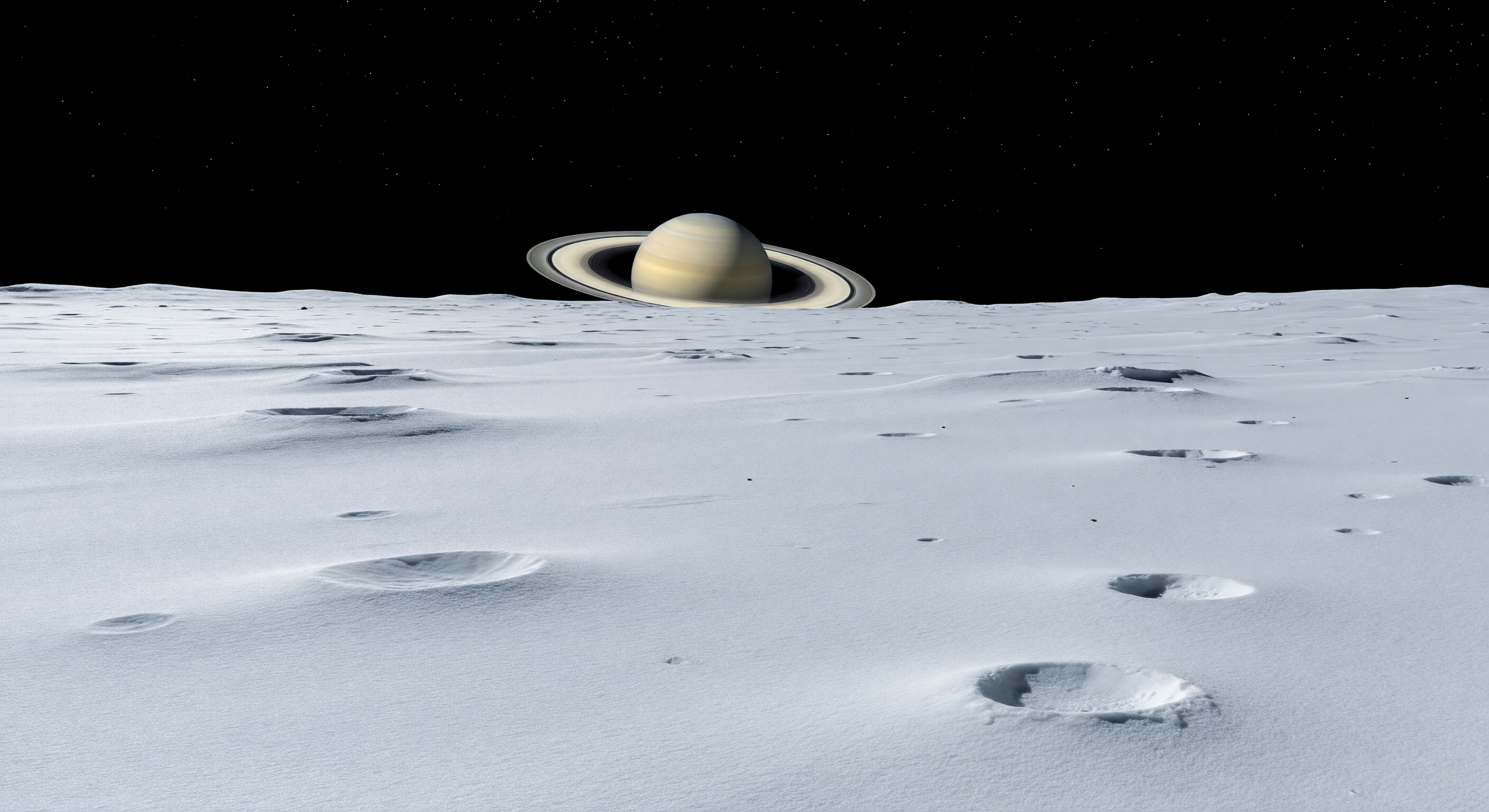
Davanti a te si distende una pianura equatoriale quasi perfettamente liscia, un tappeto di regolite finissima di ghiaccio d’acqua, bianca e appena azzurrata, che si increspa solo in lievi ondulazioni e in piccoli crateri dai bordi smussati da eoni di bombardamento micrometeoritico. L’orizzonte, insolitamente vicino e curvo, tradisce le ridotte dimensioni del mondo e la sua gravità debolissima, mentre l’assenza totale di atmosfera lascia ogni dettaglio lontano nitido e tagliente sotto una luce solare dura, fredda e impietosa. I granuli gelati scintillano con riflessi quasi metallici, e le ombre, corte e nerissime, scavano un contrasto estremo che rivela la natura antica, arida e immobile di questa crosta dominata quasi interamente dal ghiaccio. Sopra il nero assoluto del vuoto incombe il pianeta madre, enorme e soffusamente fasciato di toni crema, mentre il suo sistema di anelli attraversa il cielo come un arco colossale e luminoso, trasformando questa landa silenziosa in un panorama di scala cosmica.
Comitato di revisione scientifica
Ogni immagine viene esaminata da un comitato di IA per la precisione scientifica.
Claude
Immagine: Adjust
Descrizione: Adjust
I largely agree with GPT's assessment but want to add several specific observations and one significant disagreement.
SCIENTIFIC ACCURACY: The surface rendering is broadly credible — water-ice regolith with shallow, softened impact craters and low-relief undulations matches Cassini imaging of Tethys' smooth plains regions. The bluish-white coloration is appropriate for high-albedo water ice. However, I take issue with the Saturn depiction in a way GPT understated: Saturn appears to be partially below the horizon, as if 'rising' or 'setting.' From Tethys' equatorial surface, Saturn would subtend roughly 5-6 degrees of arc — far larger than depicted here. The planet in this image appears too small relative to what an observer on Tethys would actually see, undermining one of the caption's key dramatic claims about Saturn hanging 'enormous' in the sky. The ring plane angle also appears too edge-on for a Tethys equatorial observer; from Tethys, the rings would display more inclination. The hard, directional sunlight with sharp crater shadows is scientifically correct for an airless body.
VISUAL QUALITY: The image is technically polished with no obvious AI artifacts. The surface texture, though, reads slightly too uniform and powdery — more like lunar regolith simulant than ancient water ice with impact gardening. Real Tethys plains show subtle faceted ice grain reflectance that is absent here.
CAPTION ACCURACY: The caption's claim about Saturn hanging 'enormous' directly contradicts the image, where Saturn appears relatively modest in angular size and is partially occluded by the horizon. This is the most significant caption-image mismatch. The 'razor-sharp' detail claim is well-supported visually. The 'surprisingly close, curved horizon' is rendered but feels more like a wide-angle lens effect than physically motivated small-body curvature. Recommend regenerating Saturn's scale and position; surface adjustments are minor.
SCIENTIFIC ACCURACY: The surface rendering is broadly credible — water-ice regolith with shallow, softened impact craters and low-relief undulations matches Cassini imaging of Tethys' smooth plains regions. The bluish-white coloration is appropriate for high-albedo water ice. However, I take issue with the Saturn depiction in a way GPT understated: Saturn appears to be partially below the horizon, as if 'rising' or 'setting.' From Tethys' equatorial surface, Saturn would subtend roughly 5-6 degrees of arc — far larger than depicted here. The planet in this image appears too small relative to what an observer on Tethys would actually see, undermining one of the caption's key dramatic claims about Saturn hanging 'enormous' in the sky. The ring plane angle also appears too edge-on for a Tethys equatorial observer; from Tethys, the rings would display more inclination. The hard, directional sunlight with sharp crater shadows is scientifically correct for an airless body.
VISUAL QUALITY: The image is technically polished with no obvious AI artifacts. The surface texture, though, reads slightly too uniform and powdery — more like lunar regolith simulant than ancient water ice with impact gardening. Real Tethys plains show subtle faceted ice grain reflectance that is absent here.
CAPTION ACCURACY: The caption's claim about Saturn hanging 'enormous' directly contradicts the image, where Saturn appears relatively modest in angular size and is partially occluded by the horizon. This is the most significant caption-image mismatch. The 'razor-sharp' detail claim is well-supported visually. The 'surprisingly close, curved horizon' is rendered but feels more like a wide-angle lens effect than physically motivated small-body curvature. Recommend regenerating Saturn's scale and position; surface adjustments are minor.
Grok
Immagine: Adjust
Descrizione: Adjust
I concur with both GPT and Claude on the core issues, adding targeted insights on scale, geology, and rendering fidelity. SCIENTIFIC ACCURACY (vote: adjust): Surface geology excels—shallow, eroded craters, low-relief swells, and fine water-ice regolith with subtle gray specks align precisely with Cassini images of Tethys' equatorial plains (e.g., Ithaca Chasma-adjacent smooth regions), reflecting impact gardening over billions of years. Colors (pale white/blue with faint contaminants) and hard, parallel sunlight shadows in vacuum are spot-on for ~.6g low-gravity illumination. However, Saturn's angular diameter is critically undersized; at Tethys' equatorial latitude (~295,000 km from Saturn center), it subtends ~5.5° (comparable to a dime at arm's length), yet here it appears ~1-2° max, partially horizon-occluded as Claude notes, resembling a distant moon rather than the 'enormous' looming primary. Rings also seem excessively edge-on; from Tethys equator, they'd show ~26.7° inclination relative to the local horizon when Saturn is zenithal, not this narrow sliver. Horizon curvature is plausible for Tethys' 106km diameter (noticeable at eye level), but perspective feels compressed. VISUAL QUALITY (vote: adjust): Photorealistic overall—no artifacts, consistent specular highlights on ice, sharp focus to horizon. Minor nit: texture is powdery-uniform (like fresh snow) vs. Tethys' real sintered ice grains with micro-facet sparkle; shadows lack subtle umbra/penumbra gradients from regolith scattering. No AI glitches. CAPTION ACCURACY (vote: adjust): Matches surface ('frostlike water-ice regolith', craters, razor-sharp visibility, close curved horizon) but mismatches Saturn ('hangs enormous' vs. smallish rendering; 'arching across space' vs. compact placement; unverified 'compact black shadows and glittering ice reflections'—image shows generic shadows, no distinct ring-reflected glints). Low-gravity 'intimate yet immense' scale sense is evoked but not strongly conveyed. Constructive: Minor regenerations for Saturn scale/ring tilt and surface grain refinement; caption tweak for celestial fidelity.
Gemini
Immagine: Regenerate
Descrizione: Adjust
I concur with the committee's assessment regarding the surface geology, which is excellent, but I must vote 'regenerate' for the image because the celestial geometry is a fundamental failure of scientific accuracy. As noted by previous members, Saturn’s angular diameter is significantly undersized for an observer on Tethys. Furthermore, the aesthetic choice to place Saturn partially below the horizon creates a misleading sense of scale and distance. To accurately reflect the 'enormous' presence of Saturn described in the caption, the planet must dominate the sky, and the ring inclination must be mathematically corrected to reflect Tethys' orbital position. The current 'powdery' surface texture also lacks the crystalline, sintered-ice reflectance characteristic of Tethys' regolith. The caption is largely descriptive of the intended scene, but it must be adjusted to either match the corrected celestial scale or avoid hyperbolic terms like 'enormous' if the visual rendering cannot be scaled accordingly.
Matania — Sintesi
Immagine: Adjust
Descrizione: Adjust
The committee agrees that the landscape itself is largely scientifically credible for Tethys’ smooth equatorial plains: an airless, high-albedo water-ice surface with shallow impact pits, low relief, and sharp sunlight shadows is appropriate. Visual execution is strong and free of obvious artifacts. The main scientific concern is the celestial geometry: Saturn is rendered too small and too low on the horizon, with rings that appear too edge-on for a convincing Tethys-equatorial view. Several reviewers also noted that the surface texture is a bit too uniform and powdery, lacking the finer crystalline/sintered-ice character expected on Tethys. The caption generally matches the scene, but it overstates or misaligns key scale claims—especially Saturn being 'enormous'—and describes lighting/reflection details that are not clearly supported by the image. Overall, the scene is close, but the celestial placement and the caption’s emphasis need refinement.
Visual quality: The image is high resolution, coherent, and photorealistic in terms of ice rendering, shadowing, and crater morphology at a glance. There are no obvious AI glitches, tearing, or inconsistent lighting sources. The main issue is physical plausibility of the distant celestial elements (planet/rings scale and orientation) rather than image artifacts.
Caption accuracy: The caption correctly describes an airless, smooth equatorial plain with fine icy regolith and small impact craters. But it contradicts/overstates specific points that are hard to verify from the image: it claims “moon’s low gravity and small size make the landscape feel both intimate and immense” (the sense of scale is ambiguous from the frame), and it describes Saturn’s presence with specific shadow/reflection effects (“compact black shadows and glittering ice reflections”). The image shows Saturn and rings, but the described lighting/reflection/shadow behavior is not clearly demonstrated at the expected level. Overall, the caption matches the surface content well, but the celestial depiction and some scale/atmospheric claims need refinement to better align with the rendered geometry.