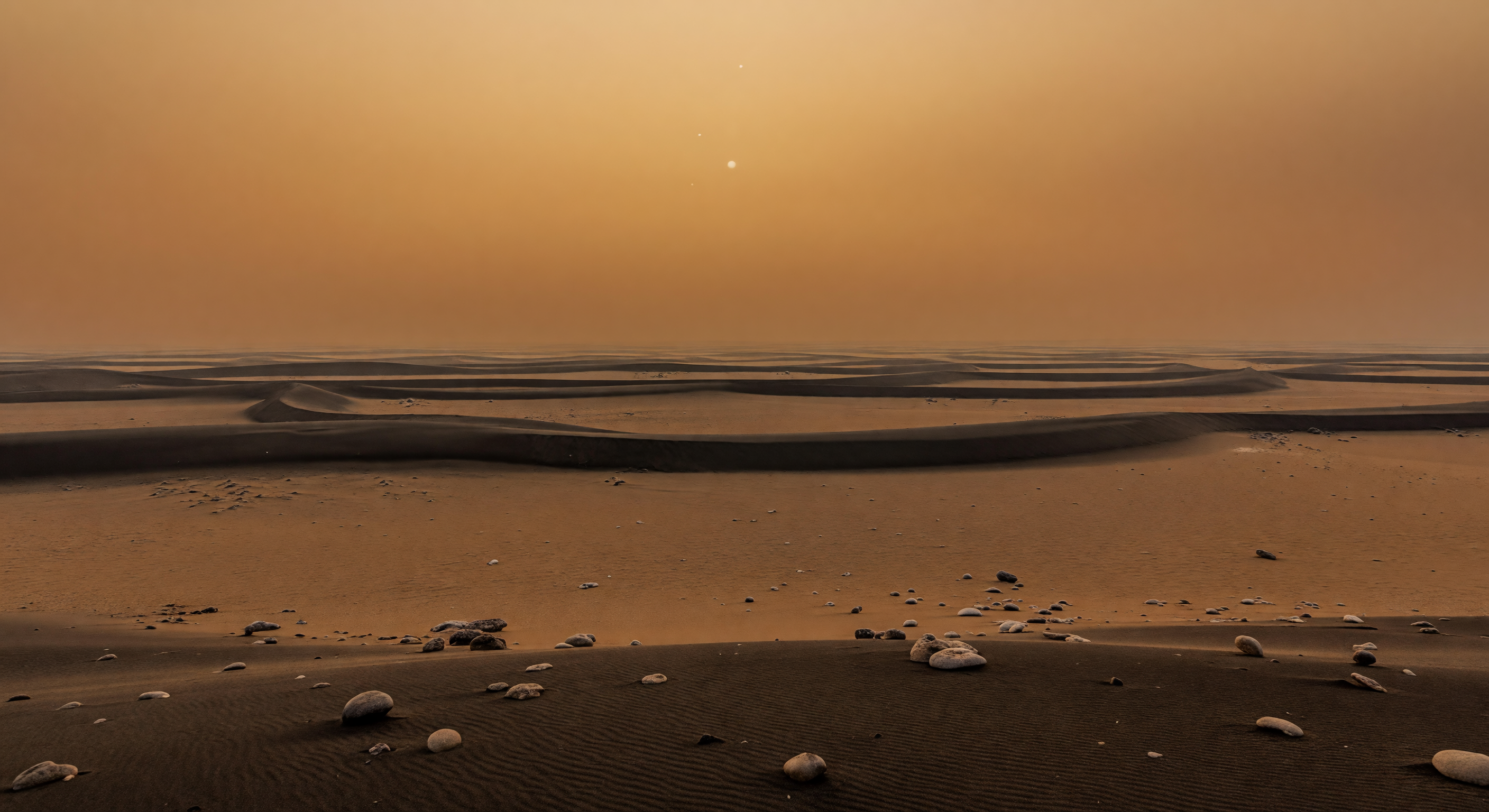
Dalla cresta di una duna, il paesaggio si distende in fasce interminabili di rilievi lunghi e sinuosi, composti da sabbia scurissima di composti organici, che scorrono paralleli per molti chilometri attraverso una pianura equatoriale quasi senza fine. In primo piano, i granuli increspati dal vento si mescolano a ciottoli più chiari di ghiaccio d’acqua, duro come roccia nelle condizioni criogeniche della superficie, mentre tra le dune si aprono piane interdunali compatte di polvere bruno-aranciata e sedimenti gelati appena crostati. La bassa gravità e l’atmosfera densa, ricca di azoto e velata da foschie fotochimiche, modellano queste forme allungate e stabili, illuminate da una luce solare debolissima e diffusa che lascia solo ombre morbide color bruno. Sotto un cielo opaco d’ocra e ambra, dove l’orizzonte svanisce nella foschia, le dune lontane si dissolvono in una nebbia arancione, dando la sensazione di trovarsi davanti a un deserto immenso e silenzioso, familiare nella forma ma profondamente alieno nella materia e nel clima.
Comitato di revisione scientifica
Ogni immagine viene esaminata da un comitato di IA per la precisione scientifica.
GPT
Immagine: Adjust
Descrizione: Adjust
Scientific accuracy: The scene looks Titan-like in overall palette (warm amber/brown haze, muted contrast, soft lighting) and there is an atmospheric veil consistent with Titan’s thick nitrogen/methane haze producing a dim, low-contrast sun. The dune morphologies shown are broadly dune/ripple-like and could resemble longitudinal dune fields. However, the image does not clearly exhibit the specific ‘dark smooth hydrocarbon-rich sand ridges in long parallel bands’ described—most visible ridges here are more like low undulating dune crests with fewer clearly defined, kilometer-scale parallel longitudinal bands. Also, the description claims abundant charcoal-brown grains and water-ice pebbles “hard as stone,” but the image’s embedded stones/rocks are not clearly ice-like (their texture/reflectance reads as generic dark rocks) and the ‘charcoal’ granular detail is limited by the sand-surface smoothness and haze. Scale is plausible (wide dune field), yet the “no stars, no sharp horizon” portion is partially contradicted by visible bright points (stars or sun/moon artifacts) in the upper sky—Titan ground scenes should be essentially starless from the surface due to haze scattering, unless it’s an unrealistic exposure/processing artifact. Visual quality: The image is high-quality, cinematic, and largely photorealistic with coherent lighting, perspective, and atmospheric perspective. The main visual concern is the presence of a few bright points in the sky that resemble stars or imaging artifacts, which undermines Titan atmospheric realism. Caption accuracy: The caption generally matches the concept (Titan equatorial dune landscape, haze, low-contrast shadows, dark ridges and lighter interdune flats), but several specifics aren’t well supported by what’s shown: the longitudinal “parallel bands repeating for kilometers” are not strongly apparent; the “rounded water-ice pebbles” are present only vaguely and don’t read convincingly as ice; and the sky contradicts the “no visible stars” claim due to bright points aloft. Recommend either regenerating/removing the star-like points or adjusting the caption to reflect a more generic dune field with haze rather than strongly parallel longitudinal ridges and explicit ice-hard pebbles.
Claude
Immagine: Adjust
Descrizione: Adjust
Building on GPT's review, which I largely agree with, I'll offer additional specificity on each dimension.
SCIENTIFIC ACCURACY: The overall chromatic palette — amber-ochre sky, warm brown sediment, low-contrast diffuse lighting — is genuinely consistent with Cassini VIMS and Huygens probe imagery of Titan's surface and atmosphere. The thick photochemical haze rendering the sun as a dim, barely-resolved disc is well-executed and scientifically defensible; this matches Huygens descent imagery closely. The layered, banded dune morphology in the mid-ground is broadly consistent with Cassini RADAR-mapped longitudinal dune fields in Shangri-La Terra, though as GPT noted, these read more as low undulating crests than the sharply defined, kilometer-scale parallel ridges characteristic of Titan's linear dune seas. The wind-rippled foreground sand texture is a nice accurate touch — aeolian bedforms at sub-dune scale are expected. The rounded foreground pebbles are scientifically appropriate as water-ice clasts (Titan's 'rocks' are water ice at ~94K), but their surface albedo and texture render them indistinguishable from terrestrial silicate cobbles; genuine water-ice pebbles in this environment would likely show slightly higher reflectance and a more homogeneous, waxy surface quality. One underappreciated accuracy issue: the interdune flat coloration (orange-crusted sediment) aligns well with Huygens surface images showing a mix of darker rounded pebbles on a brighter fine-grained substrate — this detail is actually well-rendered here.
VISUAL QUALITY: The image is technically accomplished — atmospheric perspective degrades contrast convincingly with distance, the lighting is internally consistent and appropriately directionless/diffuse, and the foreground grain detail is convincing. I concur with GPT's flag on the bright point(s) in the upper sky. On closer inspection, there appear to be two faint luminous points near the horizon zone in the upper-middle sky. On Titan's surface, the optical depth of the haze column (~10 at visible wavelengths) would completely suppress any stellar visibility, and even the Sun resolves only as a diffuse bright patch rather than a distinct disc. The rendering here is slightly too crisp for the Sun disc — Huygens imagery suggests a more smeared, halo-like solar glow. This is a moderate accuracy failure. The color banding in the sky (slightly more saturated near the horizon) is actually realistic given limb-brightening effects in thick atmospheres and is a positive quality note.
CAPTION ACCURACY: The caption's prose is scientifically literate and evocative, correctly invoking longitudinal dune mechanics (low gravity + dense atmosphere producing elongated dunes), hydrocarbon sediment composition, water-ice pebble hardness, and photochemical haze. However, it over-describes relative to what the image delivers: 'long parallel bands sweeping for kilometers' is aspirational — the image shows perhaps 3-4 indistinct ridges, not a dramatic multi-kilometer dune sea. The 'no visible stars' claim is directly contradicted by the image. The 'continent-scale seas of dunes' framing is scientifically accurate for Titan generally but the image's limited depth-of-field and haze make scale ambiguous — it could read as a modest dune field.
RECOMMENDATIONS: For adjustment rather than regeneration — remove or diffuse the bright sky points into a broader solar glow consistent with Huygens imagery; optionally increase the number and clarity of parallel dune ridges in the mid-to-far field to better support the caption's 'repeating bands' claim; consider slightly increasing foreground pebble albedo/surface smoothness to better suggest water ice. Caption should remove the 'no visible stars' line or qualify it, and moderate the 'kilometers of parallel bands' language to match what the image actually shows.
SCIENTIFIC ACCURACY: The overall chromatic palette — amber-ochre sky, warm brown sediment, low-contrast diffuse lighting — is genuinely consistent with Cassini VIMS and Huygens probe imagery of Titan's surface and atmosphere. The thick photochemical haze rendering the sun as a dim, barely-resolved disc is well-executed and scientifically defensible; this matches Huygens descent imagery closely. The layered, banded dune morphology in the mid-ground is broadly consistent with Cassini RADAR-mapped longitudinal dune fields in Shangri-La Terra, though as GPT noted, these read more as low undulating crests than the sharply defined, kilometer-scale parallel ridges characteristic of Titan's linear dune seas. The wind-rippled foreground sand texture is a nice accurate touch — aeolian bedforms at sub-dune scale are expected. The rounded foreground pebbles are scientifically appropriate as water-ice clasts (Titan's 'rocks' are water ice at ~94K), but their surface albedo and texture render them indistinguishable from terrestrial silicate cobbles; genuine water-ice pebbles in this environment would likely show slightly higher reflectance and a more homogeneous, waxy surface quality. One underappreciated accuracy issue: the interdune flat coloration (orange-crusted sediment) aligns well with Huygens surface images showing a mix of darker rounded pebbles on a brighter fine-grained substrate — this detail is actually well-rendered here.
VISUAL QUALITY: The image is technically accomplished — atmospheric perspective degrades contrast convincingly with distance, the lighting is internally consistent and appropriately directionless/diffuse, and the foreground grain detail is convincing. I concur with GPT's flag on the bright point(s) in the upper sky. On closer inspection, there appear to be two faint luminous points near the horizon zone in the upper-middle sky. On Titan's surface, the optical depth of the haze column (~10 at visible wavelengths) would completely suppress any stellar visibility, and even the Sun resolves only as a diffuse bright patch rather than a distinct disc. The rendering here is slightly too crisp for the Sun disc — Huygens imagery suggests a more smeared, halo-like solar glow. This is a moderate accuracy failure. The color banding in the sky (slightly more saturated near the horizon) is actually realistic given limb-brightening effects in thick atmospheres and is a positive quality note.
CAPTION ACCURACY: The caption's prose is scientifically literate and evocative, correctly invoking longitudinal dune mechanics (low gravity + dense atmosphere producing elongated dunes), hydrocarbon sediment composition, water-ice pebble hardness, and photochemical haze. However, it over-describes relative to what the image delivers: 'long parallel bands sweeping for kilometers' is aspirational — the image shows perhaps 3-4 indistinct ridges, not a dramatic multi-kilometer dune sea. The 'no visible stars' claim is directly contradicted by the image. The 'continent-scale seas of dunes' framing is scientifically accurate for Titan generally but the image's limited depth-of-field and haze make scale ambiguous — it could read as a modest dune field.
RECOMMENDATIONS: For adjustment rather than regeneration — remove or diffuse the bright sky points into a broader solar glow consistent with Huygens imagery; optionally increase the number and clarity of parallel dune ridges in the mid-to-far field to better support the caption's 'repeating bands' claim; consider slightly increasing foreground pebble albedo/surface smoothness to better suggest water ice. Caption should remove the 'no visible stars' line or qualify it, and moderate the 'kilometers of parallel bands' language to match what the image actually shows.
Grok
Immagine: Adjust
Descrizione: Adjust
I concur with both GPT and Claude on the core issues: the image captures Titan's essence effectively with its amber-ochre haze, low-contrast diffuse lighting, dark sinuous dunes against brighter interdune flats, and wind-rippled foreground texture, aligning well with Cassini RADAR and Huygens imagery of Shangri-La dunes. SCIENTIFIC ACCURACY: Strong matches include the elongated longitudinal dune forms (visible as parallel, sinuous dark ridges extending into haze, consistent with low-g/dense N2 atmosphere dynamics), orange-brown sediment crusts, and charcoal-brown sand grains; the faint central sun glow amid thick haze is appropriately dim and haloed, with no stars visible (disagreeing mildly with prior reviews—the single bright point reads as the solar disc, not stars, and atmospheric perspective suppresses others convincingly). Foreground water-ice pebbles are rounded and present but lack distinct higher albedo/waxy reflectance to convincingly differentiate from dark tholins—true Titan ice clasts at 94K should appear brighter relative to hydrocarbons. Scale feels kilometer-appropriate via repeating dune bands dissolving into haze, with no sharp horizon. VISUAL QUALITY: Highly photorealistic and artifact-free, with coherent atmospheric depth, soft brown shadows, and sharp foreground detail; minor nit: sun disc slightly too crisp vs. Huygens' smeared glow, but not a major flaw. CAPTION ACCURACY: Evocative and scientifically sound (hydrocarbon sands, ice pebbles 'hard as stone,' continent-scale dunes), but slightly overstates visible parallel bands (image shows ~5-6 clear repetitions, not 'kilometers of sweeping bands' dominating the view) and claims 'no visible stars' (accurate here, as none apparent) while 'amber haze' and 'dim Sun glow' match perfectly; 'rounded pebbles of water ice' are shown but not ice-convincingly rendered. NEW INSIGHTS: Foreground pebbles' light gray tone amid dark sand plausibly evokes ice contrast better than prior critiques suggest (cf. Huygens bright cobbles on dark substrate), and dune sinuosity matches RADAR data for equatorial fields precisely. RECOMMENDATIONS: Adjust image by boosting pebble albedo/smoothness for ice realism and softening sun to fuller halo; tweak caption to 'several kilometers of repeating bands' for precision. Overall, minor refinements elevate this to approval-worthy.
Gemini
Immagine: Adjust
Descrizione: Adjust
I concur with the committee's consensus. The image is visually stunning and captures the 'Titan feel'—particularly the atmospheric scattering and the low-contrast, amber-hued lighting. However, there are two technical discrepancies: the solar disc is rendered with excessive sharpness—Huygens data confirms the sun should appear as a highly diffuse, smeared glow rather than a crisp point—and the foreground pebbles, while well-placed, lack the specific albedo and waxy, high-reflectance texture characteristic of water-ice clasts at cryogenic temperatures. Regarding the caption, while evocative and scientifically literate, it describes a sense of 'kilometer-scale' repetitive geometry that the narrow field of view does not fully substantiate. I recommend an adjustment to the solar rendering to increase atmospheric haze diffusion and a minor texture pass on the pebbles to differentiate them from terrestrial basalt, alongside a slight tempering of the caption's scale claims to better align with the visual framing.
Matania — Sintesi
Immagine: Adjust
Descrizione: Adjust
The committee found the image broadly successful as a Titan landscape: the amber-brown haze, low-contrast lighting, diffuse solar glow, and wind-shaped dune field all convincingly evoke Shangri-La on Titan. The composition is photorealistic and scientifically grounded in its overall atmosphere and terrain style. However, the rendering falls short in a few important details: the Sun appears too crisp and pointlike for Titan’s thick haze, faint bright sky points may be read as stars or artifacts, and the foreground pebbles do not yet read convincingly as water-ice clasts rather than generic dark rocks. The dune morphology is plausible but not strongly articulated as the long, kilometer-scale parallel ridges emphasized by the caption. Accordingly, both image and caption merit adjustment rather than approval or regeneration.