Scientific confidence: High

At ground level on the smooth Muses Sea lowland, the view is a broad, gently rolling sheet of pale gray-beige regolith strewn with gravel, rounded pebbles, and a few half-buried cobbles, each casting an inky, razor-edged shadow under the unfiltered glare of the Sun. The surface looks subtly sorted by size—fine grains pooled among coarser fragments—revealing the behavior of loose ordinary-chondrite rubble on a tiny, porous body where ultra-low gravity lets particles migrate and settle into smooth “seas” between rougher boulder fields. Here and there, darker silicate-rich rock peeks through the dusty soil, while the horizon curves away startlingly close, making even small rises feel like the edge of a miniature world. Above it all hangs a perfectly black sky, untouched by air or haze, so the stark light, absolute shadows, and intimate scale make the landscape feel both geologically familiar and profoundly alien.

You stand among a jumbled upland of angular gray-brown silicate boulders, shattered slabs, and coarse pebble fields, where pockets of finer regolith collect precariously between rocks on a slope that seems too steep to hold together. In the asteroid’s extraordinarily weak gravity, this terrain can exist as a porous rubble pile—fragments of ordinary-chondrite material, rich in silicate minerals and darkened by subtle space weathering, loosely assembled rather than carved from a single solid mass. At local noon, unfiltered sunlight falls with brutal clarity, igniting tiny mineral glints on broken faces while casting perfectly sharp black shadows into every crack, and beyond the rocks the ground curves away within mere tens of meters, making the body’s tiny scale unmistakable. Overhead, a pure vacuum-black sky scattered with steady stars turns the scene eerily intimate and immense at once, as if an entire mountainous world had been reduced to the size of a hilltop you could almost walk across in an afternoon.

At ground level, the surface is a steep cascade of angular gravel, dusty beige fines, and fractured multi-meter boulders whose charcoal-gray faces catch a thin warm rim of sunlight while deep, perfectly black shadows slice between them. Several of these blocks seem improbably perched on smaller stones, a visible clue that this is not solid bedrock but a porous rubble pile of ordinary-chondrite-like fragments, where vanishingly weak gravity lets debris settle into delicate, unstable arrangements and allows pockets of smoother fine regolith to collect in local lows. The land drops away so quickly that the horizon curves nearby and low ridges only tens of meters high feel like distant mountains, emphasizing how tiny this body is despite the intimate detail of every pebble underfoot. Overhead there is no blue sky, no haze, only a hard white Sun in a star-filled black vacuum, making the whole scene feel stark, silent, and strangely suspended between a rocky hillside and open space.

At your feet, a delicate slope of regolith looks almost like a carefully raked gravel bed, with millimeter- to centimeter-scale pebbles in gray, beige, dusty brown, and muted olive-tan nestled among darker chips, brighter silicate flecks, and pockets of fine dust. In the harsh, unfiltered sunlight of an airless world, every grain throws a razor-black shadow, while the ground falls away so quickly that the horizon curves startlingly close, making a low hummock and a cluster of boulders only tens of meters high feel like a mountain range. This surface is the expression of an S-type rubble pile: ordinary-chondrite-like fragments, space-weathered by micrometeorite impacts and solar radiation, then slowly sorted by extremely weak gravity into smoother pebble-rich deposits that merge upslope into rougher, blockier terrain. With no wind, no haze, and no moving dust to soften the scene, the black sky and precariously balanced stones make the landscape feel both miniature and immense, as though a single careless step could disturb a world barely holding itself together.

From this knife-edge crest, the asteroid seems to drop away on both sides almost at once, as if you are standing atop a broken spine above a void, with jagged slabs of ordinary-chondrite rock, angular boulders, coarse gravel, and trapped pockets of tan-gray regolith barely clinging to the ridge in the feeble gravity. Harsh sunlight flashes from fresh fractured faces and tiny metallic flecks, while darker, space-weathered surfaces sink into pitch-black shadow so deep that the small world’s extreme curvature and contact-binary form are revealed in a single glance: two lobes falling away in different directions, rough blocky uplands rising only tens of meters high, and smoother regolith “seas” pooled in lower saddle regions along the neck. Scattered impact scars are softened by migrating dust, and some stones look impossibly perched, as though one touch could send them drifting free from this porous rubble-pile body. Above it all hangs a perfectly black, airless sky filled with hard, steady stars, making the sunlit ridge feel both intimate and perilously exposed on a world scarcely half a kilometer long.
From this narrow waist, the ground becomes a saddle of contrasting textures: smooth drifts of migrated fine regolith pooled in shallow hollows between clusters of angular boulders, gravel, and half-buried blocks of ordinary-chondrite-like rock. One side rises nearby as a low, cliff-like slope strewn with rubble from the rocky uplands, while the other falls away so abruptly that the sharply curved horizon reveals the body’s tiny, contact-binary scale—an entire world only a few hundred meters long. In this feeble gravity, loose stones can remain precariously perched and dust can slowly sort itself into “seas,” preserving a landscape that looks unstable, porous, and assembled rather than carved. Harsh sunlight from a low angle flashes off fresh fractured faces, cuts absolute black shadows across muted gray and beige-brown silicates, and leaves the scene suspended in an airless black sky where stars remain visible even in full day.

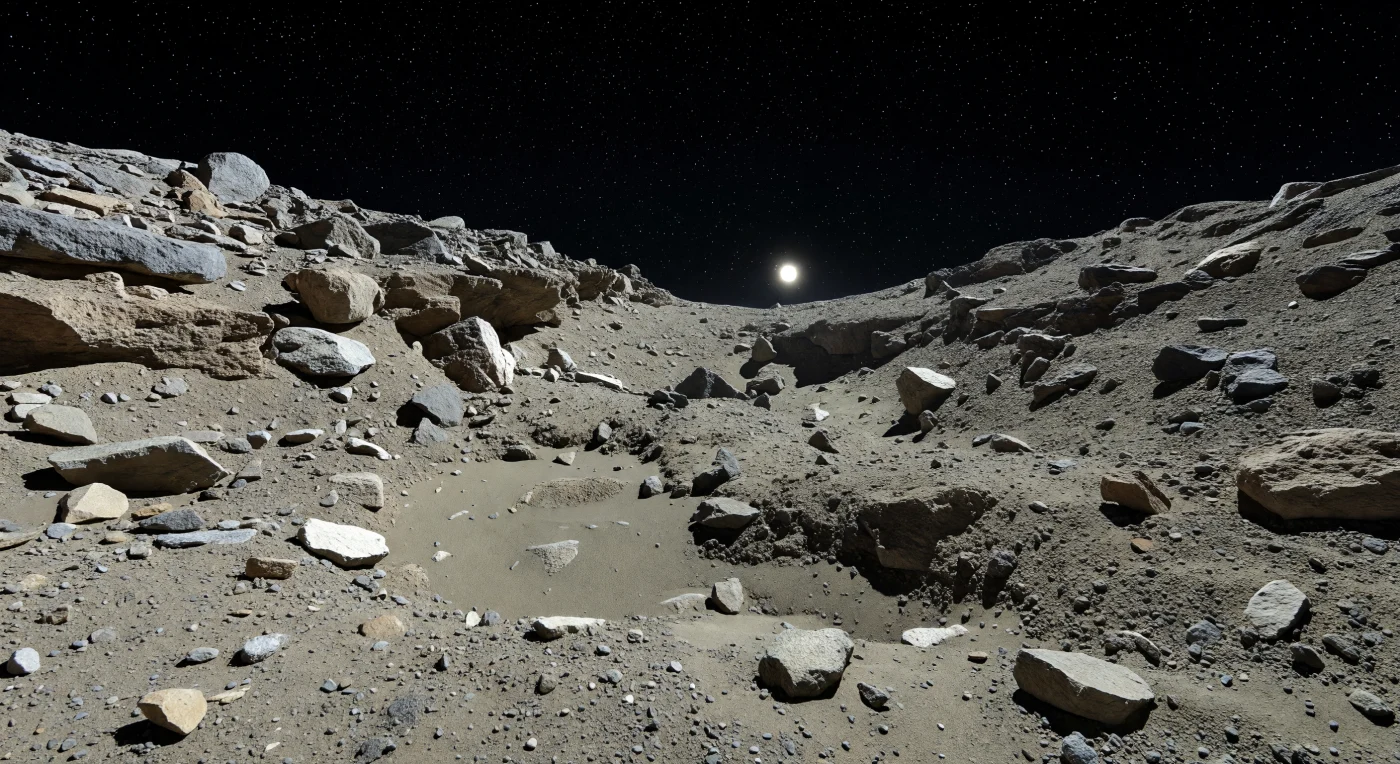
You stand at a striking boundary where a jumbled field of dark, angular boulders and fractured slabs gives way within just a few meters to a pale, smoother pond of gravel and dust, as if the surface itself has been sorted by an invisible hand. In this extreme microgravity, larger silicate blocks are left stranded at the margin while finer chondritic grains migrate and collect into low, compacted basins, revealing how a porous rubble-pile world separates material by size without wind or water. Oblique sunlight from a hard white Sun carves every pebble, pit, and dusting of space-weathered olivine- and pyroxene-rich rock into sharp relief, while shadows fall as absolute black across the regolith’s delicate ripples and softened mini-craters. Beyond the intimate foreground, the land rises only tens of meters before dropping abruptly into a startlingly near, curved horizon under a star-filled black sky, making the entire landscape feel both miniature and immense at once.

You stand on a dim, gently rippled plain of charcoal-gray to brown-gray silicate regolith, where fine dust, scattered pebbles, and a few angular ordinary-chondrite boulders barely emerge from the darkness before the ground curves away at an astonishingly close horizon. The landscape’s small scale reveals the nature of a tiny rubble-pile world: smooth “seas” of migrated fine grains lie beside hummocks, fractured outcrops, shallow micro-craters, and porous talus-like piles arranged under gravity so weak that loose particles can perch or drift in ways impossible on larger bodies. Above, the vacuum sky is a perfect black vault crowded with pin-sharp stars, and one bluish-white point shines brighter than the rest, while the absent Sun leaves only the faintest reflected glow to trace pebble rims and boulder edges and to cast shadows that fall into absolute, razor-edged black. With no air, no haze, and no sound, the scene feels both intimate and cosmic—an airless fragment of ordinary-chondrite rock suspended in space, its entire horizon only moments away.

At regolith level, the landscape is a quiet scatter of muted gray and beige-brown chondritic stones, where a barely perceptible hollow only a few meters wide interrupts the rubble like a breath pressed into dust. Its bowl shape is so subdued that it emerges mainly through geometry: a thin, absolute-black shadow clings to one rim in the low Sun, while lighter fine regolith pooled between angular boulders hints at slow grain migration in the asteroid’s vanishingly weak gravity. Around it, rough blocky uplands grade into smoother dust-and-pebble patches—miniature regolith “seas” trapped among fractured silicate rocks, some with brighter fresh faces, others darkened by space weathering in the airless vacuum. Under a pitch-black sky pricked with steady stars, the horizon drops away within a few dozen meters, making nearby rubble mounds feel monumental even as their sharp curvature reveals the tiny, porous rubble-pile world beneath your feet.

From the floor of this narrow chasm, fractured stone walls crowd in at arm’s length, their angular gray and beige silicate faces rising like cliffs even though they are only a few meters high on this tiny rubble-pile world. Hard white sunlight strikes only the upper rims and a few knife-edged protrusions, while the rest of the cavity falls into almost complete blackness—an effect of airless vacuum, where no atmosphere exists to soften shadows or scatter light into the depths. Underfoot lies a precarious jumble of sharp fragments, pea-sized gravel, dust pockets, and balanced cobbles, all weakly settled in gravity so feeble that fine regolith can drift into sheltered lows and boulders can remain improbably perched above hidden voids. Through the thin slit overhead, a black sky studded with pinpoint stars and hints of nearby boulder-strewn uplands reveal a landscape built from ordinary-chondrite rock, shattered, space-weathered, and assembled into an eerie miniature wilderness.
