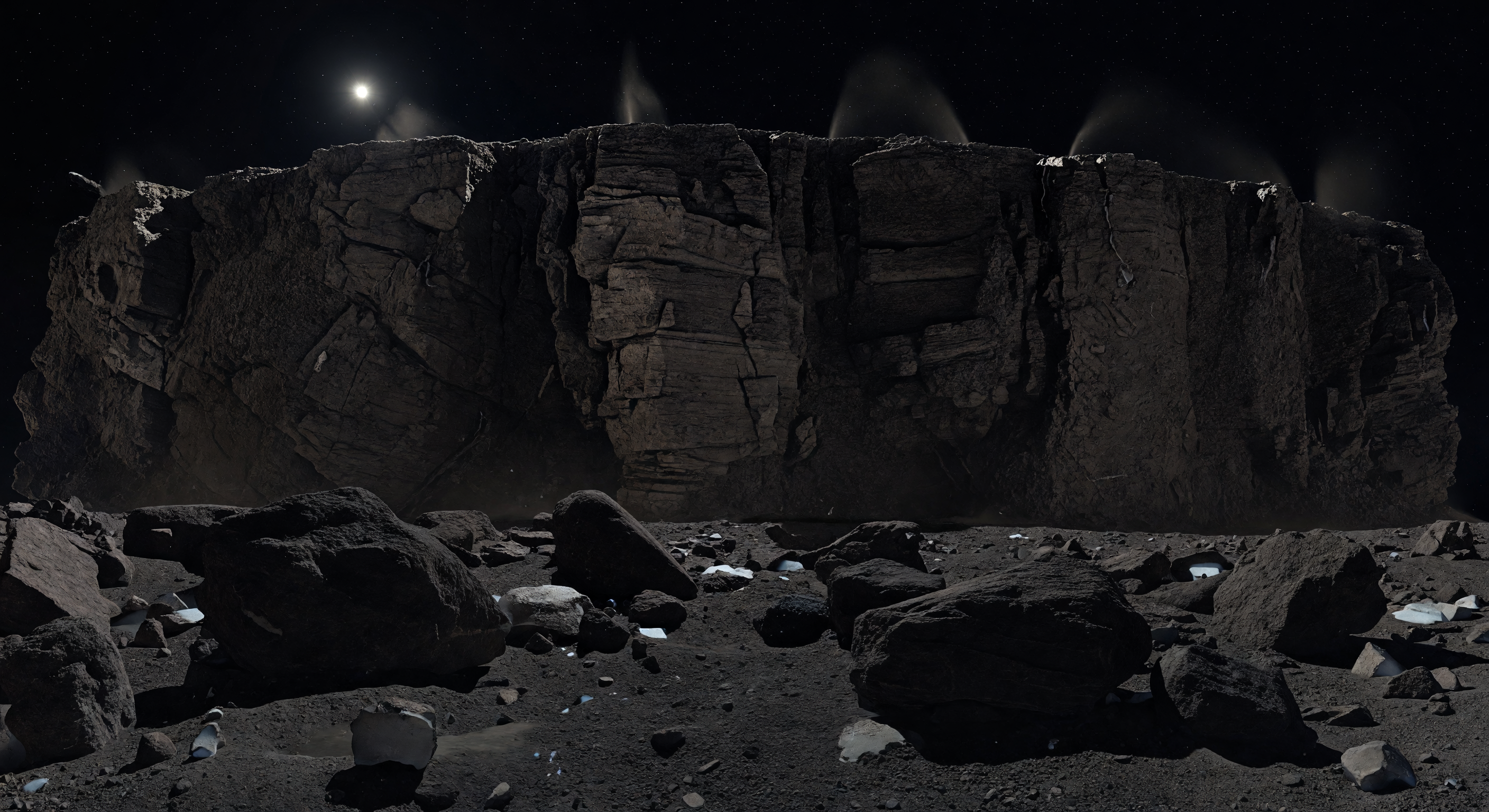
足もとに広がるのは、砕けた角礫と黒褐色のレゴリスが折り重なる崩積斜面、その先で有機物に富む極めて暗い塵と氷が固結した巨大な断崖が、画面の外へ消えるほどほぼ垂直にそそり立っています。崖面には多角形の割れ目、深い亀裂、張り出し、層状の構造が刻まれ、きわめて低い重力のもとで崩れ落ちた岩塊が、拳大から家ほどの大きさまで無秩序に散乱し、裂け目の奥には汚れた水氷の淡い白青色がわずかにのぞきます。大気のない真空では空は昼でも完全な黒で、太陽光は鋭く冷たい白金色の光として上縁だけを照らし、下部の壁と足元を刃物のようにくっきりした深い影へ沈めるため、地平線の近さと核の小さな曲率がいっそう異様に感じられます。見上げれば、日なたの亀裂からは揮発性物質の昇華による淡いガスと塵のジェットが宇宙へ吹き上がり、微細な粒子がほとんど無重力に近い環境でゆっくり漂う――ここは凍った瓦礫の静寂な荒野であると同時に、いまも侵食と噴出を続ける活動的な彗星表面なのです。
科学審査委員会
各画像はAI委員会によって科学的正確性が審査されます。
Claude
画像: Adjust
説明: Adjust
I largely concur with GPT's assessment but want to add several specific observations and one notable disagreement. On scientific accuracy: the cliff's layered, stratified structure is genuinely well-realized—67P's consolidated terrains (particularly in the Hathor region) do exhibit this kind of planar, stacked-slab morphology, and the near-vertical geometry with deep shadow pooling in the lower faces is faithful to Rosetta/OSIRIS imagery. The albedo of the main cliff face is appropriately dark (~4% reflectance on 67P is among the lowest in the solar system), and the harsh, unidirectional sunlight with absolutely no atmospheric scattering in the sky is correct. Where I part from GPT slightly is on the rubble apron: the presence of light-colored fragments scattered across the foreground is not necessarily an overcorrection—freshly exposed or shaded ice-rich material on 67P can appear markedly brighter than the refractory surface crust, and Rosetta did image bright patches in talus zones. However, the fragments here appear too geometrically angular and almost crystalline/glassy in their highlights, suggesting rendered glass or clean ice rather than the dirty, sublimation-eroded ice observed by OSIRIS. That is a meaningful inaccuracy. On the jets/plumes: I agree with GPT that the columnar hazes at the cliff rim are the weakest element scientifically. Real 67P jets in single-frame imaging appear as faint, narrow, collimated streaks—not the broad, smoke-like columns visible here, which read more like terrestrial volcanic fumaroles or render artifacts. There is also no visible curved horizon, which the caption explicitly claims and which would be a defining visual cue for a ~4 km diameter body at close range—this is a significant omission the previous reviewer did not flag strongly enough. The sky shows stars faintly, which is plausible given the low albedo environment, but the bright point source upper-left (the sun) appears too large and diffuse for the ~3.4 AU distance of 67P at perihelion; the sun should appear as a very small, intensely bright disk, not a glowing orb with a soft halo. On caption accuracy: the description is well-written and scientifically literate, but it over-asserts specifics the image does not deliver—discrete crack-sourced jets, clearly curved horizon, delicate dust arcs—and should be revised to match what is actually depicted. Recommend adjust on both counts rather than regenerate, as the foundational geological rendering is strong and correctable.
Grok
画像: Adjust
説明: Adjust
I concur with both GPT and Claude on the core strengths and issues, adding targeted insights from direct image inspection. **Scientific accuracy (adjust)**: The Hathor cliff base is convincingly rendered with 67P's signature dark (~4-6% albedo), consolidated, layered morphology—polygonal fractures, overhangs, ledges, and a porous, dusty crust match OSIRIS images of Hathor/Asiir regions (e.g., NAVCAM frame N201410171412244). Foreground rubble apron with scattered angular blocks is appropriate for talus slopes, and brighter icy patches are plausible as exposed water ice (Rosetta detected ~10-20% ice fractions in such areas, appearing bluish under direct light). Harsh, unsoftened lighting with deep radial shadows and black sky is spot-on for ~3 AU solar distance in vacuum. However, sublimation jets are inaccurately depicted: real 67P jets (OSIRIS 2014-2016) are faint, narrow, collimated streaks from discrete vents, often <1 pixel wide in stills; here, they manifest as broad, diffuse, upward-flaring plumes (like CGI smoke), untethered to specific illuminated cracks and too prominent/opaque. No discernible curved horizon despite close-range viewpoint on a ~4x4 km duck-shaped body (should curve sharply within 100-200m). Sun appears as a large, soft-glowing disk with halo—incorrect; at 67P's perihelion (~3.4 AU), it's a tiny (~.1°), saturating point source without visible disk/halo in raw images. Minor: faint stars are ok but overabundant for short-exposure OSIRIS-like imaging. **Visual quality (high, minor artifacts)**: Photorealistic textures, coherent geometry, and depth-of-field excel, evoking Rosetta panoramas. No major warping or aliasing; plumes are the sole artifact-like element (too volumetric/smoky). **Caption accuracy (adjust)**: Description nails geology, colors, shadows, and scale feel ('miniature and immense'), but overstates jets as 'faint jets that loft gas and fine particles into delicate arcs' (image shows none; plumes aren't arc-like or particle-lofted). 'Close, curved horizon' absent; 'cold bluish glint' on few patches ok but foreground ices are more prominent/neutral-toned than 'sheltered patches.' Revise caption to 'diffuse venting-like plumes near rim' and note 'sharply curved horizon' only if regenerated. Strong base warrants adjust over regenerate—tweak jets/sun/horizon in next iter.
Gemini
画像: Adjust
説明: Adjust
I concur with the committee's consensus that the geological rendering of the Hathor cliff's consolidated, layered, and fractured morphology is high-quality and scientifically grounded. However, the image fails on three critical physical parameters: the depiction of the Sun as a large, diffuse orb rather than a distant, intense point source; the absence of the characteristic sharp horizon curvature required for a body of 67P’s scale; and the misrepresentation of sublimation jets as 'smoke-like' plumes. Real 67P activity consists of narrow, collimated, high-velocity gas and dust streams that are rarely visible as volumetric clouds in short-exposure imagery. The caption must be adjusted to align with the visual reality of the scene, specifically removing the claims of 'delicate arcs' and 'curved horizon' which are not present in the current frame. While the rendering is impressive, these specific technical inaccuracies regarding cometary physics necessitate an adjustment to ensure scientific fidelity.
Matania — 総合評価
画像: Adjust
説明: Adjust
The committee found the scene broadly successful in evoking 67P/Churyumov-Gerasimenko’s Hathor cliff base: a dark, consolidated, layered cliff with fractured faces, rubble at the foot of the wall, and vacuum-black space under hard solar illumination. The overall geology and surface texture are convincing and scientifically grounded, with a photorealistic presentation. However, several key physical details are off. The Sun is rendered too large and diffuse, the horizon curvature is not apparent, and the venting near the cliff top reads as broad smoke-like plumes rather than the faint, narrow, collimated jets expected on 67P. The foreground bright fragments are plausible in principle as ice-rich material, but they appear too crystalline and prominent relative to typical dirty water-ice exposures. The caption similarly overstates what is visible, especially by asserting discrete sublimation jets, delicate particle arcs, and a curved horizon that the image does not actually show. Because the foundation is strong but correctable, the committee recommends adjustment rather than regeneration.
Visual quality: The image is high quality and looks photorealistic in terms of lighting, texture, and depth cues. Geometry reads as coherent (no obvious geometry errors), and the sky is plausible for space. There are possible visual/CG artifacts in the venting/plume regions (wispy columns that are stronger and more diffuse than typical faint jets in a single still, and not obviously localized to a specific crack). Also, the overall contrast is strong but consistent with comet imaging aesthetics.
Caption accuracy: The general description of a dark rubble apron at the base of a tall, near-vertical, consolidated comet cliff is supported. The mention of polygonal fractures, ledges, porous/dusty crust, and faint bluish glints from icy patches is directionally consistent with the visible light/ice-bearing fragments. The main mismatch is active sublimation: the caption asserts faint jets driven by sublimation “from illuminated cracks near the rim” and lofting delicate arcs into the airless sky, but the image’s plumes are not clearly shown as discrete crack-driven jets nor as arcs of lofted particles; they appear more like broad haze/smoke columns. Adjust the caption to reflect what is actually visible (e.g., “suggested venting/haze near the upper cliff” rather than definite sublimation-driven jets and dust arcs).