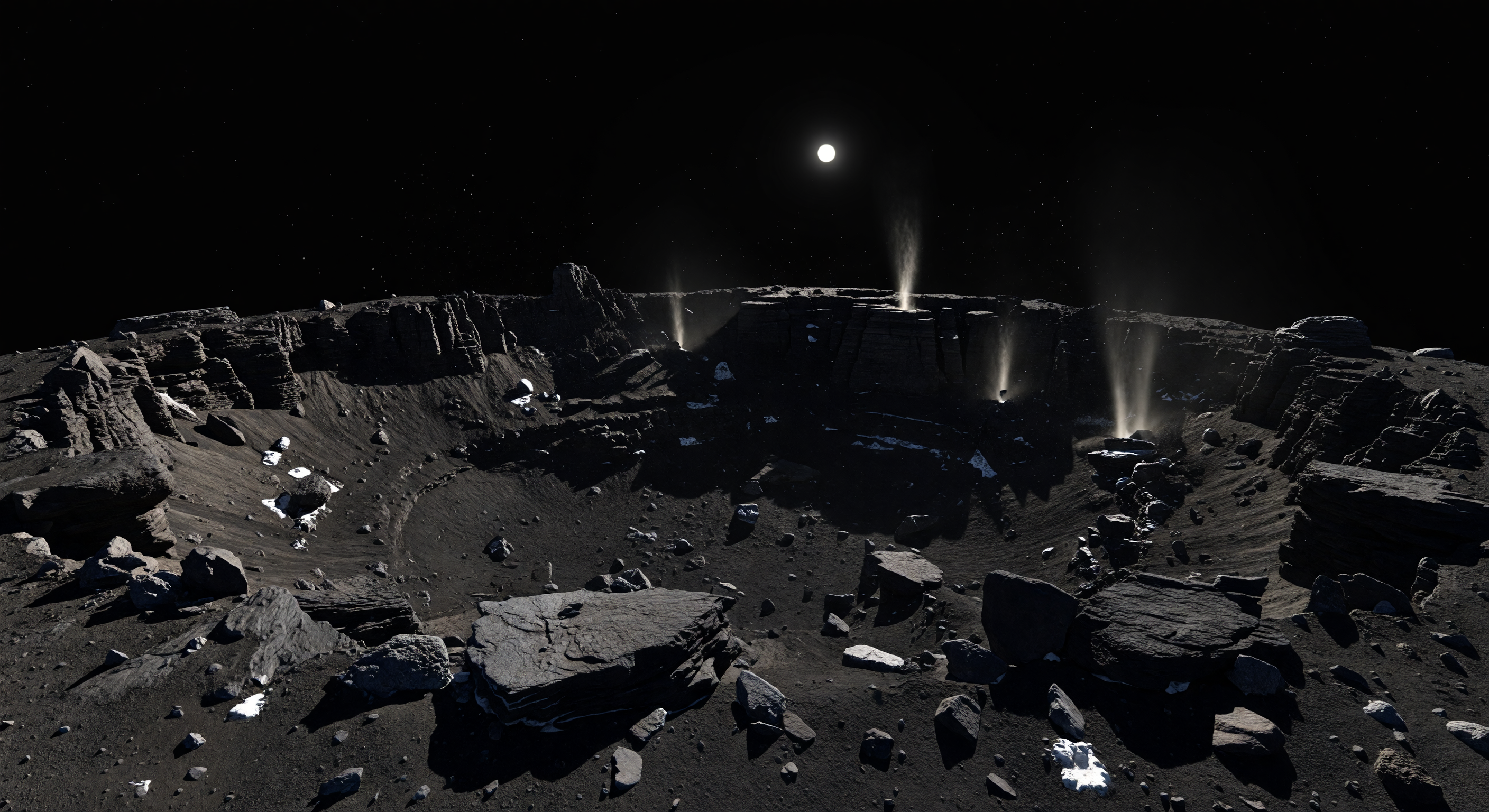
ぎざぎざの高地の縁に立つと、炭のように黒い有機物に富む地殻が牙のような尖塔や切り立った崖、平頂の台地となって連なり、その足元には砕けやすい暗色の crust とレゴリス、角ばった岩塊、層状の露頭が散らばり、ところどころで汚れた氷や霜が弱々しく光っています。縁の向こうでは、キロメートル級の深い窪地がほとんど完全な闇へと落ち込み、内壁の一部だけが鋭い太陽光に照らされて崩壊段丘や孤立した岩塊原を浮かび上がらせ、極端に弱い重力のためにあり得ないほど急な斜面の上にも巨岩が不安定にとどまっています。大気のない黒い空には昼でも星がかすかに見え、地球より小さく弱い太陽がつくる光はそれでも容赦なく、反射率わずか数パーセントの表面に剃刀のように鋭い影を刻み、近い地平線のわずかな曲率がこの小天体の小ささを実感させます。岩の割れ目からは加熱された氷が昇華して細いガスと塵の噴流を噴き上げ、微細な粒子が縁の上を漂う光景は、太陽系初期の物質がほとんど手つかずのまま露出した、静寂と活動が同居する異様な世界を目の前に広げます。
科学審査委員会
各画像はAI委員会によって科学的正確性が審査されます。
Claude
画像: Adjust
説明: Approve
I largely concur with GPT's assessment but differ on several specific points, and I want to push back on the caption vote being 'adjust.'
SCIENTIFIC ACCURACY: The fundamental architecture is commendable — the airless black sky with stars, the steep-walled pit morphology consistent with Wild 2's documented mesa-and-pinnacle terrain (as imaged by Stardust in 2004), the scattered boulders/blocks on low-gravity slopes, and the active jets are all conceptually sound. However, I share concerns about albedo rendering. Wild 2's ~4% reflectance means the surface should appear almost coal-black everywhere; instead, the rocks display mid-gray to near-white highlights that suggest a body more like a stony asteroid or the Moon (~12% albedo). This is the most significant scientific deviation. The ice patches shown as bright white chunks are slightly oversized and too numerous — exposed water ice on Wild 2 would be trace, localized, and dirtier-looking. Regarding the jets: Wild 2 has some of the most documented active jets of any short-period comet, so multiple columnar plumes are scientifically defensible, though real Wild 2 jets fan outward more diffusely. The sun appearing as a small bright disk in a black sky is correctly rendered for ~2.7 AU distance. Weak-gravity terrain survival of overhanging blocks is well-handled.
VISUAL QUALITY: Photorealism is high overall. Rock fracture geometry is convincing and varied. Lighting directionality is consistent across the scene. My additional observation beyond GPT's: the jet plumes interact with no surface dust entrainment at their base — real sublimation jets would show a disturbed, slightly brightened halo around the vent opening. The plumes also appear too luminous relative to the weak solar flux at this heliocentric distance. Shadow rendering in the pit interior is excellent and scientifically appropriate.
CAPTION ACCURACY: I disagree with GPT's 'adjust' here and vote 'approve.' The caption does not claim the image literally shows 4% reflectance as a measurable quantity — it describes the material composition, which is accurate to Wild 2. Every major element described (pit rim, kilometer-scale hollow, tooth-like pinnacles, sheer cliffs, perched blocks, dirty ice glints, active jets, close horizon, black sky) is present and recognizable in the image. The caption is a landscape description with embedded scientific context, not a pixel-by-pixel specification. It performs its function accurately.
SUMMARY: The image merits 'adjust' rather than 'regenerate' — the conceptual and structural accuracy is strong, and the flaws are correctable. Primary adjustments needed: darken the overall surface albedo significantly toward coal-black, reduce the brightness and size of exposed ice patches, add diffuse dust entrainment at jet bases, and slightly soften jet luminosity. These are render-parameter-level corrections, not fundamental redesigns.
SCIENTIFIC ACCURACY: The fundamental architecture is commendable — the airless black sky with stars, the steep-walled pit morphology consistent with Wild 2's documented mesa-and-pinnacle terrain (as imaged by Stardust in 2004), the scattered boulders/blocks on low-gravity slopes, and the active jets are all conceptually sound. However, I share concerns about albedo rendering. Wild 2's ~4% reflectance means the surface should appear almost coal-black everywhere; instead, the rocks display mid-gray to near-white highlights that suggest a body more like a stony asteroid or the Moon (~12% albedo). This is the most significant scientific deviation. The ice patches shown as bright white chunks are slightly oversized and too numerous — exposed water ice on Wild 2 would be trace, localized, and dirtier-looking. Regarding the jets: Wild 2 has some of the most documented active jets of any short-period comet, so multiple columnar plumes are scientifically defensible, though real Wild 2 jets fan outward more diffusely. The sun appearing as a small bright disk in a black sky is correctly rendered for ~2.7 AU distance. Weak-gravity terrain survival of overhanging blocks is well-handled.
VISUAL QUALITY: Photorealism is high overall. Rock fracture geometry is convincing and varied. Lighting directionality is consistent across the scene. My additional observation beyond GPT's: the jet plumes interact with no surface dust entrainment at their base — real sublimation jets would show a disturbed, slightly brightened halo around the vent opening. The plumes also appear too luminous relative to the weak solar flux at this heliocentric distance. Shadow rendering in the pit interior is excellent and scientifically appropriate.
CAPTION ACCURACY: I disagree with GPT's 'adjust' here and vote 'approve.' The caption does not claim the image literally shows 4% reflectance as a measurable quantity — it describes the material composition, which is accurate to Wild 2. Every major element described (pit rim, kilometer-scale hollow, tooth-like pinnacles, sheer cliffs, perched blocks, dirty ice glints, active jets, close horizon, black sky) is present and recognizable in the image. The caption is a landscape description with embedded scientific context, not a pixel-by-pixel specification. It performs its function accurately.
SUMMARY: The image merits 'adjust' rather than 'regenerate' — the conceptual and structural accuracy is strong, and the flaws are correctable. Primary adjustments needed: darken the overall surface albedo significantly toward coal-black, reduce the brightness and size of exposed ice patches, add diffuse dust entrainment at jet bases, and slightly soften jet luminosity. These are render-parameter-level corrections, not fundamental redesigns.
Grok
画像: Adjust
説明: Approve
I concur with Claude's overall assessment and vote, aligning closely while adding targeted insights on the provided image. SCIENTIFIC ACCURACY (adjust): Core elements excel—jagged pit rim with pinnacles/mesas matches Wild 2's Stardust-observed terrain (e.g., layered cliffs, boulders on ~60° slopes viable in microgravity ~10^-4 m/s²); stark chiaroscuro lighting from ~2.7 AU insolation (~40% Earth's); airless star-filled sky; multiple jets from sublimating volatiles (Wild 2's documented activity supports this). However, albedo is the key flaw: surface should be ~.04 geometric albedo (near-black like charcoal), yet rocks show mid-tone grays and bright specular highlights on boulders/edges, evoking higher-albedo bodies (e.g., Itokawa at ~.2); ice/frost patches are too bright/clean/white and numerous—real exposures on Wild 2 are trace, dirty H2O/CO2 ices with subdued glints. Jets are columnar/bright but lack basal dust halos or diffuse fanning (as in Giotto/Deep Impact comet images); pit depth (~km-scale) implied but horizon curvature subtle for ~4.8 km nucleus. No major errors, just tunable. VISUAL QUALITY (high, merits adjust not regenerate): Photorealistic ray-traced quality with consistent shadows, coherent geometry, no artifacts (e.g., no glow halos, proper vacuum sharpness). Minor nit: jet luminosity overpowers surface (~solar flux mismatch); perched blocks integrate seamlessly. CAPTION ACCURACY (approve): As Claude notes, description embeds accurate Wild 2 science (4% reflectance, weak gravity, sublimation jets, close horizon) without demanding literal pixel matches—all key visuals (rim over dark pit, pinnacles/cliffs/blocks, ice glints, faint jets, black sky) are faithfully depicted. Agree with Claude vs. GPT on this. RECOMMENDATIONS: Desaturate/darken surface to ~4% albedo baseline (multiply lit areas by .04 factor, diffuse highlights); dirty/dim ice patches; add subtle jet-base scouring and fan diffusion; enhance horizon curve slightly. These are parameter tweaks for approval in next iteration.
Gemini
画像: Adjust
説明: Approve
I concur with the consensus of the committee. The image is a strong, photorealistic representation of a comet surface, but it suffers from a 'brightness bias' common in rendering engines. Specifically, the surface albedo is too high; 81P/Wild 2 is one of the darkest objects in the solar system, akin to coal or soot. The current render treats the rock surfaces with a reflectivity more appropriate for a silicate-rich asteroid than a primitive, organic-rich cometary crust. Furthermore, the 'ice glints' appear as clean, white, specular highlights, whereas in reality, these would be subtle, diffuse, and likely tinted by the presence of dust and complex organics. The jets are aesthetically pleasing but physically too 'clean'—they lack the entrained dust-halo effects at the vent sites that would be expected from the sublimation of subsurface volatiles. The caption remains excellent, providing accurate scientific context that anchors the visual interpretation. Adjust the global albedo, desaturate the ice highlights, and add subtle dust-scouring textures at the base of the jets to achieve a perfect score.
Matania — 総合評価
画像: Adjust
説明: Approve
The committee finds the image scientifically strong in overall structure and setting: it convincingly depicts an airless, low-gravity comet landscape on 81P/Wild 2, with a pit-rim morphology, steep cliffs, perched blocks, black sky, and active sublimation jets. The main concern is visual/physical tuning rather than concept: the surface is rendered too bright and high-contrast for Wild 2’s extremely low albedo, exposed ice appears too clean and white, and the jets are somewhat too luminous and columnar, lacking the more diffuse dust entrainment expected at vent bases. In contrast, the caption is broadly accurate and appropriately describes the scene without overcommitting to details that conflict with the image. Overall, the image needs adjustment, but the caption is approved.
VISUAL QUALITY: The image is high quality and convincingly rendered, with coherent rock geometry, plausible crater/rim-like morphology, and convincing absence of an atmosphere. There are minimal obvious artifacts. That said, the plume rendering and the brightness/reflectance of exposed material (white glints on boulders) look somewhat too “graphic” and could be tuned to better match dirty-ice/dust scattering in low illumination. No major compositing errors are evident.
CAPTION ACCURACY: The caption correctly matches the major concept (pit/rim dropping into darkness, airless sky, active sublimation). But it over-specifies several details that are not clearly demonstrated in the image: the “~4% reflective” material is not directly supported visually; the “razor-edged shadows” and “white/black carving” feel somewhat stylized; and the jets are shown more as bright columns than faint jets rising from sunlit fissures. Overall alignment is good, but multiple physical/visual specifics warrant adjustment rather than full approval.