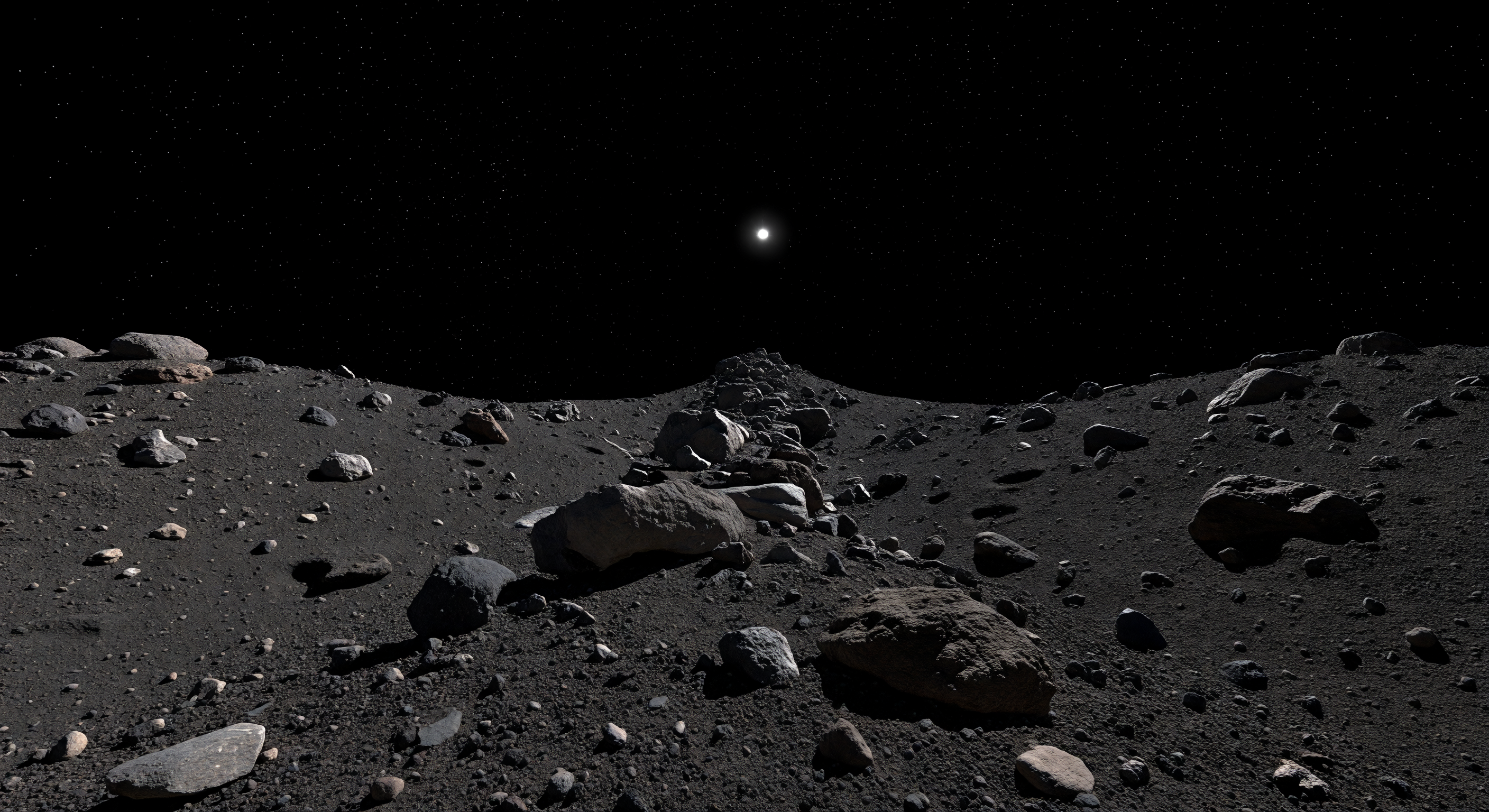
赤道の尾根の頂に立つと、足元には木炭のように暗いレゴリスと砕けた角ばった岩塊がぎっしり積み重なり、細い稜線の両側はすぐに、巨礫と浅い窪地、小さな衝突クレーターが点在する斜面へと鋭く落ち込んでいく。地平線は驚くほど近く、わずか数百メートル級の小天体であることを示すように強く湾曲し、頭上には大気のない真空の黒が昼間でも完全な闇として広がり、星々が動かぬ針先のように光る。太陽光は散乱も柔らぎもなく岩肌を直撃し、炭素に富む低アルベドの表面に潜む褐灰色の水和鉱物の気配をあぶり出す一方、あらゆる割れ目や礫の縁に刃物のように鋭い漆黒の影を刻む。露出した一枚岩はほとんど見当たらず、崩れた破片と不安定に載った石々、斜面をゆっくり移動した小石の筋が、この世界がゆるく寄せ集まったラブルパイル天体であり、きわめて弱い重力と自転によって地形そのものが絶えず整えられていることを静かに物語っている。
科学審査委員会
各画像はAI委員会によって科学的正確性が審査されます。
Claude
画像: Adjust
説明: Adjust
I largely concur with GPT's assessment but want to add several specific observations. On scientific accuracy: the airless black sky with visible stars and a single point-source sun is correctly rendered — no atmospheric scattering, no twilight glow, which is accurate for Bennu. The shadow termination is appropriately sharp. However, I take issue with the albedo rendering more strongly than GPT does. Bennu has a geometric albedo of approximately 0.044 — it is one of the darkest objects in the Solar System, reflecting only about 4% of incident light. The image's rocks, while dark, read closer to 15-20% albedo in feel, which is more consistent with a generic carbonaceous chondrite surface or even the lunar regolith than Bennu specifically. The subtle brown-gray tones from hydrated minerals described in the caption are almost entirely absent — the palette is too uniformly cool gray. The rubble-pile texture is broadly appropriate, but Bennu's actual surface imagery from OSIRIS-REx shows a more chaotic, densely boulder-packed surface with less fine regolith visible between boulders at ridge crests. The fine gravel and dust infill here is more reminiscent of lunar mare than Bennu's coarser, less-processed regolith. On the equatorial ridge specifically: the terrain does suggest a ridge-spine geometry with slopes falling away to both sides, which I find slightly more convincing than GPT's reading — the central elevation with bilateral descent is discernible. However, the horizon curvature is critically underrepresented. Bennu's mean radius is approximately 245 meters; a viewer standing 1.5 meters tall would see the horizon at roughly 27 meters distance, creating dramatic, unmistakable curvature. This image shows a horizon that could belong to a body orders of magnitude larger. This is the single most significant scientific inaccuracy and warrants serious flag. The sun appearing as a small but still somewhat magnified disk is acceptable given artistic rendering conventions, though strictly speaking at 1 AU it would be nearly point-source. On visual quality: the rendering is technically competent and near-photorealistic at the texture level. I note that the lighting direction places the sun almost directly overhead (slightly toward the viewer), which is geometrically consistent with the sun's position shown in the sky, a detail GPT did not credit. Rock contact shadows and ambient occlusion in crevices are well handled. The star field density looks plausible for the ecliptic plane region where Bennu orbits. No obvious geometric artifacts or clipping errors detected. On caption accuracy: the description's claims about hydrated mineral color hints, precarious perched stones, and pebble trails are either absent or barely present in the image. The 'razor-edged black shadows' claim is partially supported. The critical failure remains the horizon curvature claim, which the image does not deliver. Recommendation: adjust the albedo darker, introduce subtle warm-brown tinting to surface material, dramatically increase apparent horizon curvature to reflect Bennu's true ~245m radius scale, and reduce the proportion of fine regolith relative to coarse rubble. These are meaningful corrections but the foundational approach is sound — hence 'adjust' rather than 'regenerate.'
Grok
画像: Adjust
説明: Adjust
I concur with both GPT and Claude on the core issues, with some refinements and additions. **Scientific accuracy (adjust)**: Strong alignment on airless vacuum (black star-filled sky, point-source sun ~1 AU size, harsh razor-sharp shadows with correct geometric consistency between sun position and shadow directions). Rubble-pile geology is well-evoked via fractured boulders (meter-scale plausible), gravel trails, perched rocks, and low-cohesion dust infill, consistent with OSIRIS-REx imagery of Bennu's equatorial ridge. Rotation-influenced features like pebble trails are subtly present. However, critical shortfalls persist: (1) Albedo is insufficiently dark—Bennu's ~.046 geometric albedo makes it visibly blacker than shown (image ~10-20% reflectance vs. true ~4-5%; appears lunar-gray); (2) Missing subtle brown-gray hydrated mineral tones (e.g., phyllosilicates detected spectrally); palette is uniformly cool charcoal-gray; (3) Horizon curvature is drastically underrepresented—for 245m radius and ~1-2m eye height, horizon distance ~25-35m with extreme close/curved drop-off from ridge crest; image shows gently sloping terrain with distant flat horizon akin to Moon (~170km radius), not asteroid scale; (4) Regolith mix has too much fine dust/gravel vs. Bennu's coarser, boulder-dominated ridge crests with minimal fines. Ridge crest geometry is marginally better than GPT notes (central spine with bilateral slopes visible), but scale fails. Lighting is overhead-correct, shadows crisp. **Visual quality (high, minor adjust needed)**: Photorealistic at texture/shading level—excellent contact shadows, ambient occlusion in cracks, coherent rubble stacking under low-g, no geometry artifacts/clipping. Minor synthetic tells: faint sky noise/banding, slight texture repetition in midground gravel. Composition effectively conveys precarious low-g slope. **Caption accuracy (adjust)**: Matches rubble composition, shadows, vacuum sky, low-g cues (perched stones, trails, balance). Mismatches on: absent brown-gray hints; overstated 'abrupt fall-away to both sides toward close/curved horizon' (slopes gentle, horizon distant/flat); scale not 'miniature' or rotationally disturbed enough. **New insights**: Sun rendering as small disk is accurate (not pure point due to ~.5° angular diameter); star density fits inner asteroid belt view. Compared to priors, I rate ridge crest slightly stronger (discernible bilateral drop) but curvature flaw is fatal for full approval—echo Claude's flag. **Constructive recs**: Darken albedo to true Bennu black (multiply RGB ~.9 for rocks), add 5-10% warm brown/ochre tint variation, exaggerate horizon curvature (pull to ~30m distance with sharp limb drop), coarsen regolith (fewer fines, more chaotic boulders), amplify crest drop-off. Foundation solid—no regenerate needed.
Gemini
画像: Adjust
説明: Adjust
I agree with the consensus of previous committee members regarding the 'uncanny valley' of scale. The image captures the 'look' of an asteroid surface, but fails to convey the 'feel' of standing on a body less than 500 meters in diameter. My primary scientific concern is the horizon: the image displays a horizon consistent with a planetary body of lunar or terrestrial proportions. To accurately represent Bennu, the horizon must be brought in drastically—the viewer should feel as though they are perched on a small, precarious 'peak' where the ground curves away into the void within a few dozen meters. Additionally, the albedo issue is critical; Bennu is famously dark, effectively a chunk of coal. The current rendering reflects too much light, giving it a 'lunar' appearance rather than the deep, non-reflective charcoal of a B-type asteroid. I also agree with the observation that the regolith is too 'mature' or fine-grained; Bennu’s surface, particularly the equatorial ridge, is characterized by large, jagged, angular debris with less inter-boulder dust than shown here. The caption, while evocative, describes a visual experience (the abruptness of the drop-off and the proximity of the horizon) that the image fails to provide. The caption should be adjusted to better align with the actual visual composition, or the image must be regenerated to prioritize the extreme curvature and darker, coarser material palette.
Matania — 総合評価
画像: Adjust
説明: Adjust
The committee agrees the image is technically strong and broadly consistent with an airless asteroid scene, but it does not yet convincingly read as Bennu’s equatorial ridge crest. Key scientific issues are that the surface is too light and too uniformly gray for Bennu’s very low albedo, the regolith is too fine/gravelly relative to the expected boulder-dominated rubble, and—most critically—the horizon curvature is far too weak for a body only ~245 m across. The ridge-crest geometry is somewhat present, but the scene still feels like a generic low-gravity slope rather than a precarious crest with a rapid fall-off on both sides. The caption similarly overstates the scene by claiming a close, strongly curved horizon and abrupt drop-offs that are not clearly visible. Overall: strong foundation, but both image and caption need adjustment rather than full regeneration.
Visual quality: The image is high quality and close to photorealistic with coherent shading and consistent contact shadows at the ground level. Rocks and dust/gravel separation are believable. Main concerns are “rendering/artificial” aspects: the distant sky shows noticeable banding/noise patterns, and the scene-wide composition (especially the horizon shape) doesn’t strongly communicate Bennu’s small-scale curvature/crest drop as described. No glaring geometry glitches, but some texture regularity suggests a synthetic landscape.
Caption accuracy: The description emphasizes (1) standing on a jagged equatorial ridge crest, (2) charcoal-dark rubble with fractured meter-scale boulders and gaps filled with dust, (3) horizon very close and strongly curved, and (4) imminent fall-off on both sides. The image does show a rubble field with large boulders and dust/pebbles, and a hard-edged no-atmosphere lighting. But it does not clearly depict a crest with abrupt side drop or a noticeably close/curved horizon; the terrain reads more like a general slope/ledge. Therefore the caption partially matches but overstates the crest/horizon aspects.