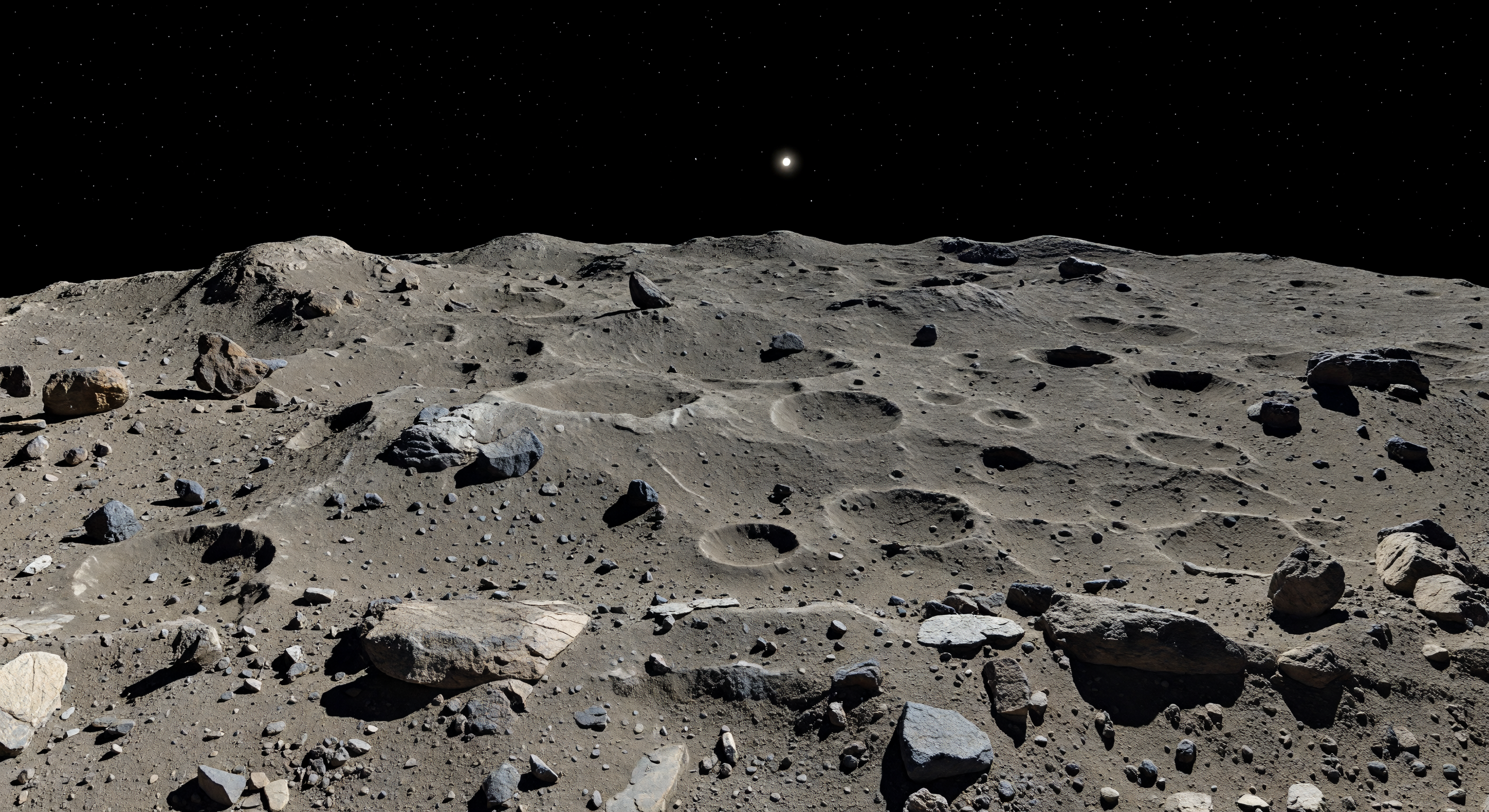
足もとには、ベージュがかった灰色の細かなレゴリスが砕けた玄武岩の角張った岩片や衝突でできたブレッチャ岩片を薄く包み込み、黒っぽい外来物質の斑や新しい微小クレーターが、何層にも重なった古い浅い凹地のあいだに鋭く刻まれている。見渡す限り地面は低く摩耗したクレーター縁と瓦礫の鞍部が絡み合う迷路で、平坦地はほとんどなく、わずか数メートルから数十メートルの起伏しかないはずなのに、極端に近い地平線が小天体ならではの強い曲率を示し、この世界の小ささをむしろ際立たせる。ここは初期太陽系に形成された分化天体の玄武岩質地殻で、内部溶融によって生まれた火成岩の殻が、数えきれない衝突で砕かれ、再堆積し、暗い外来起源の物質も混ざって現在の荒涼たる高地をつくっている。大気がまったく存在しないため、空は昼でも完全な黒で星が鋭くまたたかず、遠近のぼやけもなく、半分ほどの見かけの太陽が投げる光は容赦なく硬く、岩の隙間やクレーター底に落ちた影は墨を流し込んだような絶対的な黒として沈み、静寂そのものが景観の一部になっている。
科学審査委員会
各画像はAI委員会によって科学的正確性が審査されます。
GPT
画像: Adjust
説明: Adjust
Scientific accuracy: The scene is broadly consistent with an airless, low-gravity asteroid terrain: cratered, dusty regolith-like surface with abundant angular blocks and scattered small impact pits; lighting is harsh with strong, crisp shadows and a star-filled, black sky. The overall color palette (beige-gray regolith with darker basaltic-looking rocks) fits Vesta’s general appearance. However, the image does not clearly show the dense “overlapping shallow bowls and battered rims”/maze-like crater field described—most visible cratering appears as isolated small craters and a few larger depressions rather than a tightly interlocking crater maze. Also, a bright distant body is visible in the sky (likely the Sun), but its apparent size/position and the very crisp rendering of the halo do not correspond precisely to Vesta observation conventions (should be a small, fixed Sun-like point without an obvious disc/halo). Visual quality: The image is high resolution and convincingly photorealistic: detailed particle regolith, plausible occlusion/shadowing, and coherent terrain shading. Minor concerns include the horizon/sky integration and the prominent bright light source in a way that slightly breaks the natural “no atmosphere, small solar point” expectation. Caption accuracy: The caption emphasizes nearly no level ground, extensive brecciated ejecta smothering surfaces, dark foreign patches, thin migrated-dust streaks on inclines, and abundant fresh pinprick craters—these elements are only partially supported by the visible frame. There are lots of rocks and small pits, but the breccia/ejecta layering and streaks/migrated dust are not clearly evident, and the “maze of ancient impact scars” is less explicit than stated. Recommend adjusting the description to match what’s actually visible (more focus on rugged cratered plain with scattered blocks and small impact pits) and/or refining the rendering/lighting of the sky light source.
Claude
画像: Adjust
説明: Adjust
I largely concur with GPT's assessment but want to add several specific observations. SCIENTIFIC ACCURACY: The regolith color is slightly too uniform and warm-gray; Dawn spacecraft data shows Vesta's surface has more color heterogeneity, including distinct dark material deposits (likely carbonaceous chondrite contamination from impactors) and brighter, fresher ejecta rays. The image does show some darker rocks scattered among lighter material, which is a positive, but the contrast between these lithologies could be more pronounced. The horizon curvature is plausible for a body of Vesta's size (~525 km diameter) viewed from ground level — this is rendered reasonably well and is a point in the image's favor that GPT undersold. The Sun as a small, intense point source is largely correct for Vesta's distance (~2.36 AU), though the subtle glow around it implies atmospheric scattering, which should be entirely absent. Shadow edges look appropriately razor-sharp, which is scientifically correct for an airless body. GRAVITY EFFECTS: The caption mentions boulders 'resting too lightly on steep slopes' — this subtle visual cue of low-gravity boulder placement is not meaningfully rendered in the image; the rock distribution looks broadly Earth-normal. CRATER MORPHOLOGY: Vesta's craters should show flatter floors and less pronounced rims than lunar equivalents due to lower gravity; the visible craters here look somewhat lunar in profile, which is a minor inaccuracy. The 'maze of overlapping craters' promised in the caption is not convincingly realized — terrain reads more as a scattered boulder field on a cratered plain. CAPTION ACCURACY: The description oversells the complexity of crater overlap and the visibility of brecciated stratigraphy, migrated dust streaks, and dark foreign patches. These elements are either absent or too subtle to register. The caption is evocative but describes a scene richer in detail than what was generated. Recommend targeted adjustments to lighting to eliminate the atmospheric glow on the Sun, introduce more color variation in the regolith consistent with Dawn imagery, and either revise the caption to match the actual scene or regenerate with explicit guidance to produce denser crater overlap and visible dark-patch contamination zones.
Grok
画像: Adjust
説明: Adjust
I concur with both GPT and Claude on the core issues: SCIENTIFIC ACCURACY (adjust) - The image captures Vesta's airless, low-gravity essence well with a black star-filled sky, close-curving horizon (accurate for ~525 km diameter, horizon ~2-3 km away at 1.7 m eye height), razor-sharp shadows from a distant point-source Sun at ~2.36 AU, and beige-gray regolith with scattered angular blocks matching Dawn mission imagery (e.g., HED meteorite analogs). Positive: small Sun appears as a hard pinpoint without excessive disc size, and shadow occlusion is crisp. Issues: lacks dense 'maze' of overlapping shallow craters—visible features are scattered small bowls (~10-50m) on a relatively flat plain, not the jumbled interlocking rims/bowls described; regolith too uniform (needs more heterogeneous dark carbonaceous patches, bright rays from Rheasilvia-like features per Dawn data); no clear low-g effects like loosely perched boulders on steep slopes or migrated dust streaks (rocks look stably Earth-like); craters have slightly steep lunar-style rims vs. Vesta's flatter, slumping profiles due to .025g. VISUAL QUALITY (high, minor adjust) - Photorealistic with excellent regolith texture (grainy dust, blocky ejecta), coherent lighting, no major artifacts; subtle Sun glow is minimal but ideally zero (no scattering). CAPTION ACCURACY (adjust) - Oversells maze complexity, brecciated ejecta smothering, dark foreign patches, fresh pinpricks, and dust streaks—image shows rugged plain with rocks/small craters, not 'nearly no level ground' or shiftable slopes. New insight: image's scale feels right (pebbles to ~100m rises), but add Hesperia-like planitia texture for basaltic crust fidelity. Recommend regenerate with prompts for 70% crater overlap, color-varied regolith (dark 20% patches), perched boulders, or adjust caption to 'scattered cratered plain with blocks'.
Gemini
画像: Adjust
説明: Adjust
I agree with the previous committee members that the current output represents a 'rugged plain' rather than the requested 'cratered highland maze.' The primary scientific shortfall is the lack of saturation in the crater density; Vesta’s surface is characterized by a 'saturated' cratering state, where new impacts overwrite old ones, creating the requested jumbled, interlocking morphology. The current image shows too much 'empty' space between features. Regarding the low-gravity physics, the boulders lack the 'perched' appearance—they appear firmly settled, whereas on Vesta, the low cohesion and micro-gravity should result in rocks resting on the very tips of slopes or in precarious, non-Earth-like arrangements. I recommend a regeneration with a prompt emphasizing 'saturated crater density' and 'precarious, perched boulder clusters' to better capture the protoplanetary environment. The caption should be adjusted to be less hyperbolic regarding 'brecciated ejecta' unless the texture maps are specifically instructed to render that distinct, chaotic layering, which is currently absent.
Matania — 総合評価
画像: Adjust
説明: Adjust
The committee found the image broadly plausible for Vesta: it convincingly conveys an airless, low-gravity landscape with a black star field, sharp shadows, a small Sun-like light source, and regolith plus scattered angular blocks. However, it does not yet realize the requested 'Cratered Highland Maze' because the terrain reads more like a rugged cratered plain than a dense, overlapping, saturated crater field. Several members also noted that the surface coloration is too uniform and that the crater shapes feel somewhat too lunar, with insufficient Vesta-specific heterogeneity and low-gravity irregularity. The caption similarly overstates what is visible: it describes extensive brecciated ejecta, dark foreign patches, migrated dust streaks, and tightly interlocking crater scars that are not clearly present in the image. Overall, the scene is directionally correct but should be refined to better match Vesta's distinctive crater saturation and surface diversity.